


What if the fee your lender calls a “penalty” is actually the key to unlocking thousands of Euro in long-term savings? Most homeowners feel a sense of dread when they think about the penalty for switching mortgage early, fearing that hidden bank charges or complex mathematical formulas will simply wipe out any benefit of a lower rate. It’s completely natural to worry that breaking a FIXED RATE MORTGAGE might be a costly mistake rather than a savvy financial move.
We’re here to show you that this exit fee is a calculable business cost that you can manage with confidence. You’ll discover exactly how to calculate these fees and determine if the potential savings of a new rate outweigh the initial expense. Whether you are currently on a short-term fix or have years remaining on your contract, this guide breaks down the standard formulas used by lenders. We provide a clear, professional pathway to help you decide if starting the SWITCHING MORTGAGES process is the right step for your future financial stability.
Key Takeaways
- Understand why lenders apply break fees and how they calculate the interest income they stand to lose when you exit a term early.
- Identify the specific market conditions that could result in a zero-euro penalty for switching mortgage early, depending on your current FIXED RATE MORTGAGE term.
- Learn how to calculate your personal break-even point to ensure your long-term savings comfortably outweigh any initial exit costs.
- Discover how a professional advisor provides a seamless transition during the SWITCHING MORTGAGES process, ensuring your move is both profitable and stress-free.
Understanding the Break Fee for FIXED RATE MORTGAGES
When you sign a contract for a FIXED RATE MORTGAGE, you and your lender enter a mutual agreement for a set period. You gain the security of knowing exactly what your monthly repayments will be, whilst the lender secures a predictable stream of interest income. However, life changes. Whether you’ve found a significantly lower rate elsewhere or your financial circumstances have evolved, you might consider moving before your term ends. This is where the penalty for switching mortgage early comes into play. It isn’t a random fine designed to punish you; rather, it’s a calculated fee intended to compensate the bank for the financial loss they incur when you end the agreement prematurely.
Why do lenders charge an exit fee?
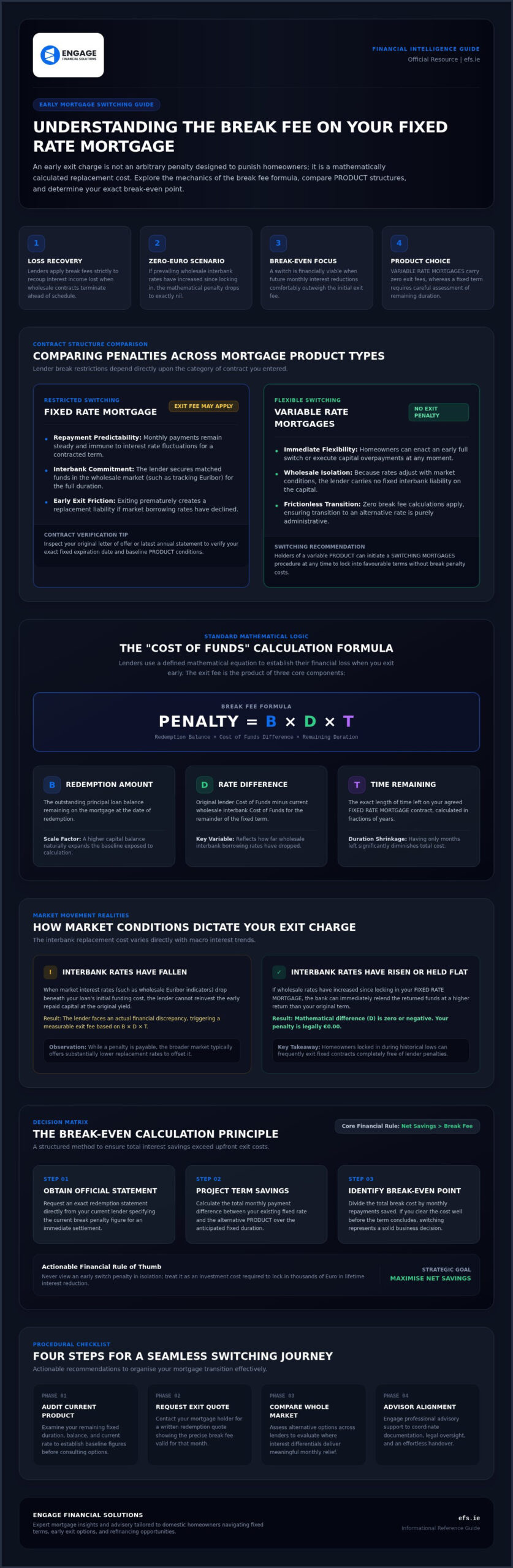
Lenders don’t simply have vaults full of cash to lend; they often borrow the funds for your mortgage from the interbank market at specific rates. When you commit to a FIXED RATE MORTGAGE, the bank locks in those funds for the duration of your term. If market interest rates fall and you decide to switch, the bank is left holding expensive debt that they can no longer “sell” to you at the original price. Most prepayment of loan terms are structured to protect the lender from this specific discrepancy. By charging a break fee, they safeguard themselves against the cost of replacing your loan in a market where they might only be able to lend that same money out at a lower return. This ensures the lender’s own financial stability isn’t compromised when borrowers choose to refinance.
The difference between fixed and variable exits
It’s helpful to distinguish between the various types of mortgage structures available. VARIABLE RATE MORTGAGES generally offer the highest level of flexibility, allowing you to make overpayments or complete a full switch at any time without facing a penalty. In contrast, FIXED RATE MORTGAGES trade that flexibility for the peace of mind of a stable payment. Whilst the penalty for switching mortgage early is a common feature of fixed terms, it’s not always a deal-breaker. You can easily identify your current status by checking your most recent annual statement or your original letter of offer. Understanding whether you hold a fixed or variable PRODUCT is the first step in determining how seamless your transition to a new rate will be. We focus on providing the clarity you need to move forward with confidence, ensuring you aren’t held back by confusion over your current terms.
How Lenders Calculate the Cost of an Early Switch
While the figure quoted by your bank might seem arbitrary, the penalty for switching mortgage early follows a strict mathematical logic. It isn’t a random charge; it’s a “replacement cost” calculation designed to ensure the lender isn’t financially disadvantaged by your decision to refinance. The final amount depends on several moving parts, including your current balance, the time left on your term, and the shifting landscape of interbank interest rates. Understanding these variables helps transform a confusing bank statement into a manageable business decision.
The role of interbank interest rates
Lenders don’t use their own savings to fund your FIXED RATE MORTGAGE. Instead, they borrow money on the wholesale interbank market, often tracking rates like the Euribor. When you lock into a fixed term, the bank locks in their own borrowing costs to match. If market interest rates drop after you’ve signed your contract, the bank faces a technical loss if you pay back the loan early. They can only lend that money out again at the new, lower market rate. This Consumer Financial Protection Bureau guidance on prepayment penalties explains how these triggers protect lenders from the interest income they lose when a borrower refinances ahead of schedule. Consequently, if market rates have fallen significantly since you started your mortgage, your penalty will likely be higher.
Understanding the Cost of Funds formula
The core of the calculation sits within the “Cost of Funds” formula. The Cost of Funds is the interest rate the lender pays to borrow the money they lent to you. To find the penalty, lenders typically look at the “Difference” (D), which is your original Cost of Funds minus the current market Cost of Funds for the remaining length of your term. They then multiply this by your “Redemption Amount” (B), which is your remaining mortgage balance, and the “Time” (T) remaining in years.
The basic formula looks like this: B x D x T. For example, if you have a large balance and several years left on your FIXED RATE MORTGAGE, even a small difference in interbank rates can lead to a substantial fee. Conversely, if you only have a few months remaining, the “Time” factor shrinks the penalty significantly. If the math feels daunting, obtaining professional guidance on SWITCHING MORTGAGES can provide you with a precise breakdown of these costs. This clarity allows you to see the “big picture” of your financial health, ensuring you only move when the long-term savings clearly outweigh the initial exit fee.
Comparing Penalties Across Different PRODUCT Types
Not every mortgage reacts the same way when you decide to change lenders. Whilst the mathematical formula we discussed previously remains the standard, the actual penalty for switching mortgage early varies significantly depending on the specific PRODUCT you hold. Understanding these structural differences is vital for any homeowner who wants to ensure their move is a profitable one. By looking at how different contracts behave, you can identify the most opportune moment to transition toward a more competitive rate.
When a FIXED RATE MORTGAGE has no penalty
It might come as a surprise, but there are scenarios where breaking a fixed term costs exactly zero Euro. This typically occurs in a rising interest rate environment. If market interbank rates have climbed since you originally fixed your rate, the bank doesn’t suffer a “loss” when you pay back the loan early. In fact, they’re often happy to see you leave, as they can re-lend that same capital to a new customer at today’s higher market rates. According to Cornell Law School’s Legal Information Institute, these clauses are designed to compensate for lost interest; if no interest is lost, the fee often vanishes. Identifying this “Zero Fee” window can save you thousands during the SWITCHING MORTGAGES process.
Why VARIABLE RATE MORTGAGES offer more flexibility
If you currently hold a VARIABLE RATE MORTGAGE, you likely won’t face any penalty for switching mortgage early. These products are designed for flexibility, allowing you to move to a new lender or a different PRODUCT type the moment a better deal appears. Whilst you don’t have the payment certainty of a fixed term, the trade-off is the total lack of friction when you’re ready to exit. This makes variable options a strategic choice for homeowners who anticipate a drop in market rates or those who plan to move house in the near future.
Beyond the bank’s break fee, you should also account for external costs that accompany a switch. Even if your penalty is low, you’ll typically need to budget for a new valuation and legal fees for the conveyancing work required to register the new charge. Some modern “Green” PRODUCT options also come with specific exit conditions. These mortgages offer discounted rates for energy-efficient homes, but if you switch to a lender that doesn’t offer a similar Green PRODUCT, you must calculate whether the lower headline rate justifies losing that specific discount. We focus on these fine details to ensure your path to a better rate is both transparent and rewarding.
Is Paying the Penalty Worth the Long-Term Savings?
Deciding whether to absorb the penalty for switching mortgage early is a strategic choice rather than a simple bill payment. You shouldn’t view the exit fee in isolation. Instead, treat it as an upfront investment that secures a more stable financial future. The goal is to determine if the total interest you save over the life of your new FIXED RATE MORTGAGE justifies the initial friction of the break fee. By looking at the “big picture”, you can transform a moment of hesitation into a confident step toward long-term security.
One of the most effective ways to evaluate this is by calculating your “Break-Even Point”. This is the specific month in the future where your accumulated savings on the new, lower rate finally exceed the cost of the penalty you paid to leave your old bank. If you plan to stay in your home for five years and your break-even point occurs at month eighteen, you’ll enjoy forty-two months of pure profit. Additionally, many lenders offer “Cashback” incentives to new customers. These lump sums can often cover a significant portion, or even the entirety, of your exit fee, making the transition virtually seamless.
Running a cost-benefit analysis
- Step 1: Obtain an exact exit fee quote from your current lender. Don’t rely on estimates; you need the precise Euro amount to ensure your math is accurate.
- Step 2: Compare your current monthly repayment against the projected new repayment. The difference between these two figures represents your monthly saving.
- Step 3: Divide the total penalty by the monthly saving. This result tells you exactly how many months it will take for the switch to pay for itself.
How to request a redemption statement
To get the process moving, you must formally ask your lender for a “Breakage Fee Quote” or a redemption statement. This document outlines the exact cost of closing your account on a specific date. It’s important to remember that because interbank rates fluctuate daily, these quotes are usually only valid for a limited period, often between five and ten working days. We recommend requesting this quote in writing via your bank’s secure messaging portal or email. This creates a clear paper trail for your advisor and ensures everyone is working with the most up-to-date figures. If you’re ready to see if the numbers work in your favour, you can start your SWITCHING MORTGAGES process here with a professional review of your options.
Seamlessly Navigating Your SWITCHING MORTGAGES Journey
Understanding the math behind a penalty for switching mortgage early is the first step toward financial freedom. However, the actual process of moving your debt from one lender to another involves significant administrative detail. This is where a professional advisor becomes an essential partner. Rather than spending your evenings comparing spreadsheets or chasing bank officials, you can rely on an expert to manage the transition. A dedicated guide ensures that every detail, from the initial market comparison to the final legal sign-off, is handled with meticulous care.
Expert guidance through the application
Engage Financial Solutions acts as a vital buffer between you and the lenders. We manage the heavy lifting of the paperwork, ensuring a straightforward and stress-free transition that respects your time. By sourcing competitive arrangement fees and navigating complex lender commissions, we ensure you don’t just find a new rate, but the best overall value for your specific circumstances. Our goal is to remove the friction often associated with the banking world, providing you with a seamless experience that prioritises your peace of mind.
Managing your overall FINANCIAL PLANNING
A mortgage switch shouldn’t happen in a vacuum. It’s a perfect opportunity to review how your debt fits into your broader life goals, such as RETIREMENT PLANNING or building your SAVINGS. When you change lenders, it’s also a legal requirement to update your MORTGAGE PROTECTION. We ensure your coverage remains fit for purpose. Whether you need to adjust your LIFE INSURANCE or consider new INCOME PROTECTION, we take a holistic view of your financial health.
This “future-back” perspective ensures that the decision you make today supports the lifestyle you want tomorrow. By integrating your mortgage into a comprehensive plan, we help you safeguard your family’s security whilst optimising your monthly outgoings. You don’t have to face the complexities of the market alone. With the right support, the penalty for switching mortgage early becomes a small, manageable step on a much larger journey toward long-term stability.
Your Pathway to Long-Term Financial Security
Understanding the penalty for switching mortgage early is the first step toward securing a better interest rate and long-term peace of mind. This fee is a calculable factor in your overall FINANCIAL PLANNING rather than an insurmountable barrier. By identifying your break-even point and accounting for bank incentives, you can determine exactly when your new rate starts delivering real profit. Whether you’re looking for immediate monthly relief or long-term security, the right information makes all the difference.
You don’t have to navigate these complex formulas alone. Our expert advisors are regulated by the Central Bank and provide comprehensive market access to ensure you find the most competitive SWITCHING MORTGAGES options available. We provide the steady guidance needed for a seamless transition, ensuring your mortgage fits perfectly with your lifestyle and future goals.
Ready to see if the numbers work for you? Book a consultation with Engage Financial Solutions to calculate your potential savings and take the first step toward a more flexible future. We’re here to help you move forward with complete confidence.
Frequently Asked Questions
Can I avoid the penalty for switching mortgage early?
Yes, you can avoid the penalty for switching mortgage early if market interest rates have risen since you fixed your term. In this scenario, the bank doesn’t lose money by you leaving early, so the fee is often zero. Alternatively, you can wait until your fixed term expires to move to a new lender without any cost. We help you monitor these market shifts to find the most cost-effective moment to transition.
How do I find out what my mortgage break fee is?
You find out the exact cost by requesting a formal redemption statement or a breakage fee quote from your current lender. This document provides a precise Euro figure valid for a specific number of days. It’s best to request this in writing to ensure your advisor has a clear paper trail. This allows us to perform an accurate cost-benefit analysis before you commit to the SWITCHING MORTGAGES process.
Does a variable rate mortgage have a penalty for switching?
Generally, VARIABLE RATE MORTGAGES do not carry a penalty for moving to a different lender or PRODUCT. These contracts offer maximum flexibility, allowing you to exit at any time without facing a break fee. This makes them a strategic option if you anticipate market rates falling or if you plan to move home soon. Whilst they lack the payment certainty of a fixed rate, the absence of exit friction is a significant benefit.
Is the mortgage penalty tax-deductible for buy-to-let properties?
For buy-to-let properties, a mortgage break fee is often considered a deductible expense against rental income, but you should always consult a qualified tax professional. Since the fee is incurred to secure better financing terms for your investment, it typically falls under allowable costs. We work alongside your broader FINANCIAL PLANNING goals to ensure any switch aligns with the tax efficiency and long-term profitability of your property portfolio.
Will my new lender pay my exit fee for me?
While a new lender rarely pays the fee directly to your old bank, many offer “Cashback” incentives that you can use to offset the cost. These lump sums are paid into your account after the switch is completed. This effectively reduces or eliminates the financial sting of the penalty for switching mortgage early. We compare the whole market to find lenders whose incentives provide the most seamless transition for your budget.
How long does it take to get a break fee quote from a lender?
Most domestic lenders take between five and ten working days to issue a formal breakage fee quote. Because interbank interest rates change daily, these quotes are only valid for a limited window, often just a week. It’s important to have your documentation ready so your advisor can act quickly whilst the quote remains accurate. This speed ensures you don’t miss out on a competitive rate because of administrative delays.
What happens to my mortgage protection when I switch lenders?
When you change lenders, your existing MORTGAGE PROTECTION policy must be formally reassigned to the new bank or replaced entirely. This is a legal requirement for most home loans. We use this transition as an opportunity to review your cover, ensuring it still provides the best value. Whether you need to update your LIFE INSURANCE or INCOME PROTECTION, we manage this integration to keep your security seamless and robust.
Can I negotiate the exit fee with my current bank?
Negotiating the specific exit fee is difficult because it is usually dictated by a fixed mathematical formula in your contract. However, it’s always worth asking your bank if they can waive certain administrative charges or offer you a better internal rate to stay. If they cannot compete with the wider market, we provide the professional support needed to move your debt to a lender that offers superior long-term value and security.
Disclaimer
Engage Financial Services LTD T/A Engage Financial Solutions is regulated by the Central Bank of Ireland CRO 764570. Suite 2 First Floor, 14 -18 Main street, Blackrock, Co Dublin. A94 W0Y3