


Did you know that the maximum State Pension currently provides just under €300 per week? For most people, this creates a significant gap between their previous salary and their retirement reality. It’s completely natural to feel a sense of unease about whether your savings will stretch far enough, especially whilst dealing with complex tax rules and market volatility. When you begin to ask what is an ARF Ireland, you are often looking for a way to ensure your hard-earned money is managed with care so you can enjoy the peace of mind you deserve.
This guide explains how an Approved Retirement Fund (ARF) offers the flexibility and potential for growth that a traditional fixed income might lack. We will walk you through the eligibility criteria, provide a clear framework to help you choose between an ARF and an annuity, and show you how this structure can protect your family if you pass away. By the end, you’ll have a straightforward plan to manage your pension with confidence and ease.
Key Takeaways
- Learn how to maintain control over your pension pot by choosing a tailored investment strategy that matches your personal risk appetite.
- Discover the critical differences between an annuity and an ARF so you can decide whether you prefer a guaranteed income for life or the flexibility to access your capital.
- Gain clarity on mandatory withdrawal rules and understand what is an ARF Ireland in the context of local Revenue requirements, including the 4% annual distribution starting at age 61.
- Explore how to safeguard your family’s financial future by ensuring any remaining funds in your retirement account can be passed on to your loved ones.
- Find out how to organise multiple pension pots into one seamless structure for a more straightforward and efficient retirement experience.
What is an Approved Retirement Fund and How Does it Work?
An Approved Retirement Fund (ARF) acts as a personal investment structure for your pension savings after you retire. It’s a popular choice for those who want to stay in the driver’s seat rather than opting for a fixed, lifelong income. The “Approved” designation means the fund complies with the strict standards set by the Revenue Commissioners, allowing your assets to grow in a tax-sheltered environment. When people ask what is an ARF Ireland residents often find it’s the most versatile tool for managing a significant pension pot. Instead of your money disappearing into an insurance company’s general fund, it remains your personal asset; this gives you the freedom to choose where it’s invested and how much you withdraw each year.
Choosing this path provides a sense of calm competence because you aren’t locked into a single decision. Since the fund stays in your name, you can adjust your investment strategy as market conditions change or as your personal goals evolve. This flexibility is vital for protecting your purchasing power over a retirement that could last thirty years or more. It’s about shifting from a mindset of accumulation to one of careful stewardship. By keeping your money invested, you maintain the potential for growth that can help combat the rising cost of living over time.
Who is eligible to open this type of fund?
Eligibility depends on the type of pension you’ve built during your career. Most people with a background in the Irish pension system, such as those holding a Personal Retirement Savings Account (PRSA) or a Personal Pension, can choose this route. If you have an Occupational Pension Scheme, you might also be eligible. Specific rules apply to “proprietary directors” who own more than 5% of their company; these individuals often have more flexibility in how they access their funds. For those who have already moved their savings into a Personal Retirement Bond, transitioning to an ARF is a straightforward way to start the drawdown process while keeping your investment options open. If you’re unsure where you stand, the team at Engage Financial Solutions can help you consolidate various old pots into one clear structure.
The role of the tax-free lump sum
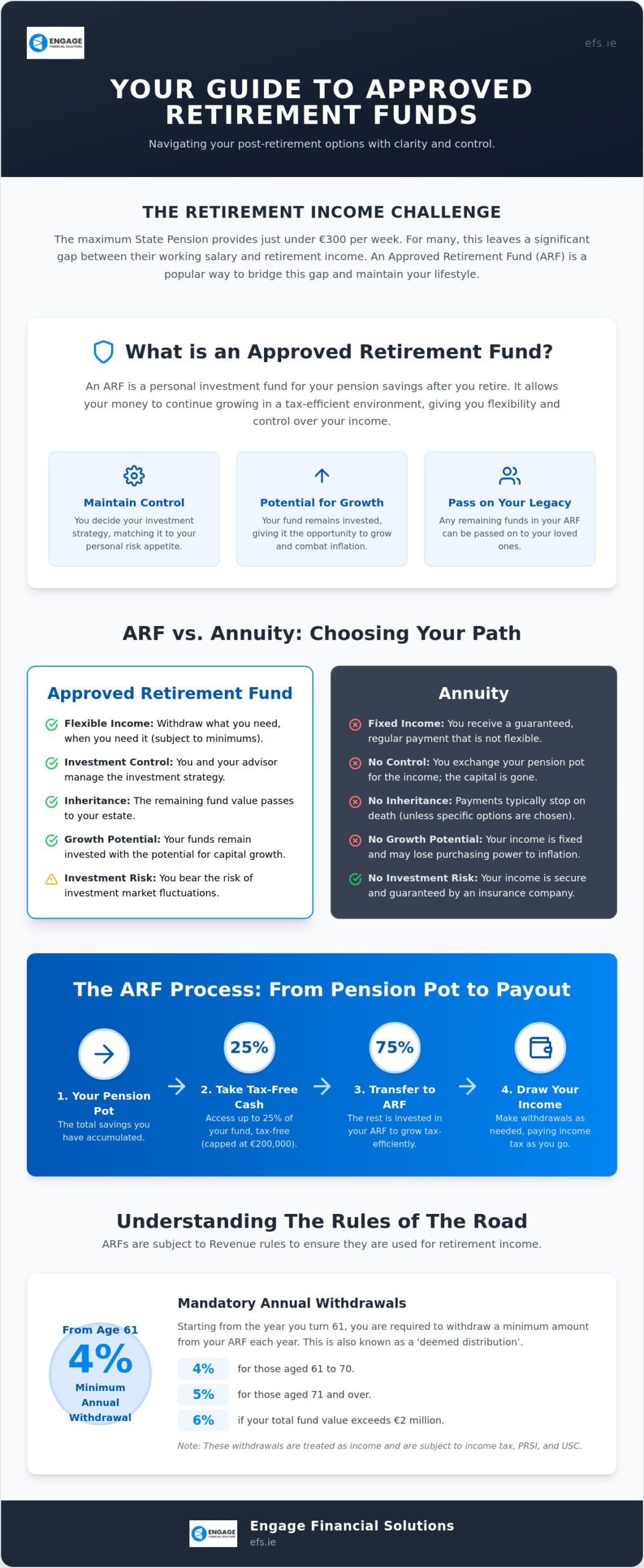
Before your ARF is established, you typically have the opportunity to take a tax-free lump sum. Usually, this amounts to 25% of your total pension pot, capped at €200,000. Once you’ve secured this portion, the remaining 75% is transferred into your ARF to continue growing. This remaining balance isn’t locked away; you can withdraw from it as needed. This process is known as “drawdown,” which allows you to tailor your income to your lifestyle. It’s a seamless way to transition from saving to spending whilst keeping your financial security intact.
The Core Benefits of Choosing a Flexible Retirement Structure
Choosing a flexible retirement structure is about more than just numbers; it’s about retaining the autonomy you’ve worked decades to earn. One of the most compelling reasons people investigate what is an ARF Ireland is the desire for total transparency. Unlike traditional pension products where your funds might feel distant or obscured, this structure allows you to see exactly where your money is held, how it’s performing, and precisely what fees are involved. This visibility provides a level of comfort that’s hard to find elsewhere, ensuring you always feel in control of your financial destiny.
Beyond transparency, the ability to take ‘income on demand’ is a significant advantage for modern retirees. Whilst you must take a minimum withdrawal each year once you reach age 61, you aren’t restricted to that amount. If you decide to fund a special anniversary trip or need to cover an unexpected home repair, you can access your capital with ease. This flexibility ensures that your pension works for your lifestyle, rather than forcing you to live within the confines of a rigid, fixed payment schedule. It’s a straightforward way to maintain your standard of living whilst keeping your options open for the future.
Maintaining control over your investment strategy
You have the power to decide how your capital is managed based on your personal comfort levels. Whether you prefer the stability of low-risk cash funds or the higher growth potential of equity-based investments, the choice remains yours. A steady guide can help you tailor these investments to your changing needs as you move through different stages of retirement. Regular reviews are essential to ensure your portfolio stays aligned with your goals, especially as market conditions shift. This proactive approach, which adheres to Pensions Authority regulations, ensures your strategy remains robust and reliable over the long term.
Protecting your family’s financial future
Perhaps the most significant emotional benefit is the protection of your legacy. In many traditional retirement setups, the fund essentially vanishes when the holder passes away. With this flexible structure, the remaining value of your fund is treated as part of your estate. If you pass away, the fund can be transferred to your spouse or civil partner’s name without an immediate tax liability, allowing them to continue drawing an income seamlessly. For children over the age of 21, the fund is typically subject to a flat 30% tax rate, but it remains a substantial inheritance rather than a lost asset. This provides an enduring sense of security, knowing your hard work will continue to benefit those you love most.
ARF vs Annuity: Deciding Which Path to Take
Choosing how to access your pension is one of the most significant financial decisions you’ll ever make. It’s helpful to view this choice as a balance between flexibility and certainty. An annuity is essentially an insurance contract; you hand over your pension pot in exchange for a guaranteed income that lasts as long as you do. In contrast, when you ask what is an ARF Ireland based advisors will explain that it’s a personal investment account where you retain ownership of your capital. This means you aren’t locked into a single path, but it also means you take on the responsibility of managing that money through the years.
One common concern is the risk of the fund running out. Since an ARF is invested in the market, its value can go up or down. If you withdraw too much during a market dip, you could deplete the fund sooner than expected. However, many retirees now opt for a hybrid approach to mitigate this worry. They might use a portion of their pot to purchase a smaller annuity that covers basic living costs, whilst placing the remainder into a flexible fund for growth and ad-hoc spending. This strategy provides a “safety floor” of guaranteed income without sacrificing the ability to access larger sums when needed.
When is an Annuity the better choice?
An annuity might be the right fit if you prioritise absolute security above all else. It’s particularly attractive for those who don’t have other sources of guaranteed income, such as a generous defined benefit pension, and want the peace of mind that their bills will always be paid. If you are in poor health, you may even qualify for an “enhanced” rate, which provides a higher monthly payment. You can explore the different types of Annuities to see how they provide a straightforward, “set and forget” solution for your post-work years.
Why the flexible fund is becoming the modern standard
Modern retirements are rarely a straight line. You might want to travel extensively in your 60s, requiring a higher income, and then scale back in your 80s. A flexible fund accommodates this “lifestyle” retirement perfectly. Additionally, the desire to leave a legacy is often the deciding factor; unlike a standard annuity, which usually stops when you pass away, any remaining balance in your fund belongs to your estate. Before you decide, ask yourself these three questions:
- Do I have enough guaranteed income from the State Pension or other sources to cover my essential monthly bills?
- Is it important to me that I can leave my remaining pension fund to my partner or children?
- Am I comfortable with my fund value fluctuating slightly based on market performance?
By answering these honestly, you can begin to see which path aligns with your long-term vision for a secure and fulfilling future.
Understanding the ‘Rules of the Road’ and Tax Obligations
Managing your pension should feel like a steady progression, not a constant battle with complex paperwork. When exploring what is an ARF Ireland savers often worry about the “fine print” regarding taxes and mandatory withdrawals. The most important rule to understand is the “imputed distribution.” Essentially, the Revenue Commissioners require you to take a minimum amount of income from your fund every year once you reach age 61. They do this to ensure your pension is used for its intended purpose: providing you with a regular income during your post-work years rather than just acting as a tax-sheltered savings account.
The mandatory withdrawal rates are quite straightforward. From age 61 until you reach 70, you must withdraw at least 4% of your fund’s value annually. Once you turn 71, this requirement increases to 5%. If you are in a position where your total fund value exceeds €2 million, the rate rises to 6%. You don’t have to worry about calculating the tax yourself; your Qualifying Fund Manager (QFM) acts as your financial steward, deducting Income Tax, Universal Social Charge (USC), and PRSI (if applicable) before the money reaches your bank account, much like a standard salary.
Managing your tax liability effectively
Strategic planning can make a significant difference to your take-home pay. Because your withdrawals are taxed as normal income, they are added to any other earnings you have, such as the State Pension. In 2026, the maximum State Pension provides an annual income of approximately €15,563, which already uses a portion of your tax-free allowances. It’s often wise to time your larger withdrawals to stay within the standard rate tax bracket where possible. Remember that tax is only paid on the money you actually take out of the fund.
The risk of ‘bomb-out’ and how to avoid it
“Bomb-out” occurs if your fund is depleted too early because your withdrawal rate consistently exceeds your investment growth. To keep your financial future secure, it’s vital to balance your need for income with the fund’s long-term sustainability. Aiming for a withdrawal rate that aligns closely with your fund’s average annual growth is a sensible starting point for maintaining your capital. For a deeper dive into creating a resilient strategy, our guide on Retirement Planning offers a clear framework for long-term security. If you want to ensure your strategy is perfectly tailored to your personal needs, you can speak with our expert advisors today to begin your journey with confidence.
How to Organise Your Retirement Fund Seamlessly
Organising your financial future shouldn’t feel like a second job. Many people reach the end of their career with a collection of different pension pots from various employers, which can lead to a fragmented and confusing financial picture. Consolidating these various accounts into a single, cohesive structure is the first step toward achieving true clarity. When you begin to understand what is an ARF Ireland based retirees often find that the real value lies in the simplicity of having one clear view of their wealth. By bringing these pots together, you reduce administrative fees and make it much easier to manage your required annual withdrawals.
A vital part of this process is receiving a ‘Statement of Reasonable Projections’ from your advisor. This document isn’t just a regulatory requirement; it’s a realistic roadmap that illustrates how your fund is likely to perform over the coming decades based on different investment scenarios. It provides the calm competence you need to make informed decisions about your spending levels. Additionally, you have the freedom to choose a fund manager who aligns with your personal values. For instance, you might prioritise Environmental, Social, and Governance (ESG) investing to ensure your capital supports sustainable and ethical businesses whilst it grows.
The importance of a tailored financial review
Starting your journey with a steady guide
The transition to retirement is a significant milestone that deserves expert stewardship to ensure everything runs smoothly. Engage Financial Solutions specialises in removing the friction from this process, handling the complex paperwork and technical requirements on your behalf. We act as a steady guide, providing the professional support needed to navigate the local market’s rules with ease. Understanding what is an ARF Ireland based savers use to protect their legacy is just the beginning. Our commitment to regular annual reviews ensures your fund remains aligned with your evolving needs, allowing you to move into this new chapter with a genuine sense of optimism and long-term security.
Securing Your Financial Future With Confidence
Transitioning into retirement is a significant milestone that deserves a plan as unique as your career. By choosing a flexible structure, you maintain control over your investment strategy and ensure that your hard-earned savings can be passed on to your loved ones. It’s the first step toward a retirement defined by choice rather than restriction. Understanding what is an ARF Ireland based retirees often use is essential for anyone weighing up the certainty of an annuity against the growth potential of a flexible fund.
Our team provides tailored advice designed to fit your specific lifestyle goals. As experts in seamless pension transitions regulated by the Central Bank, we focus on removing the friction from your financial planning. You deserve to move into your post-work years with a sense of optimism and stability. Book a straightforward retirement consultation with our team today to start building your legacy. Your future is bright, and with the right management, your pension will be too.
Frequently Asked Questions
What is the difference between an ARF and an AMRF?
The requirement to maintain an Approved Minimum Retirement Fund (AMRF) was recently abolished, significantly simplifying the retirement landscape for savers in the local market. Previously, individuals were required to set aside €63,500 if they did not meet certain guaranteed income requirements. Now, you can move your entire eligible pension pot directly into a flexible fund structure. This change makes it much easier to understand what is an ARF Ireland based retirees use to manage their wealth with total flexibility.
Can I have both an ARF and an Annuity at the same time?
Yes, you can certainly use both structures simultaneously to create a balanced and resilient retirement income. Many people choose to use a portion of their pension pot to purchase an annuity for guaranteed monthly payments whilst investing the remainder in a flexible fund for growth and legacy planning. This hybrid approach offers a tailored mix of lifelong security for your essential bills and personal control over your capital for lifestyle spending.
What happens to my fund if I pass away?
If you pass away, the remaining value of your fund becomes a valuable part of your estate rather than vanishing. It can be transferred into your spouse or civil partner’s name without an immediate tax charge, allowing them to continue drawing a seamless income. If the fund passes to children over the age of 21, it is typically subject to a flat 30% income tax. This ensures your hard-earned savings continue to provide stability for your family.
How much tax will I pay on my monthly withdrawals?
All withdrawals from your fund are treated as normal income and are subject to the same taxes as a standard salary. Your fund manager will deduct Income Tax, Universal Social Charge (USC), and PRSI where applicable before the money is paid into your account. It is important to remember that mandatory withdrawals start at 4% annually from age 61, rising to 5% once you reach age 71, and these are all taxed at your marginal rate.
Is there a limit on how much I can invest in this fund?
Whilst there is no specific limit on the amount you can place into this structure, you must stay mindful of the Standard Fund Threshold (SFT). As of January 2026, the lifetime limit for tax-relieved pension benefits is €2.2 million. If your total pension benefits exceed this threshold, you may face a higher tax rate on the excess amount. This makes professional guidance essential for those with larger pension pots to ensure their strategy remains tax-efficient.
Can I change my investment choice after the fund is set up?
You have the full flexibility to change your investment strategy at any time after the fund is established. This is one of the primary reasons people ask what is an ARF Ireland residents prefer for long-term wealth management. Whether you want to move into lower-risk cash funds as you age or seek higher growth in equities, you can adjust your portfolio to reflect your changing risk appetite or shifting market conditions with ease.
What are the typical fees associated with managing these funds?
Managing these funds involves several transparent costs, primarily the Annual Management Charge (AMC) levied by the fund provider for their stewardship. You might also encounter transaction costs within the fund or advisory fees for the ongoing professional guidance that keeps your strategy on track. These fees are deducted directly from the fund value. Your advisor will always provide a clear breakdown of these costs to ensure you feel looked after and informed.
How often can I take money out of my fund?
You can take money out of your fund as often as you need, provided you meet the mandatory annual withdrawal requirements set by the Revenue Commissioners. Whilst many people choose a regular monthly or quarterly payment to act as a “retirement salary,” you can also make ad-hoc withdrawals for specific goals like home renovations or travel. This “income on demand” feature ensures your pension remains a flexible resource that adapts to your changing lifestyle.
Disclaimer
Engage Financial Services LTD T/A Engage Financial Solutions is regulated by the Central Bank of Ireland CRO 764570. Director David Moore. Suite 2 First Floor, 14 -18 Main street, Blackrock, Co Dublin A94 W0Y3