


What if the most valuable asset in your business wasn’t your technology or your intellectual property, but the peace of mind you provide to the people who build it? You likely already know that attracting and keeping the right people requires more than just a competitive salary. As the costs of employee absence rise and managing long-term sick leave feels increasingly complex, you’re likely looking for a way to show your team they’re truly valued. Implementing a DEATH IN SERVICE BENEFIT can be a cornerstone of this strategy. It offers a safety net that protects families while demonstrating your commitment as a responsible employer.
We understand that the complexity of tax-efficient benefit structures can feel overwhelming. This guide is designed to act as a steady guide, helping you implement a strategic GROUP PROTECTION SCHEME that secures your employees’ financial futures whilst optimising your company’s tax efficiency and talent retention. Whether you’re a growing startup or an established firm, we’ll explore how to manage tax-deductible premiums and ensure a seamless claims process. By the end, you’ll have a clear roadmap to building a stable, high-retention workforce through tailored GROUP PROTECTION and COMPANY PENSIONS.
Key Takeaways
- Understand how a GROUP PROTECTION SCHEME integrates LIFE ASSURANCE and INCOME PROTECTION to provide a robust financial safety net for your workforce.
- Discover how a DEATH IN SERVICE benefit Ireland allows your business to provide tax-free lump sums to beneficiaries whilst remaining highly tax-efficient.
- Learn how to strengthen your employer brand by offering benefits that provide psychological security and encourage long-term staff retention.
- Gain insights into designing a tailored scheme, including the choice between flat-rate benefits and salary multiples for different employee grades.
- Explore how to simplify complex financial transitions by working with a partner who handles the technical details and ensures a seamless claims process.
Understanding the Fundamentals of a GROUP PROTECTION SCHEME
A GROUP PROTECTION SCHEME is more than just a corporate insurance policy; it’s a collective commitment to your team’s long-term security. These schemes are designed to provide a financial safety net for employees and their families during some of life’s most challenging transitions. By grouping cover together, businesses can often access more favourable rates and simpler underwriting than individuals could find on their own. These arrangements are often integrated within broader Occupational Pensions, forming a central pillar of a modern compensation package.
Within this framework, a DEATH IN SERVICE BENEFIT acts as a vital reassurance. It ensures that if the worst should happen, an employee’s loved ones aren’t left facing immediate financial hardship. In today’s competitive talent market, these schemes are amongst the most valued benefits because they speak directly to an employee’s sense of belonging and protection. Providing this level of care helps you stand out as an employer of choice, fostering a culture of loyalty and stability.
The Distinction Between LIFE ASSURANCE and INCOME PROTECTION
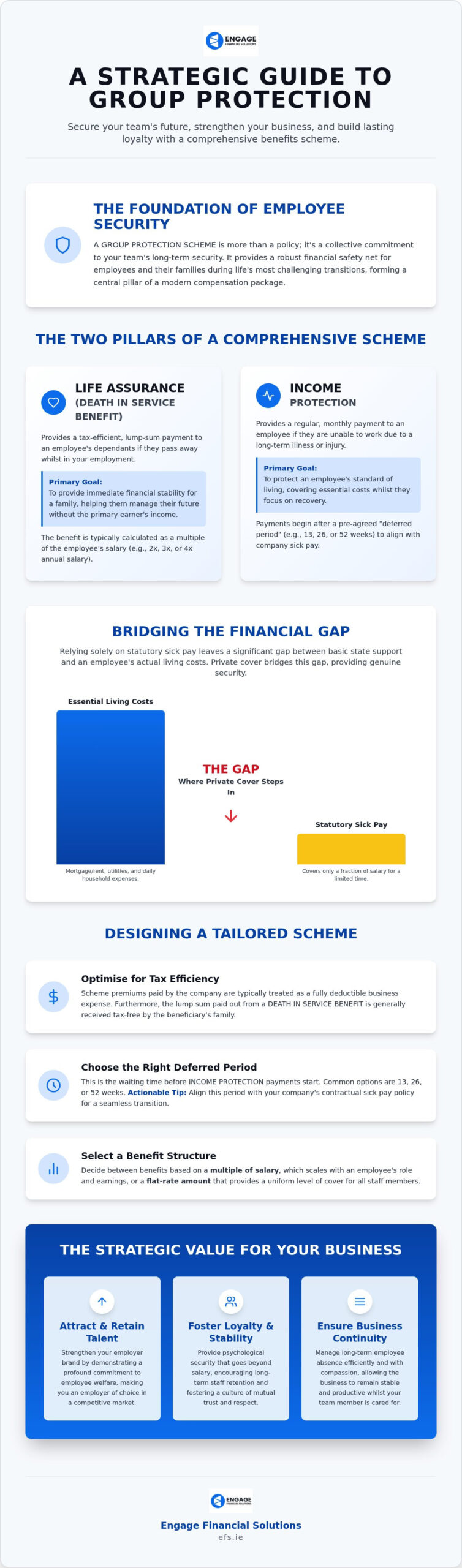
While they often sit under the same umbrella, LIFE ASSURANCE and INCOME PROTECTION serve different but equally critical roles. LIFE ASSURANCE, often referred to as a DEATH IN SERVICE BENEFIT, provides a tax-efficient lump sum to an employee’s dependants if they pass away whilst in your employment. This is usually calculated as a multiple of their salary, providing immediate stability for their family’s future.
Conversely, INCOME PROTECTION focuses on the living. It provides a regular monthly payment if an employee is unable to work due to long-term illness or injury. These payments typically start after a “deferred period,” with common options being 13, 26, or 52 weeks. Together, these components create a comprehensive shield, ensuring that whether an employee faces a health crisis or a family faces a loss, the financial impact is managed with calm competence.
Why Statutory Sick Pay is Rarely Sufficient
Relying solely on national statutory requirements often leaves a significant gap in an individual’s standard of living. Currently, statutory sick pay only covers a fraction of a typical professional salary for a very limited duration. When that period ends, many employees are forced to rely on state illness benefits, which rarely cover basic mortgage payments or rising household costs.
This creates a difficult moral dilemma for you as an employer. You don’t want to see a valued team member struggle, yet business reality means you can’t pay two salaries for one role indefinitely. Private cover acts as a necessary buffer. It removes the friction from these difficult conversations, allowing the business to remain efficient whilst ensuring the employee is looked after through a seamless, third-party claim process. By implementing a tailored scheme, you bridge the gap between basic statutory requirements and genuine financial security.
How DEATH IN SERVICE Operates Within the National Financial Framework
Establishing a DEATH IN SERVICE BENEFIT involves navigating a specific set of national financial regulations with calm competence. Within this framework, the employer serves as the policyholder, whilst the employees are the named beneficiaries. For the scheme to be fully effective and tax-compliant, it must be approved by the Revenue Commissioners. This formal recognition is what allows your business to categorise premiums as a fully deductible business expense, providing a clear path to tax efficiency. It’s a methodical process where the employer receives the claim payout and subsequently ensures the funds reach the intended recipients, providing a vital shield for families during times of grief.
Navigating the Deferred Period
The deferred period is a critical design choice in any INCOME PROTECTION scheme. It represents the “waiting time” between the start of an illness and the commencement of benefit payments. Most businesses choose between 13, 26, or 52-week periods, depending on their internal sick pay capabilities. Choosing the right duration is about finding the balance between immediate support and long-term premium sustainability. To find the most efficient fit, you should align your deferred period with your company’s contractual sick pay. If you provide six months of full pay, a 26-week deferred period ensures that the insurance kicks in exactly when your company’s obligation ends, preventing any gap in the employee’s income.
Managing Claims and Payroll Integration
A primary concern for many businesses is the administrative weight of managing claims. Modern GROUP PROTECTION is designed to be a seamless extension of your existing operations. When an INCOME PROTECTION claim is active, the insurer pays the benefit to the employer, who then processes it through the standard Pay As You Earn (PAYE) system. This ensures that all necessary deductions, including income tax and Universal Social Charge (USC), a tax on gross income, are handled correctly at source. This integration ensures that the employee receives their support through a familiar channel, maintaining a sense of stability during their recovery.
This level of integration is a key component of sophisticated Talent Retention strategies. It shows employees that their security is managed with meticulous attention to detail. If you are looking to simplify these complexities, you might consider how a tailored consultancy can help you organise your benefits to ensure they are both compliant and easy to manage. By acting as a buffer between the business and the insurer, a professional partner ensures the claims process remains respectful and efficient for everyone involved.
Analysing Strategic Value: Tax Efficiency and Talent Retention
Investing in a GROUP PROTECTION SCHEME is a strategic decision that extends far beyond a simple insurance cost. It represents a core component of a robust Employee Value Proposition (EVP) that helps you attract and keep the most talented professionals in your industry. When your team knows that their families are protected through a death in service benefit, they experience a profound sense of psychological safety. This security fosters higher levels of engagement and loyalty, as employees feel truly looked after by their organisation. It transforms the relationship from a mere transaction into a long-term partnership built on mutual respect and stability.
From a financial perspective, the benefits to your business are equally persuasive. For most companies, the premiums paid towards these schemes are treated as a deductible business expense, which can be offset against the 12.5% trading rate for corporation tax. Additionally, for many types of cover, there is no Benefit-in-Kind (BIK) for the employee, which means you can provide a high-value benefit without increasing their tax liability. This makes it a highly efficient way to reward your staff whilst maintaining a lean tax profile. To better understand how these payments are structured within the national framework, you can refer to the Irish Legal Guide to Death Benefits.
Maximising Corporation Tax Advantages
Managing employee wellbeing through a formal scheme is often more cost-effective than relying on internal cash-flow to fund long-term sick pay. Because premiums are usually 100% tax-deductible, the actual net cost to your company is lower than it first appears. This structured approach provides your finance team with a predictable, steady budget line rather than the sudden, unbudgeted stress of maintaining a salary during a lengthy absence. To ensure your business is capturing every available efficiency, it is wise to organise your scheme with the guidance of a professional advisor who understands the intricacies of tax-deductible premiums.
The Role of Early Intervention and Rehabilitation
Modern protection schemes offer more than just a financial safety net; they provide a proactive path back to health. Many high-quality providers now include access to specialist medical support, mental health services, and physical rehabilitation as part of the standard cover. This early intervention is designed to reduce the duration of an absence by providing expert care exactly when it is needed most. Having a professional partner to manage this process brings a sense of calm competence to what can otherwise be a distressing situation for the employee. Proactive stewardship of this kind benefits the business by returning a valued colleague to their role sooner, whilst safeguarding the individual’s long-term career and health.
Designing a Tailored Scheme for Your Unique Business Needs
Every organisation has a distinct heartbeat. A startup with five employees has different requirements than a manufacturing firm with fifty. Assessing the appropriate level of cover requires a meticulous look at your specific workforce demographics. A death in service benefit Ireland is most effective when it mirrors the actual needs of your team. You can choose between a flat-rate benefit, where every employee receives the same lump sum, or salary multiples. Salary multiples are often preferred as they scale naturally with an individual’s lifestyle and financial responsibilities, ensuring the protection remains relevant as a career progresses.
Determining Salary Multiples and Benefit Caps
Standard practice for LIFE ASSURANCE usually involves offering a multiple of two, three, or four times an employee’s annual salary. This provides a significant, tax-free lump sum that can clear debts or provide for children’s education. For INCOME PROTECTION, the maximum benefit is typically capped at 75% of the employee’s salary, less any state illness benefits they are entitled to receive. A practical tip for managing costs is to consider different tiers for different employee grades. This allows you to provide a comprehensive baseline for everyone whilst offering enhanced security for senior leaders whose absence might have a greater impact on the business. Balancing these levels ensures the scheme remains sustainable for the company’s budget over the long term.
The Importance of Holistic Integration
Your GROUP PROTECTION scheme should not exist in a vacuum. It works best when it is integrated with other benefits like health cover and COMPANY PENSIONS to create a seamless safety net. It is also important to consider an employee’s individual provisions, such as their personal MORTGAGE PROTECTION. When these elements are aligned, it removes the friction of overlapping cover and ensures there are no gaps in their security. A professional consultancy can perform a detailed audit of your current provisions to identify where you can streamline costs and improve outcomes.
Supporting your team’s financial health also means looking at their major life expenses. For many, their mortgage is their largest monthly commitment. Providing resources like this guide to switching mortgages can help them find additional savings, further enhancing your reputation as a proactive and caring employer. Because businesses grow and regulations shift, you should review your scheme annually to ensure it remains fit for purpose. If you are ready to build a more resilient workforce, you can speak with a consultant to begin tailoring a solution that fits your unique goals.
Securing Long-Term Stability with Engage Financial Solutions
Managing a workforce involves managing a sea of financial complexities, from shifting regulations to the rising costs of employee absence. At Engage Financial Solutions, we act as the buffer between your business and these intricacies, providing the calm competence needed to build a resilient future. A well-structured death in service benefit Ireland is a cornerstone of this resilience. Our approach is rooted in a “Future-Back” perspective. Instead of simply looking at current insurance costs, we start with your desired end-state: a workforce that feels secure, valued, and motivated. By defining this goal of long-term stability first, we work backwards to tailor a GROUP PROTECTION scheme that achieves it with meticulous precision.
Our bespoke consultancy services are designed to be both meticulous and attentive, ensuring that every solution is personalised to your unique business size and culture. We believe in a forward-looking approach to business resilience, where proactive guidance neutralises potential stresses before they occur. By partnering with a steady guide, you can move away from fragmented benefits and towards a holistic strategy that protects both your bottom line and your people.
Linking Protection to COMPANY PENSIONS
A truly integrated benefits package ensures that a period of ill health doesn’t derail an employee’s long-term retirement goals. One of the significant advantages of a unified approach is the ability to protect pension contributions during a period of disability. If an employee is receiving payments from an INCOME PROTECTION policy, the scheme can be structured to continue funding their COMPANY PENSIONS. This ensures their future security remains intact even whilst they are unable to work. This holistic integration is a hallmark of sophisticated financial planning. For a deeper look at how these elements fit into a broader strategy, our comprehensive retirement planning guide offers further context on safeguarding your team’s life-long financial health.
Taking the First Step Toward a Seamless Solution
Implementing a death in service benefit Ireland shouldn’t be a source of administrative friction. We pride ourselves on delivering a straightforward, seamless experience that respects your time and your business goals. Our process begins with an attentive consultation where we audit your current provisions and identify opportunities for better tax efficiency. Whether you’re looking to refresh an existing policy or build a new framework from scratch, we handle the technical heavy lifting to ensure a smooth transition. Securing your company’s future starts with a single, proactive decision. We invite you to contact our team today for a professional consultation and a tailored quote that reflects the unique needs of your workforce.
Building a Resilient Future for Your Business
Providing a robust safety net for your team is a strategic investment that pays dividends in loyalty and stability. By implementing a death in service benefit Ireland, you demonstrate a commitment to your employees’ families whilst optimising your company’s tax efficiency through deductible premiums. Whether you’re looking to enhance your current provisions or build a new scheme from the ground up, the right framework ensures that financial transitions remain straightforward and stress-free for everyone involved.
As a professional consultancy regulated by the Central Bank, we pride ourselves on being a steady guide through the complexities of the national financial services market. Our focus is always on delivering a seamless service that allows you to concentrate on growing your business with confidence. Secure your business and your team with a tailored GROUP PROTECTION SCHEME from Engage Financial Solutions. We look forward to helping you create a secure and optimistic future for your workforce.
Frequently Asked Questions
What is a GROUP PROTECTION SCHEME and how does it work?
A GROUP PROTECTION SCHEME is a collective insurance policy designed to provide a financial safety net for your workforce. It typically combines LIFE ASSURANCE and INCOME PROTECTION into one manageable package. The company pays the premiums, and the policy provides either a lump sum or a regular income to employees during difficult times. This centralised approach often results in more competitive rates and simpler administration compared to individual policies, making it an efficient way to protect your team.
Is the premium for GROUP PROTECTION tax-deductible for my business?
Yes, premiums paid for a GROUP PROTECTION SCHEME are generally treated as a fully deductible business expense for corporation tax purposes. This makes it a highly cost-effective way to provide a death in service benefit Ireland whilst managing your company’s tax liability. Because the business is the policyholder, these costs can be offset against your trading profits. It’s a straightforward way to enhance your benefits package without placing an undue financial burden on the company’s cash flow.
Can a small business with only a few employees set up a scheme?
Small businesses can certainly implement these schemes, as modern providers offer flexible solutions tailored to various workforce sizes. Whether you have three employees or thirty, a bespoke arrangement can be designed to fit your specific needs. Setting up a scheme early in your company’s growth helps you attract high-calibre talent by offering a level of security usually associated with larger corporations. We help smaller firms navigate the landscape to find a scaleable and sustainable solution.
What is the difference between Group LIFE ASSURANCE and Group INCOME PROTECTION?
Group LIFE ASSURANCE provides a tax-free lump sum to an employee’s dependants if they pass away whilst in your employment. This is often called a death in service benefit. Group INCOME PROTECTION, however, focuses on the living. It provides a regular monthly payment to an employee who is unable to work due to long-term illness or injury. Both work together to provide a comprehensive safety net, ensuring financial stability regardless of the life challenge an employee faces.
How long does an employee have to be absent before the scheme pays out?
The waiting time before payments begin is known as the deferred period. Standard options for INCOME PROTECTION are typically 13, 26, or 52 weeks. You should choose a period that aligns with your existing company sick pay policy to ensure a seamless transition for the employee. If your business pays full salary for six months, a 26-week deferred period ensures the insurance support starts exactly when your contractual obligations to the employee’s salary end.
Do employees have to pay Benefit-in-Kind (BIK) on these premiums?
In most cases, employees don’t have to pay Benefit-in-Kind (BIK) on the premiums paid by the employer for LIFE ASSURANCE or INCOME PROTECTION. This is a significant advantage, as it allows you to provide a high-value benefit without reducing the employee’s take-home pay. It’s an efficient way to reward your team whilst maintaining a simple tax profile for both the business and the individual. Always ensure your scheme is Revenue-approved to maintain this tax-efficient status.
What happens if an employee returns to work on a part-time basis?
If an employee returns to work in a reduced capacity or on a part-time basis after an illness, the scheme can often provide a proportionate benefit. This payment bridges the gap between their new part-time salary and their previous full-time income. This flexible approach encourages a gradual return to the workplace whilst ensuring the individual’s financial security isn’t compromised. It’s a proactive way to manage rehabilitation and help valued team members reintegrate into their roles successfully.
Are pre-existing medical conditions covered under a GROUP PROTECTION SCHEME?
Many schemes include a free cover limit, which means employees up to a certain level of benefit are covered without needing to provide medical evidence. This often allows individuals with pre-existing conditions to be included automatically, provided they meet basic eligibility criteria. For benefits exceeding this limit, some medical underwriting may be required. This feature is a major reason why a death in service benefit Ireland is so highly valued, as it provides cover that might be difficult to obtain individually.
Disclaimer
Engage Financial Services LTD T/A Engage Financial Solutions is regulated by the Central Bank of Ireland CRO 764570. Suite 2 First Floor, 14 -18 Main street, Blackrock, Co Dublin. A94 W0Y3