
The Central Bank of Ireland estimates that homeowners could save as much as €3,000 annually simply by moving their home loan to a more competitive provider. You’ve likely felt the weight of interest rates on your disposable income, and it’s natural to feel hesitant about hidden costs or the stricter lending criteria we’ve seen throughout 2026. Whether you’re looking to escape a high variable rate or your current fixed term is coming to an end, the prospect of switching mortgage Ireland should feel like a strategic opportunity for a fresh start rather than a source of stress.
Moving your home loan is more than a simple administrative task; it’s a powerful way to reset your financial trajectory. By understanding your LTV ratio and organising your documentation early, you’ve already cleared the biggest hurdles to a more affordable repayment. Whether you’re aiming to reduce your monthly outgoings or lock in long-term security with a green rate, the process of switching mortgage Ireland offers a clear path to significant savings. It’s an opportunity to align your largest debt with your broader life goals, from retirement planning to protecting your family’s future; you can also discover more about Home Loans to see how specialists like Mortgage Suite Ltd approach these long-term financial commitments.
We believe that managing your debt should be a process of calm competence, which is why this guide focuses on helping you secure a lower monthly repayment and long-term financial stability. You’ll learn how to navigate the transition with confidence, ensuring you benefit from the mid-3% rates currently available while making the most of generous cashback offers. This overview provides a clear roadmap for a seamless transition that organises your finances and safeguards your future peace of mind.
Key Takeaways
- View switching as a proactive financial health check that can significantly reduce your monthly interest burden and monthly repayments.
- Identify how your Loan-to-Value (LTV) ratio and 12-month repayment history determine your eligibility for the most competitive market rates in 2026.
- Learn to calculate the real value of switching mortgage Ireland by weighing legal and valuation fees against the long-term benefit of cashback incentives.
- Follow a straightforward, step-by-step path from your initial mortgage review to a comprehensive market comparison with an expert advisor.
- Discover how a tailored, “future-back” strategy ensures your new mortgage supports your long-term stability and broader financial aspirations.
Understanding the Benefits of Switching Your Mortgage in Ireland
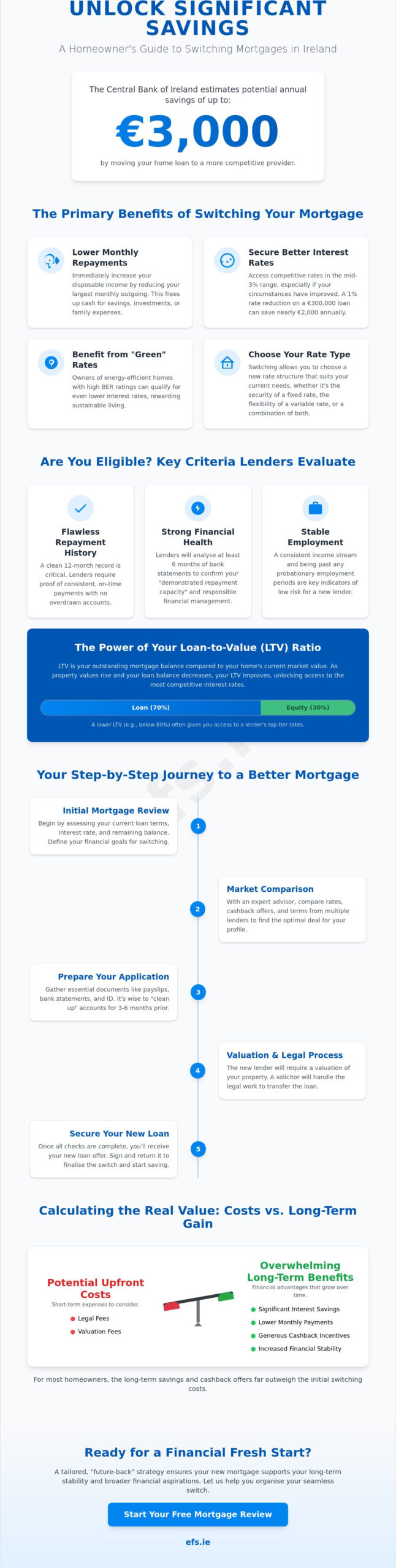
Think of switching mortgage Ireland as a vital financial health check for your household. While many homeowners view their mortgage as a static commitment, it’s actually one of the most flexible tools in your financial arsenal. The primary driver for most is a significant reduction in monthly interest repayments, which immediately increases your disposable income. In the current 2026 market, we’re seeing a surge in homeowners switching to secure “Green” mortgage rates. These products offer lower interest for properties with high BER ratings, rewarding you for energy-efficient living. Whether you’re looking to lower your monthly outgoings or you’re planning to release equity for home improvements, switching allows you to realign your debt with your current life goals.
Can You Truly Save Thousands by Switching?
Many Irish homeowners fall victim to a “loyalty tax,” where long-term customers remain on higher variable rates whilst new applicants are offered the most competitive deals. When you look at the fundamentals of Understanding Mortgage Loans, the impact of even a small interest rate shift is clear. Consider a conceptual scenario: on a €300,000 loan, a 1% reduction in your interest rate could potentially save you nearly €2,000 every year. That’s a significant sum that could instead fund a family holiday or bolster your pension contributions. Even a modest 0.5% difference can result in thousands of Euro saved over the life of the loan, making the process of switching mortgage Ireland a highly effective way to safeguard your future stability.
Fixed vs Variable Rates in the Current Market
As we move through 2026, there’s a distinct preference amongst switchers for long-term fixed rates. These products provide the peace of mind that comes from knowing exactly what your outgoings will be, regardless of wider economic shifts. Conversely, variable rates offer greater flexibility, often allowing you to make lump-sum repayments without incurring early exit fees. For those who want the best of both worlds, split rates have become an increasingly popular middle-ground solution. This allows you to fix a portion of your loan for security whilst keeping the remainder variable for flexibility. We help you organise these options to ensure your transition is straightforward and tailored to your specific needs.
Key Criteria Lenders Use to Evaluate Switchers
Lenders in 2026 are meticulous when reviewing switcher applications. They don’t just want to see that you can afford the new repayments; they want evidence that you’re a low-risk partner. Your repayment behaviour over the last 12 months is frequently the most critical factor. Any missed payments or regular overdrawn instances on your current account can be a deal-breaker. Whilst you’re looking for a better deal, the new lender is looking for a flawless track record. This scrutiny is partly due to 2026 Central Bank lending limits, which require banks to maintain strict buffers to ensure long-term market stability. Preparing your profile before switching mortgage Ireland is the best way to ensure a positive outcome.
The Importance of Your LTV Ratio
Your Loan-to-Value (LTV) ratio is the relationship between your outstanding mortgage debt and the current market value of your home. It’s the primary tool lenders use to decide which interest rate tier you fall into. Because property values across Ireland have grown steadily, you might find that your LTV has naturally improved since you first bought your home. Reaching a lower bracket, particularly the sub-60% LTV tier, often unlocks the market’s lowest interest rates. A fresh property valuation is a standard part of the process, and it can often be the key that opens the door to top-tier savings.
Financial Health and Credit Readiness
Lenders will typically request at least six months of bank statements to assess your day-to-day financial management. They’re looking for a clear “demonstrated repayment capacity.” This means they’ll analyse your regular outgoings, including childcare costs, car loans, and credit card balances, to see how much “stress room” you have in your budget. It’s wise to spend three to six months “cleaning up” your accounts by reducing discretionary spending and ensuring no missed direct debits appear.
A stable employment history remains a cornerstone of a successful application. Lenders prefer to see that you’ve passed any probationary periods and have a consistent income stream. If you’re planning a significant career move or a shift to self-employment, it’s often more strategic to finalise your mortgage switch before making the change. If you’re unsure how your current outgoings might impact your eligibility, our team can help you organise your financial profile for a successful switch. This proactive approach neutralises potential stresses before they arise, ensuring a much smoother transition to your new lender.
Calculating the Real Cost of a Mortgage Switch
Securing a more affordable interest rate is only half the battle; you also need to understand the initial investment required to get there. Whilst the prospect of switching mortgage Ireland is rooted in long-term savings, there are specific upfront costs you’ll need to budget for. These typically include legal fees, property valuation charges, and potentially an early repayment charge from your current lender. It’s about finding the “break-even point” where your monthly savings eventually outweigh these initial outlays. We focus on providing a transparent overview so you can move forward with a clear head and a steady budget.
Legal and Valuation Fees Explained
Because switching involves moving the legal title of your home from one bank to another, a solicitor is required to manage the conveyancing process. In the current Irish market, legal fees for switching mortgage Ireland typically range from €1,000 to €1,500 plus VAT. Additionally, your new lender will require an independent assessment of your home’s worth. A professional property valuation usually costs between €150 and €250. To remain competitive in 2026, many lenders offer switcher-specific packages. For instance, AIB currently provides a €3,000 payment to help cover these professional costs, whilst other providers might offer “fee-free” incentives to simplify your transition.
The Impact of Fixed-Rate Break Fees
If you’re currently on a fixed-rate contract, leaving before the term expires may trigger an early repayment charge, often called a “break fee.” This penalty is designed to compensate the lender for the loss of anticipated interest. Before making any decisions, you should request a formal break fee quote from your current provider. This figure can fluctuate based on current market interest rates and the remaining time on your contract. In many cases, it’s more strategic to time your switch to coincide with the end of your fixed term, but if the interest rate gap is wide enough, paying the fee might still result in a net gain over the long term. Understanding when should I switch my mortgage Ireland is key to making this calculation work in your favour.
Cashback offers are another vital part of the calculation. PTSB currently offers 2% of the mortgage value back at drawdown, and Bank of Ireland provides up to 3% subject to certain conditions. Whilst these lump sums are attractive for covering solicitors’ bills, they shouldn’t be the only factor in your decision. A slightly lower interest rate without cashback often provides better value over a twenty-year term than a higher rate with a one-off payment. Professional guidance is essential here to spot hidden lender charges and ensure the deal you choose truly supports your long-term financial stability. We help you weigh these variables to ensure your switch is both seamless and genuinely profitable.
The Step-by-Step Journey to a More Affordable Home Loan
The journey of switching mortgage Ireland is often perceived as a mountain of paperwork, but with the right guidance, it becomes a series of manageable milestones. While competitors often describe this as a bureaucratic hurdle, we view it as a logical progression toward your financial freedom. The entire process typically takes between six and eight weeks, and much of the heavy lifting is managed by your advisor. By following a structured path, you can move from your current high-interest rate to a more secure, lower-cost alternative without the traditional stress of dealing with multiple lenders.
The first step is a comprehensive review of your current terms. You should identify your remaining balance, current interest rate, and any potential break fees. Once you have this foundation, the process follows a clear sequence:
- Consult an independent broker: This allows you to compare the entire Irish market rather than just the products of a single bank.
- Organise your documentation: Gathering your proofs of income and identity early prevents delays later in the process.
- Secure Approval in Principle (AIP): This is your “green light” from the new lender, confirming they’re happy to take on your loan.
- Instruct your solicitor: You’ll need a legal professional to manage the conveyancing and discharge your old mortgage.
- Complete the valuation: A final check ensures your property’s value supports the loan amount you’re requesting.
Gathering Your Documentation Efficiently
In 2026, digital banking has made collecting six months of statements much more straightforward. You’ll need the “big four”: proof of ID (passport), proof of address (utility bills), proof of income (payslips), and proof of employment. For those who are self-employed, lenders typically require two years of audited accounts and a current Tax Clearance Certificate to verify stability. Having these documents ready in a digital format ensures your application moves through the system with minimal friction.
Navigating the Legal and Valuation Phase
Once your AIP is in place, the focus shifts to the legal transfer. Your solicitor handles the “deed of discharge” for your old loan and ensures the new lender’s interest is properly registered. Simultaneously, an independent valuer will visit your home. They aren’t looking for perfect decor; they’re simply confirming the property is habitable and its market value matches your application. We act as the buffer during this stage, coordinating between the valuer, solicitor, and lender so you don’t have to. If you’re ready to move toward a more secure financial future, you can start your seamless switch today with our expert team.
How Engage Financial Solutions Organises Your Seamless Switch
We act as the vital buffer between you and the often-daunting complexity of the Irish lending market. Our “Future-Back” approach distinguishes us from standard transactional services; we start by understanding your ultimate goals, such as long-term security or a debt-free retirement, and work backward to find the right mortgage product today. By leveraging our national reach and access to an extensive panel of lenders, we ensure you aren’t limited to the narrow offerings of a single high-street bank. This comprehensive view is essential for switching mortgage Ireland successfully, as it allows us to tailor a solution that fits your lifestyle rather than forcing you into a generic product that may not serve your future needs.
Our role is one of stewardship and guidance. We anticipate potential stresses, such as stricter 2026 lending criteria or valuation hurdles, and neutralise them before they impact your application. This proactive management creates a sense of calm competence, allowing you to enjoy the benefits of a more affordable home loan without the administrative burden. We manage the dialogue with lenders, solicitors, and valuers, ensuring that every piece of the puzzle fits together perfectly for a straightforward transition. By positioning ourselves as your trusted advisor, we transform a complex financial task into a clear, goal-driven strategy for your home.
A Tailored Approach to Financial Security
A “one-size-fits-all” interest rate rarely serves the best interests of a homeowner over the long term. Whether you’re managing a standard residential loan or navigating the specific complexities of self-build or buy-to-let switches, your circumstances require a bespoke strategy. We provide a professional and client-centric service that focuses on your unique financial profile. Our expertise allows us to safeguard your interests, ensuring that even the most intricate cases are handled with meticulous attention to detail. This personalised care means you can feel looked after and understood throughout the entire process, whilst we work to secure the stability you deserve.
Beyond the Switch: Protecting Your Future
Switching your mortgage is the ideal moment to conduct a holistic review of your broader financial health. It’s the perfect time to update your mortgage protection or life insurance policies to ensure they still provide adequate cover for your family at the best possible price. Often, the monthly savings generated by switching mortgage Ireland can be strategically redirected into long-term wealth builders like a PRSA or a company pension. Alternatively, if you have other financial requirements such as consolidating personal debt, working with a specialist credit broker like I Need Cash can provide a clear view of the homeowner and personal loan options available to you. By viewing the switch as one piece of a larger puzzle, you secure not just a lower rate, but a more robust financial foundation for the years ahead. We’re here to guide you through every step of this integration, making the transition as straightforward as possible.
Organise your free mortgage switching consultation with Engage today and take the first step toward a more stable and optimistic financial future.
Take the Next Step Toward Long-Term Financial Stability
Moving your home loan is more than a simple administrative task; it’s a powerful way to reset your financial trajectory. By understanding your LTV ratio and organising your documentation early, you’ve already cleared the biggest hurdles to a more affordable repayment. Whether you’re aiming to reduce your monthly outgoings or lock in long-term security with a green rate, the process of switching mortgage Ireland offers a clear path to significant savings. It’s an opportunity to align your largest debt with your broader life goals, from retirement planning to protecting your family’s future.
Our expert team provides a full-service advisory that covers everything from pensions to protection for customers nationally. As a firm regulated by the Central Bank of Ireland, we pride ourselves on delivering a professional service that prioritises your peace of mind. We act as your steady guide, ensuring every step is straightforward and free from friction. You deserve the stability that comes from a tailored financial strategy managed by professionals who truly understand your needs.
Secure your seamless mortgage switch with Engage Financial Solutions and start your journey toward a brighter financial future today.
Frequently Asked Questions
How long does the mortgage switching process typically take in Ireland?
The process of switching mortgage Ireland typically takes between six and eight weeks from your initial application to the final drawdown. This timeline is largely dependent on how quickly you can gather your documentation and the speed of the legal conveyancing. Ensuring your payslips, bank statements, and ID are ready in a digital format can help your advisor move the process along with minimal friction.
Do I need a solicitor to switch my mortgage?
Yes, you must appoint a solicitor to manage the legal transfer of the property title between your old and new lenders. They’re responsible for discharging your existing mortgage and registering the new lender’s interest with the Property Registration Authority. While this is a legal requirement, many lenders offer cashback or fee contributions specifically to help you manage these professional costs without stress.
Can I switch my mortgage if I am currently in negative equity?
Switching is generally not possible if you’re in negative equity, as lenders require a Loan-to-Value (LTV) ratio that fits their specific security criteria. Most lenders look for an LTV of 90% or less to approve a switch, with the most competitive rates reserved for those with higher equity. If property values in your area have increased, you might find you’ve moved out of negative equity, making a switch more accessible than you think.
What happens to my mortgage protection insurance when I switch lenders?
You have the choice to either “assign” your existing mortgage protection policy to the new lender or take out a completely new policy. Switching is an excellent time to review your cover to ensure it still meets your needs and offers the best value for your current life stage. We can help you manage this transition to ensure there is no gap in your security whilst you move between lenders.
Is there a minimum amount I must owe to make switching worthwhile?
Most financial experts suggest that you should have a remaining balance of at least €100,000 for the savings to clearly outweigh the costs of switching. If your balance is lower, the upfront legal and valuation fees might negate the benefits of a lower interest rate. However, if a lender is offering a full “fee-free” package or significant cashback, switching mortgage Ireland could still be a competent financial move for smaller balances.
Can I switch from a fixed-rate mortgage before the term ends?
You can switch at any time, but leaving a fixed-rate contract early often triggers an early repayment charge or “break fee.” You should request a formal quote from your current lender to see if the long-term savings of a lower market rate outweigh this one-off penalty. In many cases, timing your switch for the end of your fixed term is the most straightforward way to safeguard your savings. Our detailed guide on when should I switch my mortgage Ireland can help you identify the precise moment to act for maximum financial benefit.
Will switching my mortgage affect my credit rating?
A mortgage application involves a standard credit check, which may cause a minor, temporary dip in your credit score, but it won’t have a long-term negative impact. In fact, successfully moving to a more affordable loan and maintaining consistent repayments can actually strengthen your financial profile. Demonstrating that you can manage a major debt transition effectively reinforces your status as a reliable and proactive borrower.
How much can I borrow when switching my mortgage?
When switching, you can typically borrow the full amount of your outstanding mortgage balance. If you’re looking to borrow additional funds for home improvements, you’ll be subject to the Central Bank’s loan-to-income (LTI) limits, which generally allow for four times your gross annual income. Your advisor will help you calculate exactly what’s possible based on your current earnings and your home’s most recent valuation. If you are yet to purchase your first property, our comprehensive guide to securing a first time buyer mortgage Ireland covers everything you need to know about borrowing limits, government supports, and the 2026 lending landscape.
Disclaimer
Engage Financial Services LTD T/A Engage Financial Solutions is regulated by the Central Bank of Ireland CRO 764570. Director David Moore. Suite 2 First Floor, 14 -18 Main street, Blackrock, Co Dublin A94 W0Y3