
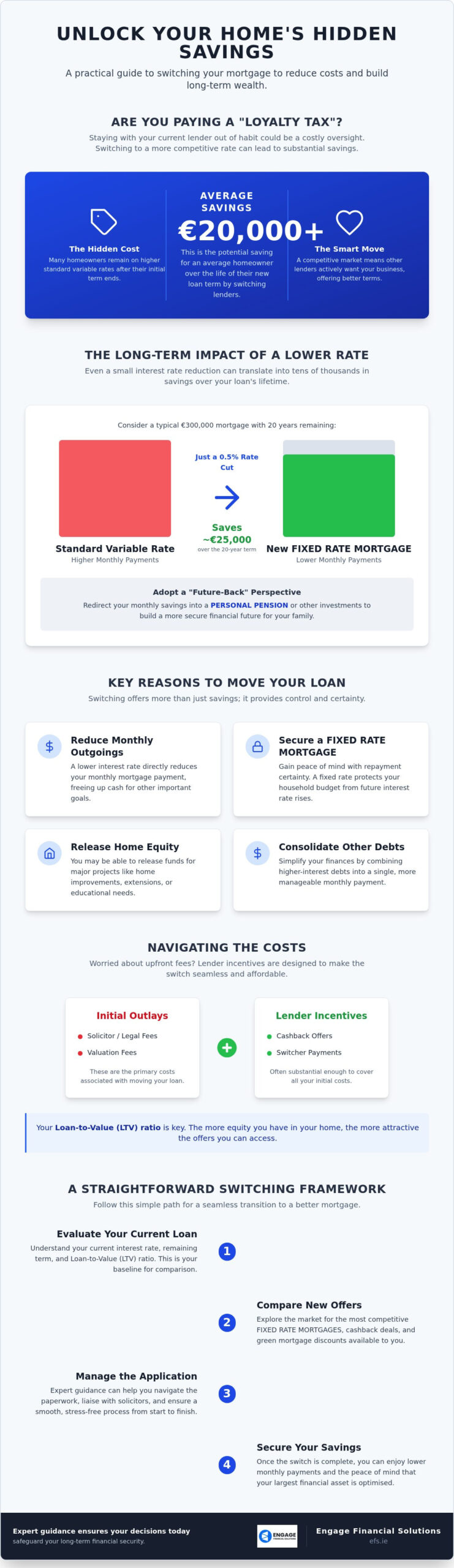
Did you know that the average homeowner could save over €20,000 by moving their home loan to a more competitive lender? In a market where the European Central Bank refinance rate sits at 2.40% as of June 2026, staying with your current provider out of habit could be one of your most expensive financial oversights. It’s completely understandable if you feel hesitant; between the jargon of FIXED RATE MORTGAGES and the perceived mountain of paperwork, many people feel anchored to high rates just to avoid the headache. You might worry that the initial costs of switching mortgage could outweigh the long-term benefits, or that the legal process will be too complex to manage alongside your daily life.
This guide simplifies that journey, showing you exactly how to calculate your true savings and navigate the transition with total confidence. Whether you’re looking to reduce your monthly outgoings or you’re seeking long-term financial security for your family, we’ll explore how to manage solicitor fees and leverage current cashback offers. You’ll discover a straightforward path to SWITCHING MORTGAGES that prioritises your peace of mind while safeguarding your future wealth. By focusing on a seamless experience, you can move toward a more affordable home loan with ease.
Key Takeaways
- Understand how SWITCHING MORTGAGES allows you to escape the “loyalty tax” of standard variable rates and secure significantly more favourable terms.
- Learn how to calculate your break-even point by comparing your current interest outgoings against the most competitive FIXED RATE MORTGAGES available in 2026.
- Discover how to effectively manage the costs of switching mortgage Ireland by utilising lender cashback incentives to cover legal fees and valuation outlays.
- Adopt a “future-back” perspective to ensure your mortgage decisions today actively safeguard your long-term financial security and retirement aspirations.
The Fundamentals of SWITCHING MORTGAGES in Today’s Market
At its core, The Fundamentals of Switching Mortgages involves moving your existing home loan from one lender to another to secure more favourable terms. It’s a strategic financial move that many homeowners overlook, often staying with the same provider for decades. By doing so, they frequently pay what experts call a “loyalty tax”. This is the extra cost incurred by remaining on a standard variable rate whilst newer, more competitive offers are available elsewhere. In the current economic climate of 2026, where the European Central Bank refinance rate was adjusted to 2.40% in June, reviewing your mortgage has become a necessity rather than an option.
The domestic market is currently highly competitive. Lenders are actively seeking to attract reliable borrowers, creating an environment where the costs of switching mortgage Ireland can be significantly offset by attractive incentives. However, the process requires careful navigation. A professional consultancy like Engage Financial Solutions acts as a vital buffer, helping you sift through complex offers to find a tailored solution that fits your specific life stage and long-term goals.
Why Homeowners Choose to Move Their Loan
Most people initiate a switch to reduce their monthly outgoings. Even a small reduction in your interest rate can save hundreds of Euro every month. Beyond simple savings, many borrowers move to secure a FIXED RATE MORTGAGE. This provides essential repayment certainty, protecting your household budget from future rate fluctuations. Whether you’re looking to release equity for home improvements or you want to consolidate other debts into a single, manageable payment, understanding the total costs of switching mortgage Ireland is the first step in re-organising your finances for long-term stability. It’s an act of stewardship over your family’s future wealth.
Understanding the Domestic Lending Landscape
Lenders are currently offering substantial rewards for those who decide to move. Various domestic banks provide switcher payments or cashback offers based on the mortgage value for qualifying applicants. Your Loan-to-Value (LTV) ratio plays a crucial role here; the more equity you have in your home, the better the rates you can typically access. You should check your current LTV before applying, as a lower ratio often unlocks the most competitive tiers. Additionally, Green mortgage discounts have become a favourite amongst modern borrowers with energy-efficient homes, offering even deeper savings for those with high BER ratings. By evaluating these factors, you can ensure that the costs of switching mortgage Ireland are minimised whilst your financial security is maximised.
Evaluating the Real Return: Is the Financial Gain Significant?
Deciding whether to move your home loan often comes down to a single, logical calculation: the break-even point. This is the moment where your monthly interest savings surpass the initial costs of switching mortgage Ireland, such as legal fees and valuation outlays. Whilst the average homeowner can save over €20,000 by moving lenders, the true value lies in how that saving is utilised over time. If your current lender has you on a standard variable rate, comparing it against the best available FIXED RATE MORTGAGES is the first step toward reclaiming your financial independence.
When evaluating the costs of switching mortgage Ireland, it’s helpful to look at the long-term horizon rather than just the immediate monthly drop. A reduction in your interest rate of just 0.5% might sound modest, yet it can save you tens of thousands of Euro over the remaining life of your loan. This is where the “Future-Back” perspective becomes essential. Instead of viewing the switch as a one-off transaction, consider what that monthly surplus could do for your lifestyle and long-term goals. It isn’t just about paying less; it’s about having more to invest in your family’s stability.
The Long-Term Compound Effect of Lower Rates
A 0.5% interest rate reduction on a typical €300,000 mortgage can result in total savings of approximately €25,000 over a 20-year term. Redirecting these funds into a PRSA or a PERSONAL PENSION allows you to benefit from tax relief whilst building a robust retirement fund. There is also a profound psychological benefit to this approach. Knowing your largest monthly expense is fully optimised brings a sense of calm competence to your overall financial planning. It’s about moving from a position of being managed by your debt to actively managing your wealth.
Cashback Offers vs. Lower Interest Rates
In the current market, lenders often compete with enticing cashback offers that range from flat lump sums to a percentage of the total loan value. These are incredibly useful for covering the costs of switching mortgage Ireland upfront, effectively making the transition cost-neutral. However, you must be careful to analyse whether a slightly higher rate with cashback is better than a lower rate without it. Some offers include hidden conditions, such as “clawback” clauses that require you to repay the incentive if you move lenders again within a specific period. A professional advisor can help you organise a personalised comparison to ensure the path you choose offers the highest possible return for your specific circumstances.
Navigating the Costs and Hurdles of Moving Your Loan
Whilst the prospect of significant savings is compelling, it’s natural to feel a sense of dread regarding the initial outlays. Understanding the costs of switching mortgage is the best way to neutralise that stress and move forward with clarity. Most homeowners discover that the upfront investment is quickly eclipsed by the long-term financial relief they experience. By taking a proactive approach to your home loan, you’re not just saving money; you’re consolidating your family’s financial security for the years ahead.
The market in 2026 is designed to encourage movement, with lenders providing various incentives to help you transition. However, you must still account for the professional services required to make the switch official. These costs are a necessary part of the process, ensuring that every detail is handled with the meticulous attention your property deserves.
Breaking Down the Third-Party Fees
You’ll need to budget for a few specific services to ensure your switch is legally sound and financially accurate. Legal fees for the conveyancing involved in a switch typically range from €1,350 to €1,600. A solicitor is legally required to handle the transfer of deeds from your old lender to the new one. Additionally, an independent valuer must confirm your property’s current worth to establish your Loan-to-Value (LTV) ratio; this usually carries a fee of approximately €150. It’s a straightforward step that helps you access the most competitive rates on the market.
Whether you’re currently on a variable rate or you’re considering leaving a fixed-rate period early, you should check if a break fee applies. These early redemption charges are capped under EU law, and your current lender is obliged to provide an estimate of these charges upon request. To alleviate these costs of switching mortgage, many domestic lenders provide switcher incentives specifically designed to cover these specific outlays. For example, many lenders provide significant switcher payments or attractive cashback offers that can effectively make your transition cost-neutral, allowing you to focus on the long-term benefits of your new loan.
The Paperwork Myth: What You Actually Need
Many homeowners feel trapped by high interest rates simply because they dread a mountain of complex paperwork. It’s a common misconception that the process is overwhelming. In reality, digital portals have made the submission process much more seamless than in previous years. You’ll generally need to organise your last three months of payslips, six months of bank statements, and valid proof of identification. This logical progression ensures that your new lender has a clear picture of your financial health.
Actionable Tip: Keep a “Financial Master File” on your device or in a dedicated folder. By regularly saving digital copies of your bank statements and salary certs, you’ll make any future application effortless and stay proactive in managing your wealth.
Finally, remember that you’ll need to update your MORTGAGE PROTECTION. Since your new lender requires this security, ensuring your policy is tailored to your new loan amount is essential for your family’s long-term stability. A professional consultancy can guide you through this process, acting as the buffer that removes friction and ensures your life-long financial health is protected.
A Straightforward Framework for a Seamless Transition
Moving your home loan doesn’t need to be a complex or intimidating project. By following a logical, five-step framework, you can manage the costs of switching mortgage whilst ensuring a friction-free experience from start to finish. The key to a successful transition is staying organised and allowing professional expertise to buffer you from the technical complexities of the lending market. This methodical approach ensures you remain in control of your financial progress at every stage.
- Step 1: Conduct a full review. Take a look at your current interest rate, the remaining balance on your loan, and the years left on your term. This data is the foundation of your potential savings calculation.
- Step 2: Consult with a specialist. Instead of approaching a single bank, speak with a consultant who can compare the entire domestic market. They’ll help you identify tailored solutions that fit your specific life stage.
- Step 3: Secure an Approval in Principle. This document confirms your borrowing capacity and gives you the green light to proceed with the application with total confidence.
- Step 4: Formalise the application. Once you’ve chosen a lender, you’ll instruct your solicitor and an independent valuer. They’ll manage the legal transfer and the property appraisal on your behalf.
- Step 5: Completion. Your new lender pays off the old loan, and you’ll soon experience the financial relief of your first reduced monthly payment.
Timing Your Move for Maximum Benefit
You should ideally start this process three months before your current fixed term ends. This window provides enough time to gather documents and secure an offer without feeling rushed or stressed. By monitoring the market during this period, you can lock in a favourable rate whilst your application is in progress. This proactive approach helps you avoid the standard variable rate trap, which serves as a loyalty tax that can unnecessarily drain your household budget during the transition.
The Role of MORTGAGE PROTECTION
When you move your loan to a new lender, they’ll require updated security to protect the debt. Ensuring your life cover matches the new loan amount and term is a legal necessity, but it’s also a chance to find better value. Often, you can find a more affordable policy that provides superior security compared to your original one. Reviewing this alongside your switch can lead to even greater long-term savings for your family. For a deeper look at how to safeguard your home, see The Comprehensive 2026 Homeowner’s Guide.
If you’re ready to secure a more affordable future for your home, you can start your mortgage review today with our expert team at Engage Financial Solutions.
How Expert Guidance Ensures Long-Term Financial Security
Whilst automated tools and online calculators can give you a rough estimate of the costs of switching mortgage, they often lack the human nuance required for a life-altering financial decision. Navigating the domestic market alone can be a daunting task, as technical jargon and lender requirements often create unnecessary friction. Choosing a DIY approach might seem appealing at first, but it frequently leaves homeowners feeling overwhelmed by the administrative burden. In contrast, working with a professional consultancy provides a layer of protection and guidance that ensures your transition is both successful and tailored to your specific needs.
Engage Financial Solutions acts as the essential buffer between you and the lenders, handling the meticulous details of the application process on your behalf. This partnership allows you to maintain a sense of calm competence whilst your financial future is being organised by experts who understand the 2026 market. A holistic review goes beyond just the home loan; it examines how your mortgage fits into your overall portfolio of PENSIONS, INVESTMENTS, and protection policies. By looking at the big picture, you ensure that every financial decision you make today actively supports your ultimate goal of long-term stability and success.
Beyond the Rate: A Holistic Financial Strategy
Switching your home loan is a pivotal moment in your broader RETIREMENT PLANNING journey. When you reduce your monthly outgoings, you create a surplus that can be strategically redirected into your PENSIONS or SAVINGS ACCOUNTS to accelerate your wealth building. It’s also an ideal time to ensure your INCOME PROTECTION is sufficient for your new loan terms, safeguarding your family against unforeseen life events. For more insights on how to optimise your household budget, read The 2026 Guide to Seamless Savings.
Your Next Steps Toward Financial Freedom
Your journey toward financial freedom starts with a single, straightforward action. A personalised consultation allows us to understand your specific life stage and tailor a solution that safeguards your future. We believe in building a partnership that prioritises your peace of mind, removing the stress of complex financial transitions through proactive stewardship. You don’t have to navigate the costs of switching mortgage alone; our team is here to provide the stability and optimism you need to move forward. If you’re ready to secure a more affordable and stable future, contact Engage Financial Solutions to start your journey today.
Securing Your Financial Future Today
Taking control of your home loan is one of the most effective ways to safeguard your family’s long-term stability. By moving away from standard variable rates and embracing competitive FIXED RATE MORTGAGES, you effectively eliminate the unnecessary “loyalty tax” that many homeowners pay. Whilst the initial costs of switching mortgage might seem like a hurdle, current market incentives and substantial interest savings make SWITCHING MORTGAGES a logical step for any proactive homeowner. Whether you’re looking to boost your retirement fund or simply want more breathing space in your monthly budget, the benefits of a well-timed switch are clear.
You don’t have to navigate this process alone. As a firm regulated by the Central Bank, Engage Financial Solutions provides expert guidance tailored to your unique needs. We offer seamless management of the entire application process, acting as the buffer between you and the lenders to ensure a stress-free experience. If you’re ready to move toward a more secure financial future, book a consultation with Engage Financial Solutions to see how much you could save. It’s time to turn your property into a powerful tool for your life-long financial health.
Frequently Asked Questions
Is it worth switching mortgage if I only have 10 years left?
It’s often highly beneficial to switch even with a shorter remaining term. Whilst the time frame is reduced, the compound interest savings on a substantial balance can still be significant. If you move from a high variable rate to one of the competitive FIXED RATE MORTGAGES, the monthly savings over 120 months add up. You should calculate the total interest payable over those years to see the true net gain.
Can I switch my mortgage if I am currently on a fixed rate?
You certainly can, though you’ll need to check for a break fee from your current lender. Under EU law, these fees are capped and depend on current market interest rates. If rates have risen since you fixed your loan, your break fee might even be zero. It’s always best to request a formal redemption statement to see if the long-term savings outweigh the exit cost.
How much does it cost to switch a mortgage in the current market?
The costs of switching mortgage usually consist of legal fees between €1,350 and €1,600 and a valuation fee of roughly €150. You might also encounter a break fee if exiting a fixed term early. Fortunately, many domestic lenders provide switcher incentives, such as €3,000 payments or 2% cashback. These offers are specifically designed to cover your outlays, often making the entire transition cost-neutral.
What is the minimum equity required to make switching worth it?
There isn’t a strict minimum, but having at least 10% to 20% equity usually unlocks the most competitive rates. Lenders offer tiered interest rates based on your Loan-to-Value (LTV) ratio; the more equity you have, the lower the rate you can typically secure. If your home has increased in value, a new valuation might move you into a cheaper bracket, making the switch even more beneficial.
Will switching my mortgage affect my credit score?
A standard application involves a credit check, which may cause a minor, temporary dip in your score, but this is a normal part of financial management. Consistently meeting your new, lower repayments will support your credit health over the long term. Since you’re replacing one debt with another rather than taking on additional credit, the impact is generally negligible compared to the stability gained from lower interest costs.
Do I need a new solicitor when I switch lenders?
You must instruct a solicitor to manage the conveyancing, but you can choose any professional on your new lender’s approved panel. They handle the transfer of deeds and ensure the legal charge is correctly registered. Whilst the process is technical, your solicitor manages the complexity on your behalf. This ensures the move is seamless and provides the security you need for your life-long financial health.
How long does the entire switching process typically take?
The process usually takes between two and four months from the initial consultation to final drawdown. Once you submit a completed application, lenders are required to provide a decision within 10 business days. The remaining time is largely spent on the valuation and legal conveyancing. Starting the process three months before a fixed term ends ensures a smooth move without falling onto an expensive variable rate.
Can I switch to a Green Mortgage if I have upgraded my home’s energy rating?
Yes, if your property has a high Building Energy Rating (BER), usually a B3 or higher, you can access specific Green Mortgage discounts. These products offer some of the lowest interest rates in the domestic market to reward energy efficiency. If you’ve recently installed solar panels or upgraded your insulation, a new BER cert could be the key to unlocking these exclusive, sustainable savings for your future.
Disclaimer
Engage Financial Services LTD T/A Engage Financial Solutions is regulated by the Central Bank of Ireland CRO 764570. Suite 2 First Floor, 14 -18 Main street, Blackrock, Co Dublin. A94 W0Y3