


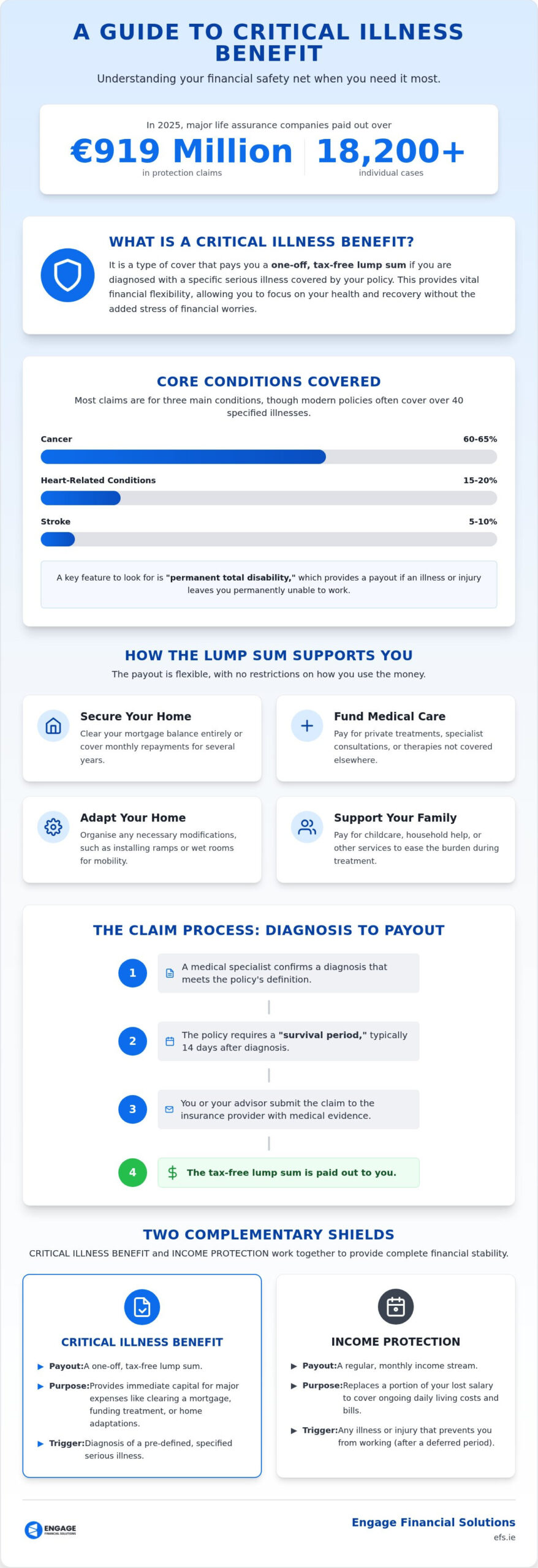
Did you know that major life assurance companies paid out over €919 million in protection claims across more than 18,200 individual cases in 2025? It’s a staggering figure that highlights just how often families rely on a financial safety net when health takes an unexpected turn. You might worry about how you’d manage mortgage payments or daily costs if a serious diagnosis occurred. This is why a CRITICAL ILLNESS BENEFIT is such a vital component of a stable financial plan.
It’s completely natural to feel overwhelmed by complex insurance jargon or the fear of choosing the wrong policy. We agree that your focus should be on recovery, not on whether the bills are paid. This guide is designed to provide you with a clear, straightforward understanding of how a CRITICAL ILLNESS BENEFIT works. Whether you’re concerned about mortgage repayments or family stability, we’ll explain how the money is paid to you and compare different options. As a first step, check your current employment contract for any existing sick pay cover to see where your gaps might be. This will give you the tools to choose a policy that offers genuine peace of mind for your future.
Key Takeaways
- Understand that a CRITICAL ILLNESS BENEFIT provides a tax-free lump sum upon diagnosis, offering vital financial flexibility whilst you focus on your health.
- Learn about the “survival period,” a standard requirement where you must survive for a set time, typically 14 days, after a diagnosis before the claim is finalised.
- Discover how a lump-sum payout and INCOME PROTECTION work together as complementary shields to provide both immediate and long-term financial stability.
- Adopt a “future-back” perspective to calculate your coverage needs by prioritising major liabilities such as mortgage repayments and essential family costs.
- Identify how a regulated consultant acts as a steady guide to navigate the complexities of the insurance market, ensuring a seamless and stress-free application process.
What is a CRITICAL ILLNESS BENEFIT and Why Does it Matter?
When you face a significant health challenge, the last thing you want is the added weight of financial uncertainty. A CRITICAL ILLNESS BENEFIT is designed to act as a vital buffer between your recovery and your expenses. Essentially, it’s a tax-free lump sum paid to you upon the diagnosis of a specific condition covered by your policy. Unlike other forms of protection that might pay out monthly, such as INCOME PROTECTION, this benefit provides immediate capital when you need it most. You can choose to have this as a standalone policy or as a valuable add-on to your existing LIFE INSURANCE.
Understanding What is a CRITICAL ILLNESS BENEFIT helps you see it as more than just a policy; it’s an act of stewardship for your family. It ensures that your home and lifestyle remain secure even if you’re unable to work for a period. By removing the friction of financial stress, you’re free to focus entirely on your health and well-being, creating a more seamless path to recovery.
The Core Conditions Covered
While every provider offers slightly different terms, most policies focus on the most common health transitions. In the local market, the “big three” conditions, cancer, heart attack, and stroke, account for the vast majority of claims. For instance, data from 2025 shows that cancer remains the leading cause of claims, making up approximately 60-65% of all payouts. This is followed by heart-related conditions at 15-20% and stroke at 5-10%.
Many modern policies are incredibly comprehensive, often covering over 40 distinct conditions. This might include anything from organ transplants to multiple sclerosis. A key feature to look for is “permanent total disability.” This is a specific inclusion that provides a payout if an illness or injury leaves you permanently unable to perform your job or basic daily tasks, offering an extra layer of stability for your future.
How the Lump Sum Supports Your Recovery
The beauty of a CRITICAL ILLNESS BENEFIT lies in its flexibility. Because the payout is yours to use however you see fit, it provides a sense of calm competence during a turbulent time. There are no restrictions on how the funds are spent, allowing you to tailor the support to your specific needs.
You might use the money to:
- Clear your mortgage entirely or cover repayments for several years.
- Fund private medical treatments or specialist consultations to speed up your recovery.
- Organise home modifications, such as installing ramps or wet rooms, if your mobility is affected.
- Pay for childcare or household help whilst you’re undergoing treatment.
By planning ahead, you ensure that a medical diagnosis doesn’t have to mean a financial crisis. A helpful tip is to review your current mortgage balance today. Knowing this exact figure helps you decide exactly how much cover you need to keep your home safe and your family protected.
How the CRITICAL ILLNESS BENEFIT Operates: From Diagnosis to Payout
The journey from a medical diagnosis to receiving your payout is designed to be a logical and supportive process. It begins when a medical specialist confirms a condition that meets the criteria outlined in your policy. Once you have this diagnosis, you notify your provider to start the claim. A key detail to understand is the “survival period.” Most policies in the local market require you to survive for a set time, typically 14 days, after the initial diagnosis before the lump sum is released. This ensures the CRITICAL ILLNESS BENEFIT provides the intended financial support for your ongoing recovery and lifestyle adjustments.
For the process to remain seamless, transparency is your best ally. Insurers rely on medical evidence provided by your doctors to validate the claim. This is why full disclosure during your initial application is so vital. By being thorough about your health history at the start, you remove potential friction during the claim stage. If you feel uncertain about how to document your medical background, speaking with an advisor can help you organise your information accurately and professionally.
Understanding ‘Specified’ Illnesses
It’s a common misconception that this cover applies to any serious health issue. In reality, a CRITICAL ILLNESS BENEFIT only pays out for conditions explicitly named, or “specified,” in your policy document. Furthermore, many conditions are subject to severity criteria. For example, a diagnosis of a very early-stage illness might result in a partial payment, whilst a more advanced stage triggers the full lump sum. Reviewing Anthem’s guide to critical illness insurance can give you a broader perspective on how these clinical definitions are structured to ensure fairness for all policyholders.
The Application and Underwriting Process
The application itself is a straightforward exercise in personal stewardship. During the underwriting phase, the insurer evaluates your personal risk profile to determine your premium. They look at several factors, including your age, health history, and whether or not you smoke. Whilst younger, non-smoking applicants often find premiums more accessible, modern underwriting is inclusive and flexible. A steady guide can help you navigate these technicalities, ensuring your policy is tailored to your specific life stage. This proactive approach allows you to secure your future stability with confidence, knowing that the heavy lifting of the application is handled with meticulous care.
CRITICAL ILLNESS BENEFIT vs. INCOME PROTECTION: Choosing the Right Shield
Choosing between a CRITICAL ILLNESS BENEFIT and INCOME PROTECTION isn’t a matter of which is “better”. Instead, it’s about understanding the specific job each policy performs in your financial ecosystem. Whilst both offer a safety net, they address different pressures. A CRITICAL ILLNESS BENEFIT delivers a single, tax-free lump sum upon diagnosis, which is designed to neutralise large, immediate liabilities. Conversely, INCOME PROTECTION provides a steady, recurring monthly payment if you’re unable to work due to any illness or injury, ensuring your day-to-day lifestyle continues without friction.
| Feature | CRITICAL ILLNESS BENEFIT | INCOME PROTECTION |
|---|---|---|
| Payout Type | Lump sum (One-off) | Monthly recurring payment |
| Primary Purpose | Clearing debt or major costs | Replacing lost salary/earnings |
| Tax Treatment | Typically tax-free | Payout is taxable (Premiums get relief) |
| Trigger | Diagnosis of a specified illness | Inability to work due to any illness/injury |
When a Lump Sum is the Priority
If your primary anxiety is the mortgage, a lump sum is often the priority. Clearing a large debt immediately removes a massive psychological burden. It’s a strategic move for those with young families or significant personal loans. This one-off payment provides the capital for home modifications or private medical care, but its main power is in debt redemption. It transforms a medical crisis into a manageable transition by neutralising your biggest monthly outgoing in one go. This is especially useful for those with specific financial milestones in sight, such as a child starting university or a planned house move.
The Case for Dual Protection
Relying on just one shield can leave gaps in your security. A CRITICAL ILLNESS BENEFIT covers specific, severe diagnoses, but INCOME PROTECTION is broader. A key detail is that mental health is now the leading cause of income protection claims, yet it’s rarely covered by a standard critical illness policy. By pairing these, you ensure that whether you face a specific physical illness or a broader health challenge, your finances remain stable.
You can learn more about this synergy in our guide to Safeguarding Your Earnings: The Comprehensive Guide to Income Protection. This holistic approach allows you to adjust the levels of each cover to fit your current budget whilst maintaining long-term peace of mind. A steady guide can help you organise these layers so they work in harmony, protecting both your immediate liabilities and your future earnings.
Tailoring Your Coverage: How Much CRITICAL ILLNESS BENEFIT Do You Need?
Determining the right level of cover requires what we call a “future-back” perspective. Instead of focusing on premiums first, start by imagining your ideal end-state: a life where your family remains in their home and your financial goals stay on track despite a serious health setback. This clarity allows you to work backwards to the present. You should begin by listing your major liabilities. Your mortgage is likely the largest, but don’t forget personal loans, credit card balances, or car finance. These are the fixed costs that won’t pause just because you’re unwell.
Family size and the age of your dependents play a massive role in this calculation. If your children are young, you’ll need cover that spans more years than if they’re already in the workforce. A simple but effective stress test is to look at your current bank balance. Ask yourself: “How many months would my savings last if my income stopped today?” For many households, the answer is just three to six months. Given that recovery from conditions like cancer or a stroke can take much longer, a CRITICAL ILLNESS BENEFIT provides the necessary capital to bridge that gap and maintain your family’s lifestyle.
Calculating the ‘Gap’ in Your Finances
To find your specific number, you can use a straightforward formula: (Annual Expenses x Years of Recovery) + Major Debts. For instance, if you estimate a two-year recovery period, multiply your yearly outgoings by two and add your outstanding mortgage balance. This provides a clear target for your sum assured. It’s also wise to factor in costs that standard health insurance often misses. These might include travel to specialist appointments, home modifications, or even the loss of a partner’s income whilst they act as your carer. Whilst a full redemption of all debt is the gold standard, remember that even a smaller amount of cover provides significantly more security than having none at all.
Adjusting for Life Stages
Your needs will naturally shift as you move through different chapters of life. Whether you’re a first-time buyer securing your first home or an established professional approaching retirement, your protection should reflect your current reality. You might opt for a “convertible” policy, which offers the flexibility to extend or change your cover as your circumstances evolve without needing fresh medical evidence. Because life moves fast, we recommend a regular review of your financial plan to keep it relevant. To ensure your cover is perfectly aligned with your current lifestyle, you can speak with our experienced advisors for a tailored review. This proactive approach ensures your stability remains a constant, no matter what transitions lie ahead.
How Engage Financial Solutions Navigates the Complexity for You
Managing the intricacies of financial protection shouldn’t be a source of stress. At Engage Financial Solutions, we act as the buffer between you and the technicalities of the insurance market. Our goal is to provide a seamless experience that allows you to feel looked after and understood. We’re committed to a process that is methodical and logical, ensuring every decision you make contributes to your long-term stability. By choosing a partner who understands the local landscape, you’re not just buying a policy; you’re securing a relationship based on trust and authoritative expertise. We take the weight of the research off your shoulders so you can focus on what matters most.
A Personalised Approach to Protection
Our team takes the time to truly understand your unique aspirations and worries. Whether you’re concerned about a new mortgage or protecting your children’s future, we tailor our advice to your specific life stage. One of the most significant benefits of our service is access to a diverse panel of providers. Whilst a single bank is restricted to its own offerings, we can navigate the market to find a CRITICAL ILLNESS BENEFIT that offers the best value and coverage for you. We also provide the distinct advantage of having a single advisor for both your mortgage and protection needs, ensuring your entire financial plan is integrated and efficient. This meticulous attention to detail ensures your policy isn’t just a generic product, but a bespoke shield designed for your actual needs.
Your Path to Financial Stability
The journey from uncertainty to security is a straightforward one with a steady guide by your side. We begin by looking at your big-picture goals and working backward to find the right protection strategy. This holistic integration means your insurance works in harmony with your mortgage and retirement plans. You’ll experience the “calm competence” that comes from knowing your financial transitions are handled by professionals. It’s about more than just numbers; it’s about the peace of mind that comes from proactive management. We invite you to take that first step towards a stable future today, knowing that we are here to simplify every step of the process.
Contact Engage Financial Solutions to discuss your CRITICAL ILLNESS BENEFIT today and discover how simple protecting your lifestyle can be.
Embracing a Future of Financial Confidence
Choosing to protect your family’s future is one of the most significant steps you can take toward lasting stability. We’ve explored how a CRITICAL ILLNESS BENEFIT acts as a vital buffer, neutralising major debts like mortgage balances and providing the flexibility you need during a health transition. By adopting a “future-back” perspective, you can ensure your coverage is perfectly tailored to your unique liabilities and lifestyle goals. It’s about creating a seamless safety net so you can focus on recovery without the friction of financial stress.
As a firm regulated by the Central Bank, Engage Financial Solutions provides expert guidance on all aspects of protection and pensions. Our client-centric approach focuses on making complex transitions straightforward and stress-free. We’re here to act as your steady guide, ensuring every detail of your plan is meticulous and proactive. Secure your financial future with a tailored CRITICAL ILLNESS BENEFIT from Engage Financial Solutions. You don’t have to navigate these complexities alone; we’re ready to help you build a more secure and optimistic tomorrow.
Frequently Asked Questions
Is the CRITICAL ILLNESS BENEFIT payout taxable?
The payout from a CRITICAL ILLNESS BENEFIT is typically tax-free when paid directly to an individual. This allows you to use the full amount to clear debts or cover medical costs without worrying about a tax bill. However, if your employer pays the premiums on your behalf as part of a group scheme, it is usually treated as a taxable benefit-in-kind. It’s always a good idea to confirm your specific tax position with a professional advisor.
Can I have a CRITICAL ILLNESS BENEFIT if I already have health insurance?
You can certainly hold both, and many advisors recommend this for full-stack protection. Whilst health insurance covers hospital stays and consultant fees, it doesn’t replace your income or clear your mortgage. A CRITICAL ILLNESS BENEFIT provides a lump sum paid directly to you, giving you the financial flexibility to pay for non-medical expenses or lifestyle changes. These products work in harmony to ensure both your health costs and your family’s stability are safeguarded.
What happens if I never make a claim on my policy?
Standard policies are designed for protection rather than investment, so if you don’t make a claim by the end of the term, the policy simply expires with no cash-in value. You’ve paid for the security of knowing the benefit was there if you needed it. Some specific policy types may offer indexation, which allows your cover to grow with inflation, but the primary goal remains safeguarding your future against unexpected health transitions during the policy term.
Do I need a medical exam to apply for a CRITICAL ILLNESS BENEFIT?
A medical exam isn’t always a requirement for a CRITICAL ILLNESS BENEFIT application. Many people can secure cover simply by answering a series of health and lifestyle questions on the application form. Whether you need an exam usually depends on your age, the amount of cover you’re requesting, or your medical history. If an insurer does require a report, they’ll typically organise it with your GP or a nurse at no cost to you.
Is CRITICAL ILLNESS INSURANCE the same as MORTGAGE PROTECTION?
These are distinct products with different triggers. MORTGAGE PROTECTION is a form of life cover that pays off your loan if you pass away, whereas CRITICAL ILLNESS INSURANCE pays a lump sum to you if you’re diagnosed with a specified condition. Whilst you can often combine them so your mortgage is cleared upon a serious illness, they are separate protections. Having both ensures your home is secure regardless of whether you face a death or a health crisis.
Can I add a CRITICAL ILLNESS BENEFIT to my existing LIFE INSURANCE policy?
It’s often possible to add a CRITICAL ILLNESS BENEFIT to an existing LIFE INSURANCE policy, depending on the terms of your original contract. You can choose accelerated cover, where a claim reduces your life cover, or additional cover, which pays out independently. Adding this layer of protection is a straightforward way to enhance your financial security. A consultant can help you review your current policy to see if this flexible option is available to you.
How long does it take for a claim to be paid out?
Once a claim is submitted and medical evidence is verified, the payout process is designed to be efficient. You must first meet the survival period, which is typically 14 days after your diagnosis. After this point, and once the insurer has confirmed that your condition matches the policy definition, the funds are usually released within a few weeks. The key to a seamless payout is providing full and accurate medical information during the initial application and claim stages.
Are pre-existing conditions covered under a CRITICAL ILLNESS BENEFIT?
Most insurers will exclude pre-existing conditions that you had before the policy started. When you apply, you’ll be asked to disclose your full medical history so the provider can tailor your cover. In some cases, an insurer might offer a policy but exclude a specific condition or charge a higher premium. Being transparent from the start ensures your policy is valid and provides a reliable safety net for any new health challenges you might face.
Disclaimer
Engage Financial Services LTD T/A Engage Financial Solutions is regulated by the Central Bank of Ireland CRO 764570. Suite 2 First Floor, 14 -18 Main street, Blackrock, Co Dublin. A94 W0Y3