


What if the pension you left behind at your old job is actually working harder for your former employer’s trustees than it is for your own future? It’s a common frustration for many professionals who have moved roles, only to find themselves managing a trail of “frozen” accounts with little visibility on performance. You likely feel disconnected from how your money is growing or concerned that high fees are quietly chipping away at your hard-earned savings. If you are looking for a way to regain control, a retirement bond Ireland can help you gather these scattered assets into one manageable, secure place.
We understand that dealing with multiple former trustees and complex paperwork feels overwhelming. You deserve a clear, single view of your financial legacy without the friction of outdated systems. Discover how to take full control of your old employer pensions and maximise your future wealth through strategic consolidation. In this guide, we will explore the mechanics of these personal policies, the strategic advantages of total ownership, and provide a straightforward roadmap to help you streamline your financial journey for long-term stability.
Key Takeaways
- Understand how to reclaim ownership of “frozen” pensions left with former employers to ensure your savings are working for your future rather than sitting idle.
- Explore how a retirement bond Ireland provides a seamless way to move your assets into a personal policy that remains entirely under your own control.
- Identify the strategic advantages of consolidation, such as reducing unnecessary management fees and gaining a single, clear view of your entire pension portfolio.
- Learn the practical steps for gathering your Leaving Service Option Statement to simplify the transfer process and remove the friction of dealing with old trustees.
- Discover the value of a steady guide to navigate complex regulations and provide a personalised retirement strategy that aligns with your long-term financial aspirations.
Navigating Your Pension Options After Leaving a Professional Role
Leaving a professional position is a significant milestone, but it often results in a financial loose end. When you move on, any contributions to that specific occupational scheme cease, and your fund effectively becomes “frozen.” This doesn’t mean your savings vanish; they remain invested, yet you’re no longer an active participant. You essentially become a passenger in a scheme managed by your former employer’s trustees. For many, this lack of direct oversight is unsettling, particularly when you’re no longer involved in the daily culture of that organisation.
To reclaim your seat at the table, you might consider a retirement bond Ireland. This personal policy is designed to hold your previous benefits in your own name. It’s frequently termed a “Buy-Out Bond” because it buys you out of the old group arrangement. Whilst the capital stays invested in the markets, the active link with your old firm is severed. Understanding local pension structures and regulations is helpful for context, but your immediate priority is likely the specific pot you’ve left behind and how to manage it with more agility.
The Problem with Leaving Pensions Behind
The primary issue with “frozen” funds is a lack of transparency. It’s often difficult to obtain a clear, real-time view of performance or the annual management charges being applied. If you’ve had a long career with several job changes, you might have multiple pots scattered across different providers. This makes updating personal details, such as a home address or a change in beneficiaries, a repetitive and frustrating chore. There’s also the very real risk of losing track of these assets entirely over several decades as companies merge or change names.
Your Three Primary Choices for Old Funds
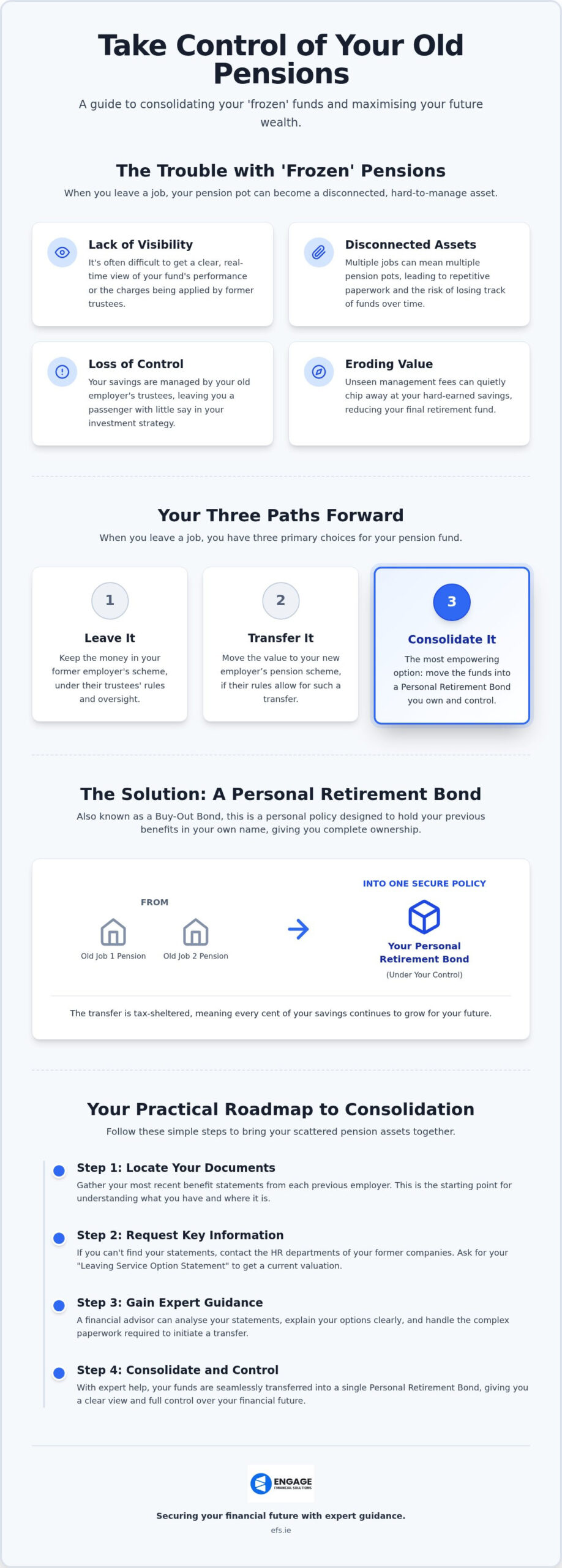
You generally face three paths when dealing with these old assets. You can leave the fund where it is, which is the default option. This keeps the money under the old scheme’s rules and trustee oversight. Alternatively, you might transfer the value to your new employer’s scheme, provided their rules allow for it. However, the third option is often the most empowering: moving the value into a personal bond. This grants you total independence, allowing you to consolidate multiple old pensions into one streamlined account that reflects your current risk profile and retirement goals.
Understanding the Mechanics of a Personal Retirement Bond
Setting up a personal retirement bond is essentially about moving your pension assets from a collective pot into a private one. You might hear this referred to as a “Buy-Out Bond.” The name is quite literal; you’re buying out your interest in your former employer’s group scheme and establishing a policy that belongs solely to you. This transition is a direct transfer of value. The funds move from the old scheme to your new bond without ever passing through your bank account. Because of this, it remains a tax-sheltered environment. You don’t pay any tax on the transfer itself, ensuring every cent of your hard-earned savings continues to grow for your future.
Taking out a retirement bond Ireland allows you to step away from the rigid structures of a previous company. It’s a straightforward way to keep your retirement planning moving forward, even when you’ve changed direction in your career. The money is usually invested in unit-linked funds. These are essentially pools of assets where your money buys “units,” and the value of your bond fluctuates based on the performance of those underlying investments. It’s a modern, efficient way to manage wealth that prioritises your personal goals over the generic needs of a large workforce.
The Role of the Trustee Explained
In a group pension, a trustee is the person or entity legally responsible for the scheme’s governance. They’re the guardians of the fund, ensuring it’s managed according to the rules. To move your money into a personal bond, you need the trustee’s formal permission. Whilst this might sound like a bureaucratic hurdle, they rarely refuse as long as the transfer is to a regulated product. Dealing with trustees and their specific requirements can be tedious. A personalised advisory service can act as a steady guide, managing all the communication with these trustees on your behalf to ensure a seamless transition.
Investment Flexibility and Choice
Group schemes often use a “one-size-fits-all” investment strategy designed for the average employee. By moving to a personal bond, you gain access to a much wider range of funds tailored to your personal risk appetite. Whether you’re ten years from retirement or thirty, you can choose funds that match your specific timeline. You’re no longer tied to the decisions of a former employer’s board. Instead, you have the freedom to change your investment strategy as your life circumstances evolve. This level of agility is vital for long-term financial health, allowing you to be proactive rather than passive.
The Strategic Advantages of Moving to a Buy-Out Bond
Selecting a retirement bond Ireland represents a strategic shift in how you view your legacy. For years, your pension was likely part of a collective group where decisions were made by a board of trustees you might never have met. By moving to a Buy-Out Bond, you step into the role of the primary decision-maker. The policy is held in your name, which means you have a direct relationship with the pension provider. This ownership eliminates the need to contact a former HR department just to check your balance or update your home address. You’re no longer a member of an old scheme; you’re the owner of your own financial vehicle.
Transparency is a significant benefit that often gets overlooked. Instead of receiving sporadic, confusing updates from multiple sources, you get one clear, easy-to-understand statement. This bird’s-eye view makes it much simpler to see how your assets are performing against your long-term goals. There’s also a strong financial case for consolidation. Many older, legacy schemes carry high annual management charges that quietly eat into your pots. Transitioning to a modern bond often allows you to reduce these costs, ensuring more of your money remains invested for your future.
Accessibility is another key advantage. In many cases, you can access your funds from as early as age 50, provided you’re no longer employed by the company that established the original pension. This flexibility is vital if you’re planning an early retirement or need to bridge a financial gap before your state pension begins. It gives you options that a “frozen” scheme simply cannot match, providing a layer of security whilst you plan your next move.
Reclaiming Control of Your Portfolio
Safeguarding your family’s future becomes much more straightforward when you have direct control. You can change your beneficiaries with a simple request, ensuring your legacy is protected exactly as you wish. This personal bond isn’t just a standalone product; it’s a flexible tool that fits into your broader, holistic financial plan. It allows you to align your old pension assets with your current savings and investment strategies, creating a unified path toward stability. Having a direct relationship with your provider leads to better financial outcomes because you’re more engaged with the performance and direction of your wealth.
Streamlining Your Financial Life
There’s a profound psychological relief in decluttering your financial life. Managing several small, disconnected pensions is a source of low-level stress that many professionals simply live with. By gathering these scattered pots, you remove the administrative burden for yourself and, eventually, for your heirs. It’s about creating a seamless experience where everything is organised and accessible. This efficiency means less time spent on paperwork and more time focusing on your future aspirations.
A Practical Roadmap to Consolidating Your Pension Assets
Organising your financial future shouldn’t feel like a part-time job. Whilst the thought of untangling years of pension paperwork might seem daunting, the actual process of setting up a retirement bond Ireland is remarkably structured. It begins with a simple audit of your past employment. You’ll need to gather your old pension scheme numbers and the contact details for the HR departments or trustees of your former employers. If you’ve lost these details, they can usually be retrieved with a bit of detective work and your PPS number.
Once you have your bearings, the next move is to request a “Leaving Service Option Statement” from each previous scheme. This document is essential because it outlines the current value of your fund and the specific choices available to you. With these statements in hand, you should consult with a professional to compare the benefits of your old schemes against a new bond. There’s no one-size-fits-all answer; it’s about finding the path that offers the best growth potential and lowest friction. Finally, you’ll sign a Letter of Authority. This simple document allows your advisor to manage the communication and paperwork with the old providers, taking the administrative weight off your shoulders.
Finding “Lost” Pensions from Your Past
It’s surprisingly easy to lose track of a pension pot if a previous company has closed or been acquired. If you find yourself in this position, you can utilise the central register of occupational pension schemes to track down the current administrators. You should never assume a small pot isn’t worth moving. Even a modest sum, when consolidated into a single retirement bond Ireland and managed correctly, can grow significantly over a decade or two. Every cent counts for your long-term security.
Evaluating the Move: What to Look For
Before you commit to a transfer, you need to look under the bonnet of your current schemes. Compare the annual management charges (AMCs) of your old structures with the proposed new bond. Even a 0.5% difference in fees can result in thousands of euros’ difference in your final pot value. You should also check for “guaranteed annuity rates” in older schemes. These are rare but can offer a much higher retirement income than modern rates, so they’re often worth keeping. Ensure your new bond offers the specific investment sectors you favour, giving you the flexibility to grow your wealth on your own terms.
If you’re ready to start the consolidation process and want a steady guide to handle the details, you can request a personalised consultation with our team today.
Securing Your Financial Future with Expert Guidance
Expert guidance acts as a necessary buffer between you and the often impenetrable language of large financial institutions. Managing the requirements of former trustees and complex transfer protocols requires a steady hand and meticulous attention to detail. By partnering with a dedicated consultant, you ensure that the technical heavy lifting is handled professionally, allowing you to focus on your daily life. This partnership is built on a “future-back” strategy. We don’t just look at what you have today. Instead, we start with your vision for retirement and work backward to identify the present actions needed to make that vision a reality.
A seamless transition of your assets today prevents a frantic and potentially stressful search for funds in twenty years. It is common for professionals to lose track of where smaller pots are held as they move between various roles over a long career. Consolidating these scattered assets into a retirement bond Ireland provides immediate clarity and control. It effectively transforms a fragmented list of old products into a cohesive financial engine. This is not a “set and forget” process. Regular, methodical reviews are vital to ensure your bond continues to perform as expected and remains aligned with your evolving risk profile.
Tailored Advice for Your Unique Journey
Every career path is different. You may have spent a decade in one sector before pivoting to a completely different industry; your financial plan should reflect that unique story. Expert advisory services prioritise your peace of mind by moving beyond generic products to find solutions that fit your specific journey. This holistic approach means looking at how your pension bond integrates with your total wealth strategy, including your mortgage and insurance cover. Working with a team that understands these connections provides a level of stability that a standalone product simply cannot offer.
Taking the First Step Toward Clarity
The benefits of starting the consolidation process today are both financial and emotional. You gain the potential for lower management fees, better investment choices, and the profound relief of knowing exactly where your money is. You don’t need to wait until you are nearing retirement to find your old pensions. Starting the search whilst you are still working is much more efficient and allows your unified fund more time to grow. If you are ready to bring your “frozen” pots together under one clear view, you can book a preliminary consultation to review your options.
Take Ownership of Your Financial Legacy Today
Reclaiming your “frozen” pension assets is one of the most effective ways to secure your long-term stability. By moving your old funds into a retirement bond Ireland, you trade the complexity of multiple providers for a single, transparent view of your wealth. This transition isn’t just about organisation; it’s about ensuring your money is invested in a way that aligns with your current risk profile and retirement timeline. You’ve worked hard for these savings, and they should be working just as hard for you whilst you focus on your current career goals.
Working with a steady guide ensures the entire process is seamless and stress-free. You don’t have to navigate the requirements of former trustees or technical paperwork alone. Our team provides regulated, jargon-free advice to help you consolidate your pots efficiently. Taking this step now prevents a difficult search for lost assets when you’re ready to stop working in the future. Start your journey toward a clearer financial future today by taking ownership of your legacy. Speak with a specialist at Engage Financial Solutions to organise your old pensions today.
Frequently Asked Questions
Can I cash in my retirement bond before I reach age 65?
Yes, you can typically access your funds from the age of 50. This early access is usually available provided you are no longer employed by the company that established the original pension scheme. It offers significant flexibility for those planning an earlier transition from the workforce. However, it’s important to check the specific rules of your original scheme, as some older structures might have different age requirements for drawing benefits.
What happens to my bond if I pass away before I retire?
The full value of your fund is generally paid to your estate if you pass away before retiring. This is typically paid as a tax-free lump sum to your legal personal representatives. Having the policy in your own name provides clear security for your family, as the assets are clearly identified as part of your personal legacy. It removes the ambiguity that can sometimes exist within large, collective employer schemes.
Will I lose money if I move my pension from my old employer?
You won’t lose money through taxation during the transfer, as it remains a tax-sheltered process. The move is a direct transfer of value from the old scheme to your new bond. Whilst some older schemes might have exit penalties, moving to a retirement bond Ireland often allows you to access lower annual management fees. Over the long term, reducing these quiet costs can actually increase the total value of your savings.
How much does it cost to set up a personal retirement bond?
There is usually no out-of-pocket cost to establish a bond. Instead, the provider typically applies an Annual Management Charge, which is a small percentage taken from the fund value each year. You should also look at the “allocation rate,” which tells you how much of your transferred money is actually invested. A 100% allocation rate means every cent of your old pension goes directly into your new investment funds.
Can I contribute more money to a retirement bond once it is set up?
You cannot make additional personal contributions to a bond once it has been established. This specific structure is designed only to hold the transfer value from a previous employer’s scheme. If you wish to continue saving for your future with new monthly contributions, you would typically look at a Personal Retirement Savings Account or join your current employer’s occupational pension scheme to benefit from any available tax relief.
What is the difference between this bond and a PRSA?
The primary difference is that a bond is for one-off transfers, whilst a PRSA allows for ongoing contributions. Retirement bonds are specifically tailored to hold “frozen” assets from old jobs. They often allow you to retain certain benefits from your old scheme, such as specific rules regarding how much tax-free cash you can take at retirement. This makes them a highly specialised tool for professionals with multiple old pension pots.
Do I need my former employer’s permission to move my pension pot?
You require formal approval from the scheme trustees rather than the employer itself. Trustees are the legal guardians of the pension fund and have a duty to ensure transfers are made to regulated, secure products. They rarely refuse a transfer request to a personal bond. An advisor can handle this entire communication process for you, acting as a buffer to ensure the transition is handled with minimal friction on your part.
How long does the transfer process typically take to complete?
The entire transfer process usually takes between six and twelve weeks to reach completion. This timeline is largely determined by how quickly your former scheme administrators provide the necessary statements. Once the paperwork is signed, the funds are moved directly between providers. Using a retirement bond Ireland simplifies this move, and a proactive advisor will monitor the progress closely to ensure your assets are transitioned as efficiently as possible.
Disclaimer
Engage Financial Services LTD T/A Engage Financial Solutions is regulated by the Central Bank of Ireland CRO 764570. Director David Moore. Suite 2 First Floor, 14 -18 Main street, Blackrock, Co Dublin A94 W0Y3