


What if the insurance policy your bank is pushing only protects their balance sheet, leaving your family’s future entirely out of the equation? It’s a common concern for homeowners who feel pressured into specific products during the stress of a property purchase. You’ve likely felt the weight of confusing jargon and the fear of wasting money on unnecessary cover, but understanding the nuances of mortgage protection vs life insurance in the domestic market is the first step toward true peace of mind.
We believe that securing your home should be a straightforward, transparent process. This guide will help you see through the lender’s requirements to find the most cost-effective security for your family—a process as vital as ensuring the physical safety of your property with a professional locksmith like londonlocks.com. Whether you’re a first-time buyer or looking to switch to a better rate, you’ll gain clarity on your legal obligations and learn how to organise a policy that safeguards the people you love, rather than just the debt you owe. We’ll show you how to move forward with confidence, ensuring your protection is tailored to your life, not just your mortgage.
Key Takeaways
- Understand why mortgage protection is designed to clear debt for the lender, whilst life insurance provides a flexible, fixed lump sum for your family’s future.
- Discover how to navigate the choice of mortgage protection vs life insurance in the local market to ensure you aren’t paying for more cover than you actually need.
- Learn the difference between “decreasing term” and “level term” policies so you can choose the right structure for your long-term financial stability.
- Explore how you can potentially use a single life insurance policy to satisfy your bank’s requirements while still providing a meaningful legacy for your loved ones.
- Find out why shopping around with a professional advisor can help you secure lower monthly premiums compared to the standard offers from your mortgage lender.
Understanding the Core Differences Between Mortgage Protection and Life Insurance
You’ve finally found the perfect home, but now you’re faced with a mountain of paperwork and a bank manager asking about your insurance. It’s easy to feel overwhelmed by the technicalities. At its core, Mortgage life insurance is a policy specifically designed to pay off your home loan if you pass away. It does one job very well. Life insurance, on the other hand, provides a broader safety net for your family to use as they see fit. Understanding the nuances of mortgage protection vs life insurance is the first step in ensuring you don’t just protect the bank’s interests, but your family’s future too.
One concept you’ll frequently encounter is “assigning” a policy. This simply means you’re legally linking the insurance to your mortgage. If a claim is made, the funds are directed to the lender first to settle the balance. Whilst both types of cover trigger a payout upon death, their targets are fundamentally different. One looks at the debt; the other looks at the people left behind. This distinction is the reason why many homeowners choose to hold both types of cover simultaneously.
The Legal Requirement for Homeowners
Most local lenders won’t release your mortgage funds until they see proof of protection. It’s a safety measure for them, but it’s also a safeguard for you to ensure your home isn’t at risk if your circumstances change. You aren’t legally obliged to take the specific policy your bank offers. In fact, exploring your options through a specialist like Engage Financial Solutions can often lead to better terms and lower monthly costs. Exceptions do exist, particularly for those over a certain age or those who cannot obtain cover due to serious health issues, where a lender might agree to proceed without it.
Who Receives the Payout?
The most practical difference is the destination of the funds. Mortgage protection is a direct line to the lender; it clears the mortgage and nothing more. This leaves your family with a debt-free home, which is a massive relief, but it doesn’t help with the weekly grocery shop or utility bills. Life insurance pays a fixed lump sum directly to your beneficiaries. This gives them the power to decide how to use the money, whether that’s clearing other debts, covering education costs, or maintaining their current lifestyle. Choosing the right path depends on whether you’re focused on the property or the people inside it.
How Mortgage Protection Works to Safeguard Your Home Loan
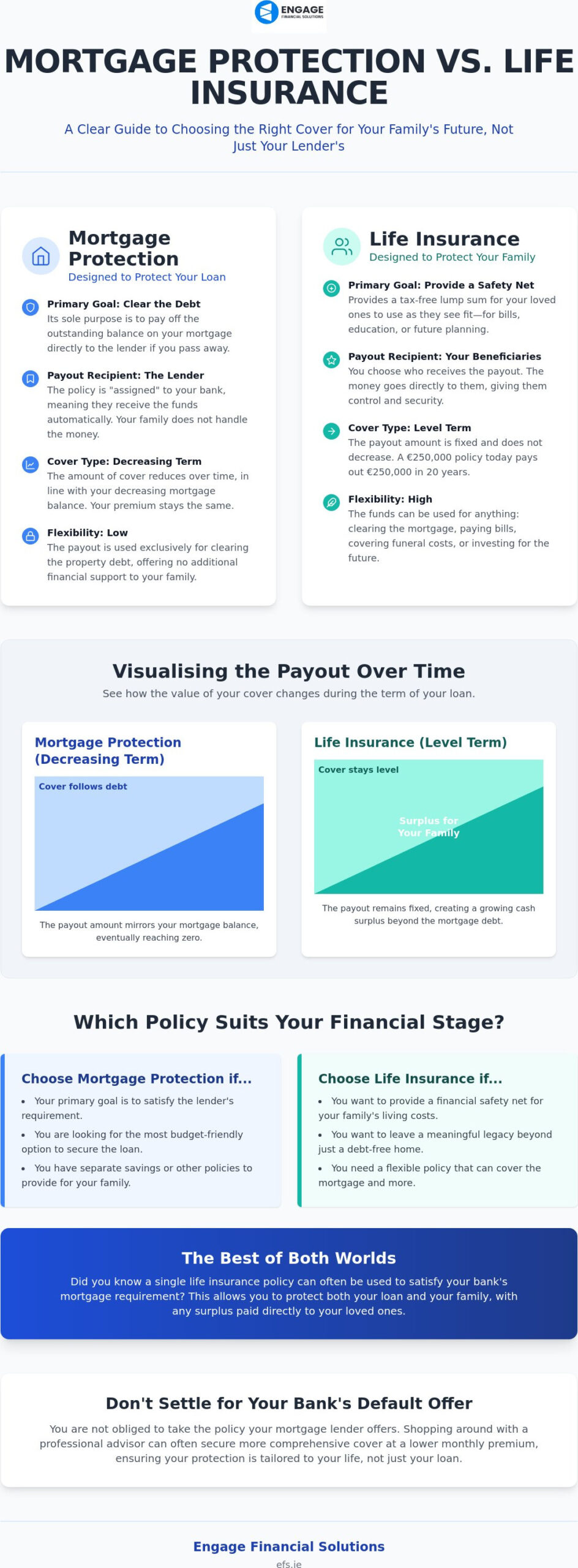
Mortgage protection is often described as the “no-frills” option for homeowners. It’s a practical tool designed with a single purpose: to clear your mortgage balance if you pass away during the term of the loan. When comparing mortgage protection vs life insurance, the most striking feature of the former is its “decreasing” nature. This means the potential payout shrinks over time, perfectly mirroring the way your mortgage debt reduces as you make your monthly repayments.
You might wonder why your monthly premium remains the same even though the insurer’s potential liability is dropping every year. The reason is simple. Actuaries calculate the total risk over the entire length of the policy and then spread that cost evenly. This creates a predictable, steady expense for your household budget, ensuring there are no surprises as the years go by. It’s a reliable way to satisfy your lender’s requirements while keeping your monthly outgoings manageable.
The policy effectively shadows your debt. If you owe €250,000 today, the cover is €250,000. Twenty years from now, if your balance has dropped to €60,000, the cover will have reduced to match. This ensures that the bank gets exactly what they’re owed, no more and no less, leaving the property to your estate free of debt.
The Mechanics of Decreasing Term Cover
Decreasing term cover is a policy where the sum assured reduces in line with a standard repayment mortgage. This structure is perfectly suited for those on a standard repayment plan, as the payout is designed to match the outstanding debt at any given time. Keep in mind that this “shadowing” effect assumes you are following your repayment schedule. If you decide to take an interest-only period or happen to miss payments, your mortgage balance might stay higher than the insurance cover. This could leave a small shortfall that your estate would need to settle. However, if you decide to switch your mortgage to a different lender for a better rate, your existing policy can usually be reassigned, keeping the process seamless.
Why Cost-Effectiveness is the Primary Draw
The primary reason many people choose this cover is its sheer affordability. Because the insurer knows their financial risk reduces every single year, they can offer much lower premiums than they would for a fixed-sum policy. To keep your costs at their absolute lowest, it’s wise to organise your policy through an independent broker who can scan the entire market for the best rates. Understanding the nuances of mortgage protection vs life insurance in the local market allows you to pick the most efficient tool for the job.
As specified in the local law on mortgage protection, you aren’t tied to the bank’s own insurance products. Shopping around is the best way to ensure you aren’t overpaying for a basic requirement. For a deeper look at how to secure your home efficiently, our Mortgage Protection Guide provides all the details you need to get started. If you’re ready to see how these savings add up, you can request a tailored quote today to compare the best available options.
Why Life Insurance Offers Broader Security Beyond Your Property Debt
While mortgage protection is a gift for your lender, life insurance is a gift for your family. It’s often referred to as “level term” insurance because the amount you’re covered for stays the same from the day you sign up until the policy ends. This fixed payout provides a much broader safety net than a policy that simply shrinks alongside your debt. When comparing mortgage life and term life insurance, the primary advantage of the latter is that it addresses your family’s actual cost of living. It’s a stable pillar for those you leave behind.
Think of it through a “future-back” lens. Instead of just looking at what you owe the bank today, you’re looking at what your family will need to maintain their lifestyle ten or twenty years from now. This perspective ensures that your protection is goal-driven. You’re safeguarding their ability to stay in their home, keep the car on the road, and maintain their standard of living without financial friction. It’s about security for people, not just for property.
Level Term vs Decreasing Term: A Clear Choice
The contrast between these two options is stark. A decreasing policy is a race to zero, where the value of your protection drops every month. In contrast, level term life insurance remains constant. If you have a €300,000 policy and pass away in the final year of the term, your beneficiaries still receive the full €300,000. This is why it’s the preferred choice for those with young children or dependents. Many of these policies also include a “convertible” option. This allows you to extend your cover at the end of the term without undergoing a new medical exam, which is a vital safeguard as you get older and your health profile changes.
Managing Family Aspirations
The flexibility of a lump-sum payout means your loved ones can prioritise their most urgent needs. It isn’t just about the roof over their heads; it’s about the life they live beneath it. A life insurance payout can fund several critical areas:
- University fees and long-term education costs for your children.
- Ongoing childcare or private tuition.
- Daily essentials like groceries, clothing, and transport.
To ensure the value of this payout doesn’t get eaten away by rising costs, many people opt for “inflation protection” or indexation. This allows your cover to grow slightly each year, keeping pace with the real world. For a more detailed look at how to structure this effectively, our Life Insurance Guide offers comprehensive insights into protecting your family’s future. Choosing the right balance between mortgage protection vs life insurance ensures that your legacy is one of stability and opportunity.
Comparing the Two: Which Policy Suits Your Current Financial Stage?
A question we often hear from homeowners is whether they can simply use one policy to cover both the mortgage and their family’s needs. The short answer is yes. You can assign a level term life insurance policy to your lender to satisfy their requirements. In this scenario, if a claim is made, the bank receives the outstanding balance of the loan first. Any remaining surplus is then paid directly to your beneficiaries. This “two-in-one” approach is a sophisticated way to manage mortgage protection vs life insurance within the local market, ensuring your family isn’t left with just a house, but also the capital to maintain it.
Relying on “just enough” cover to satisfy a bank’s minimum requirements can be a risky strategy. While it clears the debt, it ignores the sudden loss of income that your household relies on. By opting for a policy that exceeds the mortgage balance, you create a buffer. This extra layer of security provides the emotional and financial space your loved ones will need to navigate a difficult transition without the added stress of immediate bills.
Scenario Analysis: First-Time Buyers vs Established Families
Your stage in life dictates your priority. If you’re a young single professional buying your first apartment, a basic mortgage protection policy is often the most sensible, cost-effective choice. It satisfies the legal hurdle and keeps your monthly outgoings low. However, growing families usually find that a “dual-life” level term policy offers much better value. This ensures that a payout occurs on the death of either partner, providing the surviving parent with the stability they need. If you’re currently switching your mortgage to take advantage of better interest rates, it’s the perfect time to review whether your existing cover still reflects your family’s current aspirations.
The Overlap Trap: Avoiding Double Premiums
It’s surprisingly common for homeowners to pay for two separate policies that effectively do the same thing. Before signing up for a new plan, audit your existing cover. You might find that an old life insurance policy, perhaps taken out years ago, can be reassigned to your new lender. Keeping an older policy is often significantly cheaper because premiums are based on your age at the time of application. You can also consider adding Critical Illness Insurance as an optional extra. This pays out a lump sum if you’re diagnosed with a specific condition, providing a vital financial cushion when you need it most. To ensure your protection is as efficient as possible, book a comprehensive policy review with our team today.
Navigating Your Insurance Choices with Professional Guidance
Choosing the right cover shouldn’t feel like a second job. When you’re caught between bank deadlines and complex policy documents, a professional consultant acts as the essential buffer between you and the technical jargon. We focus on providing a tailored approach that ensures you aren’t paying for “ghost” cover. These are the unnecessary add-ons or inflated sums that don’t actually serve your family’s specific needs. Our goal is to bring a sense of calm competence to your financial planning, making the transition to your new home or a new policy as seamless as possible.
By looking at your situation through a “future-back” lens, we help you identify exactly what’s required to satisfy your lender whilst maintaining your family’s standard of living. It’s about more than just ticking a box for the bank; it’s about creating a stable foundation for the years ahead. We take the friction out of the process, handling the heavy lifting so you can focus on the excitement of your property journey, which often includes furnishing your new space with high-quality pieces from Sheepbridge Sofas & Beds.
The Value of Independent Advice
Local banks are often tied to a single insurance provider. This significantly limits your choices and can frequently lead to higher monthly premiums for basic cover. In contrast, an independent broker conducts a full-market search to compare multiple insurers simultaneously. This stewardship is particularly valuable during the underwriting process, where we help you navigate medical disclosures and ensure your application is presented accurately. We understand that a bank’s primary interest is safeguarding their loan, but our priority is always the long-term security of your household. Having access to a wide panel of insurers ensures you get the most competitive rates available in the domestic market.
Next Steps for Your Financial Security
Starting the process is straightforward and proactive. Before you seek a quote, gather your current mortgage balance, the remaining term of your loan, and any existing policy documents you hold. If you’ve already got cover in place, switching to a more cost-effective provider is often a simple matter of reassignment. You don’t need to wait for your mortgage anniversary to save money. We are regulated by the Central Bank, ensuring that the advice you receive is professional, transparent, and centred on your best interests. By taking action today, you can secure a more flexible and affordable safety net for your loved ones.
If you’re ready to explore the best options for mortgage protection vs life insurance in the local market, request a tailored consultation with our expert team today to begin your journey toward total peace of mind.
Building a Foundation of Long-Term Stability
Choosing the right cover is about more than just satisfying a lender’s checklist. It’s about ensuring your family can maintain their lifestyle even if the unexpected happens. You’ve seen that while mortgage protection clears the debt, life insurance provides a flexible safety net that grows with your family’s aspirations. Understanding the balance of mortgage protection vs life insurance within the local market allows you to organise your finances with total confidence.
We are here to act as your steady guide, offering full-market access to ensure you receive the most competitive premiums available. As a firm regulated by the Central Bank, we pride ourselves on providing seamless management of all your protection and mortgage needs. You don’t have to navigate these complex decisions alone. Secure your future with a tailored consultation from our expert team. Let’s work together to build a legacy of stability for the people who matter most.
Frequently Asked Questions
Is mortgage protection mandatory for every homeowner in this market?
Yes, taking out protection is a legal requirement for most homeowners under the age of 50 in the local market. Lenders generally won’t release mortgage funds until a policy is in place and assigned to them. There are specific exceptions for those who are over a certain age, those who are considered uninsurable for health reasons, or certain buy-to-let investors, but these are handled on a case-by-case basis.
Can I use an existing life insurance policy to satisfy my bank’s requirements?
Yes, you can use an existing policy provided the level of cover and the term match or exceed the requirements of your new mortgage. You will need to assign the policy to your lender, which gives them the first claim on the payout to clear the debt. This is often a cost-effective strategy if you took out the policy when you were younger and healthier, as the premiums may be lower than a new plan.
What happens to my mortgage protection if I decide to switch lenders?
Your mortgage protection policy is portable and stays with you even if you move your loan to a different bank. When you decide to switch for a better interest rate, you simply reassign the existing policy to your new lender. This makes the transition seamless and prevents the need for new medical underwriting, which is particularly beneficial if your health has changed since you first took out the cover.
Is life insurance significantly more expensive than standard mortgage protection?
Life insurance is generally more expensive because the payout remains level throughout the entire term, whereas mortgage protection decreases in line with your debt. When evaluating the choice of mortgage protection vs life insurance in the local market, it’s important to remember that the higher premium for life insurance buys you a fixed lump sum for your family, rather than just a clearing of the bank’s loan.
Can I have both mortgage protection and a separate life insurance policy?
Yes, many families choose to have both to ensure total financial security. You can have a decreasing policy that specifically clears the mortgage for the lender and a separate level term policy that provides a tax-free lump sum directly to your beneficiaries. This dual approach ensures the home is safe whilst also providing capital to cover daily living expenses, education costs, or other family debts.
What is the difference between “dual life” and “joint life” cover?
Joint life cover pays out once upon the death of the first partner and then the policy ends. Dual life cover is more comprehensive because it treats each person as having their own separate policy. This means it can potentially pay out twice; once for each partner. For families with children, dual life cover often provides better long-term value for a relatively small increase in the monthly premium.
Does mortgage protection pay out if I am diagnosed with a serious illness?
No, a standard mortgage protection policy only pays out upon death. If you want protection against illness, you must specifically choose to add Serious Illness Cover at the start of your policy. This add-on provides a tax-free lump sum if you are diagnosed with one of the specific conditions listed in your policy, giving you the financial breathing room to focus on your recovery without worrying about the mortgage.
How much life insurance cover is generally recommended for a family with children?
While every family is unique, a common professional benchmark is to aim for cover that is roughly ten times the main earner’s annual salary. This figure is designed to replace lost income for a significant period, ensuring that your children’s future education and your family’s daily costs are fully protected. We always recommend a tailored review to look at your specific debts, childcare needs, and long-term financial aspirations.
Disclaimer
Engage Financial Services LTD T/A Engage Financial Solutions is regulated by the Central Bank of Ireland CRO 764570. Director David Moore. Suite 2 First Floor, 14 -18 Main street, Blackrock, Co Dublin A94 W0Y3