


Did you know that the expiration of the IORP II exemption in April 2026 has fundamentally changed how you should approach your retirement savings? It’s natural to feel a sense of confusion regarding these updated regulations, especially when you’re focused on the day-to-day demands of running your business. You might worry about missing out on maximum tax relief or feel overwhelmed by the administrative requirements that come with long-term planning. Finding the best pension plan for self employed professionals shouldn’t be a source of stress; instead, it should be a source of stability.
Whether you’re a sole trader looking for flexibility or a company director aiming to maximise employer contributions, understanding your options is the first step toward peace of mind. You’ll discover the critical differences between the PRSA and the COMPANY PENSION to maximise your tax relief and long-term financial security. We’ll explore how to align your funding capacity with your need for portability, ensuring your transition to retirement is as seamless as possible. This guide clarifies how to lower your administrative burden whilst safeguarding your future through a tailored retirement strategy that feels both straightforward and secure.
Key Takeaways
- Understand the core distinctions between a PRSA and a COMPANY PENSION to ensure your retirement strategy remains flexible whilst providing long-term security.
- Learn how the recent IORP II governance changes have made the MASTER TRUST a more efficient and compliant option for modern business owners.
- Discover how to maximise your tax-free lump sum by choosing the retirement structure that best aligns with your specific salary and service history.
- Determine the best pension plan for self employed professionals by aligning your current career stage with your long-term financial aspirations.
- Gain clarity on the Standard Fund Threshold to protect your wealth and ensure your retirement planning remains seamless and effective.
Foundations of Retirement: Defining the PRSA and COMPANY PENSION
Choosing a retirement vehicle is one of the most significant financial decisions you’ll make as a business owner. To find the best pension plan for self employed individuals, you must first understand the two primary structures available in the local market. Both the PRSA and the COMPANY PENSION are designed to provide long-term security, yet they operate under different rules and governance standards. Crucially, both options carry the seal of Revenue approval. This ensures you can access significant tax relief on your contributions at your highest marginal rate, which is often as high as 40%.
The Core Characteristics of a PRSA
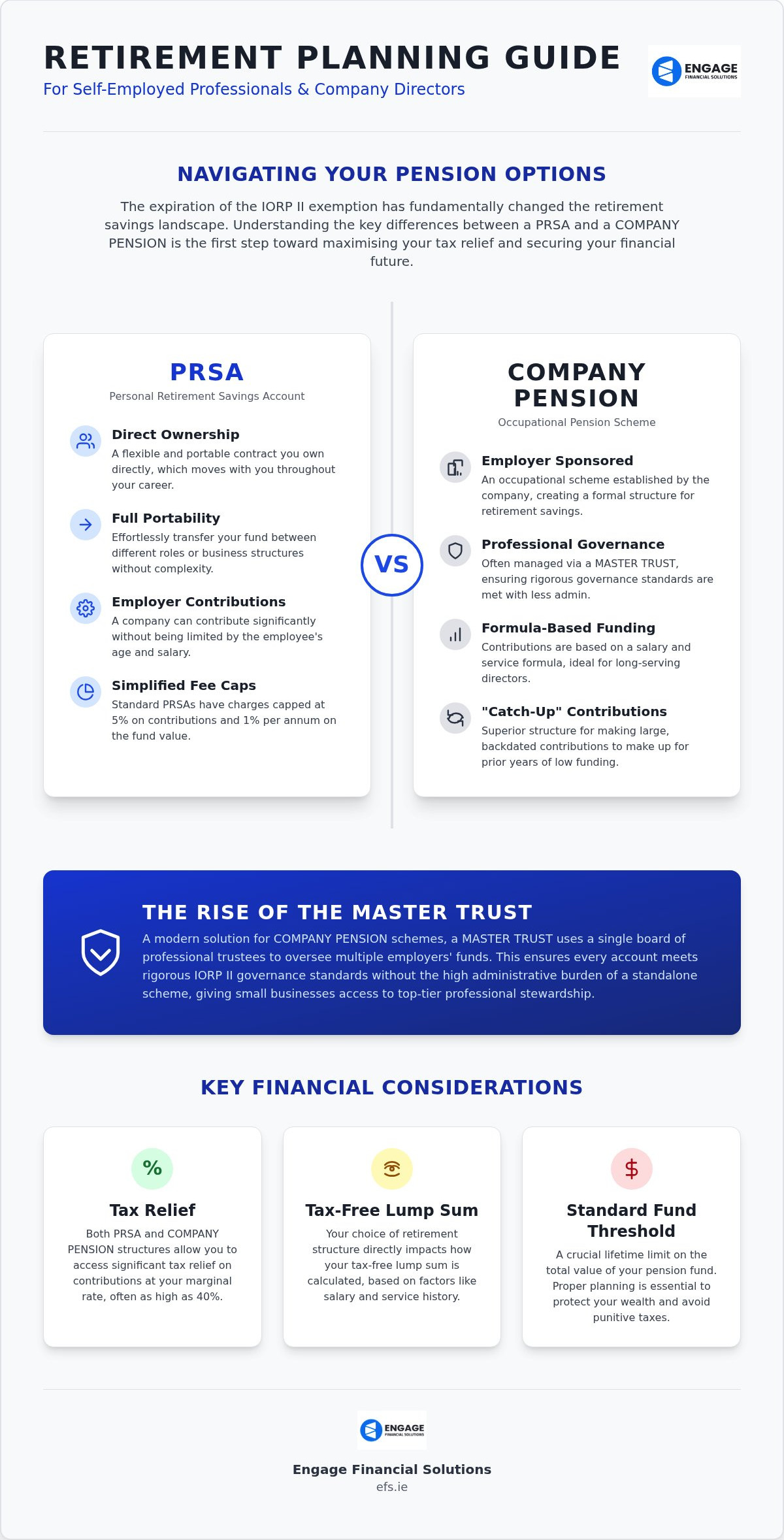
A Personal Retirement Savings Account (PRSA) is essentially a flexible, portable contract between you and a pension provider. Unlike other structures, you own the account directly. This means it stays with you regardless of whether you change your business structure or move between different roles. Within this category, you’ll encounter Standard and Non-Standard options. Standard versions are popular because they have strict fee caps; typically, charges are limited to 5% on contributions and 1% per annum on the fund value. This level of transparency makes it a strong contender for those seeking a straightforward, low-friction savings tool. Key benefits include:
- Full Portability: The account moves with you effortlessly throughout your career.
- Direct Control: You are the primary account holder with direct influence over your investment choices.
- Simplified Fees: Standard options provide a clear cost structure that protects your fund’s growth.
The Structure of a Modern COMPANY PENSION
While a PRSA is a personal contract, a COMPANY PENSION is an occupational scheme sponsored by an employer. For company directors, this often takes the form of an executive arrangement. In the current regulatory environment, most of these schemes are now managed via a MASTER TRUST. This structure uses a single board of professional trustees to oversee many different employers’ sub-funds, ensuring every account meets rigorous governance standards without the administrative headache of a standalone scheme. This setup establishes a clear relationship between three key parties:
- The Member: You, the individual building the retirement fund.
- The Employer: The business entity that sponsors the scheme and makes contributions.
- The Provider: The financial institution that manages the MASTER TRUST and investments.
This arrangement allows for higher employer contribution limits, which can be a decisive factor when searching for the best pension plan for self employed directors. By utilising a MASTER TRUST, small businesses can access the same level of professional stewardship and investment choice as large multinational corporations. This creates a stable foundation for your future wealth. You can explore how these options fit your career stage at efs.ie, where the focus remains on providing a seamless transition to financial freedom.
A Comparative Framework: PRSA versus COMPANY PENSION Features
Choosing the best pension plan for self employed professionals requires a clear look at how each structure handles your money. While both vehicles aim to grow your wealth, their rules on contributions and investment flexibility vary. The best pension plan for self employed directors often hinges on whether you prioritise administrative simplicity or the ability to inject large sums into your fund late in your career.
Employer Contribution Limits and Rules
Current Revenue rules have made the PRSA an incredibly attractive option for many business owners. In the past, employer contributions to a PRSA were limited by the employee’s age and salary. Now, a company can contribute significantly to a PRSA without these specific restrictions, provided the overall Standard Fund Threshold isn’t breached. This makes it a seamless choice for those who want to move company profits into a personal fund quickly and efficiently.
In contrast, a COMPANY PENSION operates on a salary and service formula. This structure is often superior for long-serving staff or directors who want to make large backdated contributions to “catch up” for years of low funding. If you’ve been running your business for a decade but only recently started funding your retirement, the COMPANY PENSION might allow for higher contribution levels than a standard personal arrangement. For more details on these distinctions, you can consult the CCPC guide to personal pensions.
Portability and Career Flexibility
A PRSA is frequently the favourite for those who value career agility. Because it’s a contract between you and the provider, it moves with you effortlessly if you switch from being a sole trader to a limited company director. There’s no need to transfer the fund; it simply stays active under your control. This lack of friction is a major benefit for anyone who doesn’t plan on staying in one business structure forever.
Transferring a COMPANY PENSION pot is slightly more involved. When you leave a firm, you can leave the fund where it is, transfer it to a new employer’s MASTER TRUST, or consolidate multiple old pots into a single RETIREMENT BOND. This consolidation helps you keep track of your total wealth in one place, reducing the risk of losing track of smaller funds from earlier in your career. If you’re feeling overwhelmed by multiple old pension pots, you can explore tailored consolidation options to simplify your path to financial security.
Finally, consider how you’ll access your money. Most modern schemes allow for benefit crystallisation from age 60, or even 50 in certain retirement scenarios. While a MASTER TRUST provides robust professional oversight and institutional investment choices, a PRSA offers the direct control that many independent professionals prefer. Choosing between them is about finding the balance that fits your life and your long-term aspirations.
Navigating Modern Governance and the Impact of IORP II
The regulatory landscape for retirement savings underwent a seismic shift on 21 April 2026. On this date, the long-standing exemption for one-member pension arrangements from the full weight of the IORP II directive finally expired. This change moved the goalposts for business owners, replacing a relatively light-touch regime with rigorous requirements for governance, risk management, and internal auditing. Whilst these changes might seem daunting, they’ve actually paved the way for a more secure and transparent environment. Finding the best pension plan for self employed professionals now involves choosing between two high-standard, compliant paths that prioritise your long-term security.
The Rise of the MASTER TRUST
For many years, smaller firms managed their own standalone occupational schemes. Under the new rules, the administrative burden of doing so has become impractical for most. This has led to a significant migration towards the MASTER TRUST. This structure allows you to join a large, professionally managed scheme alongside other businesses, benefiting from economies of scale and institutional expertise.
A board of professional trustees takes on the legal responsibility for compliance, safeguarding your assets and ensuring all reporting to the Pensions Authority is handled meticulously. This centralised governance removes the stress from company directors, who no longer need to act as trustees themselves. Members also benefit from institutional-grade investment strategies and modern digital portals that make tracking your fund’s progress straightforward. You can find more details on these structures in the Citizens Information guide to local pensions.
Simplified Compliance for the PRSA
If the governance requirements of an occupational scheme feel too heavy, the PRSA offers a compelling, clean alternative. Because it’s a direct contract between you and the life office, it bypasses the complex trustee reporting required by IORP II. This simplicity often translates to lower overheads for savers who don’t require the specific funding advantages of a COMPANY PENSION.
The PRSA is a flexible tool that has gained popularity because it remains unaffected by the regulatory hurdles that now face smaller occupational schemes. It’s a “what you see is what you get” arrangement. You own the contract, you control the contributions, and the life office manages the compliance. For those seeking the best pension plan for self employed status without the need for a MASTER TRUST structure, the PRSA provides a seamless and efficient route to stability. You can explore how these governance changes affect your specific situation with professional guidance that prioritises your peace of mind and financial health.
Tax Efficiency and Estate Planning: Securing Your Legacy
Legacy planning is about more than just numbers; it’s about providing a stable future for your loved ones. As you evaluate the best pension plan for self employed business owners, you must consider the Standard Fund Threshold (SFT). This is a lifetime limit, currently set at €2 million, on the total value of pension benefits you can draw. If your fund grows beyond this, the excess is subject to a heavy tax charge. Managing this limit requires careful stewardship to ensure your hard-earned wealth remains protected for the next generation.
Maximising Your Tax-Free Lump Sum
Accessing your tax-free lump sum is a major milestone. In a PRSA, the process is straightforward: you can take 25% of your total fund value. The first €200,000 is entirely tax-free, and any portion between €200,001 and €500,000 is taxed at the standard rate of 20%. This fund-based approach is often the best pension plan for self employed individuals who have built a large pot over a shorter period.
A COMPANY PENSION, however, provides a second option that can sometimes be more beneficial. Instead of the 25% rule, you can choose a lump sum based on your final salary and total years of service. For those with 20 or more years of service, this can reach up to 1.5 times your final salary. This “salary and service” model is particularly powerful for company directors who have long tenures but might have focused on business growth rather than massive pension contributions. It allows you to extract a significant tax-free sum even if your total fund is relatively modest.
Death Benefits and Estate Protection
The treatment of your pension upon your death before retirement differs significantly between these two structures. A PRSA is generally treated with the most flexibility; the entire fund is typically paid into your estate. This provides your beneficiaries with a direct, uncapped asset. In contrast, an occupational scheme or COMPANY PENSION often includes a “death in service” cap. This usually limits the lump sum to four times your final salary, plus a refund of your contributions. Any remaining balance must be used to provide an income for your spouse or dependants.
Upon retirement, the transition to an APPROVED RETIREMENT FUND (ARF) allows you to maintain control over your investments whilst drawing a flexible income. This path ensures that your wealth isn’t just a static pot but a living fund that supports your lifestyle and your legacy. To ensure your estate is fully protected and your tax relief is maximised, you can schedule a comprehensive financial review to tailor these options to your specific needs.
Strategic Selection: Choosing the Best Path for Your Career Stage
Your journey toward a secure retirement isn’t a straight line. The best pension plan for self employed professionals depends heavily on where you currently stand in your career and what you hope to achieve. Whilst a PRSA might be the perfect fit for a young entrepreneur seeking flexibility, a COMPANY PENSION often provides the heavy-lifting required for a director looking to fund a substantial gap later in life. Avoiding a one-size-fits-all approach is the only way to ensure your strategy aligns with your personal aspirations and business cash flow.
When making your selection, consider this brief checklist based on your current environment:
- Employees in Large Organisations: Typically benefit most from a COMPANY PENSION or MASTER TRUST, especially where employer matching is available.
- Small Business Owners: Often find the PRSA more accessible due to lower administrative overheads and greater portability.
- Company Directors: May require a tailored mix of both, using the COMPANY PENSION for high-level funding and the PRSA for personal flexibility.
Strategies for Directors and the Self-Employed
For many company directors, the PRSA has become the centre of their retirement planning. Its straightforward nature and the removal of complex funding caps on employer contributions make it a seamless tool for moving company profits into personal wealth. It’s particularly effective if you value direct control and portability above all else. However, if you’re starting your retirement journey later in life, perhaps in your late 40s or 50s, a COMPANY PENSION managed via a MASTER TRUST might be more advantageous. This structure allows for significant catch-up contributions based on your previous years of service, helping you build a robust fund in a shorter timeframe.
Balancing these goals with your company’s cash flow requires a meticulous eye. You need a plan that is flexible enough to handle leaner years whilst being robust enough to capitalise on profitable ones. Whether you’re a sole trader or the head of a growing firm, the goal is the same: to create a stable future without creating current financial friction. This is where professional stewardship becomes invaluable.
Taking the Next Step Toward Financial Security
Professional advice is the buffer between you and the complexities of the financial world. It’s easy to overlook pitfalls in an existing pension, such as high management fees or outdated investment strategies that no longer match your risk profile. Organising a comprehensive review of your existing pension pots and RETIREMENT BONDS is a proactive step that can save you thousands over the long term. It ensures every Euro you contribute is working as hard as possible for your future self.
At Engage Financial Solutions, we act as your steady guide through these transitions. We specialise in providing the tailored, professional guidance needed to find the best pension plan for self employed individuals in the local market. Acting now prevents the stress of a rushed decision later and ensures a seamless transition to the retirement you’ve worked so hard to earn. You can organise your personalised retirement review today to begin securing your legacy with confidence.
Securing Your Financial Freedom
You now have the clarity needed to choose between a PRSA and a COMPANY PENSION based on your unique career stage. Whether you prioritise the portability of a personal contract or the high-level funding capacity of a MASTER TRUST, the path to long-term security is clearer than ever. Navigating the post-IORP II landscape doesn’t have to be a source of friction. It’s an opportunity to safeguard your legacy with modern, transparent structures. Finding the best pension plan for self employed professionals is about aligning your current business success with your future peace of mind.
Engage Financial Solutions is regulated by the Central Bank and specialises in seamless transitions for business owners. We provide expert advice tailored to your unique career stage, ensuring your retirement strategy is as unique as your professional journey. Secure your retirement future with expert guidance from Engage Financial Solutions. Taking action today ensures your transition to retirement is steady, optimistic, and entirely on your own terms.
Frequently Asked Questions
Is a PRSA better than a COMPANY PENSION for a small business owner?
Choosing between these two depends on your specific business structure and long-term goals. A PRSA is often the best pension plan for self employed sole traders because it’s portable and straightforward. However, if you’re a company director, a COMPANY PENSION might offer superior funding capacity through specific employer contributions. We recommend a tailored review to ensure your choice aligns with your long-term financial security and your business cash flow requirements.
Can I have both a PRSA and a COMPANY PENSION at the same time?
You can certainly hold both accounts simultaneously, but you must manage your tax relief limits very carefully. Contributions to a PRSA and a COMPANY PENSION are both subject to Revenue limits based on your age and total earnings. Maintaining both can offer great flexibility, but it requires diligent oversight to avoid exceeding the €115,000 earnings cap for personal tax relief. Professional guidance ensures your dual-structure approach remains compliant and efficient.
What happens to my COMPANY PENSION if I leave my current job?
When you transition to a new role, your accumulated fund remains yours to manage. You have three primary choices: you can leave the fund in the existing scheme, transfer it to your new employer’s MASTER TRUST, or consolidate it into a RETIREMENT BOND. Each path has different implications for your investment control and future benefits. This is a critical moment to seek professional advice to ensure your retirement savings continue to grow seamlessly.
How much can my employer contribute to my PRSA under current rules?
Recent legislative updates have significantly enhanced the PRSA for business owners. Under current rules, employer contributions are no longer restricted by the employee’s age or salary percentages. This allows your company to contribute substantial amounts into your fund, provided you don’t breach the €2 million Standard Fund Threshold. This change has made the PRSA a highly competitive option for those seeking the best pension plan for self employed directors.
Which pension option offers the highest tax-free lump sum at retirement?
The highest lump sum usually depends on your length of service and your final salary. A COMPANY PENSION allows you to choose between 25% of the fund or a calculation of up to 1.5 times your final salary if you have 20 years of service. A PRSA is strictly limited to 25% of the fund value. For long-serving directors, the salary-linked option often provides a more significant tax-free payment at the point of retirement.
What is a MASTER TRUST and how does it differ from a standard scheme?
A MASTER TRUST is a modern occupational pension structure where a single board of professional trustees oversees the schemes of multiple unrelated employers. Unlike a standard standalone scheme, the MASTER TRUST handles all the complex governance, auditing, and reporting required by IORP II regulations. This reduces the administrative burden on individual company directors whilst providing members with institutional-grade investment choices and high-quality digital tracking tools for their retirement funds.
Are the investment choices different between a PRSA and a COMPANY PENSION?
Investment options do vary between these two structures. A PRSA typically offers a range of funds managed by a specific life office, which is ideal for those seeking a straightforward, transparent approach. A COMPANY PENSION, particularly when managed through a MASTER TRUST, often provides access to a broader spectrum of institutional funds and diversified asset classes. Whether you prefer direct control or professional fund management, both vehicles offer robust ways to grow your wealth.
How does the IORP II regulation affect my choice of retirement fund?
The IORP II directive has introduced much stricter governance and auditing standards for occupational schemes. This regulation has made standalone one-member schemes more expensive and complex to maintain. As a result, many business owners are now choosing between the simplified compliance of a PRSA or the professional oversight of a MASTER TRUST. These changes have ultimately made the retirement market more secure and transparent for every individual saver as they plan for the future.
Disclaimer
Engage Financial Services LTD T/A Engage Financial Solutions is regulated by the Central Bank of Ireland CRO 764570. Director David Moore. Suite 2 First Floor, 14 -18 Main street, Blackrock, Co Dublin A94 W0Y3