


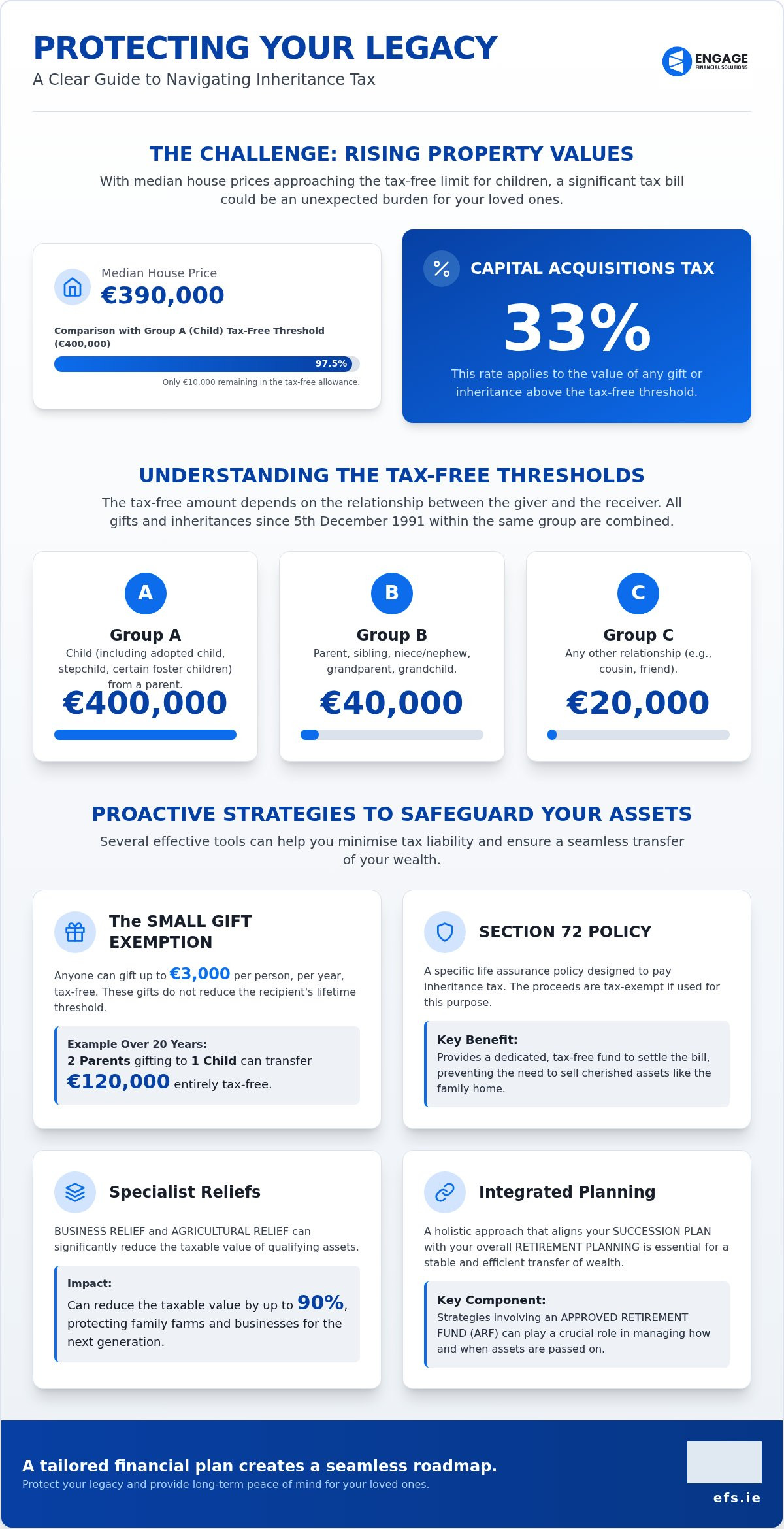
Did you know that with the median house price now reaching €390,000, a modest family home sits just a fraction away from the total tax-free limit for a child? When you realise that a small rise in property value could suddenly land your beneficiaries with a significant tax bill, it’s natural to feel concerned. We understand the anxiety surrounding the 33% CAPITAL ACQUISITIONS TAX rate, particularly the fear that cherished assets might be sold just to settle a debt. You’ve worked hard to build a legacy, and through proactive INHERITANCE PLANNING, you can ensure your assets remain protected for the next generation.
This guide provides a clear roadmap for your financial future, helping you navigate complex thresholds with confidence. By integrating your RETIREMENT PLANNING with smart estate strategies, you can ensure a seamless transfer of wealth. We’ll explore practical solutions like SECTION 72 POLICIES and the annual small gift exemption to safeguard your family home and minimise liabilities. You’ll discover how a tailored approach creates lasting stability, giving your loved ones the gift of financial certainty and the peace of mind that comes from being well-prepared for the years ahead.
Key Takeaways
- Identify the 2026 CAPITAL ACQUISITIONS TAX thresholds to understand how current property values could impact your children’s tax-free allowances.
- Maximise the €3,000 annual SMALL GIFT EXEMPTION to proactively reduce your estate’s value whilst supporting your family’s current needs.
- Discover how a SECTION 72 POLICY provides a tax-free payout specifically to settle inheritance tax, safeguarding your family home for future generations.
- Explore how integrating an APPROVED RETIREMENT FUND (ARF) into your broader RETIREMENT PLANNING ensures a more efficient and stable transfer of wealth.
- Learn how professional inheritance tax planning creates a seamless roadmap that protects your legacy and provides long-term peace of mind.
Understanding CAPITAL ACQUISITIONS TAX and Current Thresholds
In the local financial system, Capital Acquisitions Tax (CAT) is the primary tax charged when you receive a gift or an inheritance. Whether you’re receiving a property from a parent or a cash gift from a relative, the Revenue Commissioners apply a standard tax rate of 33% on any value that exceeds your specific tax-free threshold. This high rate can be daunting for families who haven’t prepared. Without proactive inheritance tax planning Ireland, your loved ones could face a “tax shock” that forces the sale of family assets or the family home just to meet the bill. Early intervention is the most effective way to protect your beneficiaries from this financial burden.
The Three Groups of Beneficiaries
Your tax-free allowance depends entirely on your relationship with the person providing the gift or inheritance. The 2026 thresholds categorise beneficiaries into three distinct groups. Group A is the most significant, with a lifetime limit of €400,000 for children inheriting from their parents. With median house prices now reaching €390,000, many families find that their primary residence alone almost exhausts this limit. Group B covers linear ancestors, descendants, siblings, nieces, and nephews, with a much lower threshold of €40,000. Finally, Group C applies to all other relationships, such as friends or distant relatives, providing a limit of just €20,000. Understanding where your beneficiaries sit allows you to build a tailored FINANCIAL PLANNING strategy that maximises these limits whilst preserving your legacy.
How Lifetime Gifts Impact Your Threshold
It’s a common misconception that thresholds reset with every new gift. In reality, the Revenue Commissioners use a cumulative system where every benefit counts. Any gift or inheritance received within the same group since 5th December 1991 is aggregated against your current threshold. This “look-back” rule means that receiving a substantial gift today directly reduces the tax-free limit available to you later in life. It’s a finite resource that requires careful management.
Meticulous record-keeping is essential for staying compliant and avoiding penalties. You must track every benefit received to ensure accurate reporting when filing a return. By starting your inheritance tax planning Ireland early, you can identify how to use specific reliefs to protect these thresholds. This proactive stewardship ensures a seamless transition of wealth. At Engage Financial Solutions, we act as a steady guide, helping you manage these complexities so your family can focus on what matters most.
Maximising Reliefs and the Annual SMALL GIFT EXEMPTION
While standard thresholds provide a base for your SUCCESSION PLAN, the most effective strategies often involve using specific exemptions to lower the final tax bill. One of the most powerful yet underutilised tools in inheritance tax planning Ireland is the Small Gift Exemption. This rule allows any individual to receive a gift of up to €3,000 from any other individual in a single calendar year without paying tax or affecting their lifetime threshold. It is a straightforward way to move wealth whilst you are still here to see the benefits, ensuring your support reaches your loved ones when they need it most.
The Power of the SMALL GIFT EXEMPTION
Consider a scenario where two parents decide to support their child’s future by gifting €3,000 each every year. Over two decades, this adds up to €120,000 transferred entirely tax-free. Because these annual gifts don’t count towards the €400,000 Group A limit, you effectively increase the total wealth passed down without triggering a 33% charge. This creates a seamless transition of assets that feels manageable rather than overwhelming. It’s a proactive act of stewardship that provides immediate help to your family whilst safeguarding their long-term security and financial health.
Qualifying for Specialist Tax Reliefs
For families with more complex assets, such as a farm or a local firm, specific reliefs can be transformative. BUSINESS RELIEF and AGRICULTURAL RELIEF are designed to protect these enterprises from being broken up to pay tax. When qualifying conditions are met, these reliefs can reduce the taxable value of the relevant assets by up to 90%. This means a farm worth €1 million might only be valued at €100,000 for tax purposes, keeping it well within the child’s tax-free threshold.
- AGRICULTURAL RELIEF: The recipient must meet the “active farmer” test or lease the land to someone who does for a minimum of six years.
- BUSINESS RELIEF: This requires the donor to have owned the business for a minimum period, typically five years for lifetime gifts or two years for inheritances.
These specific rules ensure that a family firm or farm remains a source of stability for the next generation rather than a financial burden. Navigating these requirements can be complex, but the rewards for your family’s future are substantial. Tailoring these reliefs to your unique circumstances ensures that your legacy remains intact. If you want to explore how these exemptions fit into your overall FINANCIAL PLANNING, we are here to provide the steady guidance you need to make the process straightforward and stress-free.
The Strategic Role of SECTION 72 POLICIES in Estate Planning
One of the most effective ways to manage a future tax liability is to ensure the funds are already in place when they are needed. A SECTION 72 POLICY is a specialised LIFE INSURANCE contract that has been specifically approved by the Revenue Commissioners for this purpose. The primary advantage of this policy is its unique tax status; the proceeds are completely exempt from tax when they are used to pay a CAPITAL ACQUISITIONS TAX bill. This creates a dedicated fund that protects your beneficiaries from having to find a large sum of cash at a difficult time. By using this strategy, you are effectively funding the tax for cents on the Euro, as the total premiums paid are typically much lower than the eventual tax liability.
This approach is a cornerstone of robust inheritance tax planning Ireland, as it ensures that the family home or other cherished assets remain within the family. Instead of your children being forced to sell a property to settle a 33% tax charge, the insurance payout covers the debt directly. It provides a level of security and certainty that few other financial products can match, acting as a buffer between your legacy and the complexities of the tax system. According to the Official guide to Capital Acquisitions Tax, the burden of paying the tax falls on the recipient, making this proactive step a vital act of stewardship for your loved ones.
How a SECTION 72 POLICY Functions
To qualify for the tax exemption, the policy must be a “Whole of Life” contract. This means the coverage stays in place for your entire life, rather than expiring after a set term. When the time comes, the proceeds are usually paid directly to the Revenue Commissioners to settle the outstanding CAT bill. It is important to work with a professional to ensure the level of cover is tailored to your expected liability. If the payout exceeds the actual tax bill, the surplus amount may be subject to tax, so regular reviews are essential to keep your plan efficient and straightforward.
Eligibility and Timing for Coverage
Timing is a critical factor when setting up this protection. Most providers require these policies to be established before you reach a certain age milestone, typically 75. Because these policies involve medical underwriting, it is often easier and more cost-effective to secure coverage whilst you are in good health. For married couples or civil partners, a “joint-life, second-death” structure is often the most logical choice. This ensures the payout occurs exactly when the inheritance is transferred to the next generation and the tax falls due. You can Learn about our LIFE INSURANCE options to support your legacy and ensure a seamless transition for your family.
Integrating SUCCESSION PLANNING with your RETIREMENT STRATEGY
Many people hesitate to begin their SUCCESSION PLANNING because they worry about their own future needs. It’s a common and valid concern: “I need my money for my own retirement first.” However, effective inheritance tax planning Ireland doesn’t require you to sacrifice your current lifestyle. By adopting a “future-back” perspective, you can design a strategy that ensures your own security whilst simultaneously building a tax-efficient legacy. Integrating your retirement assets into your estate plan allows for a seamless transition of wealth that feels both logical and protective.
Passing on an APPROVED RETIREMENT FUND (ARF)
An APPROVED RETIREMENT FUND (ARF) is one of the most flexible tools for both your retirement and your eventual legacy. If you pass away, your ARF can be transferred to your spouse or civil partner completely tax-free, allowing it to continue growing and providing for them. When it comes to children, the tax treatment is often more favourable than other assets. For children over the age of 21, an inherited ARF is subject to a flat tax rate of 30% rather than the standard 33% CAPITAL ACQUISITIONS TAX rate.
This 30% tax, combined with the fact that the child does not use up their Group A threshold for this specific asset, makes the ARF a highly efficient wealth transfer tool compared to simple cash savings. It allows you to provide a significant benefit to your family without the friction of complex thresholds or the fear of assets being sold to pay tax bills. You can explore these nuances further in our guide on Retirement Planning: The 2026 Guide to Financial Security.
Pension Contributions as a Wealth Transfer Tool
Maximising your retirement savings today is a form of stewardship for the next generation. Whether you are using a PERSONAL RETIREMENT SAVINGS ACCOUNT (PRSA) or COMPANY PENSIONS, the tax relief you receive on contributions effectively boosts the value of your future estate at the state’s expense. For company owners, this is particularly powerful, as it allows you to move profits into a private fund that sits outside the immediate reach of business liabilities.
A well-managed pension acts as a buffer, ensuring you have the stability you need whilst creating a straightforward roadmap for succession. By aligning your current contributions with your long-term legacy goals, you ensure that every decision serves a dual purpose. If you’re ready to see how these pieces fit together for your family, our team can help you create a tailored FINANCIAL PLANNING strategy that prioritises your peace of mind and your family’s future security.
How a Tailored FINANCIAL PLAN Ensures a Seamless Legacy
Creating a legacy involves more than just listing assets; it’s about ensuring your family’s future is handled with care and precision. A bespoke SUCCESSION PLAN acts as a bridge between your hard work and your family’s long-term security. By working with a professional, you create a buffer between your loved ones and the friction of tax compliance. This level of “calm competence” ensures that the transfer of wealth is not a source of stress, but a straightforward extension of your life-long FINANCIAL PLANNING. When you have a clear roadmap in place, you can move forward with the optimism that comes from knowing your affairs are in perfect order.
The Steps to a Robust Inheritance Strategy
Building a resilient plan is a methodical and logical process. First, we conduct a thorough Asset Valuation and Threshold Assessment. This step identifies exactly where your beneficiaries stand in relation to the 2026 limits and helps anticipate potential liabilities. Second, we identify every applicable relief. Whether it is the SMALL GIFT EXEMPTION discussed earlier or the DWELLING HOUSE EXEMPTION, which can protect a primary residence under specific conditions, we ensure no opportunity for tax efficiency is missed. Finally, we implement funding tools like SECTION 72 POLICIES. This ensures the cash is ready exactly when the Revenue Commissioners require it, preventing the forced sale of cherished family property.
Why a Professional Advisor is Essential
Attempting inheritance tax planning Ireland on your own carries significant risks. DIY planning often leads to unintended tax liabilities or missed deadlines, which can result in costly interest and penalties for your heirs. An expert advisor provides a “full-stack” service, coordinating with your legal professionals to ensure your will and your financial strategy are perfectly aligned. This holistic integration removes the guesswork and provides the stability you deserve. You can Explore our Financial Planning services to see how we tailor these solutions to your unique lifestyle and long-term aspirations.
The financial landscape is never static. Regulations evolve and thresholds can change, which is why we recommend reviewing your plan every three to five years. This proactive approach ensures your strategy remains flexible and effective, no matter how your personal circumstances or the wider market might shift. Achieving a seamless legacy is a journey of stewardship, and having a steady guide makes all the difference. For a personalised approach that prioritises your family’s peace of mind and financial health, you can Contact Engage Financial Solutions for a personalised consultation.
Securing Your Legacy for the Future
Protecting your family’s future is a proactive act of stewardship that requires a clear roadmap. By understanding the current thresholds and using tools like the SMALL GIFT EXEMPTION or SECTION 72 POLICIES, you can ensure a seamless transfer of wealth. Integrating your SUCCESSION PLANNING with your broader RETIREMENT PLANNING, such as managing an APPROVED RETIREMENT FUND (ARF), allows you to protect your lifestyle whilst safeguarding your legacy. Effective inheritance tax planning Ireland is about replacing anxiety with the peace of mind that comes from long-term security.
At Engage Financial Solutions, we provide the steady guidance you need to navigate these complex transitions with professional ease. As a firm regulated by the Central Bank, we specialise in personalised, jargon-free guidance that prioritises your unique goals. Whether you’re protecting the family home or managing a complex business estate, our expertise in SUCCESSION PLANNING ensures your assets are handled with meticulous care and attention to detail.
Secure your family’s future with a tailored FINANCIAL PLAN from Engage Financial Solutions. You’ve worked hard to build your legacy; let’s work together to ensure it remains protected for the years to come.
Frequently Asked Questions
What is the current threshold for a child inheriting from a parent?
The current lifetime tax-free threshold for a child inheriting from a parent, known as the Group A threshold, is €400,000. This limit applies to the total value of all gifts and inheritances received from both parents since 5th December 1991. If the value of the inheritance exceeds this amount, the child is liable for CAPITAL ACQUISITIONS TAX at the standard rate of 33% on the balance. Early planning ensures you maximise this allowance.
How does a SECTION 72 POLICY help with inheritance tax?
A SECTION 72 POLICY is a specific LIFE INSURANCE contract approved by the Revenue Commissioners. The proceeds from this policy are exempt from CAPITAL ACQUISITIONS TAX provided the money is used to pay an inheritance tax bill. It effectively allows you to fund a future tax liability for a fraction of the cost through regular premiums. This ensures that your beneficiaries don’t have to sell the family home or other assets to settle the debt.
Can I give my children money every year without paying tax?
Yes, you can utilise the SMALL GIFT EXEMPTION to transfer wealth whilst you are still alive. This rule allows you to gift up to €3,000 to any individual in a single calendar year without it affecting their lifetime tax-free threshold. If two parents gift the same child, that child can receive €6,000 annually tax-free. It’s a straightforward and effective tool for inheritance tax planning Ireland, helping to reduce the eventual value of your taxable estate.
Is the family home exempt from CAPITAL ACQUISITIONS TAX?
The family home may be exempt under the DWELLING HOUSE EXEMPTION, but strict criteria apply. To qualify, the beneficiary must have lived in the property for at least three years before the inheritance and must not own or have an interest in any other residential property. They must also continue to live in the house for six years after receiving it. Because these rules are complex, professional guidance is essential to ensure your SUCCESSION PLANNING remains robust.
What happens if I inherit an APPROVED RETIREMENT FUND (ARF)?
The tax treatment of an inherited APPROVED RETIREMENT FUND (ARF) depends on your relationship with the deceased. If you are a spouse or civil partner, the transfer is typically tax-free. For children over the age of 21, the fund is subject to a flat tax rate of 30% rather than CAPITAL ACQUISITIONS TAX. This makes an ARF a highly efficient tool for wealth transfer, as the inheritance does not exhaust the child’s Group A lifetime threshold.
Do I need to pay tax on a gift if it is below the threshold?
You don’t need to pay tax if the gift is below your relevant threshold. However, you must still file a tax return with the Revenue Commissioners if the total value of gifts and inheritances received within a specific group exceeds 80% of that group’s threshold. Keeping meticulous records of all benefits received since 1991 is vital. This proactive approach ensures your inheritance tax planning Ireland stays transparent and helps avoid any unexpected penalties or interest later.
What is the difference between a gift and an inheritance for tax purposes?
For the purposes of CAPITAL ACQUISITIONS TAX, a gift is a benefit you receive whilst the donor is still alive, whereas an inheritance is received after they pass away. Both are subject to the same 33% tax rate and thresholds. The primary difference lies in the valuation date and the filing deadlines for the tax return. Strategic SUCCESSION PLANNING often involves a mix of both to maximise exemptions like the SMALL GIFT EXEMPTION.
How can BUSINESS RELIEF reduce my tax liability?
BUSINESS RELIEF is a powerful tool that can reduce the taxable value of qualifying business assets by up to 90%. This relief is designed to ensure that a family firm can be passed to the next generation without being broken up to pay a tax bill. To qualify, the business must be a trading entity, and the donor must have owned it for a minimum period. It provides stability and ensures a seamless transition.
Disclaimer
Engage Financial Services LTD T/A Engage Financial Solutions is regulated by the Central Bank of Ireland CRO 764570. Director David Moore. Suite 2 First Floor, 14 -18 Main street, Blackrock, Co Dublin A94 W0Y3