


What if the generic advice to simply buy “ten times your salary” is actually leaving your family’s future to chance? It’s a common concern for parents trying to determine how much LIFE INSURANCE do I need to protect their home and lifestyle. We know that you want to ensure your dependants are never burdened by debt, yet the difference between MORTGAGE PROTECTION and LIFE INSURANCE can often feel confusing and opaque.
You deserve a clear, personalised figure that offers genuine peace of mind without the stress of overpaying for unnecessary premiums. In this guide, we’ll show you how to calculate the precise level of LIFE INSURANCE required to safeguard your family’s stability. We’ll take a professional, methodical look at your specific goals to ensure your plan is as efficient as it is secure.
We’ll also explore how existing employer benefits and local tax regulations, such as the 33 per cent Capital Acquisitions Tax rate, influence your total requirement. By the end of this article, you’ll have a straightforward roadmap to a more secure future, allowing you to focus on what matters most today while we help you manage the complexities of long-term protection.
Key Takeaways
- Move from generic salary multiples to a precise income replacement model that reflects your family’s actual monthly requirements and lifestyle goals.
- Clarify how your mandatory MORTGAGE PROTECTION policy clears your home loan, freeing your LIFE INSURANCE to provide specifically for daily living costs and education.
- Follow a straightforward two-step calculation to determine exactly how much life insurance do i need ireland based on your household expenses and your youngest child’s age.
- Learn how a professional review can help you navigate local tax thresholds, such as the 33 per cent Capital Acquisitions Tax, whilst securing the most competitive premiums.
The Core Purpose of LIFE INSURANCE in Modern Financial Planning
Thinking about the future often brings up a difficult question: how will my family manage if I am no longer there to provide for them? At its most basic level, LIFE INSURANCE is a financial safety net designed to pay out a tax-free lump sum to your beneficiaries upon your death. Understanding What is Life Insurance? starts with seeing it as a promise of future stability rather than just another monthly expense. It acts as a buffer between your loved ones and the harsh financial realities of losing a primary earner. At Engage Financial Solutions, we view this as a form of stewardship, where you carefully manage today’s resources to safeguard tomorrow’s standard of living.
The “right” amount of cover isn’t a static number found on a generic chart. It is deeply subjective. Your needs depend on your specific lifestyle, your children’s ages, and your long-term family goals. Whether you are planning a legal marriage ceremony with Rev. Brenda O’Grady Wedding Solemniser & Family Celebrant or securing your household’s financial future, taking a professional approach ensures every detail is managed. Many parents start their search by asking how much life insurance do i need ireland, only to find generic calculators that miss the nuances of local family life. A calculated, logical decision provides a level of peace of mind that guesswork simply cannot match. It allows you to move forward with optimism, knowing that your family’s security is anchored by a plan tailored specifically to them.
LIFE INSURANCE vs MORTGAGE PROTECTION
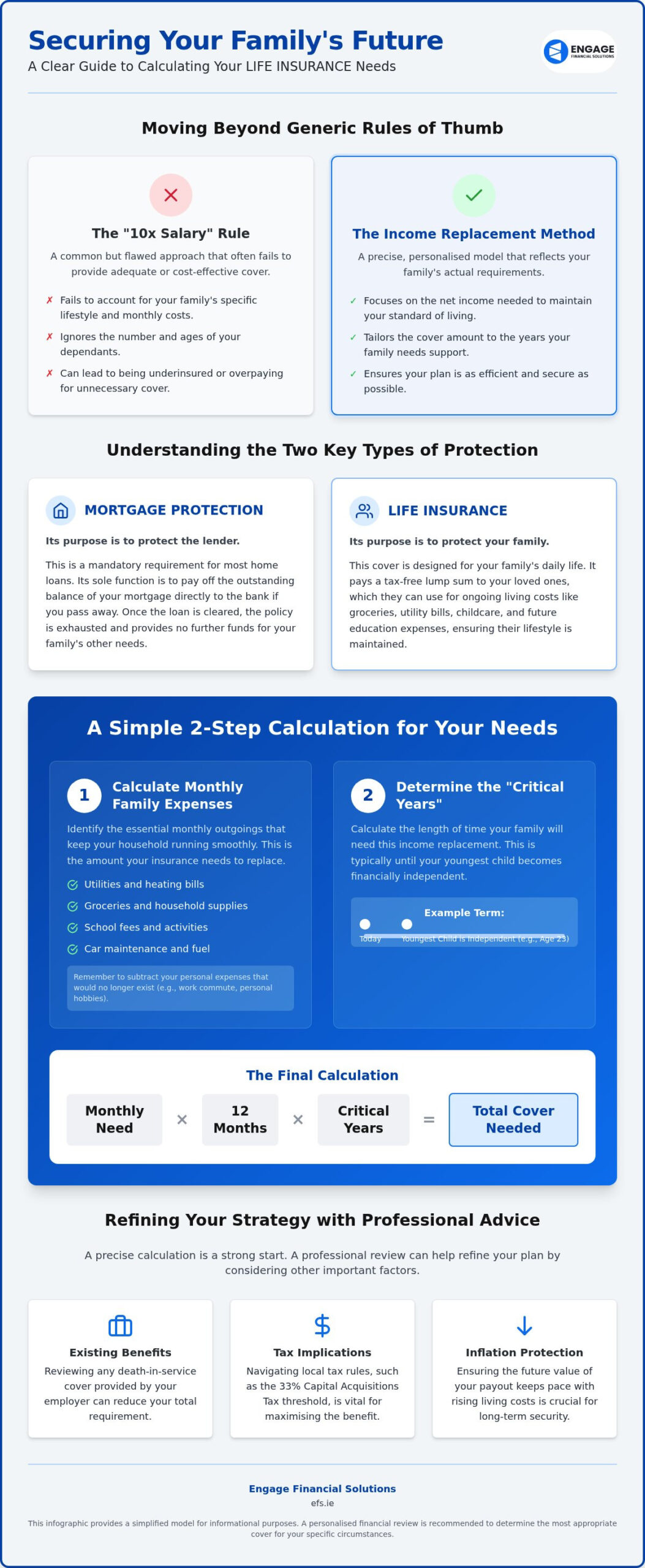
It is vital to distinguish between “protecting the bank” and “protecting the people you love.” In our local market, MORTGAGE PROTECTION is a legal requirement for most home loans. Its sole purpose is to pay off the lender so your family can stay in the house. However, once the mortgage is cleared, that policy is exhausted. LIFE INSURANCE, on the other hand, is designed for your family’s daily needs. It covers groceries, utility bills, and future education costs. Whilst both are forms of life cover, they serve very different masters. One looks after the institution; the other looks after your home’s heartbeat.
Why One-Size-Fits-All Multiples Often Fail
You might have heard the rule of thumb that you need ten times your annual salary. This is often an oversimplification that leads to either overpaying for unnecessary cover or leaving your family short. A family with three toddlers has vastly different requirements than a couple whose youngest child is entering university. A blanket multiple doesn’t account for the length of time your dependants will rely on your income. By focusing on the actual standard of living you wish to maintain, you can create a more accurate and cost-effective strategy. This methodical approach ensures your plan is robust enough to handle reality without being an undue burden on your current monthly budget.
The Income Replacement Method: A More Accurate Approach
When you begin researching how much life insurance do i need ireland, it is easy to get lost in large, abstract numbers. However, a more effective strategy is to view your cover through the lens of monthly household requirements. Instead of chasing a generic multiple of your gross salary, you should focus on the actual net income your family needs to maintain their current lifestyle. This shifts the focus from a one-off windfall to a sustainable, long-term plan that mirrors your monthly contribution to the home.
To find this figure, start by identifying the portion of your salary that truly goes toward family maintenance. You can often subtract your personal expenses that would no longer exist, such as commuting costs, professional memberships, work lunches, or individual hobbies. This provides a leaner, more accurate “replacement income” figure. According to this Irish consumer guide on life insurance, understanding these distinctions is a vital part of choosing the right policy for your specific circumstances. Once you have this monthly amount, you can determine the “Critical Years”, which is the duration for which this income must be provided.
Identifying Household Essential Costs
Your calculation should centre on non-negotiable outgoings that keep the household running smoothly. These typically include:
- Utilities and heating bills
- Weekly groceries and household supplies
- School fees, uniforms, and extracurricular activities
- Car maintenance, tax, and fuel
It is also wise to factor in future inflation to ensure the purchasing power of the payout doesn’t diminish over time. With rising living costs, a modest annual buffer helps ensure the pot doesn’t run dry too early. The replacement period is typically defined by the number of years until your youngest dependant reaches age 21 or 25. If you find these calculations overwhelming, a tailored financial review can help simplify the process and ensure no detail is overlooked.
Accounting for the “Stay-at-Home Parent” Value
One of the most common mistakes in protection planning is underestimating the value of a non-earning parent. LIFE INSURANCE isn’t just about replacing a payslip; it’s about replacing labour. If a stay-at-home parent were no longer there, the cost of hiring professional services for childcare, housekeeping, and transport would be substantial. This often means a non-earning parent requires a similar, or sometimes even higher, level of cover than the primary breadwinner. By valuing this essential work, you ensure that the family’s daily rhythm remains undisturbed during a difficult transition.
How Mandatory MORTGAGE PROTECTION Changes the Calculation
Many families assume they need a massive lump sum to clear their mortgage and provide for their loved ones. In this specific market, however, the landscape is different because lenders legally require you to have MORTGAGE PROTECTION in place before they release funds. This policy is specifically designed to pay off the remaining balance of your home loan if you pass away. Because your home is already safeguarded by this mandatory cover, the calculation for how much life insurance do i need ireland changes fundamentally. It no longer needs to account for your biggest debt, which often makes comprehensive protection far more affordable here than in other jurisdictions.
The CCPC guide to life insurance highlights that understanding what you already have is the first step in avoiding overpayment. If you include your mortgage balance in your LIFE INSURANCE total, you are essentially double-insuring the same debt. This leads to unnecessarily high premiums that could be better spent on other family priorities. By separating your debt clearance needs from your income replacement requirements, you can arrive at a more precise figure for how much life insurance do i need ireland without the stress of over-insuring.
Auditing Your Existing MORTGAGE PROTECTION
Before adding new cover, it is vital to ensure your current MORTGAGE PROTECTION policy is actually doing its job. You should verify that the level of cover matches your remaining loan balance and that the term aligns with the years left on your mortgage. If you have recently moved home or are considering switching your mortgage to a better rate, your policy may need a formal update to remain valid. A proactive audit ensures there are no gaps in your safety net, providing a seamless transition if your financial circumstances change.
Clearing Other Liabilities
Whilst your mortgage is likely covered, other liabilities often remain exposed. Car loans, credit cards, and personal loans can place a significant strain on a grieving family if they are not accounted for. You must decide whether you want your LIFE INSURANCE to provide a lump sum to clear these debts immediately or if they should be serviced monthly through the income replacement pot. In most cases, clearing high-interest debt first is the most efficient use of your cover, as it immediately reduces the family’s monthly outgoings and simplifies their financial future.
Step-by-Step: Calculating Your Specific Level of Cover
Calculating your total requirement doesn’t have to be a source of anxiety. It’s a methodical process that starts with your family’s daily reality rather than a generic guess. By following a structured approach, you can identify the exact amount of cover needed to maintain your household’s stability. When you begin to ask how much life insurance do i need, it’s helpful to break the calculation into these five logical steps:
- Step 1: Total your annual essential household expenses. This includes everything from groceries and utilities to car costs, but you should exclude the mortgage as this is already handled by your MORTGAGE PROTECTION.
- Step 2: Multiply this annual figure by the number of years until your youngest child reaches financial independence, typically age 21 or 25.
- Step 3: Add a lump sum for “Immediate Needs”. This should cover funeral costs, which typically range between €3,000 and €7,000 locally, plus a small emergency fund buffer.
- Step 4: Subtract any existing “Death in Service” benefits from your employer or any personal LIFE INSURANCE policies you already own.
- Step 5: Subtract liquid assets, such as accessible savings or sellable investments, that your family could use to bridge any gaps.
This “future-back” perspective ensures you’re starting with the end goal: a family that is financially secure and looked after. It removes the friction of guesswork and replaces it with a clear, actionable figure. If you’re unsure about the specifics of your existing policies, a personalised protection audit can provide the clarity you need to move forward with confidence.
The “Death in Service” Audit
Check your employment contract or speak with your HR department to confirm if you have a Death in Service benefit. Many local employers offer a tax-free lump sum of three to five times your annual salary. Whilst this is a valuable foundation, you shouldn’t rely on it as your only source of security. This cover is usually tied to your employment; if you change jobs, face redundancy, or the company changes its benefits package, your protection could vanish instantly. Relying solely on employer benefits often creates a dangerous protection gap during career transitions.
Factoring in Social Welfare Support
The Social Welfare Survivor’s Pension provides a baseline level of support for families who have lost a spouse or civil partner. Whilst this payment is a helpful safety net, it’s best to treat it as a “bonus” rather than the foundation of your financial plan. State benefits can change, and the rates may not be sufficient to maintain your family’s specific standard of living. Taking a conservative approach that assumes minimal state reliance ensures your family’s future remains stable, regardless of changes to government policy.
Refining Your Strategy with Professional Advice
Whilst you now have a clearer idea of the calculations involved, moving from a figure on paper to a live policy can still feel daunting. A DIY approach to protection often leads to costly mistakes, such as missing out on tax efficiencies or choosing a policy that doesn’t quite fit your long-term goals. An expert guide acts as a buffer between you and the complexities of the local financial market, ensuring your application process is as seamless as possible. By partnering with a consultant, you gain access to competitive rates across multiple providers that might not be readily available to the public.
True financial security is rarely about a single product. It is about how your LIFE INSURANCE integrates with your broader strategy, including INCOME PROTECTION and RETIREMENT PLANNING. We look at the “big picture” to ensure every decision you make today supports your lifestyle aspirations for tomorrow. For those seeking to align their broader portfolio with ethical principles, exploring Shariah compliant investments South Africa can provide a valuable blueprint for value-based wealth management. This holistic integration prevents your cover from feeling like a fragmented list of products and instead turns it into a robust, proactive shield for your family. Our role is to provide the calm competence you need to navigate these choices with confidence.
Term Life vs Whole of Life
Choosing between different types of cover is a critical step in your journey. TERM LIFE INSURANCE provides a payout if you pass away within a specific timeframe, such as until your children are grown or your youngest child finishes university. This is typically the most cost-effective and straightforward choice for families with young dependants. Conversely, WHOLE OF LIFE INSURANCE lasts for your entire lifetime but often comes with higher premiums. At Engage Financial Solutions, we help you navigate these options to find the perfect fit for your budget and your family’s future needs.
Reviewing Your Cover as Life Evolves
Your need for protection is not static. Whether you are welcoming a new baby, moving into a larger home, or celebrating a career promotion, these milestones are natural triggers to review your strategy. Even a change like marriage or a shift in employment can significantly alter the answer to the question of how much life insurance do i need ireland. We recommend a regular review to ensure your cover remains relevant and that you aren’t overpaying for unnecessary benefits. If you are ready to secure your family’s future with a plan that is built around your specific goals, contact our expert team today for a tailored quote. Our goal is to make your financial transition steady, optimistic, and entirely stress-free.
Securing Your Family’s Financial Future Today
Protecting your household is about more than just picking a round number; it’s about creating a tailored strategy that reflects your specific needs. By moving away from generic salary multiples and focusing on the income replacement method, you ensure that your loved ones can maintain their standard of living without the stress of financial friction. It’s helpful to remember that your mandatory MORTGAGE PROTECTION already safeguards your home, allowing your LIFE INSURANCE to focus entirely on daily essentials and future goals.
Determining exactly how much life insurance do i need ireland is a methodical process that benefits from expert oversight. As a consultancy regulated by the Central Bank, we provide access to all major providers and offer personalised guidance for your unique family situation. We’re here to act as your steady guide, removing the complexity from your financial planning and replacing it with calm competence.
Request a personalised LIFE INSURANCE quote from our expert advisors
You deserve the peace of mind that comes from a logical, well-structured plan. Let’s help you navigate the path toward long-term stability and optimism for your family’s future.
Frequently Asked Questions
Is LIFE INSURANCE mandatory for homeowners locally?
No, LIFE INSURANCE is not a legal requirement for homeowners, but MORTGAGE PROTECTION typically is. Lenders usually insist on a policy that clears the loan balance if you pass away. Whilst MORTGAGE PROTECTION looks after the bank’s interest in the property, LIFE INSURANCE is a voluntary choice you make to provide a tax-free lump sum for your family’s daily living costs and future security. It offers a broader safety net beyond simply clearing debt.
Does my employer’s “Death in Service” benefit count as LIFE INSURANCE?
Yes, it is a form of life cover, but it’s important to understand its limitations. These benefits are usually tied to your employment contract and often pay out a multiple of your salary. If you change jobs or are made redundant, this protection typically ceases immediately. Many people choose a personal policy to ensure they have a stable, long-term safety net that stays with them regardless of their career path.
Can I have more than one LIFE INSURANCE policy?
Yes, you can hold multiple policies simultaneously to meet different financial goals. You might have one policy specifically for income replacement and another to cover potential inheritance tax liabilities under Capital Acquisitions Tax rules. Having separate policies can offer greater flexibility, allowing you to tailor the terms and cover amounts as your family’s circumstances evolve over time. This approach ensures every specific risk is meticulously managed.
What is the difference between LIFE INSURANCE and SERIOUS ILLNESS COVER?
The primary difference lies in what triggers a payout: death versus diagnosis. LIFE INSURANCE pays a lump sum to your beneficiaries when you pass away, providing them with long-term stability. SERIOUS ILLNESS COVER pays a tax-free lump sum directly to you if you are diagnosed with a specific condition covered by the policy. Having both ensures your family is protected if the worst happens, whilst also providing you with financial support during a difficult recovery.
Will my LIFE INSURANCE premiums increase as I get older?
If you choose a standard TERM LIFE INSURANCE policy, your premiums are usually fixed for the entire duration of the term. This provides price stability and helps you budget with confidence. However, some reviewable policies or WHO_LE OF LIFE plans may see premium adjustments over time. Selecting a fixed-term plan is often the most straightforward way to ensure your costs remain predictable as you navigate different life stages with your family.
How much does the average family pay for LIFE INSURANCE each month?
Monthly costs vary significantly based on your age, health, and the level of cover you require. When families ask how much life insurance do i need ireland, they often find that premiums are more accessible than expected when tailored to their actual needs. Factors like smoking status and the length of the term will influence the final price. A professional review can help you find the most competitive rates whilst ensuring your family’s future remains secure.
Does LIFE INSURANCE cover funeral expenses?
Yes, the tax-free lump sum provided by a LIFE INSURANCE policy can be used to cover any immediate costs, including funeral expenses. Families often use a portion of the payout to settle these bills quickly, alleviating financial pressure during a difficult time. Including a specific amount for these costs in your initial calculation ensures that your loved ones have the liquid funds available to manage all final arrangements without dipping into their daily living budget.
What happens to my LIFE INSURANCE if I switch my mortgage?
Switching your mortgage lender typically has no direct impact on your personal LIFE INSURANCE policy. Unlike MORTGAGE PROTECTION, which is specifically tied to your loan, a LIFE INSURANCE policy is an independent contract between you and the insurer. However, moving home or changing your financial structure is an excellent time to review your cover. This ensures your protection levels still align with your new circumstances and that your family remains fully safeguarded during the transition.
Disclaimer
Engage Financial Services LTD T/A Engage Financial Solutions is regulated by the Central Bank of Ireland CRO 764570. Director David Moore. Suite 2 First Floor, 14 -18 Main street, Blackrock, Co Dublin A94 W0Y3