

Did you know that the average household could save over €2,400 every single year simply by moving away from a standard variable rate? Whilst many homeowners feel frustrated by rising interest rates, the reality is that the current market offers significant opportunities for those willing to take a proactive step. It’s perfectly natural to feel hesitant or confused by the various fixed and variable options available, especially when the application process feels daunting.
Our goal is to show you that switching MORTGAGE to get a better rate doesn’t have to be a source of stress. By understanding how to navigate the domestic market, you can secure a lower interest rate and significantly reduce your monthly repayments. In this 2026 guide, we’ll explore how to leverage your home’s equity to unlock market-leading rates, compare the benefits of different MORTGAGE PRODUCT options, and provide a clear checklist to ensure your transition is entirely seamless. Whether you’re nearing the end of a fixed term or looking to escape a high variable rate, you can achieve long-term financial stability with the right guidance.
Key Takeaways
- Understand how moving away from a high-cost Standard Variable Rate can lead to immediate monthly savings and long-term financial security.
- Discover the exact framework for switching mortgage to get a better rate by comparing your current interest costs against new lender offers and upfront fees.
- Evaluate whether a FIXED RATE or VARIABLE RATE MORTGAGE provides the best balance of stability and flexibility for your specific lifestyle and future goals.
- Prepare a comprehensive document pack, including pay slips and bank statements, to ensure a seamless and stress-free application process from the very start.
- Learn how a professional advisor acts as a steady guide and a buffer between you and the lenders, ensuring your financial decisions are organised around your peace of mind.
The Financial Logic of Switching Mortgage to Get a Better Rate
SWITCHING MORTGAGES is the process of moving your current home loan from one lender to another to secure more favourable terms. It’s a strategic financial reset that allows you to shop for a better price on your largest monthly commitment. Many homeowners remain on high-cost Standard Variable Rates long after their initial incentive period has ended, often due to a perceived complexity in the application process. Lenders frequently rely on this inertia, applying what is known as a ‘loyalty penalty’ where existing customers pay significantly higher interest than new applicants for the same PRODUCT. By switching mortgage to get a better rate, you are taking active control of your financial journey. Your primary objective is to reduce the total interest paid over the remaining life of the loan, ensuring more of your income stays within your household.
Recognising When You Are Overpaying
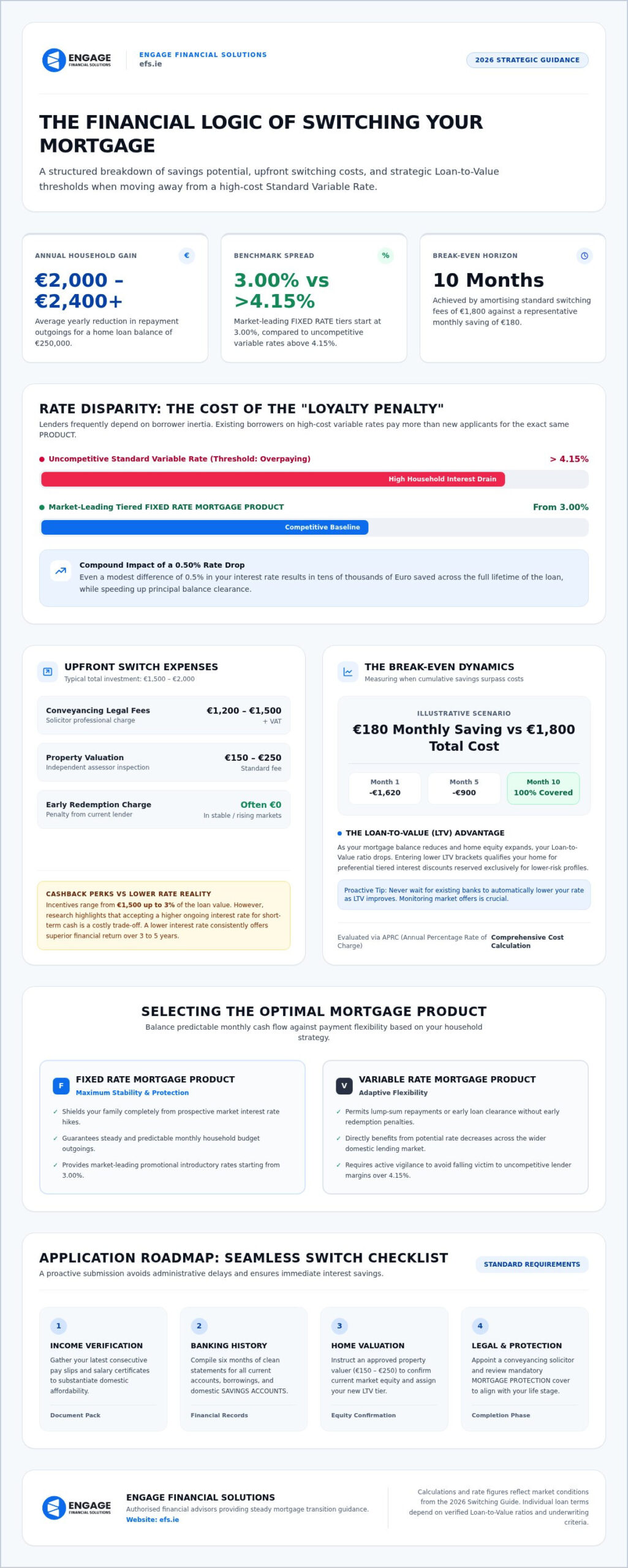
Identifying the signs of an uncompetitive interest rate is the first step toward long-term security. If you are currently on a VARIABLE RATE exceeding 4.15%, you are likely overpaying, especially whilst market-leading FIXED RATE MORTGAGES are available from 3.00% for certain tiers. Your Loan-to-Value (LTV) ratio is a critical factor in this assessment. As you pay down your MORTGAGE balance and property values grow, your equity increases. This natural progression often moves you into a lower LTV bracket, which unlocks access to tiered discounts that lenders reserve for lower-risk borrowers. You shouldn’t wait for your bank to offer these lower rates; they rarely do so automatically, making it essential to monitor the market and seek out better value.
The Long-Term Impact on Your Financial Security
Reducing your interest costs does far more than just lower your monthly outgoings. It accelerates your path to being debt-free by ensuring a larger portion of each payment targets the principal balance rather than just servicing the interest. These redirected funds can then be used to strengthen other areas of your life, such as RETIREMENT PLANNING or building your SAVINGS ACCOUNTS. We view this through a ‘future-back’ lens, where today’s proactive decisions provide the peace of mind that comes from a stable and predictable financial base. The switching threshold is the point at which the cumulative interest savings generated by your new rate surpass the combined cost of legal fees and valuation charges required to complete the move.
Calculating the Real Savings: Is It Worth the Move?
Comparing your current interest rate to a new offer requires a look beyond the headline figures. To see the true value of a move, you must examine the Annual Percentage Rate of Charge (APRC). This figure represents the total cost of the loan, including interest and all unavoidable charges, over its entire lifetime. Whilst switching mortgage to get a better rate can save a household with a €250,000 balance roughly €2,000 to €2,400 annually, you must first account for the upfront costs. Typical expenses for a switch range between €1,500 and €2,000. This includes conveyancing solicitor fees, often €1,200 to €1,500 plus VAT, and an independent property valuation fee of about €150 to €250. You should also check if your current lender will apply an early redemption charge, though these are often zero in a stable or rising rate environment.
Many lenders provide “Cashback” incentives, ranging from fixed payments of €1,500 to 3% of the loan amount, which can effectively neutralise these initial outlays. However, research from the CCPC suggests that accepting a higher long-term interest rate in exchange for a cash perk can be a costly trade-off. A lower rate almost always provides superior value over a three to five year period. It’s about finding the balance that provides immediate relief without compromising your future security.
Understanding the Cost-Benefit Analysis
The “break-even point” is the moment your monthly interest savings have fully covered your total switching costs. If you save €180 a month and spent €1,800 to switch, you’ll reach this point in just ten months. Even a modest 0.5% difference in your interest rate can result in tens of thousands of Euro in savings over the full term of the loan. During this process, you must also address your MORTGAGE PROTECTION. This is the mandatory insurance that clears your debt if you pass away. Whilst you can often move an existing policy to a new lender, reviewing your coverage ensures it remains tailored to your current life stage.
The Influence of Your LTV on Available Rates
Your Loan-to-Value (LTV) ratio is the percentage of your home’s market value that you are borrowing. Lenders reserve their most competitive rates for those in the lowest LTV bands, particularly those under 60%. Because property prices have grown, you might find you’ve naturally moved into a cheaper tier without even realising it. A fresh valuation is essential to prove this new equity level to a lender. Working with an experienced consultancy to manage your switch allows you to access specific rates and non-bank lenders that aren’t always available directly to the public, ensuring your transition is both profitable and seamless.
Choosing Between FIXED and VARIABLE MORTGAGES
Over 80% of households now opt for fixed-rate terms, reflecting a broad desire for stability amongst homeowners. Switching mortgage to get a better rate isn’t a sign of financial distress; it’s a hallmark of a meticulous borrower who understands that market conditions change. If your home has a Building Energy Rating (BER) of B3 or higher, you can access GREEN RATE MORTGAGES. These provide discounts of 0.20% to 0.40% off standard pricing, with some market-leading options starting at 3.00% for energy-efficient homes. This proactive approach ensures you aren’t paying more than necessary for your home loan whilst benefiting from a more sustainable property.
The Case for Long-Term Fixed Rates
Repayment certainty is the primary benefit of choosing a fixed term. By switching mortgage to get a better rate, you lock in a specific cost regardless of how the broader economy behaves. Whilst inflation or market rates fluctuate, your monthly outlay remains constant, providing the peace of mind that comes from long-term security. You should choose a term length that aligns with your future lifestyle goals, whether that’s a three-year term for flexibility or a ten-year term for maximum stability. You must also evaluate potential breakage fees if you need to move again early. In the current climate where the ECB main refinancing rate is 2.65%, these early redemption charges are frequently zero, but it’s vital to request a written quote before making your move.
Exploring Flexible Variable and Hybrid Options
Standard VARIABLE RATES currently range between 4.15% and 5.50%. Whilst they are often more expensive than fixed options, they offer unparalleled flexibility. These rates allow you to make significant overpayments or clear the loan entirely without facing any penalties. This is a powerful tool for those expecting a windfall or a significant rise in income. Some homeowners choose Split MORTGAGES, where they fix a portion of the balance for security whilst keeping the remainder on a VARIABLE RATE for flexibility. This allows you to benefit from Mortgage Overpayment Savings whilst maintaining a predictable baseline for your monthly budget. This tailored approach ensures your MORTGAGE matches your unique financial circumstances and long-term aspirations.
A Straightforward Roadmap for a Seamless Switch
Moving your home loan to a new lender typically takes between 6 and 10 weeks from the initial enquiry to the final drawdown. Whilst this might seem like a significant period, much of the time involves behind-the-scenes coordination between your advisor, the lender, and your solicitor. By following a structured roadmap, you can ensure the process remains straightforward and stress-free. The goal is a seamless transition that delivers the long-term security you deserve. When you are switching mortgage to get a better rate, having a steady guide ensures every milestone is met with calm competence.
Preparing Your Application for Success
To start switching mortgage to get a better rate, you’ll need to assemble a comprehensive document pack. Lenders generally require your latest Employment Detail Summary (EDS), three months of payslips, and six months of bank and credit card statements. It’s vital that your bank account conduct is ‘lender-ready’ before you apply. This means avoiding missed direct debits or excessive credit use in the months leading up to your switch. Organising these files early prevents unnecessary back-and-forth and keeps your application on track. Maintaining a clean credit record is equally important, as it reinforces your position as a reliable borrower deserving of the most competitive PRODUCT rates.
Navigating the Legal and Valuation Requirements
Once your application is provisionally approved, the lender will require an independent property valuation. This typically costs between €150 and €250 and confirms that the home’s current market value supports the loan amount. Simultaneously, your solicitor will handle the conveyancing process. They are responsible for discharging your old MORTGAGE and registering the new charge with the land registry. A professional advisor acts as a buffer here, managing the communication between these parties so you don’t have to.
Under 2026 regulations, lenders must issue a formal decision within 10 business days of receiving a completed application, making the timeline more predictable than ever before. This efficiency allows you to move forward with optimism, knowing your financial future is being managed with care. If you’re ready to begin your journey, you can start your seamless switch with Engage Financial Solutions today.
Securing Your Future with Engage Financial Solutions
At Engage Financial Solutions, we act as a steady guide and a buffer between you and the complexities of the banking world. Switching mortgage to get a better rate is a significant financial milestone, but it shouldn’t be a source of friction or stress. Our “Future-Back” perspective ensures that every decision we make together is driven by your long-term aspirations. We don’t just look at the debt you have today; we look at the security you want for your family tomorrow. With our national reach and access to a comprehensive panel of lenders, we identify opportunities that might not be visible on the high street, providing you with the peace of mind that comes from a professionally managed transition.
A Tailored Approach to Your Financial Health
Every household has a unique story, which is why we provide personalised guidance rather than generic solutions. Whether you are looking to lower your monthly outgoings or shorten your loan term to become debt-free sooner, we assess your specific circumstances to find the most suitable PRODUCT. Our advice is fundamentally holistic. We recognise that your MORTGAGE is just one piece of your financial puzzle. By integrating your home loan strategy with Switching Mortgages, INCOME PROTECTION, and PENSIONS, we help you build a robust foundation. This meticulous attention to detail ensures that your path to financial health remains clear and well-managed.
Take the Next Step Toward Savings
You shouldn’t feel obligated to stay with a lender that no longer serves your best interests. Reviewing your current rate is a straightforward way to discover potential savings without any initial commitment. Our expert team is ready to provide a personalised consultation, navigating the market on your behalf to find the most flexible and cost-effective terms. Switching mortgage to get a better rate is about more than just numbers; it’s about the optimism that comes from knowing you are in a stronger position than you were yesterday. Reach out to our national team today to begin your journey toward a more secure and stable financial future.
Take Control of Your Financial Future Today
The path to long-term stability begins with a single, proactive step. We’ve explored how a strategic financial reset can protect your household from unnecessary interest costs and how your home’s equity can unlock market-leading rates. Whether you are moving from a standard variable rate or seeking a competitive green fixed term, your mortgage should reflect your current life stage and future goals.
Our expert team serves customers nationally, providing the meticulous guidance required to navigate the market with confidence. As a consultancy regulated by the Central Bank, we focus on delivering a seamless process designed to eliminate the inherent stress of financial transitions. We manage the coordination between lenders and solicitors, ensuring your experience is entirely straightforward. Switching mortgage to get a better rate is about more than just monthly savings; it’s about the peace of mind that comes from a professionally managed plan. Book a Personalised Mortgage Review with Engage Financial Solutions today. We look forward to helping you achieve a more predictable and secure financial future.
Frequently Asked Questions
Can I switch my MORTGAGE if I am currently on a fixed rate?
Yes, you can switch your MORTGAGE whilst on a fixed term, but you may face an early redemption charge. You should request a breakage fee quote from your current lender in writing before proceeding. In the current market, these fees are often zero if interest rates have remained stable or risen since you locked in your rate. Switching mortgage to get a better rate can still be profitable if the long-term interest savings outweigh any initial penalty.
How much does it cost to switch my MORTGAGE to a new lender?
Typical upfront expenses for a switch range from €1,500 to €2,000. This includes conveyancing solicitor fees, which often sit between €1,200 and €1,500 plus 23% VAT, and an independent property valuation fee of roughly €150 to €250. Multiple lenders provide switching subsidies or legal fee contributions to help offset these outlays. We recommend focusing on the long-term interest rate rather than just the initial cash perk to ensure you receive the best overall value.
Will I need a new MORTGAGE PROTECTION policy when I switch?
You don’t always need a new MORTGAGE PROTECTION policy when you move to a new lender. In many cases, your existing policy can be reassigned to the new provider through a process called a deed of assignment. However, switching is an excellent opportunity to review your coverage. If your circumstances have changed, we can help you organise a tailored policy that provides better security for your family’s future whilst potentially reducing your monthly premiums and improving your stability.
How long does the process of switching for a better rate usually take?
The process of switching mortgage to get a better rate typically takes between 6 and 10 weeks from application to completion. Under the Revised Consumer Protection Code of 2026, lenders are now required to issue a formal decision on your switching application within 10 business days of receiving all required documents. This regulation helps ensure a more predictable timeline, allowing you to plan your financial transition with greater confidence and significantly less stress throughout the entire process.
Do I need a solicitor when I am SWITCHING MORTGAGES?
Yes, you must engage a solicitor when you are SWITCHING MORTGAGES. The legal process involves discharging the existing charge your current lender holds over your property and registering a new charge for the incoming lender. Whilst your broker manages the financial application, the solicitor ensures the title deeds are correctly handled and transferred. Many homeowners use a portion of their lender’s cashback incentive to cover these essential legal professional fees during the transition to a new rate.
What is the minimum equity required to get a better rate?
There is no strict minimum equity requirement, but having a lower Loan-to-Value (LTV) ratio unlocks the most competitive PRODUCT rates. Lenders reserve their market-leading discounts for borrowers with an LTV of 60% or lower. If house price growth has increased your home’s value since you first borrowed, you might qualify for these cheaper tiers. A professional valuation will confirm your current equity level and help us identify the most suitable rates for your specific financial situation.
Can a MORTGAGE BROKER find rates that I cannot find myself?
A MORTGAGE BROKER often has access to specific rates and non-bank lenders that do not deal directly with the public. These intermediary-exclusive options can provide significantly better value than the standard PRODUCT options found on the high street. By working with a consultancy, you benefit from a whole-of-market comparison. This ensures you aren’t limited to a single bank’s offerings and can secure a tailored solution that provides long-term financial stability and the peace of mind you deserve.
What happens to my current MORTGAGE if the switch is delayed?
If your switch is delayed, your current MORTGAGE remains active under its existing terms and conditions. You will continue making repayments to your original lender until the new loan is officially drawn down and the old balance is cleared. The new interest rate only applies from the date of completion. Our team acts as a proactive partner, coordinating between all parties to minimise friction and ensure your transition is as seamless and straightforward as possible for your household.
Disclaimer
Engage Financial Services LTD T/A Engage Financial Solutions is regulated by the Central Bank of Ireland CRO 764570. Suite 2 First Floor, 14 -18 Main street, Blackrock, Co Dublin. A94 W0Y3