


You might believe that the path to homeownership is becoming increasingly narrow, yet the reality is that your first set of keys could be well within reach. Whether you’re currently navigating the complexities of the rental market or you’re ready to start your journey towards long-term security, understanding your borrowing capacity is the first step towards a stable future. It’s completely normal to feel a sense of anxiety regarding rising property prices and the meticulous paperwork required for a loan, especially whilst trying to understand how the HELP TO BUY scheme can assist your specific goals.
We promise to simplify the domestic property market for you, providing an expert roadmap that transforms confusion into clarity. In this guide, we’ll explain how to maximise government supports to boost your deposit and how the latest Central Bank lending limits affect your FIRST TIME BUYER MORTGAGE. You’ll discover a straightforward way to move from renting to owning, ensuring a seamless experience that prioritises your peace of mind and financial health whilst safeguarding your aspirations for the years ahead.
Key Takeaways
- Understand the current borrowing limits and how to meet the 10% deposit requirement for a FIRST TIME BUYER MORTGAGE.
- Learn how to maximise your deposit by claiming a tax rebate through the HELP TO BUY scheme for newly built properties.
- Compare the benefits of a FIXED RATE MORTGAGE against a VARIABLE RATE MORTGAGE to find the right fit for your monthly budget.
- Organise your application documents effectively to move quickly from an initial Approval in Principle to a successful Letter of Offer.
- Protect your future stability by arranging essential MORTGAGE PROTECTION and INCOME PROTECTION before you collect your keys.
Navigating the Path to Homeownership: Understanding Borrowing Limits and Deposits
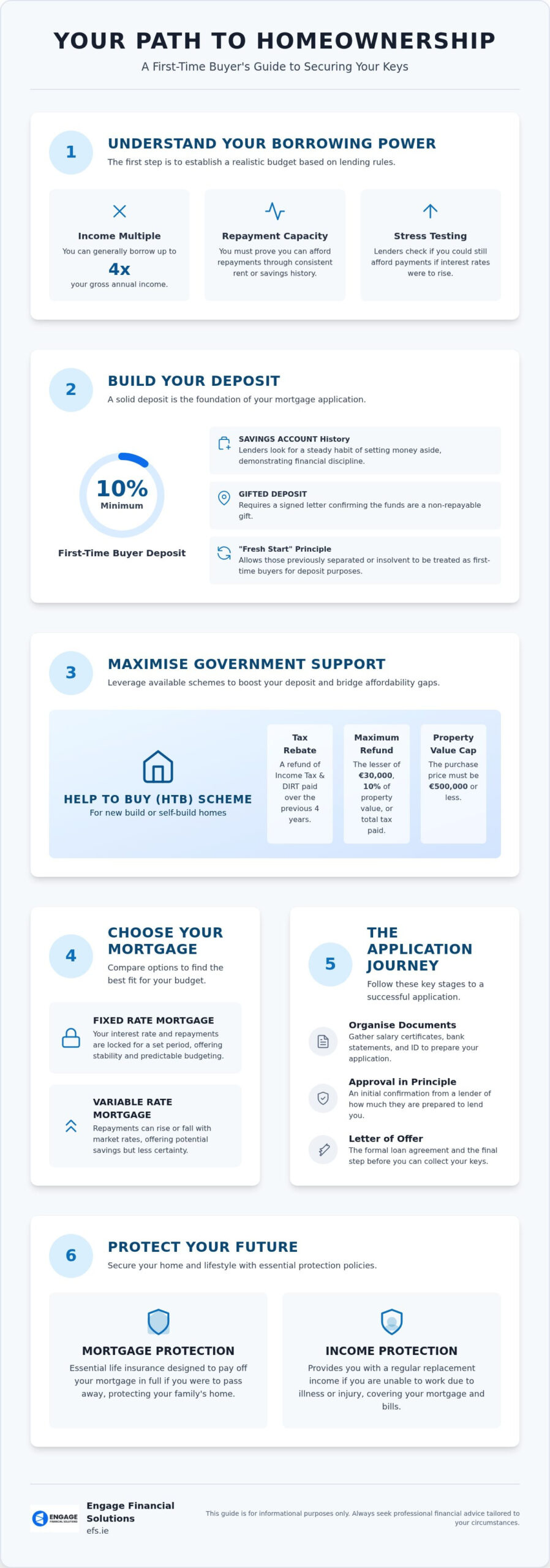
Securing a FIRST TIME BUYER MORTGAGE is a significant milestone that requires a clear understanding of the domestic regulatory framework. Local lending rules, overseen by the Central Bank, are designed to ensure that you don’t overstretch your finances whilst pursuing your dream home. In this market, you can generally borrow up to four times your gross annual income. For joint applicants, this calculation applies to your combined salaries, providing a clearer picture of your total borrowing capacity from the outset.
Lenders also look for “demonstrated repayment capacity” amongst all applicants. This means you must prove you can consistently afford your future loan repayments through your current rent or regular savings. It’s a proactive way to show you’re ready for the responsibility of homeownership. By mastering these rules early, you can approach the market with confidence and a realistic budget.
The 10% Deposit Rule and How to Organise Your Savings
For the vast majority of local lenders, a 10% deposit is the minimum requirement to secure a loan. Whilst this might seem like a high hurdle, the “Fresh Start” principle offers a second chance to those who previously owned a home but no longer have a financial interest in it due to separation or insolvency. If you find yourself in this position, you’re treated as a first-time buyer for deposit purposes, which can make a massive difference to your timeline.
If you’re lucky enough to receive a GIFTED DEPOSIT, you’ll need specific documentation to satisfy lender requirements. Banks need a signed gift letter confirming the funds don’t need to be repaid and that the donor has no stake in the property. Maintaining a consistent history in a SAVINGS ACCOUNT is equally vital. It’s not just about the final amount; it’s about showing a steady habit of setting money aside every month. This reliability is exactly what a MORTGAGE BROKER looks for when preparing your application for a domestic lender.
Calculating Your Borrowing Power: Income Multiples and Stress Testing
While the four-times-income limit is the standard, lenders also perform “stress testing” on your application. This process ensures you can still afford your repayments even if interest rates were to rise by a certain percentage in the future. It’s a safeguard that provides long-term security for your household. Understanding how this interaction works with the First Home Scheme can help you bridge any gaps between your mortgage and the property price, especially when combined with the HELP TO BUY scheme.
Treatment of discretionary income, such as bonuses or overtime, varies significantly amongst different lenders. Some may include 100% of a regular bonus, whilst others might only consider a fraction. Providing clear salary certificates helps your advisor tailor your application to the lender most likely to recognise your full earning potential. This meticulous preparation ensures a straightforward path to your new front door.
Maximising Support: A Deep Dive into HELP TO BUY and the FIRST HOME SCHEME
Government incentives are designed to provide the missing pieces of your homeownership puzzle. These supports effectively lower the entry barrier, allowing you to secure a new home with a smaller personal deposit than you might have expected. By leveraging these domestic initiatives, you can bridge the gap between your savings and the purchase price of a modern, energy-efficient property. Combining these schemes ensures a more stable financial foundation as you move from renting to owning.
Unlocking HELP TO BUY: Eligibility and Application
The Help to Buy (HTB) incentive is a vital tool for those purchasing or self-building a new home. It functions as a tax rebate, returning Income Tax and DIRT you’ve paid locally over the previous four tax years. Currently, the scheme allows for a maximum refund of the lesser of €30,000, 10% of the property’s market value, or the total amount of tax paid in that four-year window. This rebate is specifically for new properties with a purchase price of €500,000 or less.
To begin, you’ll need to access the Revenue Online Service to request a ‘Summary of Claim’. This document confirms your eligibility and the maximum amount you can receive. It’s a straightforward process that provides immediate clarity on your budget. Once you have this confirmation, you can use it as part of your deposit when applying for a MORTGAGE. This rebate has helped thousands of buyers reach their goals faster by significantly boosting their upfront funds.
The FIRST HOME SCHEME: How Shared Equity Works
Whilst the HELP TO BUY scheme focuses on your deposit, the FIRST HOME SCHEME addresses the total cost of the property. This is a shared equity arrangement where the state and participating lenders provide a portion of the purchase price in exchange for an ownership stake in your home. It’s tailored for new-build houses and apartments, ensuring you can afford a home that meets your needs without overextending your bank loan. It’s an excellent option for those whose borrowing capacity doesn’t quite meet the market price of their preferred property.
- No service charge applies for the first five years of the equity stake.
- From year 6, a modest service charge begins, starting at 1.75% and increasing over time.
- You have the flexibility to ‘buy back’ the equity stake at any time, though there’s no obligation to do so whilst you live in the home.
Crucially, these two supports can be used in tandem. When you combine the tax rebate with shared equity, the maximum stake the government takes is typically 20%. This integrated approach reduces the initial financial pressure and makes higher-value properties more accessible. If you’re feeling overwhelmed by the various criteria, seeking advice from a professional advisor can help you organise your application for a seamless experience. This proactive step ensures you maximise every available support to secure your future stability.
Choosing Your Strategy: FIXED RATE vs VARIABLE RATE MORTGAGES
Selecting your interest rate structure is as important as finding the property itself. Whilst a single bank only shows you their own products, a professional MORTGAGE BROKER provides access to a wider panel of domestic lenders. This ensures you aren’t just getting a rate, but the right rate for your unique financial goals. This tailored approach creates a seamless transition from your initial application to collecting your keys, removing the friction often associated with complex financial decisions.
The Case for Stability: Why Many Choose FIXED RATE MORTGAGES
Many buyers prioritise certainty in an ever-changing market. A FIXED RATE MORTGAGE allows you to lock in your monthly repayments for a set period, typically between 3 and 10 years. This protects you from market volatility and makes monthly budgeting straightforward. It’s a popular choice amongst those utilising the HELP TO BUY scheme Ireland to secure a new-build home, as it complements the stability of a modern property. You’ll know exactly what’s leaving your account each month, providing significant peace of mind for your future.
However, it’s vital to consider your long-term plans before committing to a long fixed term. If you decide to switch lenders or overpay significantly before the term ends, you might encounter ‘break fees’. Your advisor will help you weigh these costs against the benefits of stability, ensuring your choice is tailored to your specific circumstances. You can find more detail on eligibility through the Revenue Commissioners HELP TO BUY SCHEME pages.
If you’re purchasing a new-build, you’ll likely benefit from a high BER rating. Lenders often offer ‘Green Mortgages’ with lower interest rates for energy-efficient homes with a rating of A3 or higher. This reward for sustainability can save you thousands of Euro over the life of your loan, making your new home even more affordable in the long run.
VARIABLE RATE MORTGAGES and the Freedom to Overpay
If you value flexibility over absolute certainty, a VARIABLE RATE MORTGAGE might be the right fit for your household. These rates can fluctuate based on market conditions, but they often allow for unlimited overpayments without penalties. This is ideal whether you expect your income to grow or you plan to use annual bonuses to pay down your loan faster. By reducing your capital balance early, you can significantly cut the total interest paid over the term of the mortgage.
Some lenders also offer ‘LTV Variable Rates’. This means your interest rate might drop automatically as you pay down the balance and your equity in the home increases. It’s a proactive way to lower your costs as your financial position strengthens. Seeking expert guidance ensures you find the rate that aligns with your long-term aspirations, providing a clear path to debt-free homeownership.
Preparing for Success: The Step-by-Step FIRST TIME BUYER MORTGAGE Application
Moving from browsing property listings to signing a contract requires a methodical approach. The application process is a journey of several months, starting with a deep dive into your financial habits and ending with the legal transfer of a property. By staying organised and proactive, you can remove much of the friction that typically causes delays. It’s about showing a lender that you aren’t just a dreamer, but a reliable partner for a long-term loan. For additional insight into the financial mechanics of property transactions, Barton Springs Financial provides a useful breakdown of how funds are managed through accounts like escrow.
An Approval in Principle is your first major milestone. It’s a non-binding indication from a lender showing how much they’re willing to lend you based on your initial financial details. Having this document in hand transforms you into a ‘serious buyer’ in the eyes of estate agents and developers. In a competitive market, many sellers won’t even allow a viewing unless you can prove you have the funds ready. A MORTGAGE BROKER is invaluable here, as they can help you secure AIP from multiple lenders, ensuring you have the best possible foundation before you start making offers.
The Documentation Checklist: Avoiding Common Delays
Lenders require a mountain of paperwork to verify your identity and income. Collecting these documents early prevents a last-minute scramble when you find your perfect home. You’ll need up-to-date identification and proof of address for all applicants, along with a clear trail of your earnings. If you’re planning to use the Help to Buy scheme Ireland, you’ll also need your ‘Summary of Claim’ from the Revenue online service. Standard requirements include:
- Six months of consecutive bank statements for all accounts.
- Three months of recent payslips and a signed salary certificate from your employer.
- Your most recent P60 or Employment Detail Summary.
- For self-employed applicants, at least two years of audited accounts and Chapter 4 tax certificates.
Your account conduct amongst these statements is critical. Lenders look for ‘clean’ accounts, meaning no missed direct debits, no unpaid fees, and no evidence of excessive gambling. It’s also wise to minimise non-essential debt, such as car loans or credit cards, at least six months before you apply. Reducing these outgoings increases your disposable income, which directly improves your borrowing capacity.
Once your offer is accepted, the focus shifts to the valuation and the final Letter of Offer. At this stage, your solicitor takes the lead in the conveyancing process. They’ll manage the legal transfer of the property, check the title deeds, and ensure all domestic regulations are met. This partnership between your broker and solicitor ensures a seamless transition to homeownership. If you’re ready to take the first step towards your new front door, talk to a MORTGAGE BROKER today to begin your application with confidence.
Beyond the Keys: Integrating Your MORTGAGE into a Holistic Financial Plan
Collecting your keys is a momentous occasion, but it’s really the beginning of a new financial chapter. A MORTGAGE isn’t just a loan; it’s a long-term commitment that should sit comfortably within a broader strategy for your future. For many couples, this milestone often coincides with other major life celebrations; if you’re also planning a wedding to mark your new start, Stephen Brady Irish Celebrant offers professional, legally binding ceremonies throughout the country. Whilst the initial excitement focuses on the property, the long-term success of your homeownership journey depends on how well you safeguard your income and your family’s security. This holistic approach ensures that your home remains a source of stability rather than a cause of stress.
In this domestic market, MORTGAGE PROTECTION is a legal requirement for most homeowners. This specific type of LIFE INSURANCE is designed to pay off the remaining balance of your loan if a policyholder passes away, ensuring that your loved ones can stay in their home without the burden of debt. It’s a fundamental safety net that provides immense peace of mind. Many buyers mistakenly believe they must purchase this policy from their mortgage lender, but you’re actually free to shop around. A professional broker can often find better value and more tailored coverage than a single bank’s standard offering.
Choosing the right policy involves more than just finding the lowest price. You need to ensure the coverage matches your loan term and interest rate structure. For a deeper look at how to organise this cover, explore our MORTGAGE PROTECTION guide. This proactive step is as vital as the Help to Buy scheme Ireland was during your deposit-building phase, as it protects the asset you’ve worked so hard to acquire.
Future-Proofing with INCOME PROTECTION and PENSIONS
Your ability to earn an income is your most valuable asset. If you were unable to work due to a serious injury or long-term illness, how would you meet your monthly repayments? INCOME PROTECTION provides a steady monthly payment to replace a portion of your salary, allowing you to focus on recovery without financial friction. It acts as a buffer between your household and the complexities of the financial world, ensuring your mortgage stays on track regardless of life’s unpredictable turns.
Securing your first home early also provides a solid foundation for your RETIREMENT PLANNING. A mortgage-free home is often the cornerstone of a comfortable retirement, reducing your outgoings significantly in later years. By integrating your home loan with your PENSIONS and other investments, you create a seamless path to long-term wealth. We invite you to book a consultation with Engage Financial Solutions. As your steady guide, we’re here to help you navigate every financial transition with calm competence and a focus on your lifelong goals.
Your Seamless Path to a New Front Door
Homeownership is a journey that rewards those who approach it with a clear strategy and expert guidance. By now, you should have a firm grasp on how to maximise your deposit through the Help to Buy scheme Ireland and how to bridge any funding gaps using shared equity. Whether you’re organising your savings or comparing interest rates, remember that your home is the foundation of your long-term financial security. We’ve explored the importance of clean account conduct and the legal necessity of MORTGAGE PROTECTION to safeguard your future.
As a firm regulated by the Central Bank, we pride ourselves on being expert advisors in FIRST TIME BUYER MORTGAGES. We offer comprehensive support from your initial application right through to your final protection policies. Start your seamless journey to homeownership with Engage Financial Solutions today. Your future stability is within reach, and we’re here to ensure the process is as straightforward and stress-free as possible. You’ve done the research; now let’s make it a reality.
Frequently Asked Questions
How much can I borrow as a first-time buyer in the current domestic market?
First-time buyers can typically borrow up to 4 times their gross annual income under current Central Bank regulations. If you are applying with a partner, this multiple applies to your combined gross salaries. Lenders will also assess your demonstrated repayment capacity to ensure you can comfortably manage the loan. This limit is designed to provide long-term stability for your household finances whilst preventing over-indebtedness in the domestic property market.
What is the minimum deposit required for a FIRST TIME BUYER MORTGAGE?
The minimum deposit required for a FIRST TIME BUYER MORTGAGE is 10% of the property’s purchase price. This allows you to secure a loan for up to 90% of the home’s value. Whilst this is the standard requirement, those qualifying under the Fresh Start principle may also benefit from this lower threshold. You can build this deposit through personal savings, gifted funds, or by utilising the Help to Buy scheme Ireland for newly built homes.
Can I use the HELP TO BUY scheme for a second-hand home?
No, you cannot use the Help to Buy scheme Ireland for a second-hand home. The incentive is specifically designed to support the purchase of newly built properties or self-build projects with a market value of €500,000 or less. If you are interested in a pre-owned property, you will need to fund your deposit through other means, such as personal savings or gifts, whilst still adhering to the standard 10% deposit requirement for your loan.
How long does the MORTGAGE application process typically take from start to finish?
The mortgage application process typically takes between three and six months from your initial enquiry to the final closing. This timeline includes securing an Approval in Principle, finding a suitable property, and completing the legal conveyancing. Factors such as the speed of your documentation collection and the complexity of the property’s title can influence the duration. Working with a dedicated advisor helps ensure a seamless experience by anticipating potential delays before they occur.
What is the difference between Approval in Principle and a Letter of Offer?
An Approval in Principle is an initial indication from a lender of how much they are willing to lend you, subject to property valuation and final checks. In contrast, a Letter of Offer is the formal, legally binding document issued once a specific property has been approved and all conditions are met. This letter outlines the final interest rate, term, and monthly repayments, serving as the definitive contract for your domestic property loan.
Is it better to use a MORTGAGE BROKER or go directly to a bank?
Using a MORTGAGE BROKER is often better because it provides access to a wide panel of domestic lenders rather than just one bank’s products. An advisor offers personalised guidance, helping you navigate complex criteria and find the most competitive rates, such as Green Mortgages for energy-efficient homes. This professional stewardship removes friction from the application process, ensuring your choice is tailored to your unique financial goals and long-term security.
Do I need LIFE INSURANCE to get a MORTGAGE?
Yes, you are legally required to have MORTGAGE PROTECTION, which is a specific type of LIFE INSURANCE, before a lender will release your funds. This policy ensures that the remaining balance of your loan is paid off if a policyholder passes away, protecting your family’s home. Whilst your lender may offer you a policy, you are free to shop around via an independent advisor to find better value or more flexible coverage for your future.
What happens if I have a break in my employment history whilst applying?
A break in your employment history can complicate your application, as lenders generally prefer to see at least six months of continuous service in your current role. If you have recently changed jobs or had a gap, you may need to provide additional context or wait until your probationary period is complete. Providing a clear explanation and demonstrating a steady history of savings can help reassure the lender of your long-term financial stability and repayment capacity.
Disclaimer
Engage Financial Services LTD T/A Engage Financial Solutions is regulated by the Central Bank of Ireland CRO 764570. Director David Moore. Suite 2 First Floor, 14 -18 Main street, Blackrock, Co Dublin A94 W0Y3