

What if you could reclaim up to 50% of your investment directly from your income tax bill whilst fuelling the next generation of local success stories? Facing a 40% tax bracket often feels like a steep climb, and it’s natural to feel hesitant about the perceived complexity of unquoted company investments. You’ve worked hard for your capital, so the thought of it being eroded by high tax rates is understandably frustrating.
In this article, you’ll discover how the EMPLOYMENT INVESTMENT INCENTIVE SCHEME (EIIS) provides a professional, tax-efficient bridge to safeguard your wealth and support domestic entrepreneurial growth. Whether you are looking to diversify a property-heavy portfolio or simply want to reduce a substantial tax bill, this incentive offers a methodical path forward. We’ll explore the specific 2026 relief tiers, the straightforward steps to claim your deduction, and how this unique opportunity fits into your long-term financial health and stability.
Key Takeaways
- Discover how to reclaim up to 50% of your investment against your income tax whilst fostering growth amongst local trading companies through the EIIS.
- Gain clarity on the 2026 relief tiers to ensure you are maximising the efficiency of your capital and tax savings.
- Compare the benefits of direct investment against managed funds to find the right level of diversification for your portfolio.
- See how tax-efficient incentives can be seamlessly integrated with your PENSIONS and SAVINGS to support your long-term financial security.
- Follow a methodical, step-by-step process to navigate the scheme with the support of a professional and steady guide.
What is the EMPLOYMENT INVESTMENT INCENTIVE SCHEME (EIIS)?
The EMPLOYMENT INVESTMENT INCENTIVE SCHEME (EIIS) is a strategic tax relief incentive designed to encourage private investment in small and medium-sized trading companies (SMEs). When considering the benefits of EIIS Ireland, it’s helpful to view it as a partnership between the investor and the local economy. By providing vital equity finance to companies that are ready to scale, you receive significant tax breaks in return for your support. Fundamentally, the scheme serves as a mechanism for high-earning tax residents to support local growth whilst reducing tax liability.
The mechanics are straightforward yet powerful. The scheme allows you to deduct the cost of your investment directly from your total income for the year, which can lead to a substantial reduction in your final bill. Understanding how this fits into the broader context of taxation within this jurisdiction is essential for any proactive investor. Unlike traditional investment routes, the primary return here is often the immediate tax saving, which provides a layer of security even before the underlying company begins to grow.
The Evolution of the Incentive
The scheme has matured significantly to become the streamlined relief it is today. In the past, investors had to navigate a complex two-tranche system that often delayed the full tax benefit. Today, the process is much more efficient, allowing you to claim the full relief in the year the investment is made. For those looking at the 2026 landscape, these updates ensure that investment limits and qualifying criteria are aligned with the needs of modern businesses. Beyond your personal portfolio, there’s a clear social benefit. Your capital directly supports local employment and fosters innovation in high-growth sectors, creating a more stable and prosperous future for everyone.
Who Can Benefit from This Scheme?
This incentive is particularly attractive if you have a high income tax liability, whether that comes from PAYE, professional fees, or rental income. Many people find it a valuable tool once they’ve already maximised their annual PENSION contributions and are seeking further ways to manage their tax exposure. It serves as a compelling alternative to traditional SAVINGS ACCOUNTS, which may not offer the same level of after-tax efficiency. If you’re looking for a way to make your capital work harder whilst contributing to the growth of domestic enterprises, this scheme offers a professional and methodical path to achieving those goals.
Maximising Your Tax Relief: Understanding the 2026 Tiers
Not all tax-efficient investments are created equal. The 2026 landscape for EIIS Ireland offers a nuanced approach to relief, where the percentage you reclaim is directly linked to the development stage of the company you support. This tiered structure ensures that capital is directed where it’s needed most whilst rewarding you for the level of risk you undertake. It’s a methodical way to align your personal tax goals with the growth of local enterprise.
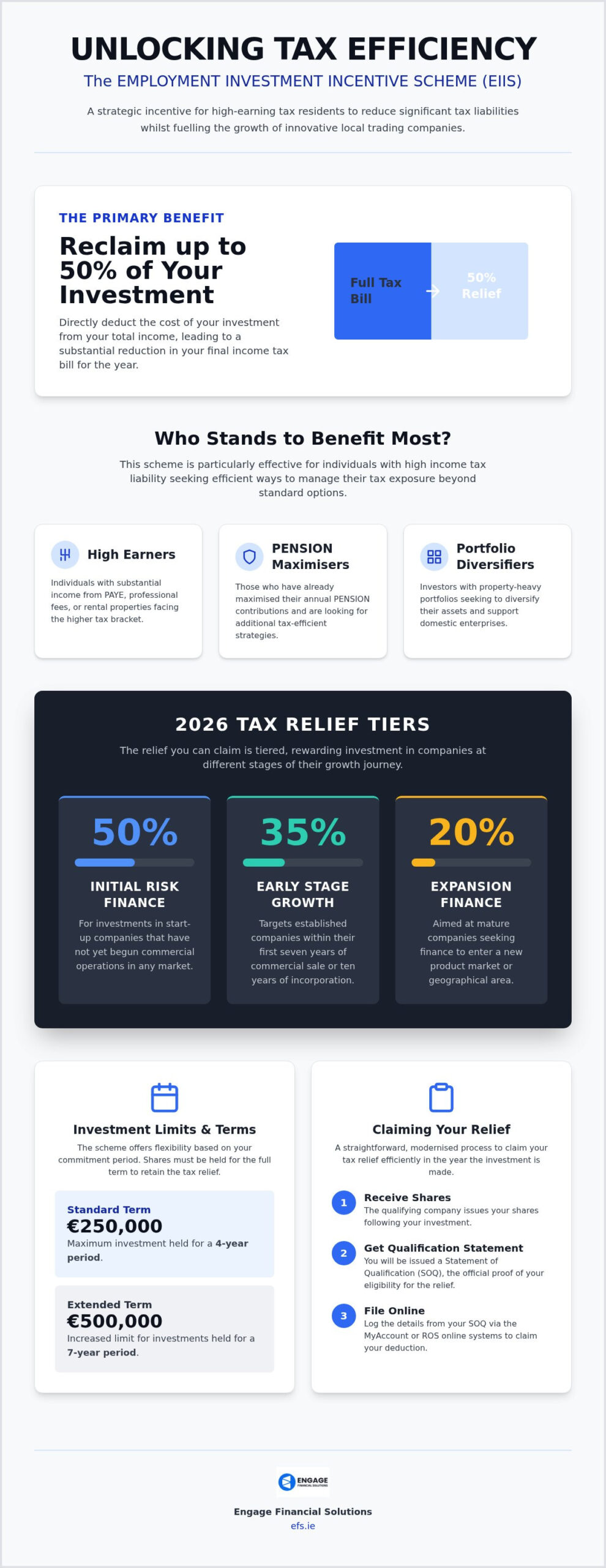
The 50% Relief Tier focuses on “initial risk finance” for companies that haven’t yet operated in any market. It’s the most generous level, acknowledging the higher stakes of backing a pre-revenue business. The 35% Relief Tier is the most common, targeting established companies within their first seven years of commercial sale or ten years of incorporation. Finally, the 20% Relief Tier is available for mature companies seeking “expansion risk finance” to fund a new economic activity or enter a new market. Your investment capacity is also flexible; you can invest up to €250,000 for a four-year holding period. If you are in a position to commit for longer, the limit increases to €500,000 for a seven-year term.
Holding Periods and Capital Growth
To safeguard your tax relief, you must hold your shares for the full mandatory term. If you sell early, the tax benefit is clawed back by Revenue. Whilst the primary draw is the reduction in your income tax bill, the long-term potential for capital growth shouldn’t be overlooked. A successful investment can provide a significant after-tax return beyond the initial saving, contributing to your overall wealth and security. This “future-back” perspective allows you to see the investment as a building block for long-term stability.
Claiming Your Relief from Revenue
Claiming your relief is a straightforward digital process that removes much of the traditional friction associated with tax incentives. Once the company issues your shares, you’ll receive a Statement of Qualification, which is the certificate needed to prove your eligibility. You then simply log this through the MyAccount or ROS systems. As per the Official EIIS Guidelines, the full relief is usually applied in the year the investment is made. Navigating these tiers requires a meticulous approach to ensure every detail is handled correctly, and having a steady guide can make the entire transition feel seamless.
Evaluating Risk: Direct Investment versus Managed EIIS Funds
Choosing how to allocate your capital is a pivotal decision that requires a balance between ambition and security. You can opt for Direct Investment, where you select a specific company to support. This path offers the potential for high rewards if the business flourishes, but it also carries concentrated risk. If that single company struggles, your capital is directly impacted. Alternatively, Managed EIIS Funds allow you to spread your capital across a portfolio of diverse companies. This diversification helps to safeguard your overall position by ensuring that your success isn’t tied to the performance of just one entity. Whilst EIIS Ireland offers significant tax relief, your capital is at risk because these are unquoted companies that don’t have the same liquidity as those on a public exchange.
Professional due diligence is the cornerstone of a successful strategy. When you choose a fund, you’re relying on experienced managers to vet each opportunity, assess the management team, and scrutinise the business plan. If you go the direct route, the responsibility for vetting the business falls entirely on your shoulders. This PwC Analysis of EIIS Changes highlights how evolving regulations and market conditions make professional oversight even more vital for those looking to protect their wealth. A steady guide can help you navigate these choices, ensuring that your approach is both methodical and aligned with your long-term goals.
Exemption from the High Earners Restriction
One of the most compelling aspects of the scheme is its status regarding the High Earners Restriction. Unlike many other tax credits and reliefs, EIIS is not subject to the usual limits that cap the amount of relief high earners can claim in a single year. This unique feature makes it a premier tool for those with very high annual incomes who may have already reached the limits on other relief mechanisms. You can use this incentive alongside your PENSION or other financial planning tools without any conflict. It provides a flexible and powerful way to manage your tax bill whilst your other SAVINGS and INVESTMENTS continue to grow in the background.
Liquidity and Exit Strategies
The “locked-in” nature of this incentive means you won’t have access to your capital for a minimum of four years. Because of this, liquidity must be a primary consideration before you commit. Managed funds typically plan for exits through company buy-backs, trade sales, or third-party refinances once the mandatory term expires. It’s essential to only invest capital that you don’t anticipate needing for the medium term. This ensures your financial stability remains intact whilst you wait for the investment to mature. Our team at Engage Financial Solutions can help you evaluate your current cash flow to ensure that any commitment you make supports your future-back perspective on wealth.
The Practical Journey: Selection to Completion
Moving from the theoretical benefits of EIIS Ireland to the actual investment requires a methodical and well-timed approach. The transition should feel seamless, ensuring that every administrative detail is handled with precision to protect your tax relief. By following a structured path, you can neutralise the stress often associated with complex financial schemes. The journey typically involves four key milestones:
- Step 1: Consultation. Speak with a financial advisor to ensure the investment aligns with your broader goals for your PENSIONS and overall wealth.
- Step 2: Review. Examine available opportunities or fund prospectuses for the current tax year to find the right risk-reward balance.
- Step 3: Subscription. Complete the necessary paperwork and transfer your funds well before the year-end deadline to secure your relief for the current period.
- Step 4: Certification. Receive formal confirmation of your share issue and the subsequent tax certificate required for your return.
If you are ready to begin this process with a steady guide, contact our experienced team for personalised guidance through every stage.
Timing Your Investment
In this market, the vast majority of activity occurs during the final quarter of the year. Many people wait until October or November to assess their total annual income and tax liability. However, starting your review process as early as September allows you to avoid the “December rush” when popular funds may reach their capacity. By understanding how EIIS Ireland operates within the annual tax cycle, you can better time your capital deployment. Proactive planning ensures you have ample time for due diligence, and prompt action often leads to a faster recovery of your capital through tax savings.
Required Documentation for Investors
To ensure a straightforward subscription, you’ll need to provide several essential documents. These typically include proof of identity, proof of address, and your relevant tax reference numbers. Once the investment is finalised, the company will issue an EIIS 3 certificate. This document is your “golden ticket” for claiming relief from Revenue, as it confirms that the company and the investment meet all legislative requirements. It’s vital to keep these records in a secure place for at least six years following your investment, as they may be required during a routine review of your tax affairs.
Integrating EIIS into Your Holistic Financial Strategy
A truly effective financial plan doesn’t look at tax incentives in isolation. Instead, it views them as interconnected pieces of a larger puzzle. When you consider the benefits of EIIS Ireland, it’s helpful to see how the immediate tax relief can amplify your other goals. For instance, the tax you reclaim can be strategically redirected into your PENSION, effectively allowing you to fund your retirement using money that would otherwise have gone to the tax authorities. This synergy creates a powerful cycle of wealth preservation and growth that supports your long-term security.
Balancing risk is equally vital for maintaining peace of mind. Whilst the potential returns from unquoted companies are attractive, they should only form a tailored portion of a diversified portfolio. A healthy strategy ensures that your high-growth assets are supported by more liquid SAVINGS and traditional INVESTMENTS. Whether you are planning for a major life event or simply looking to protect your family’s future, this incentive can also play a role in inheritance planning. By holding these shares, you are building a tangible asset that can be part of a long-term wealth transfer strategy, provided the mandatory holding periods are respected.
Beyond the Tax Break: Wealth Creation
It’s easy to focus solely on the immediate deduction, but the real value lies in building a “future-back” portfolio. This perspective starts with your end goals, such as a comfortable retirement or a legacy for your children, and works backward to today’s actions. There’s also a unique satisfaction that comes from seeing local businesses thrive amongst your community because of your support. At Engage Financial Solutions, we’re committed to providing the stable, professional guidance you need to ensure these investments fit seamlessly into your lifestyle. We act as your steady guide, helping you navigate the complexities of the market whilst you focus on what matters most.
Next Steps with Engage Financial Solutions
Taking the next step towards tax efficiency should be a straightforward and stress-free experience. We invite you to a personalised consultation where we can review your current tax position and determine if this scheme aligns with your broader aspirations. Our expertise isn’t limited to tax incentives; we provide a full-stack service that covers MORTGAGES, LIFE INSURANCE, and comprehensive RETIREMENT PLANNING. By looking at your entire financial landscape, we ensure that every decision you make today contributes to a more secure and optimistic tomorrow. Learn more about our comprehensive financial planning services and discover how we can help you tailor a solution that meets your specific needs.
Securing Your Financial Future Through Strategic Relief
Taking a proactive approach to your tax strategy allows you to turn a standard liability into a powerful engine for wealth creation. By understanding the tiered relief structure and the importance of diversification, you can protect your capital whilst fostering the growth of local enterprises. Whether you are aiming to maximise the 50% relief tier or seeking the stability of a managed fund, the key is to ensure these decisions fit seamlessly within your wider portfolio of PENSIONS and SAVINGS.
Navigating the specific requirements of EIIS Ireland requires a meticulous eye for detail and a steady hand. As an independent and professional advisory regulated by the Central Bank, we specialise in local financial market navigation to ensure your transition is straightforward and stress-free. It’s a methodical way to bridge the gap between complex legislation and your long-term aspirations for security and optimism.
Ready to take control of your annual tax bill? Book a consultation with our expert team to organise your tax strategy and discover how we can tailor a solution that safeguards your future. We look forward to helping you achieve a more efficient and stable financial path.
Frequently Asked Questions
Is EIIS better than a PENSION for tax relief?
It depends on your specific goals, but these tools are often used together rather than as direct competitors. A PENSION provides tax-free growth and relief at your marginal rate, whilst the incentive offers a high upfront deduction of up to 50% for 2026. Many investors choose this route once they’ve reached their annual PENSION contribution limits. It’s an additional layer for tax efficiency that supports your overall financial security.
Can I lose my money in an EIIS investment?
Yes, your capital is at risk when you invest in unquoted companies. Because these businesses are in earlier stages of development, there’s a possibility they may not succeed. The tax relief acts as a significant buffer, essentially reducing your net cost of investment from the outset. You should ensure any commitment is part of a diversified portfolio that includes more liquid SAVINGS and traditional INVESTMENTS to maintain stability.
What happens if the company I invest in fails?
If the company fails, you may lose the original capital you invested. However, the income tax relief you’ve already claimed is generally not clawed back by Revenue in the event of a genuine business failure. This means your maximum exposure is limited to the net amount invested after the tax saving. It’s a risk-reward trade-off that requires a methodical approach and careful due diligence before you commit any funds.
How much is the maximum I can invest in one year?
For the 2026 tax year, you can invest up to €250,000 annually if you hold the shares for at least four years. If you’re willing to commit to a longer seven-year term, the maximum investment limit increases to €500,000. These limits apply to the total amount on which you can claim relief in a single tax year, providing substantial scope for high earners to reduce their annual tax bill.
Do I need to be a tax resident to claim the relief?
Yes, you must have a domestic income tax liability to benefit from the scheme. The relief works by deducting the investment amount from your total taxable income. If you don’t pay income tax within this jurisdiction, there’s no liability to reduce. This makes EIIS Ireland a specific tool for those with significant PAYE, professional, or rental income who want to protect their wealth from high tax rates.
Can I use EIIS to reduce my Capital Gains Tax?
No, the relief is strictly for income tax purposes and cannot be used to offset Capital Gains Tax (CGT). It also doesn’t reduce Universal Social Charge (USC) or Pay Related Social Insurance (PRSI) payments. It’s designed specifically to lower your income tax liability. If the investment grows in value and you eventually sell the shares at a profit, that gain may be subject to CGT at the prevailing rate.
How long do I have to hold the shares?
You must hold the shares for a minimum of four years to retain your tax relief for investments up to €250,000. If you’ve opted for the higher €500,000 limit, a seven-year holding period is required. Disposing of the shares before these mandatory terms expire will result in a clawback of the relief by Revenue. It’s vital to plan for this medium-term commitment as part of your holistic financial strategy.
What is the difference between direct EIIS and an EIIS fund?
Direct investment involves buying shares in one specific company, which offers high potential rewards but concentrated risk. An EIIS Ireland fund spreads your capital across a portfolio of several different businesses to diversify your exposure. This helps to safeguard your overall position. Funds also provide professional due diligence, whereas direct investors are responsible for vetting the company’s management team and business plan themselves to ensure it’s a secure fit.
Disclaimer
Engage Financial Services LTD T/A Engage Financial Solutions is regulated by the Central Bank of Ireland CRO 764570. Director David Moore. Suite 2 First Floor, 14 -18 Main street, Blackrock, Co Dublin A94 W0Y3