


What if a few minor spending habits or a lack of clear documentation were the only things standing between you and your new front door? It is a common concern for many aspiring homeowners, especially when trying to understand what mortgage lenders look for during the assessment process. You have likely spent years diligently saving a deposit, yet the thought of a lender scrutinising your bank statements can feel intrusive. It is vital to remember that banks aren’t just looking at your current balance; they are searching for a proven pattern of financial stewardship and the long-term stability required to manage a significant loan.
We act as the buffer between you and the lender’s complexity, providing the calm competence you need to move forward with confidence. Preparation is the key to progress. Whether you are seeking a FIRST-TIME BUYER MORTGAGE or exploring options for SWITCHING MORTGAGES, you will discover the specific criteria used to assess your suitability. We will explore current Central Bank limits, such as the four times income rule, and outline a clear roadmap to becoming “mortgage ready.” By helping you organise your finances so your behaviour aligns with professional standards, we ensure a seamless path toward securing a tailored MORTGAGE with favourable terms and long-term security.
Key Takeaways
- Understand how lenders evaluate your repayment capacity by distinguishing between your basic salary and variable income components.
- Discover what mortgage lenders look for when reviewing your six-month bank statement history to ensure your financial behaviour meets their standards.
- Learn about current regulatory lending limits, including Loan-to-Income ratios and the 10% deposit required for a FIRST-TIME BUYER MORTGAGE.
- Follow a structured six-month roadmap to organise your documentation and prepare for a seamless MORTGAGE application process.
- Explore how an independent broker acts as a buffer between you and the lender, managing the stress of the application on your behalf.
Proving Financial Capacity Through Sustainable Income
Understanding what a mortgage is involves more than just picking a house; it’s about proving you can support the debt long-term. When considering what mortgage lenders look for Ireland applicants often focus on the total loan amount, but banks focus on “repayment capacity.” This is your demonstrated ability to meet monthly repayments whilst maintaining a reasonable standard of living. Lenders assess this by looking at your net monthly income and comparing it against your existing financial commitments to ensure you aren’t overstretched.
Primary Income and Employment Status
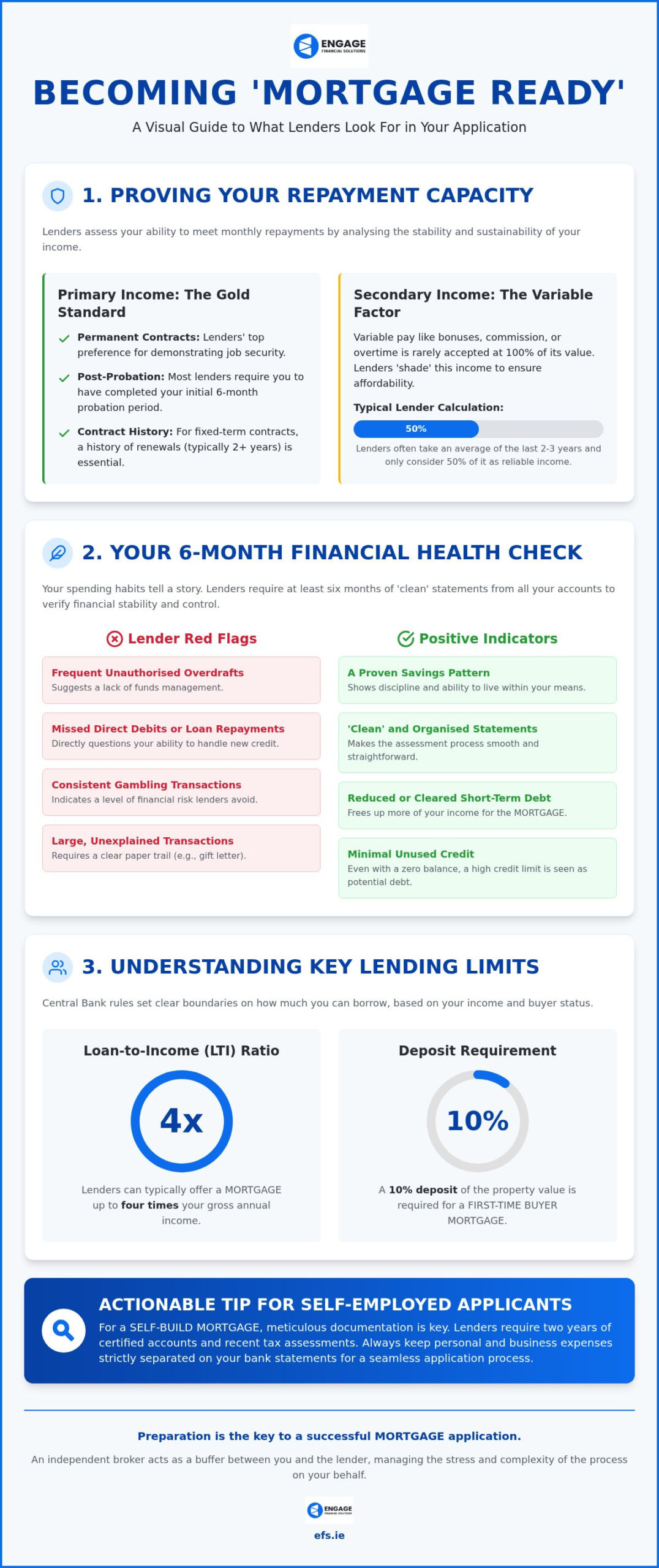
Permanent contracts remain the gold standard for any MORTGAGE lender. Banks seek the security of a steady paycheck, which is why the “probation period” rule is so strictly applied. Most lenders require you to have completed your initial six-month probation before they will issue a full letter of offer. If you’re in the public sector, your guaranteed increments are viewed as highly stable and predictable. Conversely, private sector employees must often provide a longer history of employment to demonstrate the same level of security. For those in professional services on fixed-term contracts, lenders typically look for a track record of at least two years of continuous employment in the same industry with clear evidence of contract renewals.
Secondary Income and Sustainability
Variable pay, such as bonuses, commission, or overtime, is rarely accepted at 100% of its value. Instead, lenders will “shade” or discount these figures. A common approach is to take an average of these payments over the last two or three years and apply a percentage, often 50%, to the final calculation. This ensures the loan remains affordable even if a bonus isn’t paid one year. Rental income from existing properties or certain social welfare payments might be included, provided they are documented and recurring. Sustainable income is the foundation of any loan application, representing the reliable financial core that safeguards your future home.
If you are preparing for a SELF-BUILD MORTGAGE as a self-employed applicant, your documentation must be meticulous. Lenders generally require two years of certified accounts and your most recent Chapter 4 tax assessments from Revenue. Keeping your personal and business expenses strictly separated on your bank statements will create the seamless application process that lenders prefer. You can find more tailored advice on preparing your financial roadmap at Engage Financial Solutions.
Managing Your Financial Behaviour and Credit Profile
Lenders don’t just want to see how much you earn; they want to see how you choose to spend. When investigating what mortgage lenders look for Ireland applicants often find that their daily habits are just as important as their annual salary. Banks use your bank statements to “stress test” your lifestyle, ensuring that your financial behaviour aligns with the long-term commitment of a home loan. They are looking for a pattern of stability that suggests you can handle the responsibility of a monthly repayment without falling into financial distress.
Analysing Bank Statements for ‘Red Flags’
Your bank statements tell a story of your priorities. Lenders typically require at least six months of “clean” statements for every account you hold, including digital banks like Revolut. Frequent use of an unauthorised overdraft or missed direct debits are significant red flags that suggest a lack of financial control. Similarly, consistent gambling transactions can stall an application, as they indicate a level of risk that banks are often unwilling to accept. If you have large, non-recurring transactions, such as a one-off gift or a major purchase, it is best to have the paper trail ready. Clear documentation removes friction and helps your advisor present your case in the best possible light.
The Role of Existing Credit and Debt
Every loan over €500 is recorded on the Central Credit Register. Lenders check this report to see your history with personal loans, car finance, and credit cards. Existing debt directly impacts your borrowing capacity because it reduces the amount of disposable income you have available for a MORTGAGE. In some cases, closing an unused credit card can actually improve your standing. Even with a zero balance, a high credit limit is viewed as potential debt that you could tap into at any time. Balancing your debt-to-income ratio is a vital part of meeting the Regulatory Lending Limits set by the Central Bank. You can check your own credit report for free before applying to ensure there are no surprises or errors that need correcting.
If your proposed MORTGAGE repayment is higher than your current rent, you should bridge that gap through regular savings. For example, if your rent is €1,200 and your expected repayment is €1,500, saving at least €300 every month proves to the lender that you can already afford the higher cost. This consistent behaviour creates a “shadow” repayment pattern that builds immense confidence in your application. If you’re unsure how your current debts might affect your application, you can organise a consultation to review your financial roadmap.
Understanding Regulatory Lending Limits and Requirements
Whilst your personal spending habits are a vital part of the assessment, your borrowing power is ultimately governed by strict regulatory measures. These rules ensure that the local property market remains stable and that borrowers do not take on unsustainable levels of debt. When you begin to research what mortgage lenders look for, you will find that the primary frameworks involve how much you can borrow relative to your income and how much of a deposit you must provide from your own resources.
Loan-to-Income (LTI) Ratios and Borrowing Power
The Loan-to-Income limit is a calculation used to determine your maximum loan based on your gross annual earnings. For a FIRST-TIME BUYER MORTGAGE, the current limit allows you to borrow up to 4 times your gross annual income. If you are a mover or a second-time buyer, this limit is slightly tighter, typically capped at 3.5 times your income. For joint applications, lenders combine both salaries before applying the multiple, which significantly increases your potential budget. The following table illustrates how these limits apply across different income levels:
| Gross Annual Income | First-Time Buyer Limit (4x) | Mover/Second-Time Buyer (3.5x) |
|---|---|---|
| €70,000 | €280,000 | €245,000 |
| €100,000 | €400,000 | €350,000 |
| €130,000 | €520,000 | €455,000 |
It is worth noting that lenders have a limited allowance to grant “exceptions” to these rules. In 2026, banks can allocate up to 15% of their total lending to first-time buyers and movers at levels above these standard multiples. Securing an exception requires a particularly strong financial profile, and an independent broker often acts as the buffer to help you navigate these complex criteria.
Loan-to-Value (LTV) and Your Deposit
The Loan-to-Value ratio represents the percentage of the property’s price that you are borrowing versus the amount you are providing as a deposit. In the current market, both first-time buyers and movers are required to provide a minimum deposit of 10%, meaning a 90% LTV. You must organise your finances early to ensure these funds are readily available and can be clearly tracked through your bank statements.
Government initiatives can also play a significant role in meeting these requirements. For instance, the Help to Buy scheme or the First Home Scheme can assist in bridging the gap between your savings and the required 10% deposit for new-build homes. You can find more detail on these supports in our First Time Buyer Mortgage Guide. Providing a larger deposit than the 10% minimum can often lead to more competitive interest rates, as it reduces the risk for the lender and increases your long-term financial security.
How to Organise Your Finances for a Seamless Application
Securing a MORTGAGE is a journey that begins long before you attend your first viewing. To ensure a straightforward approval, you must align your financial profile with the specific criteria that define what mortgage lenders look for. By taking a proactive approach to your bank statements and documentation, you can remove potential friction and present yourself as a reliable borrower from the very start.
The Six-Month Preparation Strategy
A methodical countdown is the most effective way to become “mortgage ready.” Between months six and four, your priority should be stabilising your financial behaviour. This involves clearing minor debts, such as credit card balances or small personal loans, and ensuring you stay well within any agreed overdraft limits. Banks prefer to see a clean slate where your income isn’t being diverted to high-interest short-term credit.
From month three to month one, the focus shifts to proving your repayment capacity. You must ensure all savings are regular, traceable, and made into a dedicated account. Avoid moving large sums of cash between accounts without a clear paper trail, as this can trigger unnecessary queries during the assessment. In the final month, you should gather your most recent salary certificates and employment detail summaries to ensure your application reflects your current earning power.
Document Checklist for Success
Lenders require a comprehensive set of records to verify your identity and financial standing. Having these ready in advance prevents delays that could cause you to miss out on a property. Your checklist should include:
- Identity Verification: A valid passport or driving licence, along with two recent utility bills to confirm your current address.
- Employment Evidence: Your most recent Employment Detail Summary from Revenue, three to six months of consecutive payslips, and a Salary Certificate signed by your employer.
- Financial History: Six months of statements for every account you hold, including savings, current accounts, and any digital banking platforms.
It is also vital to consider your protection requirements early in the process. Lenders will not allow you to draw down your loan without a valid MORTGAGE PROTECTION policy in place. Obtaining LIFE INSURANCE quotes alongside your application ensures that this final hurdle doesn’t slow down your move-in date. To start building your personalised financial roadmap, contact our expert team today for professional guidance.
Organise all your digital and physical records into a single, secure folder. Label every PDF statement clearly by month and account type. This level of meticulous organisation allows your advisor to submit a complete, high-quality application, which significantly improves the speed of your approval.
Partnering with a Consultant for Long-Term Financial Success
Navigating the mortgage market alone can feel like a fragmented experience, especially when trying to decipher the subtle differences between various institutions. When you understand what mortgage lenders look for Ireland applicants often realise that each institution has a slightly different set of internal rules and risk appetites. An independent broker acts as your buffer, using professional expertise to translate your financial history into a compelling narrative that meets these diverse criteria. Rather than approaching a single bank, you gain access to a broad panel of lenders, ensuring your application is positioned where it has the highest probability of success.
Navigating the Market with Calm Competence
The true value of a professional advisor lies in their ability to remove friction from what is often a high-pressure transition. We don’t just submit paperwork; we tailor your application to highlight your specific financial strengths, whether you are a first-time buyer or looking to move. Having a single point of contact for your MORTGAGE, PENSIONS, and INSURANCE provides a holistic view of your financial health. This integrated approach ensures that your new loan doesn’t exist in a vacuum but supports your overall lifestyle. If you are already a homeowner, our Switching Mortgage Guide explains how regular reviews can continue to save you money long after your first approval.
Securing Your Future Beyond the Approval
Approval is just the first step toward long-term security. A robust financial plan must safeguard your home against life’s uncertainties. This is why MORTGAGE PROTECTION is more than a regulatory requirement; it is a fundamental pillar of your family’s stability. We also recommend reviewing your INCOME PROTECTION to ensure that your repayments are covered even if you are unable to work due to illness or injury. By staying informed about what mortgage lenders look for Ireland borrowers can position themselves for better terms both now and in the future. Our goal is to ensure that your home remains a source of comfort rather than a source of financial strain.
Schedule a full financial review shortly after your loan draws down. This allows you to align your new monthly commitments with your broader SAVINGS AND INVESTMENTS strategy and your RETIREMENT PLANNING. Ensuring that your MORTGAGE fits seamlessly into your long-term goals is the key to true financial freedom. You can contact us to organise a tailored roadmap for your complete financial journey.
Your Seamless Path to Home Ownership
Becoming “mortgage ready” is a methodical process that rewards those who plan ahead. By stabilising your spending habits and organising your documentation early, you transform a complex regulatory hurdle into a straightforward financial transition. Understanding what mortgage lenders look for Ireland is about more than just your current bank balance; it’s about proving a consistent pattern of financial stewardship. Whether you are seeking your first home or looking to switch for better terms, expert guidance ensures you navigate the market with confidence and ease.
At Engage Financial Solutions, we provide personalised roadmaps for long-term financial security. As a firm regulated by the Central Bank, we act as your buffer, offering expert guidance across a panel of leading lenders to find your perfect fit. We handle the friction of the application so you can focus on the excitement of your move. Secure your financial future with a tailored MORTGAGE consultation today and take the first step toward a seamless approval. Your future home is closer than you think.
Frequently Asked Questions
How many months of bank statements do mortgage lenders usually require?
Lenders typically require six months of consecutive bank statements for all your current and savings accounts. This period allows them to assess your spending behaviour and confirm that your savings pattern is consistent. They will look for any unauthorised overdraft use or returned payments during this time. Providing clean statements for this duration is a key part of what mortgage lenders look for when assessing applicants for a new home loan.
Can I get a MORTGAGE if I have a personal loan or car finance?
You can certainly secure a MORTGAGE whilst holding other debts; however, these repayments will be deducted from your total borrowing capacity. Lenders calculate your “net disposable income” after all existing loan commitments are met. If your car finance or personal loan repayments are high, it may reduce the maximum loan amount a bank is willing to offer you. It’s often beneficial to clear smaller debts before submitting your application.
What is the minimum deposit needed for a FIRST-TIME BUYER MORTGAGE?
The minimum deposit required for a FIRST-TIME BUYER MORTGAGE is 10% of the property’s purchase price. This means you can borrow up to 90% of the value, known as the Loan-to-Value (LTV) ratio. For a property valued at €350,000, you would need a minimum deposit of €35,000. These funds can come from your own savings, government schemes like Help to Buy, or a gift from a family member.
Does being on a probation period affect my MORTGAGE approval?
Most lenders require you to have completed your initial probation period and be in a permanent role before they will issue a full MORTGAGE offer. Whilst some banks may consider an application if you are near the end of your probation, the standard rule is six months of permanent employment. This provides the lender with the necessary security regarding your income stability and your long-term ability to meet the monthly repayments.
How do lenders view gifts from family members for a deposit?
Lenders generally accept gifted deposits from parents or close relatives, provided the donor signs a “deed of gift” or a gift letter. This document confirms that the money is a non-repayable gift and that the donor will have no legal interest in the property. Whilst a gift helps meet the 10% requirement, banks still prefer to see that you have a proven track record of regular personal savings.
What happens if my MORTGAGE application is refused by a lender?
If your application is refused, the first step is to request a clear explanation for the decision. Common reasons include issues with credit history, insufficient repayment capacity, or “red flags” on bank statements. A refusal from one lender doesn’t mean you can’t get a loan elsewhere. An independent broker can review your profile and identify which alternative lender’s criteria might be a better fit for your specific financial circumstances.
Is LIFE INSURANCE mandatory when taking out a home loan?
MORTGAGE PROTECTION is a specific type of LIFE INSURANCE that is legally mandatory for most residential home loans. This policy ensures the loan is cleared if a borrower passes away during the term. Whilst you must have this cover in place before your loan draws down, you are not obliged to purchase it from your lender. You can shop around to find more competitive rates or tailored cover that better suits your needs.
How does the Central Bank’s LTI limit affect how much I can borrow?
The Loan-to-Income (LTI) limit restricts your borrowing based on your gross annual earnings. For a FIRST-TIME BUYER MORTGAGE, you can generally borrow up to 4 times your income. If you are a mover or a second-time buyer, the limit is typically 3.5 times your income. These rules are a core component of what mortgage lenders look for when determining your borrowing power. Some exceptions are available for applicants with strong financial profiles.
Disclaimer
Engage Financial Services LTD T/A Engage Financial Solutions is regulated by the Central Bank of Ireland CRO 764570. Suite 2 First Floor, 14 -18 Main street, Blackrock, Co Dublin. A94 W0Y3