

Your pension balance alone can’t tell you whether you’re saving enough. A 4% withdrawal illustration can help estimate the income a pension pot might provide over a 30-year retirement, but your target depends on spending, when you retire and how long your savings need to last.
It’s understandable to want a clear figure, especially if you’re wondering how much you need to retire at 60. Retiring then means planning for the years before the State Pension becomes available at 66, as well as the years that follow. Your target also needs to account for inflation and changing investment returns.
This guide will help you estimate the retirement savings you may need from your desired income, assess likely costs and understand how withdrawal choices, including an ARF or an annuity, can shape your income. You’ll also learn how to review your savings and contributions and identify practical steps towards a more secure retirement plan.
Key Takeaways
- Use the 4% withdrawal illustration as a starting point for estimating what a pension pot might provide, not as a personalised target.
- Set an income goal by separating essential spending from the extras that would make retirement comfortable.
- Factor in housing costs when estimating your retirement budget, particularly if you expect to rent or still have a mortgage.
- Stress-test your plan against inflation, changing investment returns and the possibility of a long retirement.
- Review your age, salary and current contributions together to identify where an adjustment could strengthen your future income.
Estimating pension pot sizes using a 4% withdrawal illustration
A 4% withdrawal illustration estimates an initial annual income by multiplying your pension pot by 0.04. A €500,000 pot gives about €20,000 a year; €750,000 gives €30,000; and €1 million gives €40,000 before tax. This rule of thumb is based on a 30-year retirement horizon, so it is a starting estimate, not a personal forecast.
Work backwards from your target. If you want €40,000 annual income, first subtract the State Pension you expect to receive; then estimate how much private pension income must fill the gap. The maximum State Pension (Contributory) used in the calculations is €15,564 per year. Your entitlement depends on your PRSI record, so don’t assume you’ll receive the maximum.
Occupational pensions are arranged through an employer. A defined benefit scheme provides a pension calculated under its rules, often linked to salary and service. A defined contribution scheme builds a pot from contributions and investment returns. With a PRSA or personal pension, you save for retirement through an individual arrangement. A PRSA is a personal retirement account, while a personal pension is another type of individually arranged pension.
For tax relief, the maximum contribution limits are linked to age: 30% of earnings for ages 50-54, 35% for ages 55-59 and 40% from age 60. The earnings limit used to calculate relief is €115,000. These are limits, not guaranteed relief amounts; your eligible contribution and tax position affect the relief available.
To check your State Pension contribution record, request your contribution statement from the Department of Social Protection. The minimum qualifying record is 520 PRSI contributions; 2,080 contributions qualify for the maximum State Contributory Pension rate. Compare that record with your pension scheme statements to see what income each source may provide.
Then compare your current contributions with your target and retirement date. For example, someone earning €61,908 who starts saving at age 30 would need to contribute 22% of salary, or €1,135 monthly, to target €40,860 by age 66. Starting at age 35, the example rises to 27%, or €1,393 monthly.
Include employer contributions in your total. A €300 employee contribution plus €300 from an employer means €600 enters the pension before contribution deductions. Check whether your scheme’s projection includes both amounts, and consider increasing contributions gradually when your budget allows. This gives you a clearer view of whether your pension, State Pension and other income can meet your retirement target.
What is a comfortable pension for retirement?
There’s no single income figure that suits every household. The amount you may need for retirement depends on your housing, regular expenses and the activities you want to keep.
Comparing retirement lifestyle levels
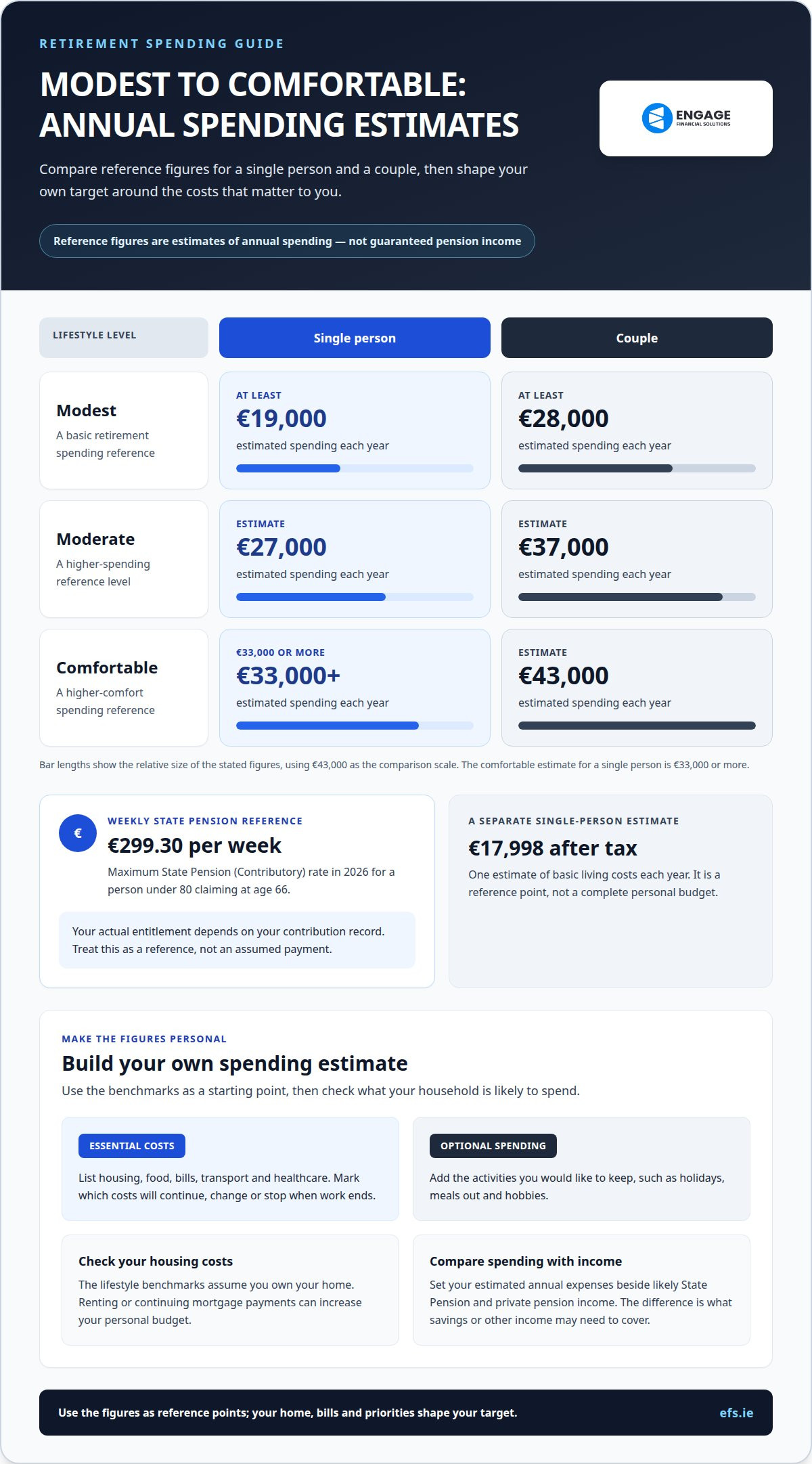
Modest, moderate and comfortable describe different spending standards, rather than fixed pension products or guaranteed income levels. Pensions Council research from 2024 estimates annual spending of at least €19,000 for a single person and €28,000 for a couple for a modest retirement. For a moderate standard, the estimates are €27,000 and €37,000 respectively; comfortable figures are €33,000 or more for a single person and €43,000 for a couple. Use these as reference points, then shape your target around your own priorities.
Retirement lifestyle expenses
Retirement expenses are the costs your income needs to cover, from household bills to leisure activities that matter to you. Lifestyle benchmarks assume retirees own their homes, so renting or continuing mortgage payments can increase your personal budget. List essential costs separately from optional spending to see how much income you need for daily expenses and how much would support a more comfortable lifestyle.
For context, the maximum State Pension (Contributory) rate for a person under 80 claiming at age 66 is €299.30 per week in 2026. That provides a baseline, but your actual entitlement depends on your contribution record. A State Pension alone may not meet a moderate or comfortable spending target, so include other expected income when estimating the gap.
Try a simple budget exercise. Group expected expenses into housing, food, transport, bills, healthcare and leisure. Mark each as essential or optional, then consider how it might change after work ends. For example, commuting costs may fall, while heating or travel spending could change. Your own spending pattern matters more than a general lifestyle label.
Household circumstances also shape your target. A couple can share some costs, while a single person pays household expenses alone. Research benchmarks reflect these different spending needs. If you plan to support family or move home, include those choices in your estimate rather than relying on a standard figure.
Compare your estimated annual expenses with likely income from the State Pension and private pensions. The difference is the amount your savings or other income sources may need to cover. A retirement income plan can help bring spending assumptions and expected income together, giving you a clearer basis for setting a target.
Estimated annual retirement costs for single people
For a single person, the retirement budget needs to cover the full household, rather than costs shared with a partner. One estimate puts basic living costs at €17,998 after tax each year. Treat this as a reference point, not a complete personal budget: the amount you need depends on your home, regular bills and chosen activities.
Build your estimate around the expenses you expect to face. Separate essential spending, such as food, utilities and transport, from optional costs, such as holidays, meals out or hobbies. Consider how each might change after work ends. For example, commuting may become less frequent, while spending on travel or home improvements could rise.
Housing can make a particular difference to a single-person budget. Rent, mortgage repayments, maintenance and service charges affect how much pension income remains for other needs. Write down the housing costs you expect in retirement rather than assuming today’s payments will continue unchanged. If you plan to move, compare the likely costs of each option before setting your income target.
Review irregular expenses as well as monthly bills. Replacing an appliance, repairing a car or paying for dental treatment can disrupt your budget if you count only routine spending. Set aside an allowance for occasional costs, based on your plans and past spending. This makes your estimate more realistic without treating every month as identical.
Consider the difference between income before tax and money available for living costs. The €17,998 estimate is after tax, so compare it with the amount you expect to have available, not simply your gross pension income. Your State Pension and private pension income may affect your overall finances differently; map each source separately before assessing the shortfall.
A pension pot estimate is more useful when it reflects your spending pattern. Someone who owns their home and spends modestly may need a different income target from a renter who regularly travels. Avoid relying on a single average: record essential costs first, then add the optional spending that would make retirement comfortable.
Revisit your estimate as your plans change. Changes to housing, health needs or travel plans can shift the balance between essential and optional expenses. Keep a simple annual budget, compare it with projected pension income and note the largest gaps. This gives you a practical basis for adjusting your retirement target and savings plan.
Investment risk, inflation and longevity
Your pension’s value at retirement depends on contributions, investment returns, charges and time invested. To estimate its future value, use your current pot, monthly contributions and expected retirement date, then account for fees and inflation. Without those inputs, a single growth figure cannot show what your money may buy.
Investment risk matters because returns can rise and fall, especially over shorter periods. A fall near retirement can affect your pot just as you’re preparing to draw an income. Review how your savings are invested and whether the level of risk fits your timeframe and plans. Risk affects both potential growth and the possibility of losses.
Charges also affect the amount left invested. A 1% pension management charge, compared with a 0.5% charge, may reduce the final pot by tens of thousands of euro. Check the charges shown in your pension information and include them in any projection. Even a small difference can compound across years of contributions and investment growth.
Inflation changes what your retirement income can buy. At 2% annual inflation, €30,000 in yearly spending would equate to approximately €44,578 after 20 years. At the same rate, the value of money would fall by about half over 35 years. Include rising costs when setting a target for a comfortable retirement.
Longevity affects how long your savings must provide income. A retirement plan beginning at age 60 may need to fund 25-30 or more years. By 2046, projected life expectancy is 85 years for men and 89 years for women. Consider how your income plan would support you if retirement lasts longer than expected.
Monthly contributions and tax relief can affect how much you accumulate, while investment returns and charges influence the final amount. Review your pension projection regularly, especially after changing your contributions or retirement plans. Compare its projected value with future spending, allowing for inflation rather than relying only on today’s euro amount.
Withdrawals create another risk during retirement: taking income after a market fall can leave less invested to recover. A steady withdrawal plan should account for market fluctuations, expected spending and the length of retirement. Revisit it as circumstances change rather than assuming the same withdrawal level will remain suitable throughout.
Retirement savings by age and salary
Your age, earnings, existing pension and planned retirement date all shape how much you may need to save. A common rule of thumb is to target retirement income equal to 40% to 50% of your current salary. The Pensions Council cautions that replacing about 50% of pre-retirement salary can be too simplistic. Treat salary percentages as a starting point, then compare projected income with your expected spending.
One broad savings guide suggests having a pension pot worth one times your annual salary by age 30, three times by age 40 and five times by age 50. These milestones are not personal forecasts. Your starting age, employer contributions, investment returns and retirement plans all affect the result. If your pot is below a milestone, use it as a prompt to review your contributions, not as a reason to assume you cannot catch up.
Starting early gives contributions more time to grow, while delaying can mean saving more later to reach the same target. An example based on an annual salary of €61,908 illustrates how timing can change the required saving rate. Starting at age 30 and targeting €40,860 annual income by age 66 requires saving 22% of salary, or €1,135 monthly. Starting at age 35 raises the example to 27%, or €1,393 monthly.
For the same salary and income target, starting at age 40 means saving 34%, or €1,754 monthly, by age 66. These figures illustrate one scenario, not a universal contribution schedule. Your existing pension, employer contributions and expected State Pension entitlement influence the amount your own savings need to provide.
If you’re asking whether you’re saving enough for retirement, compare your current contributions with your projected income and desired retirement date. If there’s a gap, consider increasing contributions gradually, such as after a pay rise or when another regular expense ends. Considering an increase of 2% or 3% if you’re behind, but your budget and remaining time matter when choosing a sustainable change.
Retiring before age 66 also affects the calculation because your savings may need to cover the years before State Pension income begins. If you plan to stop work at 60, include that bridge period in your estimate, rather than treating all retirement years as one phase. Revisit your figures when your salary, retirement date or expected spending changes.
Turn your age and salary into a practical contribution target with personalised retirement planning, so your savings plan reflects your circumstances and desired retirement date.
Engage Financial Solutions
Engage Financial Solutions can help you consider how your retirement income needs relate to your wider financial commitments. If you’re weighing regular income against flexibility, discuss whether an annuity suits your plans. Income Protection and Mortgage Protection can also form part of your financial planning before retirement, helping you consider how illness or mortgage commitments could affect your household finances.
Bring your estimated expenses, pension statements and preferred retirement date to a discussion. These details can help clarify the income gap you’re planning for and the questions to explore before making decisions. Whether retirement is approaching or still years away, reviewing your plan can help you make informed choices at each stage.
Contact Engage Financial Solutions to discuss your retirement income plans.
Make your next financial decision with confidence
Your retirement plan should evolve as your priorities and circumstances change. Set a regular time to review whether your choices still fit the future you want, and note any decisions that need attention. A written plan can make your next step clearer.
Consider how financial commitments outside your pension affect your long-term flexibility. Changes in work, family responsibilities or housing plans may alter what feels manageable. Looking at these decisions together can help you keep your priorities in view.
Take one practical step today: write down the question you most need answered and the information that would help you decide. A clear starting point can make future choices feel more manageable and keep your plans moving forward.
Frequently Asked Questions
How much do I need to retire at 60?
Start by separating the income you’ll need before State Pension payments begin from income needed later. For example, someone withdrawing €35,000 annually might need around €140,000 to cover the first six years before State Pension age. That is a bridge-funding illustration, not the total pot required for retirement. Add your other income sources and consider how your spending may change across retirement.
Can you retire comfortably with auto-enrolment alone?
Auto-enrolment can build pension savings, but whether it supports your plans depends on your contribution history, pay and investment outcomes. Treat it as one part of your retirement provision. Check how much is accumulating and whether you have other workplace or personal pension savings. If the projected income falls short of your target, consider whether additional contributions or a later retirement date could help close the gap.
How large should your pension pot be?
Work out how much your savings need to provide after accounting for other retirement income. Then consider how you want to take that money: regular guaranteed payments and flexible withdrawals can produce different outcomes. A pot’s headline value alone doesn’t show how long it may last or how much income it can support. Include charges, tax treatment and your preferred balance between certainty and access.
How can a financial adviser help?
A financial adviser can bring together pension statements, income expectations and your preferred retirement choices. They can help you understand how different options work, identify the assumptions behind projections and compare how changes to contributions or timing affect your plan. Before a discussion, gather your scheme details and note any decisions you’re weighing. This helps focus the conversation on practical choices rather than broad estimates.
Is the State Pension enough to live off?
Whether State support covers your needs depends on your actual entitlement and household circumstances. Your PRSI record affects eligibility and the rate payable, so a maximum-rate estimate may not reflect your position. Check your contribution statement and identify any periods that could affect your record. Then consider what private pension income, savings or other resources could supplement State support if it falls short.
How much retirement income do I need?
Set your target by estimating how much you’ll want to spend, then distinguish that from gross income before deductions. Your tax position and how you take pension income affect what reaches your bank account. Consider whether your plans include supporting family, moving home or spending more on travel. Reassess your target when those priorities or your household circumstances change.
What is the current State Pension rate and eligibility age?
In 2026, the maximum State Pension (Contributory) rate for a person under 80 claiming at age 66 is €299.30 per week. You can qualify from age 66, and the Department of Social Protection allows a claim to be deferred until age 70. Your personal payment depends on your PRSI contribution record, so use your own entitlement information for planning rather than assuming the maximum.
What percentage of salary should I contribute to a pension?
Choose a contribution level by comparing your projected retirement income with the amount you want available. Include employer payments in the total and consider how long contributions have to grow. If your plan appears short, test a gradual increase that fits your monthly budget, then review it after changes in pay or expenses. The right contribution level is one that supports your target without making current commitments unmanageable.
Disclaimer
Engage Financial Services LTD T/A Engage Financial Solutions is regulated by the Central Bank of Ireland CRO 764570. Suite 2 First Floor, 14 -18 Main street, Blackrock, Co Dublin. A94 W0Y3