


Starting a pension at 50 isn’t too late. If you’re wondering whether it is too late to start a pension at 50, there’s no upper age limit for starting one, and you may still have years of earnings in which to contribute. The State Pension Contributory is available from age 66 to people who qualify, according to the Department of Social Protection.
It’s understandable to feel that starting later leaves you with less time to build savings. The amount you could have in retirement will depend on factors such as how much you contribute, investment performance and charges, so a pension needs to fit your circumstances and plans.
This guide explains pension tax relief, investment risk and charges, and how working longer could give you more time to save. Whether you hope to retire as soon as possible or stay in work longer, these practical considerations can help you assess your options and plan for retirement income.
Key Takeaways
- Starting a pension at 50 can still give you time to build retirement savings; focus on a contribution level that fits your budget.
- Understand how age-related contribution limits and income tax relief may affect the amount you can contribute.
- Consider investment risk and charges together, as both can affect the value of your pension over time.
- Compare your expected retirement income with your plans to see whether working longer could give your savings more time to grow.
- Review how your pension fits alongside other retirement options, including an Annuity or an Approved Retirement Fund.
Should I delay retirement to build more savings?
Delaying retirement can give you more time to contribute and invest, while postponing withdrawals. Weigh this against your intended retirement date, spending needs and other income.
Growing the pension fund by delaying retirement
Delaying retirement gives your pension fund longer to remain invested and may allow further contributions from your earnings. One estimate suggests delaying retirement from age 66 to 68 could increase a pension fund by 10-15%, although investment returns and charges affect the outcome.
Working longer may also mean drawing on your pension for fewer years. If you’re considering another year or two at work, compare the extra contributions and potential investment growth with the income you’d forgo by retiring later. This can help you judge whether the additional time supports your plans.
Retirement timing, spending goals and income needs
Choose a retirement date based on the income you’ll need for the life you want, not simply a target age. Someone planning to travel or help family, for example, may need a different budget from someone expecting lower day-to-day spending.
People retiring in their 50s or early 60s may need savings to support them for 20-30 years. List your expected regular costs, one-off plans and any debts, then consider how these may change over time. Include the effect of income tax when estimating how much retirement income will be available to spend.
Use your spending estimate to compare retiring earlier with working longer. The key question is whether the income available at each date can support your priorities.
Private pension access and State Pension income
Access to a private pension before State Pension age depends on the pension arrangement and its rules. The State Pension Contributory is available from age 66 to people who qualify, according to the Department of Social Protection.
Can you access a private pension before State Pension age? It may be possible, depending on the access conditions of your arrangement. Treat private pension income and State Pension income as separate parts of your plan, and account for any gap if you expect to stop working before State Pension payments begin.
Check your expected State Pension entitlement alongside your other income before choosing a retirement date. This helps show which years may need to be funded from savings or a private pension, rather than assuming all income sources start at the same time.
Investment risk near retirement
Pension investments can rise or fall in value, and you could get back less than you invest. This is especially relevant as retirement approaches if you expect to withdraw money soon: a fall in value could leave less available for those withdrawals.
Review when you expect to draw on your pension and how much of your income will rely on it. A longer period before withdrawals may give investments more time to recover from falls, while a near-term spending need makes fluctuations more immediate. A 5% real annual growth assumption, net of charges, is an illustration, not a guaranteed return.
Don’t base your decision on a single growth assumption. Consider how different outcomes might affect your retirement date and spending plans, then use that comparison to decide whether to keep working or draw income sooner.
Maximum pension contribution for tax relief at 50?
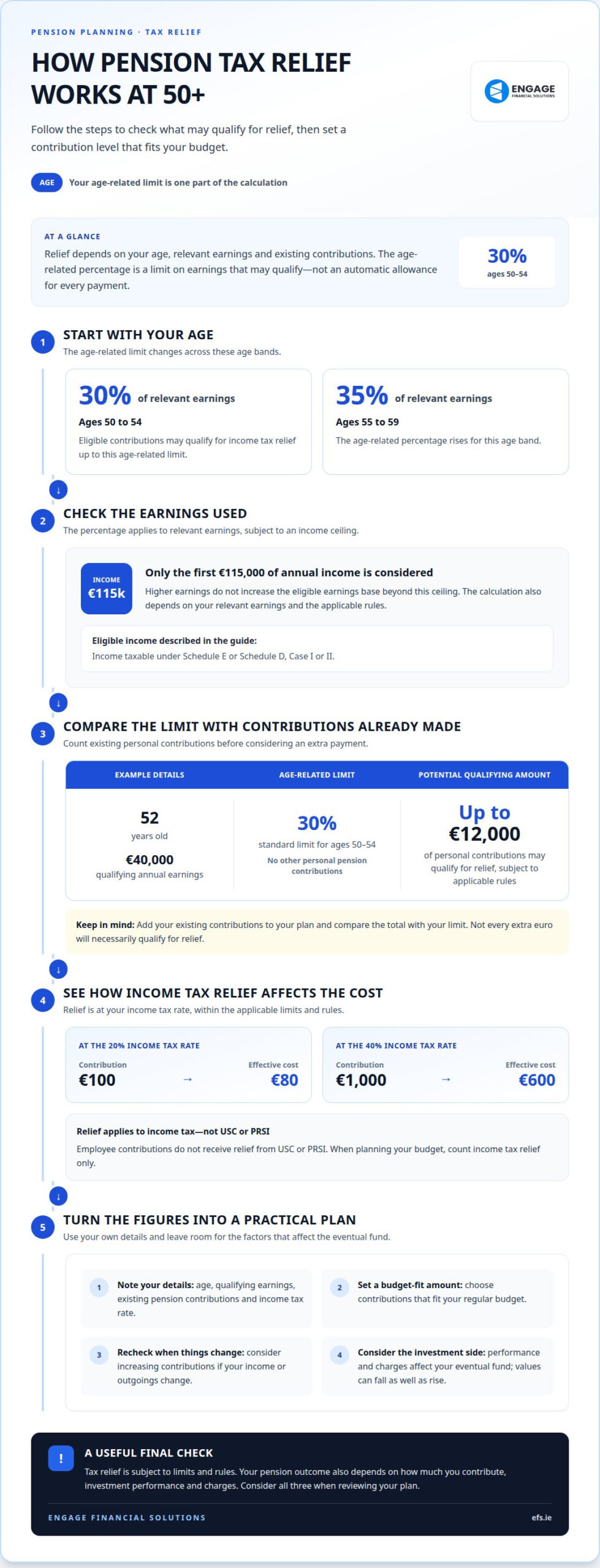
At age 50, eligible pension contributions can qualify for income tax relief within age-related limits. The amount depends on your age, relevant earnings and existing contributions.
After age 50, what tax relief is available? From ages 50 to 54, contributions may qualify for relief up to 30% of income. Relief is at your income tax rate, subject to the applicable limits and rules.
Tax relief on pension contributions
Tax relief reduces the effective cost of eligible pension contributions by giving relief against income tax. At the 20% income tax rate, a qualifying €100 contribution has an effective cost of €80; at the 40% rate, a €1,000 contribution is described as costing €600 after relief.
Relief applies to income taxable under Schedule E or Schedule D, case I or II, and only the first €115,000 of annual income is considered. Employee contributions don’t receive relief from USC or PRSI, so account for income tax relief only when planning your budget.
Age-related limits on tax-relieved contributions
The age-related limit sets the maximum percentage of relevant earnings that can qualify for relief. For ages 50 to 54, the limit is 30%; for ages 55 to 59, it is 35%. The percentage applies to earnings, not automatically to every contribution you make.
For example, a 52-year-old with €40,000 in qualifying annual earnings and no other personal pension contributions may have up to €12,000 of personal contributions qualify for relief under the standard 30% age-related limit, subject to applicable rules. The €115,000 income ceiling also affects the calculation, so higher earnings don’t increase the eligible base beyond that cap.
Choosing and maximising contributions before retirement
Choose contributions that fit your regular budget, then consider increasing them if your income or outgoings change. Before making an additional payment, add up your existing contributions and compare the total with your age-related limit. Not every extra euro will necessarily qualify for tax relief.
Contributions are invested, so your eventual pension fund depends on investment performance and charges as well as how much you pay in. Values can fall as well as rise. Before changing contributions or investments, consider your time to retirement and how comfortable you are with fluctuations.
To make a practical plan, note your age, qualifying earnings, existing pension contributions and tax rate. These details show how much may qualify for relief and what contribution is affordable. Retirement planning can help you bring those figures together with your wider retirement goals.
Investment risk and pension charges
Investment choices and charges affect how much of your contributions may remain in the pension fund. For someone starting at 50, the investment period and planned retirement date help shape the decisions.
A PRSA is a personal retirement account, a Personal Pension is arranged individually, and an Occupational Pension is linked to employment. Terms, investment choices and charges can differ. Compare how each arrangement fits your earnings, contribution plans and intended retirement date.
Investment growth and compounding
Investment growth adds returns to your pension savings. When returns can generate further returns, this is known as compounding and can help a fund grow over time. Growth varies, however, and charges reduce the amount that remains invested.
A projection in the research assumes 5% average annual investment growth in real terms, net of charges. Treat that as an illustration, not a forecast for your own position. Compare projections using the same contribution period, charges and growth assumptions, so you can see which differences drive the result.
Investment risk for late starters
Investment risk is the possibility that your pension investments will lose value, including when you need to access them. Values can rise or fall, and you could get back less than you invested.
If you start at 50 and plan to retire at 66, your money could remain invested for 16 years. That period gives investments time to grow, but it also means market falls can affect your fund. Consider how a fall near your planned retirement date could affect the income you expect to take.
Risk involves more than choosing cautious or higher-growth investments. Your retirement date, expected withdrawals and ability to keep contributing all matter. A sudden market fall may have a greater impact if you need to withdraw soon than if your pension can remain invested.
Charges and comparing pension arrangements
Charges reduce the amount left invested, so consider them alongside investment performance. Review the charges for your pension arrangement and its investments, including how they are taken from the fund. Ongoing charges can reduce the amount available over time.
When comparing a PRSA, Personal Pension and Occupational Pension, review each arrangement’s investment choices, charges and contribution terms. An Occupational Pension may include employer contributions, so account for these when comparing overall value. Check how tax relief applies to your own eligible contributions, and don’t confuse relief with investment growth.
Compare like with like: use the same annual contribution, investment period and growth assumption for each arrangement. Then consider whether the investment risk suits your retirement plans. This helps you understand what could affect your pension fund before retirement.
Is it too late to start a pension?
You may be asking, is it too late to start a pension at 50? No. There’s no upper age limit for starting a pension, and people starting at 50 may still have 15 to 18 years of salary-earning time for contributions. The useful next step is to assess your savings, obligations and retirement goals together.
Using pension calculators
A pension calculator estimates how contributions and investment growth could affect a future pension fund. Use it to test different retirement dates and contribution levels instead of relying on a single projection.
For a useful estimate, enter your current savings, planned contributions and intended retirement age. Change one assumption at a time, such as contributing more or retiring later, to see its effect. Treat projections as planning tools, since investment returns and charges can change the eventual fund.
For example, contributing €200 a month for 15 years means paying in €36,000 before investment returns, charges, employer contributions or tax relief. A calculator can show how different assumptions change that starting figure, but it can’t replace a full review of your finances.
If you have an employer scheme, include it in your estimate. Record your contributions separately from employer payments so the projected total reflects both sources clearly.
Seeking financial advice
Financial advice can help align pension choices with your income, debts and plans. It can also help you assess whether your contribution level, investment approach and retirement date work together, with advisory firms such as Safe Harbor Financial Resources illustrating how tailored insurance and retirement solutions can support long-term financial stability.
Before deciding, list your regular income, savings, mortgage repayments and other debts. Include dependants’ needs, such as ongoing household costs or financial support you expect to provide. These commitments affect how much you can contribute without putting pressure on your day-to-day budget.
Gather details of existing pensions and any employer scheme, including contributions and charges. A financial review can then consider how these arrangements fit with a new pension and your expected retirement income. This is especially useful if you’ve changed jobs or have several pensions.
Also test your budget under different income tax assumptions. For instance, don’t base an affordable contribution on receiving 40% relief unless that rate applies to your circumstances. Relief can affect the net cost, but your regular cash flow still needs to cover the contribution.
If you’re still wondering, is it too late to start a pension at 50, focus on the choices within your control. Whether you expect to clear your mortgage before retiring or support dependants for longer, those details help shape a realistic plan. Planning for retirement also frequently prompts wider estate preparations; for those managing property or affairs abroad, resources such as flexlegalflorida.com can provide guidance on estate planning and probate. A clear assessment can turn a late start into practical decisions about contributions, savings and timing.
Starting a pension at different ages
Yes, you can start a pension at 50, and there’s no upper age limit. To begin, review existing arrangements, decide what you can afford to contribute and consider how your chosen retirement date affects your plans.
Starting a pension at 50
Starting at 50 gives you less time to contribute than an earlier start, but your payments can still add to your retirement savings. People aged 50 to 54 may qualify for tax relief on pension contributions up to 30% of income, subject to the applicable rules.
The limit is a ceiling for tax relief, not a recommended contribution target. If your budget supports less, choose an amount you can sustain and review it as your circumstances change. Balance pension saving against current expenses and other financial commitments.
Age-related relief limits differ: they are 15% of salary for people under 30 and 20% for those aged 30 to 39. An earlier start allows more time for contributions and investment growth, while the limits increase with age.
Steps to start a pension
A clear sequence can make the decision easier to manage. Start by listing your existing pensions, current contributions and intended retirement date. This shows what you already have and how much time remains to build savings.
- Review your arrangements. Gather details of any Personal Pension or Company Pension, including contributions and charges.
- Set a contribution budget. Compare your regular income with essential costs, then choose an amount you can maintain.
- Consider tax relief. Compare eligible contributions with the age-related limit and your relevant earnings.
- Review investment choices. Consider your retirement timeline and comfort with changes in investment value.
- Revisit your plan. Review contributions if your salary, spending or retirement plans change.
Use these steps to clarify your choices. Keep contributions within your budget and the relevant tax-relief limit, rather than treating the maximum as a target.
Starting at different ages changes the balance between time, contributions and potential growth. For example, a 40-year-old planning to retire at 65 has 25 years to contribute. The practical focus is choosing a sustainable contribution and a retirement date that fits your plans.
For help shaping your next steps, explore pension planning options in light of your income, existing arrangements and retirement goals.
Engage Financial Solutions
Engage Financial Solutions can help you consider retirement income choices alongside your wider financial commitments. If you’re weighing pension saving against protecting household income or managing mortgage commitments, looking at these decisions together can help clarify your priorities.
As retirement approaches, an Annuity is one option for turning pension savings into income. Mortgage Protection and Income Protection may also support your household’s financial security, depending on your circumstances. The right focus depends on your priorities, existing arrangements and plans for later life.
If you’d like to discuss how these choices relate to your retirement plans, contact Engage Financial Solutions for a conversation.
Make your next pension decision with confidence
If you’ve wondered whether it’s too late to start a pension at 50, focus on the decision you can make now: set a realistic savings goal that fits your wider plans. A clear view of your priorities can help you move from uncertainty to a manageable next step, without needing to settle every retirement choice at once.
Your pension plan sits alongside other financial commitments. Mortgage costs, for example, can affect how much you can set aside. Engage Financial Solutions offers Switching Mortgages, First-time Buyer Mortgages and Buy-to-let Mortgages. Consider these commitments together so your decisions support your future plans without stretching your budget in competing directions.
If you’d like to talk through how your pension plans fit your circumstances, contact Engage Financial Solutions. Taking one considered step now can help you build a clearer path towards the retirement you want.
Frequently Asked Questions
Can I contribute a lump sum instead of paying monthly?
A lump-sum contribution may be an option, depending on your pension arrangement. Before paying one, add it to your other contributions for the relevant tax year and compare the total with your age-related tax-relief limit and earnings. Consider whether using savings this way would leave enough accessible money for planned costs or emergencies. Regular contributions and occasional lump sums can suit different budgets.
Can I make backdated pension contributions?
Tax relief on a contribution depends on when it is paid and which year’s earnings you’re claiming against. For contributions relating to 2025 earnings, the stated payment deadline was 31 October 2026. That date has passed, so it can’t serve as a current deadline. Keep contribution dates and payment records together, and distinguish a new contribution from claiming relief for an earlier tax year.
Can starting later still make a difference?
Yes. Contributions made after 50 can still add to your retirement savings, and the eventual fund also depends on investment performance, charges and how long the money remains invested. For example, increasing a contribution after a pay rise can build savings without relying on a single large payment. Review the amount alongside your existing pension arrangements, so you understand how each contribution changes your overall plan.
How much could I contribute before retirement?
The amount depends on your qualifying earnings, age-related limit and existing contributions. For ages 50 to 54, the relief limit is 30% of income, with only the first €115,000 of annual income considered for relief. Treat this as a ceiling, not a target. Work out the total contributions already being made, then compare any additional amount with your budget and remaining eligible limit.
How much do I need to retire comfortably?
There’s no single suitable target for everyone. Your regular spending and retirement plans determine the income you’ll need. Separate essential costs, such as household bills, from discretionary plans, such as travel, and consider how these may change when you stop working. Include expected pension income and other savings in your estimate. A household still paying a mortgage may need a different income plan from one with no repayments.
How much pension could you build by contributing from age 50 to retirement?
One illustration projects a fund of about €490,000 at age 66 for someone aged 50, earning €70,000 and contributing 30% of salary for 16 years, assuming 5% growth. This is an example, not a promise of a particular outcome. Your result can differ with contributions, investment performance and charges. Use projections to compare scenarios, rather than treating one estimate as a guaranteed target.
How much should you contribute to a pension at age 50?
Choose an amount that fits your regular budget, then review it against your earnings and other pension contributions. At ages 50 to 54, the age-related limit for relief is 30% of income, but that doesn’t mean you need to contribute the maximum. For example, you might begin with a manageable regular payment and revisit it after a change in salary or household spending.
What is the maximum age for tax-relieved pension contributions?
The age-related contribution limit for people over 60 is 40% of annual salary. This is a limit on contributions that may qualify for relief, not a recommended payment level. Eligibility also depends on relevant earnings and the applicable rules. If you’re over 60, calculate the limit using your earnings and existing contributions before deciding how much to pay into a pension.
Disclaimer
Engage Financial Services LTD T/A Engage Financial Solutions is regulated by the Central Bank of Ireland CRO 764570. Suite 2 First Floor, 14 -18 Main street, Blackrock, Co Dublin. A94 W0Y3