


Why do so many homeowners pay a “loyalty tax” to their bank every month without even realising it? You likely know that protecting your home is a legal requirement, but the price gap between a lender’s quote and the open market can be startling. If you are researching how much is mortgage protection Ireland homeowners pay on average, you’ve likely noticed that prices vary wildly between providers. It’s completely normal to feel a bit anxious about how health disclosures or habits like vaping might impact your monthly budget.
We’re here to clear up the confusion surrounding complex jargon like “dual life” versus “joint life” policies so you can make an informed choice for your future. This guide will show you the exact factors that determine your monthly premiums and reveal how to secure the best value for your home protection in 2026. You’ll gain a clear understanding of the monthly budget you need and learn practical ways to lower your costs legally; this ensures your family stays secure and your transition into a new home remains as seamless as possible.
Key Takeaways
- Learn why this cover is a mandatory requirement for most domestic homeowners and how factors beyond your loan amount influence your final monthly cost.
- Discover how health choices, such as being a non-smoker for at least 12 months, act as the most significant lever in reducing your premiums.
- Understand the difference between decreasing and level term policies to ensure you only pay for the specific level of protection your home requires.
- Find out how much is mortgage protection Ireland homeowners can save by exercising their legal right to choose an independent provider over a bank’s bundled offer.
- See how professional guidance can help you organise a tailored policy that provides long-term security whilst removing the friction of complex insurer jargon.
Factors Influencing the Cost of Safeguarding Your Home Loan
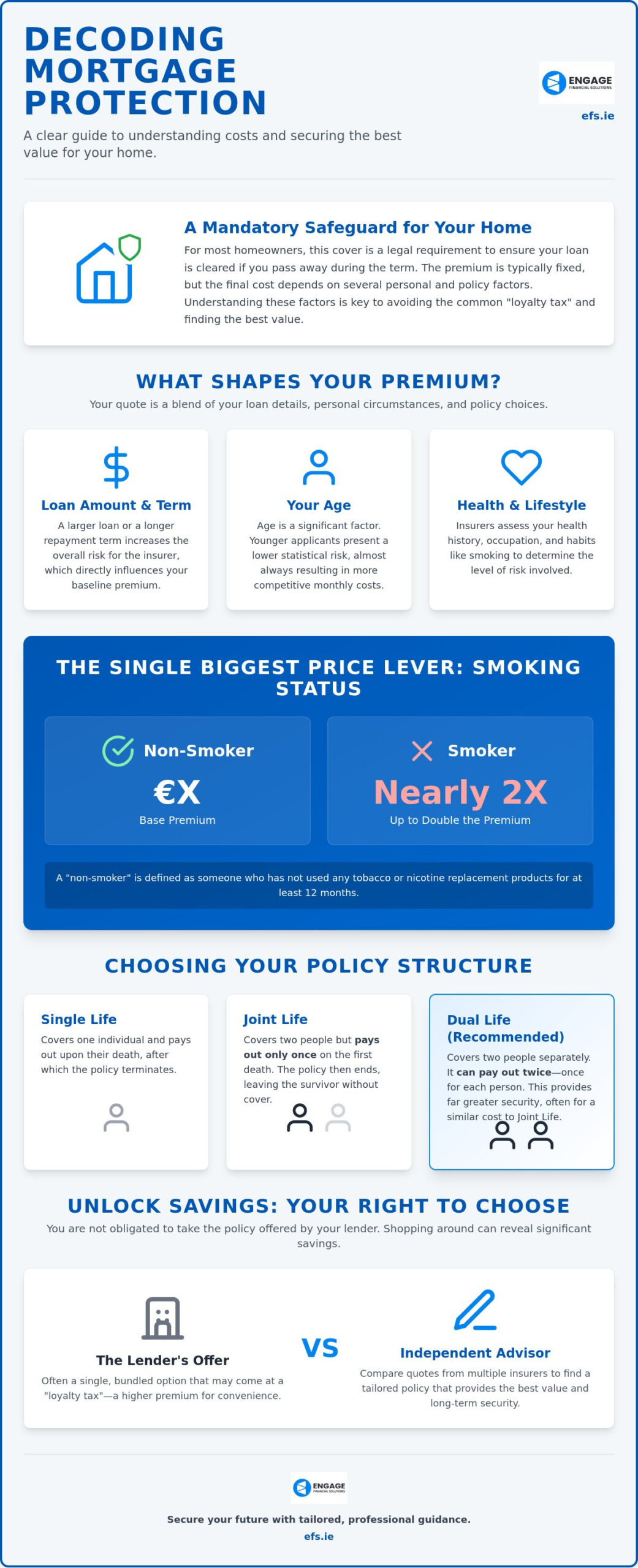
Securing a new home is one of life’s most significant milestones, but it comes with specific legal obligations that you must manage. For most domestic homeowners, having a policy in place to cover the debt is a mandatory requirement under the Consumer Credit Act 1995. This type of cover, frequently referred to as Mortgage life insurance, ensures that your loan is cleared if you pass away during the term. Whilst many people start their journey by asking how much is mortgage protection Ireland providers charge on average, it’s vital to realise that the loan amount is merely the starting point for your quote.
The premium you pay is generally fixed for the entire duration of your policy. This provides a sense of stability and optimism, as you don’t have to worry about your costs rising as you get older or as your health changes. However, the final price depends on a blend of your personal details and how you choose to structure your protection. By working with a steady guide at Engage Financial Solutions, you can navigate these choices without the friction often associated with complex financial jargon.
The Relationship Between Loan Size and Premiums
Mandatory vs. Optional Policy Add-ons
When you organise your cover, you’ll encounter several options that can influence the final price. Most standard policies include terminal illness benefit at no extra cost, which pays out if you’re diagnosed with an illness where life expectancy is less than 12 months. Adding serious illness cover is a different matter; this provides a lump sum upon the diagnosis of specific conditions, but it will noticeably increase your monthly quote. You also need to consider the structure of the policy:
- Single Life: Covers one person and pays out upon their death.
- Joint Life: Covers two people but only pays out on the first death, after which the policy ends.
- Dual Life: Covers two people and can pay out twice, once for each person, providing a higher level of security for a similar monthly cost.
Choosing the right structure ensures your home is protected in a way that fits your specific lifestyle and long-term aspirations. We take a “future-back” perspective, starting with your goal of total security and working backward to find the most efficient policy structure for your needs.
How Personal Health and Lifestyle Shapes Your Monthly Quote
When insurers look at your application, they aren’t just looking at a loan number; they’re looking at you as an individual. This process is known as underwriting. It’s how providers decide the level of risk they are taking on. If you’ve been wondering how much is mortgage protection Ireland insurers typically charge, the answer often hinges on your date of birth. Age is the most significant baseline factor. A 30-year-old will almost always pay less than a 45-year-old for the same level of cover because the statistical risk of a claim is lower as a younger applicant.
Your job also plays a role in the final figure. Whilst most office-based roles won’t affect your premium, certain manual or high-risk occupations might lead to a slight increase. It’s all about providing a clear picture of your daily life to ensure your family’s future is stable. For a deeper look at the legal side of things, the CCPC offers a great resource on understanding mortgage protection requirements. This helps you see the bigger picture before diving into the specifics of your personal health history.
The Impact of Smoking and Lifestyle Choices
Smoking is perhaps the single biggest price lever in the domestic market. In many cases, a smoker can expect to pay nearly double the premium of a non-smoker for the exact same policy. Insurers define a “non-smoker” as someone who has not used any tobacco or nicotine replacement products for at least 12 months. This includes vaping. Most domestic providers now treat e-cigarettes the same as traditional cigarettes when calculating risk.
If you’ve recently quit, there’s a silver lining. Once you’ve reached the one-year milestone of being nicotine-free, you can often apply to have your policy reassessed. Taking this step could significantly lower your monthly outgoings and improve your long-term financial health.
Medical Underwriting and Pre-existing Conditions
If you have a history of health issues, an insurer might apply what’s known as a “loading” to your premium. This is an additional charge added to the standard rate to reflect a higher risk level. It’s not a reason to worry; it’s simply a way to ensure your policy is tailored correctly to your circumstances. Full disclosure is the most critical part of this process. It might be tempting to gloss over a high BMI or a minor past illness, but honesty is the only way to guarantee a valid claim in the future.
Insurers use BMI ranges as a quick health indicator; being within a certain range can help keep your quotes at the standard rate. If the process feels overwhelming, you can speak with a professional advisor who acts as a buffer between you and the complex jargon of the insurance world. This ensures the application is straightforward and your peace of mind remains intact.
Comparing Policy Structures: Finding the Best Value for Your Needs
Choosing the right structure for your cover is about more than just finding the lowest quote; it’s about matching your protection to your family’s long-term aspirations. When you’re trying to calculate how much is mortgage protection Ireland homeowners should budget for, the policy structure you choose is often the deciding factor. Whilst a basic policy meets your legal requirements, a slightly more tailored approach can offer significantly better value for your future security.
At Engage Financial Solutions, we act as a steady guide to help you look past the initial price tag. We focus on a “future-back” perspective, ensuring that the policy you choose today still makes sense a decade from now. This prevents the friction of having to reorganise your cover if your circumstances change later on.
Decreasing Term vs. Level Term Insurance
Decreasing term insurance is the standard choice for most people purchasing a principal private residence. The mechanics are straightforward: the level of cover reduces over time, roughly in line with the decreasing balance of your repayment mortgage. Because the risk to the insurer drops as the debt reduces, this is typically the most cost-effective way to safeguard your home.
Level term insurance, by contrast, keeps the sum assured constant throughout the entire policy. If you have a €300,000 mortgage and pass away in year twenty, a level policy still pays out the full €300,000, clearing the remaining debt and leaving a surplus for your beneficiaries. On average, level term cover can cost between 25% and 40% more than decreasing term cover. It’s an excellent option if you want to provide an extra layer of stability for your loved ones beyond just clearing the house loan.
Joint Life vs. Dual Life Policies
Many couples instinctively opt for a Joint Life policy, which pays out upon the first death and then terminates. Whilst this clears the mortgage, it leaves the surviving partner without any life cover. This can be a problem if they want to secure a new policy later in life when health issues might make premiums much more expensive.
Dual Life policies are a more robust alternative. They provide separate cover for both individuals. If one partner passes away, the mortgage is cleared, but the surviving partner’s cover remains in place. The price gap between these two options is often surprisingly small, sometimes costing only a few euros more per month. We frequently recommend Dual Life because it offers double the potential payout and ensures long-term security for the surviving spouse. It’s a prime example of how spending a tiny bit more now can create a much more stable financial future for your family.
Practical Ways to Organise Your Cover for Maximum Savings
Many homeowners accept the first quote they receive from their lender because it feels like the easiest path. It’s a convenient option, but it often leads to a “loyalty tax” in the form of higher monthly costs. You aren’t tied to your bank’s insurance partner. You have the legal right to “assign” a policy from any independent provider to your lender. This simple move can save you thousands over the life of your loan. If you’re already in the process of switching your mortgage to a more competitive interest rate, it’s the ideal moment to re-evaluate your protection costs too.
The Benefits of Independent Advice
Switching and Saving on Existing Policies
You don’t have to wait for a new house to save money. If you’ve had your policy for several years, you might be paying more than necessary. The market is competitive, and newer products often come with lower premiums or better benefits. When people ask how much is mortgage protection Ireland based on current 2026 rates, they often find they can replace an old, expensive policy with a modern, more efficient one for a lower monthly outlay.
If your health has improved or you’ve quit smoking since you first took out your cover, the potential savings can be substantial. Just remember the golden rule: never cancel your existing policy until your new cover is fully active and the first premium has been paid. This ensures there’s no gap in your security. To see how much you could potentially save by moving to a more tailored plan, contact our expert team today for a straightforward, professional review.
Securing Your Future with Tailored Professional Guidance
Managing the domestic insurance market requires more than just a search engine; it requires a partner who understands your individual story. While you might initially focus on how much is mortgage protection Ireland providers list in their basic tables, the true value lies in how that policy performs when you need it most. Determining how much is mortgage protection Ireland homeowners should expect to pay involves looking at the big picture of your financial health, rather than just chasing the lowest headline rate. We act as your steady guide, managing the friction of the application process and acting as the buffer between you and complex insurer requirements.
Our approach is built on the principle of “calm competence.” We want you to feel looked after and understood, knowing that your home security is in expert hands. By focusing on a “future-back” perspective, we ensure that the policy you select today is robust enough to grow with you as your life evolves. This proactive strategy neutralises potential stresses before they occur, allowing you to enjoy your home with total peace of mind.
A Client-Centric Approach to Protection
Every home and every family is unique, so we don’t believe in one-size-fits-all solutions. Instead, we offer a bespoke service that focuses on your specific needs, whether you are a first-time buyer or looking to switch your existing cover to a more efficient provider. We pride ourselves on clear, jargon-free communication during every step of the process. This ensures you understand exactly what you are paying for and how it safeguards your future. For a deeper dive into your options and the latest market trends, our 2026 homeowner’s guide to protection provides a wealth of information to help you feel fully informed and confident in your choices.
Taking the Next Step Towards Peace of Mind
Securing your home is a long-term commitment, and your protection should reflect that. A “future-back” approach means we look at your desired end-state, a debt-free home and a secure family, and work backward to find the right financial tools for today. It is vital to remember that a policy that seems like the cheapest “fix” might lack the essential flexibility required as your circumstances change.
Getting started is a straightforward and seamless process. A tailored consultation removes the stress from the application, giving you the space to focus on the joy of your home. With the support of Engage Financial Solutions, you can move forward with the optimism that comes from knowing your most valuable asset is truly protected. We are here to ensure your transition into a more secure financial future is as smooth and rewarding as possible.
Your Path to Long-term Financial Security
Securing your home is about finding the right balance between monthly cost and comprehensive cover. We’ve seen that shopping independently rather than accepting a bank’s bundle can lead to significant savings over the life of your loan. By choosing a robust policy structure and disclosing your health history accurately, you create a foundation of stability for your family. Understanding how much is mortgage protection Ireland residents pay on average helps you set a realistic budget whilst ensuring your most valuable asset is safeguarded against the unexpected.
Our team is regulated by the Central Bank and offers access to the leading insurance providers locally. We pride ourselves on our expertise in tailoring cover for unique health and lifestyle needs, removing the stress from complex applications. You deserve a straightforward process that puts your needs first and looks toward your future goals. Book a personalised consultation to secure your home and take the friction out of your financial planning. Taking action now ensures your family’s future is secure and your financial transition remains seamless. We are ready to help you navigate these choices with clarity and confidence.
Frequently Asked Questions
How much does mortgage protection cost per month on average?
Monthly costs depend on factors like your age and mortgage size; for instance, a healthy 30-year-old with a €250,000 loan might see quotes around €18 per month. When calculating how much is mortgage protection Ireland homeowners need to budget for, remember that these figures are general market indicators. Your personal quote will be tailored to your specific loan term, health history, and whether you choose a single or dual life structure.
Can I use my existing life insurance instead of buying a new policy?
You can often use an existing life insurance policy if the level of cover and the remaining term are sufficient to satisfy your lender’s requirements. To do this, you must “assign” the policy to the bank so they have a legal claim on the proceeds if you pass away. This can be a straightforward way to streamline your finances if your current cover is already robust enough to protect the loan.
Does my health status or BMI significantly change the price?
Your health status is a primary driver of the final premium, and a BMI outside the standard range can lead to a “loading” or additional charge. Insurers use these metrics to assess long-term risk and determine the cost of your cover. Full disclosure during your application ensures that your policy remains valid and provides the stability you need for your family’s future security, avoiding any issues if you need to claim.
What is the difference between joint life and dual life cover costs?
The price difference between these structures is often smaller than expected, with dual life cover offering a second potential payout for a modest premium increase. Whilst joint life cover ends after the first claim, dual life keeps the surviving partner protected. This small extra investment provides double the security and ensures long-term peace of mind for your household without adding significant friction to your monthly budget.
Is it possible to switch my provider to save on monthly premiums?
It is absolutely possible to switch providers, and doing so is one of the most effective ways to lower your monthly outgoings. You have the legal right to move your policy to a different insurer at any time during your mortgage term. This is an excellent opportunity to find a more competitive rate if your health has improved or if prices in the domestic market have become more favourable.
Does smoking or vaping increase the cost of my monthly quote?
Using tobacco or nicotine products, including vaping, typically results in significantly higher premiums compared to non-smokers. Most domestic insurers treat vaping exactly the same as smoking, which can often double your monthly quote. If you have been nicotine-free for at least 12 months, you may be eligible for much lower rates, making it a great time to re-evaluate your cover and reduce your monthly costs.
How does serious illness cover affect the overall price of the policy?
Adding serious illness cover will increase your total premium because it provides a lump sum benefit upon the diagnosis of specific medical conditions. This additional layer of protection ensures that you can manage your mortgage repayments if you are unable to work due to a major illness. It transforms a basic life policy into a more comprehensive safety net that supports your long-term financial health.
What happens if I cannot pay my premiums during the mortgage term?
If you stop paying your premiums, your policy will eventually lapse, which means your home is no longer protected and you may be in breach of your mortgage contract. Lenders require this cover to be active throughout the loan term to safeguard the debt. If you face financial difficulty, it’s best to speak with a professional guide to explore flexible options rather than letting the cover expire.
Disclaimer
Engage Financial Services LTD T/A Engage Financial Solutions is regulated by the Central Bank of Ireland CRO 764570. Director David Moore. Suite 2 First Floor, 14 -18 Main street, Blackrock, Co Dublin A94 W0Y3