

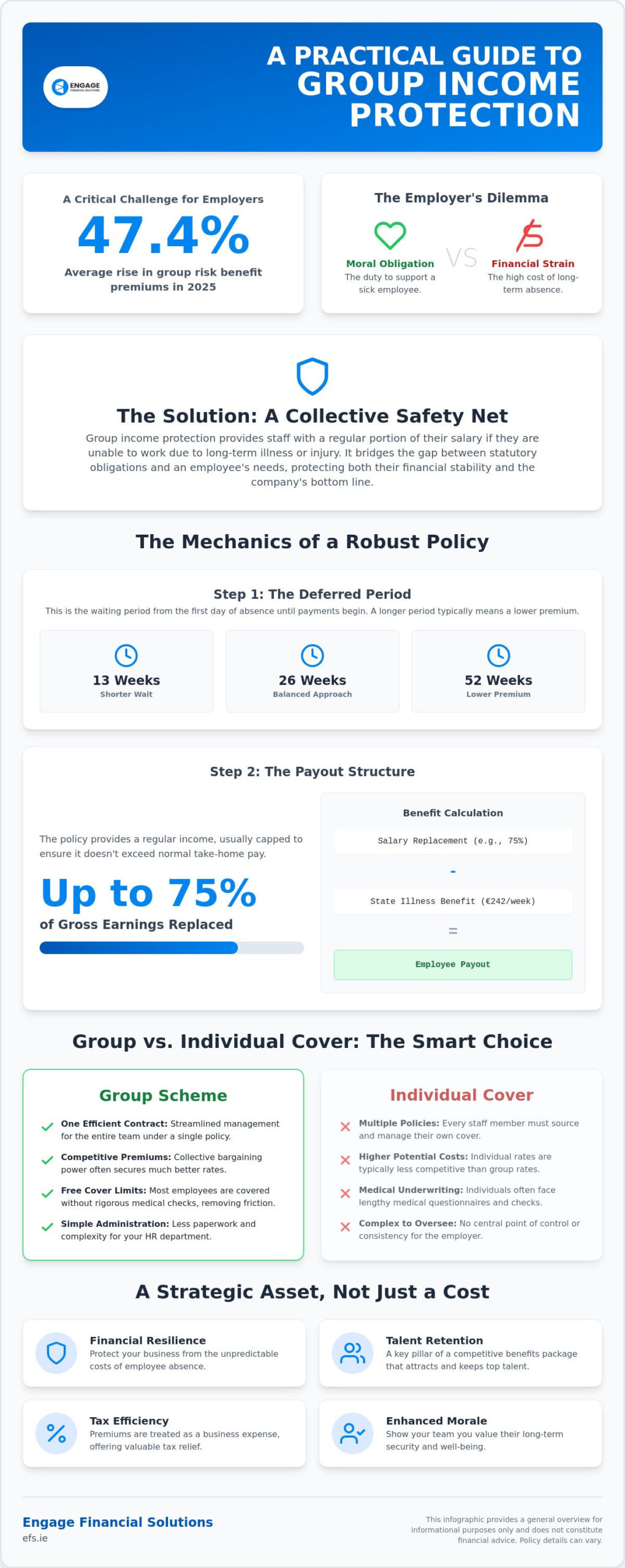
In 2025, many employers saw premiums for group risk benefits rise by an average of 47.4%, making the search for sustainable staff support more critical than ever. You likely recognise the moral difficulty of stopping a sick employee’s pay, yet the high cost of long-term absence can feel like an impossible weight on your balance sheet. Implementing a tailored scheme for group income protection within the domestic market allows you to bridge the gap between statutory sick pay and a staff member’s needs without creating a financial strain on your company’s operations.
We understand that navigating insurance jargon and tax implications can feel overwhelming, but securing your team’s future doesn’t have to be a friction-filled process. This guide will show you how to provide genuine financial security whilst benefiting from available tax reliefs and improved employee retention. We’ll explore the 2026 rates for State Illness Benefit, the latest statutory requirements, and how to create a seamless claims experience that acts as a steady guide for both you and your workforce.
Key Takeaways
- Discover how group income protection provides a reliable safety net for your team, offering them financial stability if they ever face long-term illness or injury.
- Master the technical side of your policy by learning how to navigate deferred periods and set appropriate salary replacement levels, which are often capped at 75% of gross earnings.
- Turn a moral obligation into a strategic asset by using tax-efficient premiums to protect your business from the unpredictable costs of employee absence.
- Identify how a thorough workforce audit and a clear definition of disability can ensure your coverage is perfectly tailored to your company’s unique needs.
- See how professional stewardship can make the entire setup process straightforward and seamless, allowing you to focus on running your business with peace of mind.
Collective Salary Safeguarding: What It Is and Why It Matters
Running a successful business involves managing dozens of moving parts. One of the most significant responsibilities you face is the welfare of the people who make your company thrive. Group income protection acts as a collective safety net, designed to support your team if life takes an unexpected turn. Essentially, it ensures that if a staff member is unable to work due to a medium or long-term illness or injury, they continue to receive a regular portion of their salary whilst they remain on your payroll.
Understanding what is income protection insurance? is the first step toward building a resilient organisation. Unlike a standard sick pay policy that might only last a few weeks, these schemes are built for the long haul. They provide a structured, predictable way to look after your employees without the business having to foot the bill directly from its cash flow. In the local market, this has become a key pillar of any competitive employee benefits package, showing that you value your staff’s long-term security as much as their daily output.
The Core Purpose of a Group Scheme
The main goal here is twofold: you want to provide financial stability for your employees whilst ensuring cost-certainty for the company. When an employee faces a health crisis, the last thing they need is the stress of a dwindling bank balance. This scheme bridges the gap between statutory sick pay and their eventual return to work. By implementing such a plan, you create a buffer that protects the individual’s lifestyle and the company’s bottom line. It’s a strategic tool that builds deep talent retention and ensures your business remains financially resilient regardless of individual health setbacks.
How It Differs from Individual Protection
Managing a single corporate contract is far more efficient than expecting every staff member to source their own cover. In larger groups, you often benefit from “free cover limits,” which means most employees won’t need to go through rigorous medical checks to be protected. This ease of underwriting is a massive advantage for a busy HR department, as it removes the friction and delay often associated with personal insurance applications.
Collective bargaining also works in your favour. By covering your entire team under one umbrella, you can often secure much more competitive premiums than an individual could find on their own. It removes the administrative headache of tracking multiple policies and ensures that everyone is looked after under one straightforward, professionally managed arrangement. This streamlined approach makes the setup process feel seamless and allows you to focus on your core business goals whilst we handle the complexities of the policy details.
The Mechanics of a Robust Protection Policy
A robust policy operates as a silent partner in your business, providing a seamless transition for employees who are too unwell to work. By understanding the underlying mechanics, you can tailor a scheme that provides maximum security whilst remaining cost-effective. At its heart, group income protection Ireland relies on a few key variables that determine both the level of support for your staff and the annual cost to your business.
The first concept to grasp is the “deferred period”. This is essentially a waiting time between the first day of an employee’s absence and the point when the insurance payments begin. Most companies choose to align this with their own internal sick pay arrangements. As of 2026, employers must provide up to 10 days of Statutory Sick Pay, but a professional group scheme covers the much larger gap that follows.
Choosing Your Deferred Period
You generally have the choice of a 13, 26, or 52-week deferred period. This decision is a primary driver of your premium costs; a longer wait for the insurer typically results in a lower cost for the employer. When selecting a timeframe, it is worth considering your company’s cash flow and how long you can afford to support an employee’s salary before the policy takes over. Choosing a period that matches your existing sick pay policy ensures there are no gaps in the employee’s income.
Understanding the Payout Structure
Once the deferred period ends, the policy provides a regular income, usually capped at 75% of the employee’s gross earnings. This ensures they have a significant portion of their salary replaced without exceeding their normal take-home pay. The benefit is calculated as the chosen percentage minus any state benefits, such as the €242 weekly State Illness Benefit available in 2026.
The payment process is designed to be straightforward. The insurer pays the benefit directly to the company, and you then distribute it through your normal payroll. This means the employee receives their money just like a regular salary, with Income Tax, USC, and the 4.35% PRSI rate applied as usual. This maintains a sense of normality and stability for the individual during a difficult time. Many modern policies also offer “Pension Protection” options that keep retirement contributions active during a claim, safeguarding their long-term future.
Insurers now place a greater emphasis on Early Intervention Services (EIS). These programmes offer rehabilitation and back-to-work support, helping your staff recover more quickly and return to their roles safely. If you are looking to build a more resilient workforce, speaking with a specialist can help you navigate these options with ease.
Strategic Advantages for the Modern Employer
Every business owner eventually faces a difficult choice: how long can you afford to pay a valued staff member who is too ill to work? It’s a painful moral dilemma. You want to be supportive, yet you have a duty to keep the company’s finances stable. By integrating group income protection Ireland into your benefits strategy, you effectively outsource that difficult decision to a professional insurer. This ensures your employee is looked after whilst you maintain the company’s financial health. It removes the emotional weight of deciding when to stop an employee’s pay, replacing uncertainty with a structured, compassionate process.
Investing in such a scheme also elevates your status as an employer of choice. In a competitive hiring market, candidates look for more than just a base salary; they seek security and evidence that a company cares about its people. Providing a comprehensive safety net fosters deep loyalty amongst your existing team. It sends a clear message that you are a steady guide, committed to their long-term wellbeing even during their most challenging times. This proactive approach to care, often supplemented by rewarding team experiences like those from Inbound Golf, results in higher retention rates and a more engaged, resilient workforce.
Tax Relief and Financial Efficiency
The financial logic for this cover is just as compelling as the moral one. Premiums paid by your business are generally treated as a deductible business expense. This means you can offset the cost against corporation tax, making it a highly efficient way to allocate your benefits budget. For the employee, the structure is equally favourable. Under current rules, employer-paid premiums are typically not considered a taxable benefit-in-kind (BIK). This allows you to provide a high-value benefit without your staff seeing a reduction in their monthly take-home pay. It’s a cost-effective alternative to self-funding a long-term absence, which can often lead to unpredictable and significant financial drains on your resources.
Early Intervention and Rehabilitation
Modern policies act as much more than a simple financial payout; they are a proactive tool for workplace wellbeing. Most schemes now include Early Intervention Services (EIS) that focus on the primary causes of long-term absence, such as mental health struggles and musculoskeletal issues. These services provide your team with immediate access to mental health counselling, physiotherapy, and even career coaching. By addressing health concerns before they escalate, these programmes help employees return to the workforce faster and in better health. This proactive management reduces the overall cost of absence and ensures your team feels supported throughout their recovery journey.
Navigating the Selection and Setup Process
Implementing a new benefits scheme shouldn’t be a source of administrative stress. The process becomes straightforward when you begin with a clear audit of your workforce demographics. Every company is unique, and a “one size fits all” product rarely provides the precise level of security your team requires. By tailoring a group income protection Ireland policy to your specific needs, you ensure that the cover is both relevant and cost-effective for your business.
A critical part of this setup is defining the criteria for a claim, often referred to as the “definition of disability”. We typically recommend an “own occupation” definition. This ensures the policy pays out if the individual cannot perform the specific duties of their current role, rather than any job at all. It provides much higher security for specialised staff and removes ambiguity during a claim. Regular reviews are also essential. As your business grows and salaries increase, your policy must keep pace to avoid leaving anyone under-insured.
Defining the Scope of Cover
You have the flexibility to choose who is included in the scheme. Whether you decide to cover every staff member or limit the benefit to specific grades or departments, the choice should reflect your company culture and budget. Another vital consideration is the “ceasing age”. This is the point at which the cover ends, and it usually aligns with the current state pension age. To get started, you will need to gather a simple dataset for your team:
- Current gross annual salaries
- Dates of birth for all eligible employees
- Specific job titles and departments
- Length of service for each team member
The Role of Professional Guidance
If you are ready to build a more secure future for your workforce, our team can help you organise a tailored group protection scheme today.
How Professional Guidance Ensures a Seamless Experience
Engage Financial Solutions acts as a steady guide for businesses as they manage the local financial landscape. Led by David Moore, our team brings a sense of calm competence to the setup of your benefits, ensuring you feel looked after from the very first conversation. We take the technical weight off your shoulders, managing the intricate details of group income protection Ireland so you can focus on the daily operations of your company. This professional stewardship ensures that your policy is not just a document in a drawer, but a living, breathing part of your company’s commitment to its people.
A Tailored Approach to Your Business
We don’t believe in off-the-shelf products. Instead, we start by listening to your specific goals and understanding the unique makeup of your workforce. This allows us to tailor a structure that fits your budget whilst providing the highest level of security for your staff. Our support doesn’t end once the policy is live; we remain your partner during the claims process, removing friction and ensuring a straightforward experience for everyone involved. You can learn more about our approach to income protection and how we prioritise your business’s needs.
Peace of Mind for the Future
The ultimate benefit of professional guidance is the emotional relief it provides. Knowing that your team is looked after, no matter what health challenges they might face, allows you to lead with optimism and stability. We are committed to providing jargon-free, outcome-oriented advice that makes sense for your business’s long-term aspirations. By removing the stress of complex financial transitions, we help you build a more resilient future. Contact Engage Financial Solutions for a tailored consultation to begin safeguarding your workforce today.
Building a Resilient Future for Your Team
Protecting your workforce is about more than fulfilling a duty; it’s about creating a stable environment where your business and your people can thrive together. By implementing a robust scheme for group income protection Ireland, you remove the stress of the moral dilemma surrounding sick pay whilst securing significant tax efficiencies for your company. This strategic move ensures that long-term absence no longer poses a threat to your operational continuity or your employees’ financial wellbeing.
As specialists in seamless financial transitions, our team provides the expert stewardship needed to navigate these complex benefits with ease. Regulated by the Central Bank, we offer personalised guidance from David Moore to ensure your policy is perfectly tailored to your unique requirements. Secure your team’s future with Engage Financial Solutions and experience the peace of mind that comes from proactive, professional care. We look forward to helping you build a more secure and optimistic future for your organisation.
Frequently Asked Questions
How does group income protection differ from individual cover in this market?
Group cover differs from individual plans primarily through its simplified setup and collective pricing. In the domestic market, group schemes often include a “free cover limit,” meaning most staff won’t need medical exams to qualify for protection. Individual policies require personal underwriting for every applicant; this can be slower and more expensive for your team members. A group contract covers everyone under one umbrella, making it much easier for you to manage.
What is a typical deferred period for a company-wide scheme?
Most businesses choose a deferred period of 13, 26, or 52 weeks depending on their internal sick pay arrangements. This is the waiting time before the insurance starts paying out. Selecting a longer period typically reduces your annual premium; it’s a flexible way to manage your company’s budget. You should choose a timeframe that matches how long your business can comfortably support an employee’s full salary before the insurance takes over.
Are the premiums for these policies tax-deductible for my business?
Yes, premiums paid by an employer for group income protection Ireland are generally treated as a fully deductible business expense. You can offset these costs against your corporation tax. These payments are not usually considered a taxable benefit-in-kind (BIK) for your employees. This makes it a highly tax-efficient way to provide a high-value benefit without reducing your staff’s monthly take-home pay or increasing their personal tax liability.
What percentage of an employee’s salary can usually be protected?
You can usually protect up to 75% of an employee’s gross annual salary. This figure is a standard limit set by the Revenue Commissioners to ensure the benefit doesn’t exceed their normal take-home pay. The payout is calculated by taking that 75% and subtracting the State Illness Benefit, which stands at €242 per week in 2026. This ensures your staff member receives a steady, reliable income whilst they are unable to work.
Can a small business with only a few employees set up a protection scheme?
Small businesses can certainly establish these schemes, often with as few as three or five employees. While larger firms might enjoy higher free cover limits, smaller teams still benefit from professional group protection and collective rates. It’s a straightforward way for a growing company to project the stability of a much larger organisation. We provide the same personalised guidance to small teams that we do for major corporations to ensure a seamless setup.
What happens if an employee leaves the company; do they keep their cover?
Cover typically stops the moment an employee leaves your payroll. Since the policy is a corporate contract between the employer and the insurer, the protection is a benefit of their employment. If they move to a new company, they would need to be added to that employer’s scheme or source their own individual protection. There is usually no option for the individual to “take the policy with them” when changing jobs.
Is there a limit on the total amount of benefit an employee can receive?
There is usually an overall cap on the annual benefit, which varies by provider but often reaches up to €250,000. While the 75% salary rule is the primary limit for most staff, these higher caps ensure that even your most senior executives are adequately protected. We help you navigate these limits during the initial setup to ensure your cover remains relevant for your entire workforce as salaries grow over time.
Does the scheme cover pre-existing medical conditions for all staff members?
Many group schemes cover pre-existing conditions for any staff member who falls within the “free cover limit.” This means they don’t have to disclose their medical history to be protected. It’s one of the most significant advantages of group income protection Ireland, as it ensures even those with previous health struggles are included in your company’s safety net. This creates a truly inclusive benefit that supports the wellbeing of your entire team.
Disclaimer
Engage Financial Services LTD T/A Engage Financial Solutions is regulated by the Central Bank of Ireland CRO 764570. Director David Moore. Suite 2 First Floor, 14 -18 Main street, Blackrock, Co Dublin A94 W0Y3