


If you were unable to work tomorrow, how long would your business and your household survive on your current savings alone? It’s a question that keeps many business owners awake at night, especially since the safety net of employer-funded sick pay simply doesn’t exist when you’re the one in charge. Securing Income Protection for self employed professionals isn’t just about insurance; it’s about building your own internal sick-pay department that steps in when you can’t. Whether you’re a sole trader or a company director, you deserve the same financial stability as any employee.
We understand that the prospect of proving your income or understanding complex tax rules can feel daunting. In this guide, you’ll discover how this specific PRODUCT can provide a reliable monthly payout of up to 75% of your profits, ensuring your mortgage and bills are covered whilst you focus on recovery. We’ll walk you through the straightforward steps to safeguard your family home and explain how to organise your cover in the most tax-efficient way possible. By the end, you’ll have a clear roadmap to achieving total peace of mind, knowing your future is secure regardless of what life throws your way.
Key Takeaways
- Learn how to replace the missing safety net of employer sick pay with a tailored PRODUCT that ensures you stay financially stable whilst you focus on recovery.
- Discover how Income Protection for self employed professionals can provide a tax-free monthly benefit of up to 75% of your profits to cover essential bills and mortgage payments.
- Understand the process of claiming tax relief at your marginal rate of up to 40% on your premiums, which effectively reduces the net cost of your protection by nearly half.
- Explore how to customise your policy by choosing the right waiting periods and benefit amounts that align with your specific occupational class and business cash flow.
- Find out why partnering with a steady guide helps you navigate the local panel of insurers to find a seamless, reliable solution for your long-term security.
The Reality of Working for Yourself: Why a Personal Safety Net is Essential
Being your own boss brings immense freedom, but it also means you’re the sole engine driving your financial future. When you leave a traditional job, you leave behind the safety of a corporate HR department and, crucially, the cushion of employer-funded sick pay. If you fall ill or suffer an injury that prevents you from working, your income doesn’t just dip; it often stops entirely. This is where Income Protection for self employed professionals becomes an essential tool rather than an optional extra. It’s a PRODUCT designed to mirror the stability of a monthly salary, providing a financial bridge when you’re unable to man the helm of your business.
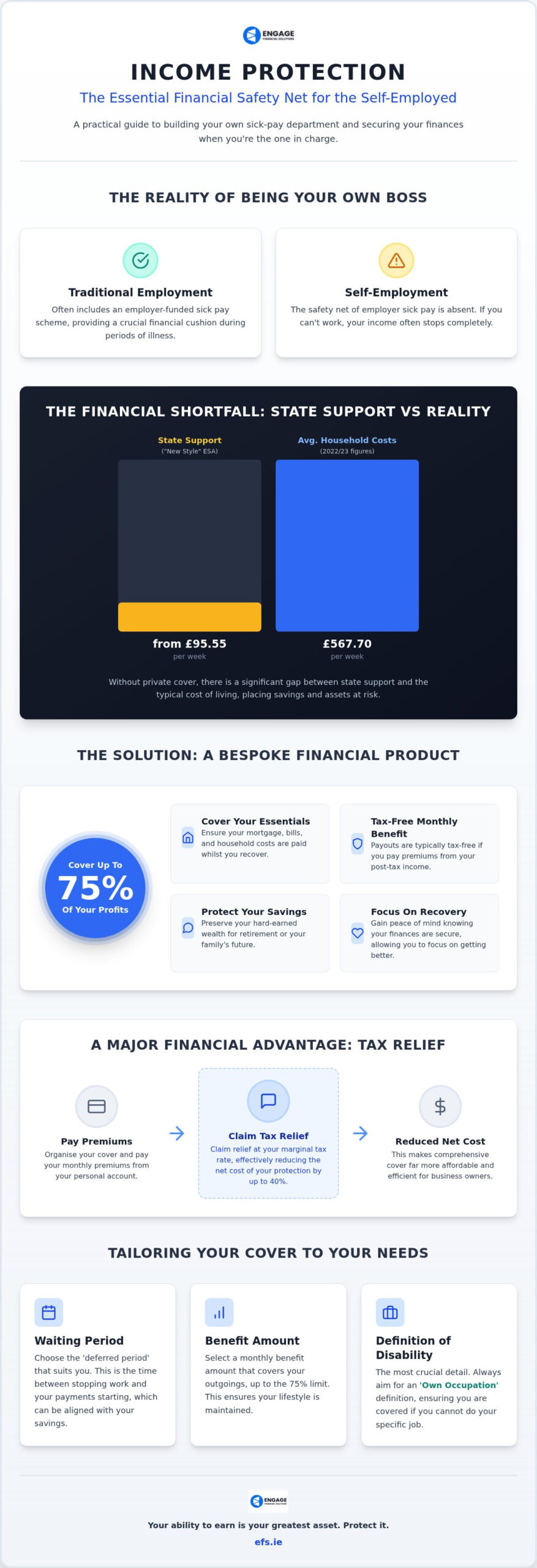
Relying on state support alone can be a sobering experience. With “New Style” ESA rates for those over 25 starting at just £95.55 per week during the assessment phase, there’s a stark contrast to the average weekly household expenditure, which was recorded at £567.70 in 2022/23. Without a private safety net, the financial shortfall can become overwhelming very quickly. Taking a proactive approach with Engage Financial Solutions allows you to replace that missing security with a plan tailored to your specific needs.
Identifying the Risks for Sole Traders and Freelancers
For many small business owners, you are the business. If a long-term illness strikes, business continuity is immediately threatened. Fixed costs like your mortgage, utility bills, and business overheads don’t pause just because you’ve had to. Amongst freelancers, the “no work, no pay” reality creates a unique kind of pressure that can actually hinder recovery. Your ability to earn is arguably your greatest asset; protecting it ensures that a period of ill health doesn’t lead to a permanent financial setback for your family or your firm.
Bridging the Gap Between Savings and Long-Term Security
You might have a “rainy day” fund, but medical crises often last longer than a few weeks. Savings can be depleted with alarming speed when they’re covering both business expenses and personal life. By putting Income Protection Insurance in place, you preserve your hard-earned wealth for its intended purpose, like your retirement or your children’s education. This PRODUCT offers a guaranteed income stream, allowing you to focus entirely on your recovery without the crushing anxiety of mounting debt. It’s about ensuring your lifestyle remains safeguarded, no matter what the future holds.
Understanding the Mechanics: How This Financial PRODUCT Protects Your Profits
Securing Income Protection for self employed professionals requires a clear understanding of how insurers view your business ledger. Unlike a PAYE employee with a steady payslip, your income might shift with the seasons or the success of a specific contract. Most providers allow you to cover up to 75% of your gross earnings, less any state benefits you might be entitled to receive. This ensures that if you’re sidelined by illness, the resulting monthly payment provides a stable foundation for your household finances. Crucially, these payments are typically tax-free when you’ve paid the premiums from your personal, post-tax income, providing a net benefit that closely mirrors your normal take-home pay.
The definition of disability used in your policy is perhaps the most important detail to get right. You should aim for “own occupation” cover, which means the PRODUCT pays out if you’re unable to perform the specific duties of your current role. Some lower-quality policies use an “any occupation” definition, which might refuse a claim if the insurer believes you could technically work in a different, unrelated field. When you’re managing a business, you need the certainty that your specific expertise is what’s being protected. Understanding these nuances is a key part of disability insurance for self-employed people, as it ensures your safety net is actually fit for purpose. If you’re unsure how your specific setup fits into these rules, speaking with an advisor can clarify your options.
Defining Your Insurable Income
For sole traders, your “income” for insurance purposes is generally your net profit after business expenses but before tax. If your profits fluctuate, insurers typically look at an average of your earnings over the last two or three years to establish a fair level of cover. It’s vital to be accurate here; over-insuring can lead to paying higher premiums for a benefit amount that you won’t be able to prove with tax returns in the event of a claim. Keeping your cover aligned with your actual Self-Assessment filings ensures a seamless claims process later on.
The Role of the Deferred Period
The deferred period is the “waiting time” between the day you become unable to work and the day your first payment is triggered. These periods typically range from 4 to 52 weeks. Choosing a longer waiting period can significantly reduce your monthly premium, making the PRODUCT much more affordable. A practical strategy is to align this period with your existing emergency cash reserves. If you have enough savings to cover three months of bills, selecting a 13-week deferred period can lower your costs whilst still providing long-term security.
Tailoring Your Cover: Waiting Periods, Benefit Amounts, and Occupational Classes
One of the greatest advantages of this financial PRODUCT is its inherent flexibility. As your business evolves, your protection should too. If your profits increase or your overheads shift, you can typically adjust your cover levels to match your new reality. Two features that are particularly popular amongst local business owners are the ‘Hospitalisation Benefit’ and ‘Waiver of Premium’. The former provides a daily payment if you’re confined to a hospital bed for a set number of nights during your waiting period, whilst the latter ensures you don’t have to worry about policy costs whilst you’re actually receiving a benefit. These additions create a seamless layer of support that protects your cash flow from every angle.
Securing Income Protection for self employed professionals isn’t just about picking a number; it’s about understanding how your daily life dictates your policy’s structure. By working with a broker who understands the local panel of insurers, you can fine-tune these variables to ensure you aren’t overpaying for cover you don’t need or, conversely, leaving yourself exposed. This tailored approach is what transforms a standard insurance policy into a robust business continuity plan. For those in the Australian market, Smart Advance provides similar expert brokerage services to help businesses secure the funding they need to stay resilient.
Choosing a Waiting Period That Fits Your Cash Flow
The deferred period is a vital lever in managing the cost of your cover. A 4-week period offers immediate peace of mind but comes with higher premiums. Conversely, a 26-week period is much cheaper but requires a significant cash buffer to survive the half-year wait. For many sole traders, the 13-week period is often the “sweet spot.” It allows enough time for short-term illnesses to pass whilst keeping monthly costs manageable. We always encourage clients to organise their finances so they can comfortably bridge a three-month gap, as this significantly reduces the long-term cost of their security.
Understanding Occupational Classes
Insurers categorise jobs into “occupational classes” based on the statistical risk of a claim. Class 1 usually covers office-based roles like accountants or software developers, who typically pay the lowest rates. Class 4 covers manual trades or high-risk roles like electricians or site managers. A consultant will naturally pay less than a tradesperson for the same level of cover because the likelihood of a minor injury preventing an office worker from doing their job is lower. When applying, be meticulous when describing your daily tasks. If you’re a business owner who spends 80% of your time on admin and only 20% on-site, ensuring the insurer knows this can result in a more favourable classification and a lower premium.
Maximising Your Security: Tax Relief and Proving Your Earnings
One of the most compelling reasons to prioritise Income Protection for self employed professionals is the significant tax efficiency built into the system. Unlike many other forms of insurance, the premiums you pay for this PRODUCT qualify for tax relief at your marginal rate, which could be as high as 40%. This effectively means that for every pound you invest in your security, the real cost to your pocket is nearly halved. It’s a rare instance where the tax authorities actively incentivise you to protect your future stability.
While the premiums are tax-deductible, it’s important to understand that the monthly benefits you receive during a claim are treated as taxable income. This is a vital distinction to keep in mind when calculating exactly how much cover you need. Since the payout replaces your profits, it is subject to the same tax and social insurance contributions as your regular earnings. By factoring this in from the start, you ensure that the net amount landing in your bank account is sufficient to maintain your lifestyle without any stressful surprises.
How to Claim Your Tax Relief
Claiming your relief is a straightforward process, but it does require you to be organised during your annual filing. The Revenue Commissioners allow you to include your premiums as a deductible expense, reducing your overall tax liability for the year. To ensure a smooth process, follow these steps:
- Keep a record of your annual premium certificate provided by your insurer.
- Include the total premium amount in the relevant section of your annual self-assessment tax return.
- If you’re a company director, ensure the premiums are correctly accounted for as a business expense or personal relief, depending on your policy structure.
For a deeper dive into the technical nuances of these policies, you can read our Safeguarding Your Earnings: The Comprehensive Guide to Income Protection. Taking the time to get these details right ensures you’re maximising every financial advantage available to you.
Preparing for the Underwriting Process
Medical underwriting is the stage where the insurer assesses your health history to determine your premium and terms. For the self-employed, this process is generally efficient, but it does require total transparency. You’ll likely be asked about your medical history, lifestyle, and any recurring health issues. Modern insurers are increasingly flexible, often providing cover for individuals with well-managed pre-existing conditions, though specific exclusions might apply. Being honest from the outset is the best way to ensure that your claim is valid and pays out exactly when you need it most. If you’re ready to see how these tax benefits apply to your specific business, request a personalised quote from our team today.
Taking the Next Step: How Expert Guidance Simplifies Your Protection
Finding the right Income Protection for self employed professionals can feel like a secondary business project in itself. With a vast panel of local insurers offering different definitions of disability and varying premium structures, the complexity can be overwhelming for someone already managing their own firm. This is where a professional broker becomes indispensable. By acting as your advocate, we filter through the options to find the specific terms that align with your unique business model. We act as a protective buffer, handling the meticulous details of the application and medical queries so you can remain focused on your daily operations.
Our role doesn’t end once your policy is in place. We provide ongoing stewardship, ensuring your cover remains relevant as your business grows or your lifestyle changes. If the time comes to make a claim, having a dedicated partner means you don’t have to deal with a faceless insurance company alone. We guide you through the process, ensuring the transition from working to receiving your benefit is as seamless as possible. This level of support removes the friction from the financial world, allowing you to move from a place of anxiety to one of calm competence and long-term security; for those building their own digital ecosystems, you can visit Gemba to see how to provide similar financial seamlessness for your own users.
The Benefits of Personalised Financial Advice
Personalised advice is about more than just finding a low price; it’s about ensuring this financial PRODUCT is actually fit for purpose. A “Steady Guide” who understands the nuances of the local market ensures you don’t fall into the trap of paying for unnecessary extras that don’t apply to your specific trade. This level of meticulous care is similar to why many people seek professional help in other complex areas. For instance, you might consider why use a mortgage broker to navigate those specific hurdles; in both cases, expert intervention removes the stress from a significant life decision. We help you tailor your waiting periods and benefit amounts to match your actual cash flow, ensuring your safety net is both robust and affordable.
Starting Your Journey to Financial Stability
Achieving long-term stability shouldn’t be a source of stress. Our process is designed to be straightforward and efficient, starting with a simple conversation about your business structure and your family’s needs. We take the time to understand your “future-back” perspective, working from your desired end-state of security to find the right present-day solution. The result is a fully tailored plan that safeguards your greatest asset: your ability to earn. To take the first step toward a worry-free future, Contact Engage Financial Solutions to secure your earnings today and discover the peace of mind that comes from being truly protected.
Securing Your Business Legacy and Personal Peace of Mind
Navigating the local market as a business owner requires foresight and a commitment to long-term stability. By now, it’s clear that this financial PRODUCT is more than just a policy; it’s a strategic tool that bridges the gap between your hard-earned profits and the uncertainty of illness. You’ve seen how claiming tax relief at your marginal rate can effectively halve the cost of your premiums, making robust security surprisingly accessible. Whether you’re a sole trader or a company director, Income Protection for self employed professionals ensures that your greatest asset, your ability to work, remains safeguarded against life’s unpredictable turns.
Taking this step doesn’t have to be complex. As an experienced team regulated by the Central Bank, we provide expert guidance on tax-efficient policies and offer access to a wide panel of leading insurers. We’re here to act as your steady guide, ensuring every detail is tailored to your specific life stage and business goals. You deserve the confidence that comes from knowing your family home and your lifestyle are secure. Secure your income with a tailored protection plan from Engage Financial Solutions and start your journey toward a more stable, optimistic future today.
Frequently Asked Questions
Is income protection for the self-employed tax-deductible?
Yes, you can claim tax relief on your premiums at your marginal rate, which is often as high as 40%. This relief effectively lowers the net cost of your PRODUCT. Whilst the premiums are deductible, keep in mind that any benefits you receive during a claim are treated as taxable income. This ensures the system remains fair and transparent for all business owners.
How much does income protection cost for someone working for themselves?
The cost depends on several personal factors including your age, health, and specific occupational class. Your choice of deferred period also plays a major role; selecting a longer waiting time, such as 13 or 26 weeks, can reduce your monthly outlay. Because every business is unique, it’s best to get a tailored quote for this PRODUCT that reflects your actual risks and budget.
Can I get income protection if I have a pre-existing medical condition?
Yes, it’s often possible to secure Income Protection for self employed individuals even with a history of health issues. Insurers will assess your medical records during the underwriting process and may offer cover with specific exclusions or a small increase in premium. Being transparent about your history is vital to ensure your policy remains valid and provides the security you expect.
What is the maximum amount of income I can protect as a sole trader?
You can typically protect up to 75% of your gross earnings, which is your profit before tax but after business expenses. Insurers subtract the value of any state benefits you’re eligible for from this total to determine your maximum monthly payout. This cap ensures the benefit provides a replacement income whilst ensuring you don’t receive more than you would normally earn whilst working.
How long will the policy pay out if I cannot return to work?
Most policies are designed to pay out until you are fit to return to your job or until you reach your chosen retirement age. You can select a limited payout period, such as two or five years, to lower your premiums, but a full-term policy offers the greatest long-term stability. This ensures that a permanent disability doesn’t result in a total loss of your future earnings.
What happens if my business income fluctuates from year to year?
Insurers usually look at an average of your net trading profits over the last two or three years to establish a stable cover level. If your earnings dip significantly, it’s important to adjust your Income Protection for self employed policy to reflect your new reality. This proactive management prevents you from paying for more cover than your tax returns can actually prove at the point of a claim.
Is there a difference between serious illness cover and income protection?
Yes, serious illness cover provides a one-off lump sum payment upon the diagnosis of a specific condition, whereas this PRODUCT provides a regular monthly income. Income protection is often more flexible because it covers any illness or injury that prevents you from working, not just a predefined list. Having a monthly benefit allows you to maintain your lifestyle and pay recurring bills over a long period.
Can I cancel or change my policy if I return to being an employee?
You have the freedom to cancel or amend your policy at any time if your employment status changes. If you move into a PAYE role, you might find that your new employer offers some form of group protection, or you may choose to keep your personal policy for extra security. We can help you review your cover to ensure it remains a seamless fit whilst you navigate your new circumstances.
Disclaimer
Engage Financial Services LTD T/A Engage Financial Solutions is regulated by the Central Bank of Ireland CRO 764570. Director David Moore. Suite 2 First Floor, 14 -18 Main street, Blackrock, Co Dublin A94 W0Y3