


Most people assume that CRITICAL ILLNESS COVER and INCOME PROTECTION are essentially the same thing with different names. They’re not, and confusing the two could leave a significant gap in your financial safety net at exactly the wrong moment. When it comes to weighing up critical illness cover vs income protection, the question isn’t really which one is better; it’s understanding that they’re built to solve entirely different problems.
You’re not alone if you’ve sat staring at two policy documents wondering why both seem to cover “getting seriously ill.” It’s one of the most common points of confusion in personal financial planning, and the overlap in language doesn’t help. The fear of paying for duplicate cover is completely understandable, as is the uncertainty around which policy actually qualifies for tax relief and under what circumstances.
This guide cuts through that confusion. By the time you’ve finished reading, you’ll have a clear picture of what each policy actually pays out, when it pays out, and how each one fits into your broader financial life. We’ll also walk through the tax implications for each, so you can make a genuinely informed decision rather than an expensive guess.
Key Takeaways
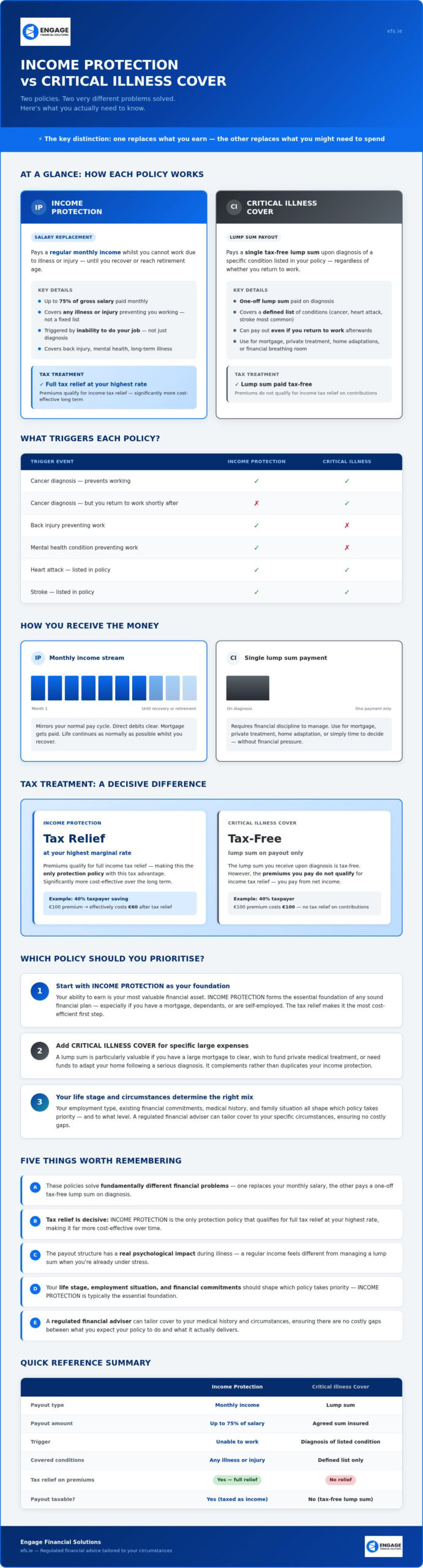
- INCOME PROTECTION and CRITICAL ILLNESS COVER are built to solve fundamentally different financial problems — one replaces your monthly salary whilst you cannot work, whilst the other pays out a one-off tax-free lump sum upon diagnosis of a serious condition.
- When weighing up critical illness cover vs income protection, the tax treatment is a decisive factor: INCOME PROTECTION is the only protection policy that qualifies for full tax relief at your highest rate, making it significantly more cost-effective over the long term.
- The payout structure you choose has a real psychological impact during illness — receiving a regular income feels very different from managing a lump sum, and understanding that difference is essential to building a plan that genuinely supports your lifestyle.
- Your life stage, employment situation, and existing financial commitments should all shape which policy takes priority in your plan — and in many cases, INCOME PROTECTION forms the essential foundation before anything else is considered.
- A regulated financial adviser can tailor a policy to your specific medical history and circumstances, ensuring there are no costly gaps between what you expect your cover to do and what it will actually deliver.
Understanding the Core Differences Between INCOME PROTECTION and CRITICAL ILLNESS COVER
At their core, these two policies are built around a single but crucial distinction: one replaces what you earn, and the other replaces what you might need to spend. That difference shapes everything, from how the money arrives to what you can do with it once it does.
INCOME PROTECTION is, at its most straightforward, a salary replacement policy. If illness or injury prevents you from doing your job, the policy steps in and pays you a regular monthly income until you’re well enough to return to work, or until you reach your chosen retirement age. It’s designed to keep your financial life running as normally as possible whilst you focus on recovering. Think of it as a bridge between your last healthy pay cheque and your return to earning.
CRITICAL ILLNESS COVER, also referred to as SERIOUS ILLNESS COVER, works quite differently. Rather than replacing your income on a monthly basis, it pays a single tax-free lump sum if you’re diagnosed with a specific condition named in your policy. That money is yours to use however you see fit, whether that’s clearing your mortgage, funding private treatment, adapting your home, or simply buying yourself time to make important decisions without financial pressure bearing down on you.
The confusion between the two is entirely understandable. Both policies are triggered by serious health events, and both are designed to protect your financial stability when your health fails. A cancer diagnosis, for example, could activate either policy, depending on how each is structured. That overlap in trigger events makes people assume the policies themselves overlap, when in reality they’re addressing very different financial consequences of the same illness.
The Scope of INCOME PROTECTION
What makes income protection insurance particularly broad is that it isn’t limited to a specific list of diagnoses. If you cannot perform the duties of your own occupation, whether due to a back injury, a mental health condition, or a long-term illness, the policy is designed to respond. Payments are typically calculated at up to 75% of your gross salary, and they continue for as long as you remain unable to work within the terms of your policy.
The Specificity of CRITICAL ILLNESS COVER
CRITICAL ILLNESS COVER operates from a defined list. Your policy will specify exactly which conditions qualify for a payout, with cancer, heart attack, and stroke being amongst the most commonly included. The lump sum is paid on diagnosis rather than on your inability to work, which means you could theoretically receive a payout and return to your job shortly afterwards. That specificity is both its strength and its limitation, and understanding it is central to the critical illness cover vs income protection question that many people across the market are only beginning to ask seriously.
Payout Structures: Monthly Support versus One-Off Lump Sums
There’s a psychological dimension to financial protection that rarely gets discussed, and it matters more than most people expect. Receiving a regular monthly payment during illness feels fundamentally different from receiving a large lump sum. One feels like a salary. The other feels like a windfall. And how you relate to money under stress has a direct bearing on how well either policy actually serves you when you need it most.
With INCOME PROTECTION, the monthly payment arrives with a rhythm that mirrors your normal working life. Your direct debits still clear. Your mortgage still gets paid. The ordinary structure of your financial life continues, which means one less thing to manage at an already difficult time. A lump sum, by contrast, requires a level of financial discipline and forward planning that can be genuinely difficult to maintain when you’re unwell, uncertain about your recovery timeline, or simply overwhelmed by a diagnosis.
That’s not a criticism of CRITICAL ILLNESS COVER. It’s simply an honest recognition that both payout structures carry distinct advantages, and understanding those differences is central to the broader critical illness cover vs income protection question that many people only begin to ask after a health scare has already arrived.
The Mechanism of INCOME PROTECTION
The single most important decision when setting up INCOME PROTECTION isn’t the benefit amount. It’s the deferred period, which is the waiting time between becoming unable to work and receiving your first payment. Common options are 4, 8, 13, or 26 weeks, and the right choice depends almost entirely on how long your employer continues to pay you during sick leave. Choosing a 26-week deferred period, for example, typically reduces your premium significantly whilst aligning neatly with a six-month employer sick pay scheme. Choosing too short a deferred period when you have generous sick pay simply means paying for cover you won’t use during those early weeks.
Two additional features are worth understanding before you sign anything:
- Benefit coordination with social welfare: If you receive illness or disability payments from the Department of Social Protection, your INCOME PROTECTION benefit may be adjusted so that your combined income doesn’t exceed the agreed percentage of your pre-illness salary, typically up to 75% of gross earnings.
- Escalation in claim: Some policies include an option for your monthly benefit to increase annually during a claim, helping your payments keep pace with inflation over what could be a lengthy recovery period. Given that some claims run for several years, this feature can make a meaningful difference to your purchasing power over time.
It’s also worth knowing that tax relief on income protection premiums is available at your marginal rate, making this one of the most tax-efficient protection products available to PAYE workers and the self-employed alike.
The Role of SERIOUS ILLNESS COVER in Debt Management
Where CRITICAL ILLNESS COVER genuinely excels is in handling large, immediate capital needs. A diagnosis of a covered condition can trigger costs that a monthly income simply isn’t structured to absorb quickly, whether that’s private treatment, home adaptations, or clearing a mortgage balance so that one financial pressure is permanently removed.
While insurance provides a safety net, the underlying debt structure is just as important. For those looking to optimise their residential or commercial lending, Rockett Finance offers expert brokerage to help secure a more stable financial future.
Three features shape how this cover actually works in practice:
- Mortgage linkage: SERIOUS ILLNESS COVER is frequently arranged alongside MORTGAGE PROTECTION, with the lump sum sized to clear the outstanding home loan on diagnosis. This is one of the most common and practical applications of the cover.
- Partial payments: Many policies now include provisions for less severe but still life-altering conditions, paying a percentage of the sum assured rather than requiring a full qualifying diagnosis. This broadens the practical scope of the cover considerably.
- Cover reduction on claim: Once a lump sum or partial payment is made, that portion of the cover ceases. If your full sum assured is paid out, the policy ends. This is a critical distinction from INCOME PROTECTION, which continues paying for as long as your inability to work persists within the policy terms.
Understanding how these structures interact with your existing financial commitments is where genuinely tailored advice makes a real difference. A conversation with a regulated adviser at Engage Financial Solutions can help you map the right payout structure to your specific circumstances, rather than defaulting to a policy that sounds right but leaves gaps you haven’t anticipated.
Comparing Tax Treatment and Long-Term Value
Of all the differences between these two policies, the tax treatment is the one that most directly affects what you actually pay each month. And yet it’s the detail that gets glossed over most often. Understanding it properly can meaningfully change the long-term maths of your protection plan.
Tax Relief on INCOME PROTECTION Premiums
INCOME PROTECTION is the only personal protection policy that qualifies for tax relief at your marginal rate. If you’re a higher-rate taxpayer paying 40% income tax, Revenue effectively subsidises nearly half the cost of your premium. A monthly premium of €100 costs you closer to €60 in real terms once relief is applied. That’s not a minor discount. Over a ten or twenty-year policy term, it represents a substantial reduction in the true cost of your cover.
Revenue does apply a ceiling to this relief. The total premium you can claim against must not exceed 10% of your total income in a given tax year. For most policyholders, this limit is generous enough that it won’t restrict the benefit, but it’s worth confirming your position, particularly if your earnings fluctuate year to year.
Claiming the relief itself is straightforward. PAYE employees can apply through Revenue’s myAccount portal to have the relief reflected in their tax credits, which reduces the tax deducted from their salary each month. If you’re self-employed, the relief is claimed through your annual self-assessment return. Either way, the process is simpler than most people expect, and a regulated adviser can walk you through it to ensure you’re not leaving money on the table.
The Investment in CRITICAL ILLNESS COVER
CRITICAL ILLNESS COVER premiums receive no tax relief. That’s a straightforward fact, and it’s one of the key considerations in any honest critical illness cover vs income protection comparison for the Irish market. The trade-off is that the payout, when it comes, is entirely tax-free. A lump sum of €200,000 paid on diagnosis is yours in full, with no deduction at source.
Because the policy is underwriting the risk of a single large capital payment rather than an ongoing income stream, premiums tend to be higher per euro of benefit than INCOME PROTECTION. The policy also typically includes a survival period, usually 14 days, meaning you must survive for that period following diagnosis before the lump sum is released. This is a standard industry condition, but it’s one that catches people off guard if they haven’t read their policy carefully.
One genuinely valuable feature that often goes unnoticed is Children’s Cover. Most CRITICAL ILLNESS COVER policies include a level of cover for your children at no additional premium, paying a partial lump sum if a child is diagnosed with a covered condition. For parents, this can provide meaningful financial breathing room at an already devastating time.
The choice between Guaranteed and Reviewable premiums also shapes long-term affordability in ways that matter. A Guaranteed premium is fixed at outset and will not change for the life of the policy. A Reviewable premium starts lower but can be reassessed by the insurer at intervals, typically every five years, and may increase as you age or as the insurer’s claims experience changes. For a policy you intend to hold for decades, that initial saving on a Reviewable premium can quietly become a significantly higher cost over time.
Taken together, these tax and structural differences mean that INCOME PROTECTION and CRITICAL ILLNESS COVER carry very different long-term cost profiles. Mapping those profiles against your own earnings, tax position, and financial commitments is precisely the kind of analysis that a conversation with a regulated adviser at Engage Financial Solutions is designed to provide.
Which Policy Should You Prioritise for Your Financial Plan?
The most honest answer to this question is that it depends entirely on your circumstances, and anyone who tells you otherwise is selling you a product rather than a solution. The real question isn’t “which one is better?” It’s “which one does your financial life need most right now, and can you build from there?” That shift in framing, from product selection to financial planning, is where genuinely useful advice begins.
Rather than treating the critical illness cover vs income protection question as a binary choice, the most robust approach is to identify your single greatest financial vulnerability and address that first. Everything else follows from that starting point.
Evaluating Your Employment Status
Your employment situation is the single most decisive factor in determining where your priorities should lie. If you’re self-employed, there is no employer sick pay scheme standing between you and a loss of income. The day you stop working is the day your earnings stop. INCOME PROTECTION isn’t a nice-to-have in that situation; it’s the financial foundation without which everything else is exposed. For professionals in this position, the Own Occupation definition is the gold standard, meaning the policy pays out if you cannot perform the specific duties of your own job, not just any job you might theoretically do.
Public sector workers face a different calculation. Many benefit from generous sick pay arrangements that continue full pay for a defined period, followed by half pay. The smart approach here is to wrap your INCOME PROTECTION deferred period around that existing entitlement, so your policy activates precisely when your employer’s support runs out, rather than duplicating cover you already have.
Assessing Your Debt and Family Obligations
Your mortgage balance and family commitments pull the balance in a different direction. If you carry significant mortgage debt and have young children, a serious diagnosis could create an immediate capital crisis that a monthly income alone isn’t structured to resolve quickly. This is where CRITICAL ILLNESS COVER earns its place, not as a replacement for income replacement, but as a targeted shield for your largest fixed liability.
Consider a household with two incomes, a substantial mortgage, and high childcare costs. A lump sum on diagnosis could clear the mortgage entirely, immediately reducing the monthly financial pressure to a manageable level regardless of what happens next. That’s a fundamentally different kind of security from a monthly payment, and for families in that position, it’s often irreplaceable.
The strongest plans typically combine both approaches: INCOME PROTECTION as the foundation that keeps your financial life running, and CRITICAL ILLNESS COVER as the layer that handles the large, immediate capital demands that a monthly income simply can’t absorb. Neither policy is redundant when each is sized correctly around your actual commitments.
If you’d like to map the right combination to your specific circumstances, a conversation with the team at Engage Financial Solutions is the most straightforward way to build a plan that genuinely reflects your life rather than a generic template.
Navigating Your Options with Expert Guidance
Knowing the difference between INCOME PROTECTION and CRITICAL ILLNESS COVER is one thing. Knowing which combination is right for your specific income, health history, and financial commitments is another matter entirely. That’s where the difference between reading an article and speaking to a regulated adviser becomes genuinely significant.
The Value of Personalised Financial Advice
Working with a broker rather than going directly to a single insurer changes the dynamic entirely. A broker with access to a wide panel of providers can compare terms, definitions, and premium rates across the market on your behalf, rather than presenting you with a single option dressed up as the best one. That market-wide perspective is particularly valuable when weighing up critical illness cover vs income protection across different providers, since the definitions of covered conditions and the scope of own occupation clauses vary considerably between insurers.
One area where this expertise makes a real, practical difference is underwriting, which is the process by which an insurer assesses your health history before agreeing to cover you. Disclosing a pre-existing condition, a previous diagnosis, or a family medical history can feel daunting, and handling it poorly can result in exclusions that quietly hollow out your cover without you realising it. A skilled adviser knows how different insurers approach specific health disclosures, and can guide you through the process in a way that protects your interests from the outset. The goal is always to secure the broadest possible cover at the most competitive premium, with no unwelcome surprises at claim stage.
The team at Engage Financial Solutions, regulated by the Central Bank, is built around exactly this kind of careful, personalised guidance. The emphasis isn’t on moving quickly through an application. It’s on understanding your full picture first, so that the policy placed at the end of the process is genuinely aligned with your life rather than a generic template that happens to fit most people reasonably well.
Organising Your Protection Strategy Today
The most practical thing you can do right now is start whilst you’re healthy. Premiums are calculated on your age and health at the point of application. Every year that passes, and every new health development that arises, can narrow your options or increase your cost. Securing the right cover today locks in your current health status, which is almost always your most favourable underwriting position.
Getting started is straightforward:
- Review your existing cover to identify any gaps between what you currently hold and what your financial commitments actually require.
- Gather the basics before your consultation: your current salary, your employer’s sick pay policy, your mortgage balance, and any existing policies.
- Book a conversation with a regulated adviser who can map the right structure to your circumstances, rather than defaulting to whichever product is easiest to sell.
Think of it as working backwards from the life you want to protect. If the goal is a household that remains financially stable regardless of what your health does next, the question becomes which combination of policies builds that stability most efficiently for your specific situation. That’s the conversation worth having, and it’s the one that Engage Financial Solutions is designed to facilitate, without pressure, without jargon, and without leaving gaps you’ll only discover when it’s too late to fill them.
Your Next Step Towards Genuine Financial Security
The critical illness cover vs income protection question doesn’t have a single right answer, but it does have a right process. Start by understanding what each policy is actually built to do: one keeps your financial life running month by month, the other handles the large, immediate costs that a monthly income can’t absorb quickly. Get that distinction clear, and the rest of your planning becomes considerably more straightforward.
What makes the biggest difference is acting whilst you’re healthy. Your current health status is almost always your most favourable underwriting position, and every month you wait is a month closer to a health event that narrows your options.
The team at Engage Financial Solutions is regulated by the Central Bank and works with a wide panel of providers to find cover that genuinely fits your circumstances. The application process is designed to be seamless and stress-free from start to finish. Book your personalised protection review with Engage Financial Solutions today and build a plan you can rely on.
Frequently Asked Questions
What is the main difference between INCOME PROTECTION and CRITICAL ILLNESS COVER?
INCOME PROTECTION replaces your monthly salary if illness or injury stops you from working, paying you a regular income until you recover or reach retirement age. CRITICAL ILLNESS COVER pays a one-off tax-free lump sum if you’re diagnosed with a specific condition listed in your policy. One keeps your financial life running month by month; the other handles large, immediate capital needs that a monthly payment can’t address quickly.
Do I need both INCOME PROTECTION and SERIOUS ILLNESS COVER for full security?
For most people, the strongest approach combines both policies, each sized to a different financial need. INCOME PROTECTION forms the foundation, covering your ongoing bills and day-to-day costs, whilst SERIOUS ILLNESS COVER acts as a targeted shield for your largest fixed liabilities, such as clearing a mortgage balance. Whether you need both depends on your income, your debt level, and your family commitments, which is why a personalised review matters more than any generic rule.
Can I get tax relief on my CRITICAL ILLNESS COVER premiums?
No. CRITICAL ILLNESS COVER premiums do not qualify for tax relief. This is one of the most decisive distinctions in the critical illness cover vs income protection comparison for the Irish market. The trade-off is that the lump sum paid on diagnosis is entirely tax-free. INCOME PROTECTION is the only personal protection policy that qualifies for tax relief at your marginal rate, making it considerably more cost-effective over a long policy term.
How long will an INCOME PROTECTION policy pay me if I cannot return to work?
An INCOME PROTECTION policy will continue paying your monthly benefit for as long as you remain unable to work within the terms of your policy, up to your chosen retirement age. If you’re unable to return to work for twenty years, the policy pays for twenty years. This is fundamentally different from CRITICAL ILLNESS COVER, where the policy ends once the lump sum has been paid out in full.
Is CRITICAL ILLNESS COVER the same as MORTGAGE PROTECTION insurance?
No, they’re separate products that serve different purposes. MORTGAGE PROTECTION is a life insurance policy that clears your outstanding mortgage if you die during the policy term. CRITICAL ILLNESS COVER pays a lump sum on diagnosis of a covered condition whilst you’re alive. The two are frequently arranged together, with the CRITICAL ILLNESS COVER sized to clear the mortgage balance on a serious diagnosis, but they remain distinct policies with different triggers and terms.
What happens to my INCOME PROTECTION if I change jobs or become self-employed?
Your INCOME PROTECTION policy generally remains in force if you change jobs, though you should notify your insurer and review whether your new employment situation affects your benefit level or deferred period. If you move from employment to self-employment, the policy becomes even more important, since you lose the safety net of employer sick pay entirely. A regulated adviser can help you review and adjust your cover so there are no gaps during a career transition.
What specific illnesses are typically covered under a SERIOUS ILLNESS COVER policy?
Most SERIOUS ILLNESS COVER policies include cancer, heart attack, and stroke as core covered conditions. Beyond those three, the list varies considerably between insurers and can extend to conditions such as multiple sclerosis, organ failure, and loss of limbs. Many policies also include partial payments for less severe but still significant conditions. Because the definitions of covered conditions differ from one provider to the next, comparing policy wording across a wide panel of insurers is essential before committing.
How does the deferred period affect the cost of my INCOME PROTECTION?
The deferred period is the waiting time between becoming unable to work and receiving your first payment, and it’s one of the most direct levers for managing your premium. A longer deferred period, such as 26 weeks, typically reduces your premium significantly compared to a four-week wait. The smart approach is to align your deferred period with how long your employer continues to pay you during sick leave, so your policy activates precisely when your existing support runs out rather than duplicating cover you already have.
Disclaimer
Engage Financial Services LTD T/A Engage Financial Solutions is regulated by the Central Bank of Ireland CRO 764570. Director David Moore. Suite 2 First Floor, 14 -18 Main street, Blackrock, Co Dublin A94 W0Y3