


Is your high street bank truly looking out for your long term interests, or are they simply offering you the best of a very limited range? It’s perfectly natural to feel a sense of loyalty to the institution that holds your current account, especially when they promise convenience and familiar faces. However, as your financial needs become more complex, you might start to wonder why use a financial advisor instead of my bank for significant milestones like switching mortgages or starting a pension. The reality is that whilst a bank is a shop for their own products, an independent advisor acts as a steady guide across the entire market.
We understand the frustration of feeling like just another number in a large system or struggling to decode layers of technical jargon that seems designed to confuse. This article will show you how choosing professional guidance can lead to more flexible solutions and the peace of mind that comes from a tailored strategy. We will explore how moving beyond restricted options can help you secure lower monthly repayments and a retirement plan built for your specific goals. By the end, you will see how a single point of contact who understands your full story can transform your financial outlook from one of uncertainty to one of lasting stability.
Key Takeaways
- Understand why bank managers are tied agents and how an independent professional scans the entire domestic market to find you more competitive mortgage rates.
- Discover the primary reasons why use a financial advisor instead of my bank, focusing on the shift from being a transactional customer to a valued client with a bespoke plan.
- Learn how to avoid the convenience tax by identifying where lower monthly repayments or better investment terms exist beyond your local high street branch.
- See how a holistic approach integrates your mortgage, pension, and income protection into one clear strategy that evolves as your life changes.
- Get practical tips on gathering the necessary documentation to ensure a straightforward and stress-free transition from bank-led services to independent guidance.
The Choice Gap: Accessing the Whole Market vs. One Limited Menu
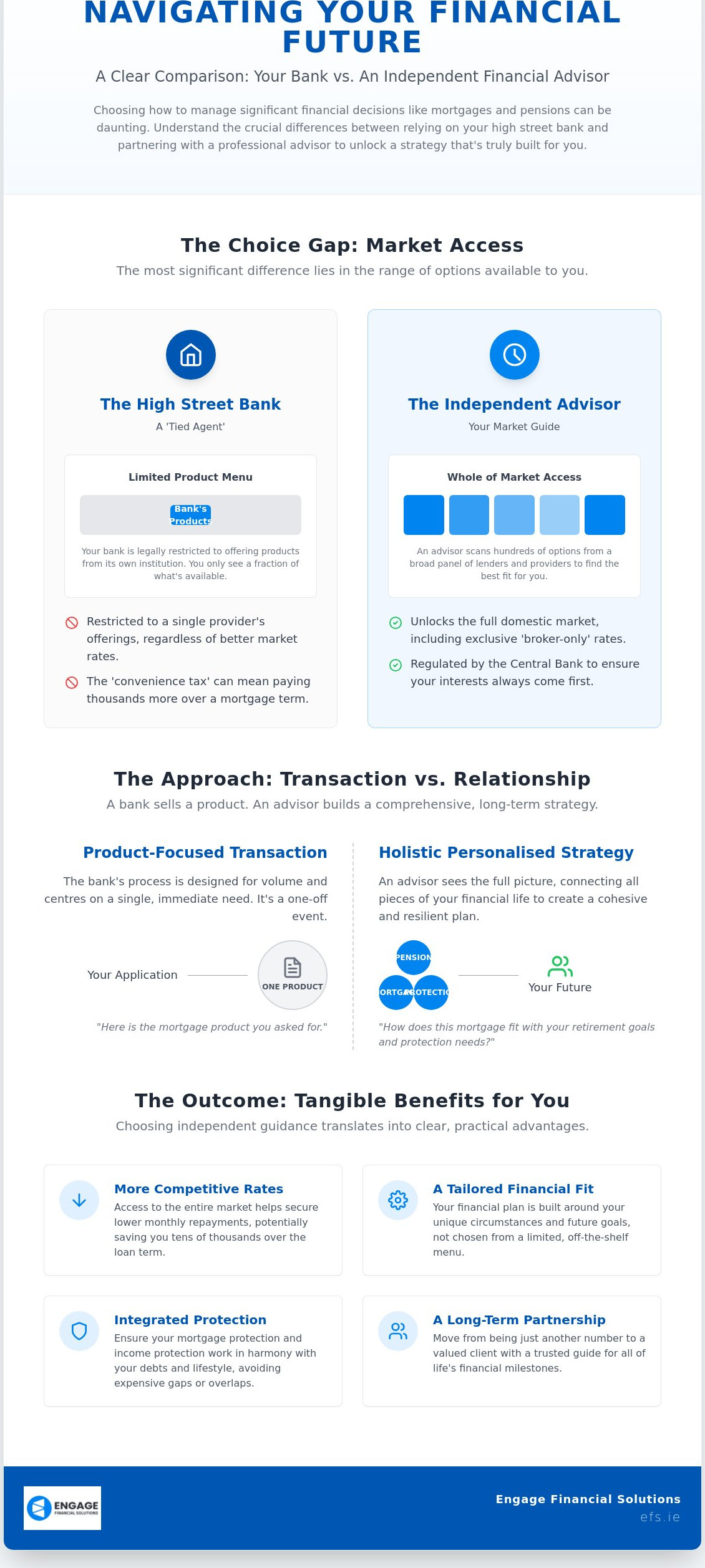
Walking into a high street bank feels safe. You have likely had an account there for years, and there is a certain comfort in the familiar branding. But when you sit down to discuss a mortgage or a pension, that friendly staff member is legally a “tied agent.” This means they are restricted to offering products solely from their own institution. Even if the bank across the street has a significantly lower interest rate or more flexible terms, they cannot tell you about it. It is like visiting a car dealership; the salesperson is never going to suggest you buy the more efficient model from the competitor next door.
The Single Provider Restriction
Banks essentially operate as showrooms for their own specific financial products. They prioritise their own profitability and shareholder interests, which means their “best” offer is simply the best they have on their own menu, not the best available in the wider market. Whilst the convenience of using your existing mobile app is tempting, it often masks a “convenience tax.” Over a twenty or thirty year mortgage, a seemingly small difference in rates can cost you tens of thousands of pounds. The psychological comfort of staying put rarely outweighs the mathematical reality of the market.
The Independent Advisor Advantage
This limitation is a primary reason why use a financial advisor instead of my bank. An independent professional has access to the “whole of market.” Instead of one restricted menu, they work with a broad panel of lenders and providers that includes every major domestic player and several specialised firms that do not even have high street branches. These specialised lenders often offer exclusive “broker-only” rates that the general public cannot access directly. This creates a significant advantage for you, as it opens doors to deals that remain hidden from those who only look at the high street.
This breadth of access is especially critical for niche commercial requirements that standard bank branches often overlook; for example, you can learn more about V4B Business Finance to understand how specialised brokers secure competitive terms for UK van fleet funding.
The role of an advisor is to act as a meticulous filter. They scan hundreds of options, scrutinising the fine print of every mortgage and pension scheme to find the handful that actually fit your specific financial story. In this market, independent advice is strictly regulated by the Central Bank to ensure your interests always come first. This level of stewardship provides a layer of protection and choice that a single-brand salesperson cannot offer. By partnering with a firm like Engage Financial Solutions, you ensure your financial future is built on a foundation of choice rather than limited options. You move from being a customer buying a product to a client receiving a bespoke strategy designed for long term security.
Personalised Strategy vs. Product Selling: Finding Your Perfect Fit
Banks are built for volume. When you walk into a local branch, the conversation usually centres on a single, immediate need. It is a transaction. You need a mortgage; they sell you a loan. This “now” focused mindset is a significant reason why use a financial advisor instead of my bank. Whilst a bank sees a standalone application, an independent advisor sees the cornerstone of your wider financial security. They look beyond the immediate paperwork to understand how one decision ripples through your entire life, from your current monthly budget to your eventual retirement goals.
A holistic approach ensures that your financial products work in harmony rather than in isolation. Whether you are a first-time buyer stepping onto the property ladder or a seasoned professional looking to maximise your pension contributions, your strategy must be integrated. A bank rarely asks how your new mortgage repayments might affect your ability to fund a PRSA, or if your existing protection policies are still fit for purpose. An advisor acts as a steady guide, connecting these dots to prevent expensive overlaps or dangerous gaps in your coverage.
Beyond the Mortgage Transaction
One of the most overlooked aspects of financial health is the synergy between debt and protection. If you are switching mortgages to a lower rate, it is vital to review your mortgage protection simultaneously. A bank might simply tick a box, but an advisor ensures the cover amount and term still align with your new loan. They also evaluate your income protection to ensure it reflects your current salary and lifestyle. This meticulous attention to detail ensures your family is safeguarded against the unexpected, providing a level of security that a simple product sale cannot match.
Building a Long-term Partnership
The high street bank often feels like a rotating door of staff. You might build a rapport with a manager only to find they have moved to a different branch six months later, forcing you to tell your story all over again. Choosing independent guidance offers the benefit of continuity. You gain a single point of contact who knows your full financial history and understands your long term aspirations. Creating a holistic financial plan ensures that every piece of your puzzle fits together perfectly as your life evolves through marriage, career shifts, or growing a family. This partnership provides the calm competence you need to stay on track, regardless of how market conditions or domestic regulations might change in the future.
Navigating the True Cost of Financial Decisions
It is easy to assume that bank-led advice is free because you rarely see an itemised invoice on your monthly statement. This perception often leads to what we call a “convenience tax.” Whilst you might save an hour by signing papers at your local branch, you could inadvertently commit to a higher interest rate that persists for decades. A mortgage rate that is just 0.5% higher than the market best might seem small on a monthly basis. Over a thirty year term, however, that gap can grow into a sum that would have significantly boosted your retirement fund or paid for a child’s university education.
The return on investment from professional guidance is often immediate and measurable. By switching your mortgage for better value, the long term savings frequently outweigh any initial advisory costs. Beyond debt, advisors ensure you are not leaving money on the table regarding your pension. Many people fail to maximise tax relief simply because their bank-provided scheme is poorly structured. An independent expert identifies these inefficiencies, ensuring every pound you earn is working as hard as possible for your future security.
Understanding Advisor Remuneration
Transparency is the bedrock of a trusted partnership. Before your first meeting, it is helpful to understand the difference between commission-based models and flat engagement fees. A regulated advisor has a strict legal obligation to disclose exactly how they are paid, whether that is through a fee you pay directly or a commission from a policy provider. This clarity allows you to compare the cost of advice against the potential savings on complex products like buy-to-let loans or self-build mortgages, where the right structure can save you thousands in interest and tax.
The Cost of Doing Nothing
One of the greatest risks to your wealth is “lazy money.” Leaving large sums in standard bank deposit accounts often means your purchasing power is being eroded by inflation. This is another vital reason why use a financial advisor instead of my bank; an advisor proactively identifies stagnant funds and suggests more efficient investment vehicles. Engaging in comprehensive retirement planning prevents the late-stage financial stress that comes from realising too late that your savings haven’t kept pace with your goals. Taking action today replaces that uncertainty with a methodical, logical path toward long term stability.
How to Transition from Bank-Led Services to Independent Support
Moving away from a long term banking relationship can feel like a significant hurdle, especially if you have managed your finances at the same branch for years. However, the transition from restricted bank advice to independent guidance is designed to be a straightforward and stress-free process. Understanding why use a financial advisor instead of my bank often begins with the realisation that you deserve more choice; the next step is simply organising the information that will allow an expert to build your new strategy.
The process is methodical and logical. It starts with a clear picture of where you are today so that your advisor can map out the most efficient route to where you want to be. By taking control of this transition, you replace the “one size fits all” approach of the high street with a bespoke plan that evolves alongside your life milestones.
Preparing for Your First Meeting
Before your initial consultation, gathering your current financial data will help your advisor provide immediate value. Having these documents ready allows for a more detailed analysis of your existing arrangements. Aim to collect the following:
- Your most recent mortgage statements to check current rates and remaining terms.
- Details of any existing pensions, including PRSAs, Company Pensions, or Retirement Bonds.
- Current insurance policy documents for Mortgage Protection, Income Protection, or Critical Illness Insurance.
As a practical exercise, try to define your goals for the next 5, 10, and 20 years. It is also incredibly helpful to write a single sentence defining your primary financial anxiety, such as “I am worried my pension won’t support my current lifestyle,” to share with your advisor during the first chat.
Evaluating Your New Advisor
Your peace of mind depends on knowing you are in safe hands. Always verify that any advisor you consider holds current Central Bank authorisation. This ensures they meet strict professional standards and are legally required to act in your best interest. During your first meeting, don’t be afraid to ask about the breadth of their panel. A truly independent advisor should have access to a wide range of lenders and providers, ensuring you aren’t just moving from one limited menu to another. They should also demonstrate expertise across the full suite of services, from switching mortgages to managing ARFs in retirement.
Once you decide to move forward, your advisor will conduct a “Fact-Find.” This is a comprehensive review that acts as the blueprint for your financial future. They will handle the heavy lifting of the paperwork, managing the switch from your bank to new providers to ensure the transition is seamless. This marks the beginning of ongoing stewardship, where regular check-ins ensure your plan stays on track as market conditions change. If you are ready to move beyond limited options, you can start your journey toward financial clarity with a team that prioritises your long term security.
Partnering with Engage Financial Solutions for Long-Term Success
Choosing to move away from the high street is about more than just finding a lower interest rate; it is about finding a partner who prioritises your long term security. At Engage Financial Solutions, we pride ourselves on a philosophy of “calm competence.” We act as the essential buffer between you and the often overwhelming complexities of the financial world. Based in Blackrock, our team serves clients nationwide, combining the meticulous attention of a local consultant with the sophisticated capabilities of a modern, full-stack firm. This personalised touch is a core reason why use a financial advisor instead of my bank, as it replaces the generic service of a large institution with a dedicated, lifelong partnership.
Our approach is methodical and logical, designed to remove the friction from every transition. Whether you are navigating the excitement of buying your first home or the intricate details of a retirement strategy, we ensure the process is straightforward. We don’t just sell products; we build the financial architecture that supports your lifestyle. By understanding your full story, we can anticipate potential stresses and neutralise them before they occur, keeping you one step ahead at every milestone.
The Benefits of Our Specialist Network
One of the primary advantages of our service is the breadth of our specialist network. We provide access to an extensive panel of lenders for residential and commercial property loans, ensuring you aren’t limited by the narrow criteria of a single bank. Our stewardship extends to your protection needs as well. We help you navigate tailored policies that safeguard your earnings and your family, from Critical Illness Insurance to Mortgage Protection. For those looking toward the future, our expertise in PRSAs, Company Pensions, and ARFs ensures that your retirement is built on a foundation of stability and choice rather than restricted options. To see how experts manage these complex transitions, you can discover Evergreen Wealth Management for further insights into specialist retirement planning.
Your Next Steps to Financial Security
We utilise a “Future-Back” perspective to ensure your strategy is always goal-driven. This means we start by defining your desired end-state; perhaps that is a debt-free home, a secure retirement fund, or the peace of mind that your family is protected. Once the destination is clear, we work backward to the present, identifying the precise actions needed today. We handle the heavy lifting of paperwork and lender negotiations, making the entire experience as seamless as possible. If you are ready to move from being a bank customer to a valued client, you can schedule your professional consultation with Engage Financial Solutions today. Let us help you build a future defined by choice and long term success.
Securing Your Financial Future Through Choice
Transitioning from the limited menu of a high street bank to the expansive options of an independent advisor is a significant step toward long term security. You have seen how accessing the whole market can lead to more competitive mortgage rates and how a holistic plan ensures your pension and protection are perfectly aligned with your lifestyle. When you reflect on why use a financial advisor instead of my bank, the ultimate benefit is the shift from being a transactional customer to a valued client with a bespoke roadmap designed for your specific needs.
Our team is regulated by the Central Bank and brings deep expertise across mortgages, pensions, and protection to every conversation. We prioritise straightforward, jargon-free guidance to ensure you feel confident and in control of every decision. If you are ready to replace limited options with tailored solutions, it is time to take the next step. Begin your journey to financial clarity with a professional advisor and experience the peace of mind that comes from a plan built entirely around your goals. Your future self will thank you for choosing choice over convenience.
Frequently Asked Questions
Is a financial advisor better than a bank for a mortgage?
A financial advisor is often better because they scan the entire domestic market rather than being limited to a single brand’s products. Whilst your bank can only sell you their own loans, an independent professional compares rates and terms across dozens of providers to find the most competitive fit for your budget. This breadth of choice is a key reason why use a financial advisor instead of my bank, ensuring you don’t miss out on better deals elsewhere.
How much does it cost to use a financial advisor for a pension?
The cost varies depending on whether the advisor works on a flat fee or a commission basis. All regulated advisors must provide a clear disclosure document outlining their remuneration before you commit to a plan. In many cases, the long term growth and tax efficiencies gained through expert management far outweigh the initial costs, especially when compared to the restricted, often higher-fee schemes offered by high street institutions.
Can a financial advisor access different mortgage rates than my bank?
Yes, independent advisors frequently have access to “broker-only” rates that are not advertised to the general public or available at branch level. These exclusive deals can offer lower interest rates or more flexible terms for specific scenarios, such as first-time buyers or those looking to switch. By using an advisor, you gain entry to these hidden market segments, potentially saving you thousands over the life of your loan.
Is my money as safe with a financial advisor as it is with a bank?
Your money is held by regulated product providers, such as insurance companies or pension funds, rather than the advisor themselves. These institutions are subject to the same strict Central Bank regulations and investor compensation schemes as the major high street banks. An advisor’s role is to guide your choices and manage the strategy, ensuring your capital is placed with secure, reputable firms that match your risk profile and long term goals.
Do I need a large amount of savings to see a financial advisor?
You don’t need a vast fortune to benefit from professional guidance. Whether you are just starting your first pension, saving for a deposit, or looking to switch your mortgage to reduce monthly outgoings, expert advice is accessible to everyone. Most advisors welcome clients at all life stages, as the value of early, methodical planning is often greatest when you are building your wealth from the ground up.
What happens if I want to switch away from my bank-held mortgage?
Switching away from a bank-held mortgage is a straightforward process when managed by an independent professional. Your advisor will handle the heavy lifting, from comparing new lenders to managing the valuations and legal paperwork required for the transition. This seamless approach removes the stress of dealing with multiple parties, allowing you to move to a more competitive rate with minimal friction and maximum clarity on your savings.
How often should I meet with my financial advisor?
It is generally recommended to meet for a formal review at least once a year. These check-ins allow you to adjust your strategy if market conditions change or if you experience a significant life event like a career shift, marriage, or the birth of a child. Regular stewardship ensures your mortgage, protection, and pension plans remain aligned with your evolving goals, providing the stability needed for long term success.
What is the difference between a tied agent and an independent broker?
A tied agent is legally restricted to selling products from one specific institution, such as a single bank or insurance company. In contrast, an independent broker works on your behalf to scan the entire market for the best possible solutions. This distinction is a fundamental reason why use a financial advisor instead of my bank, as it guarantees that the advice you receive is based on your best interests rather than a single company’s sales targets.
Disclaimer
Engage Financial Services LTD T/A Engage Financial Solutions is regulated by the Central Bank of Ireland CRO 764570. Director David Moore. Suite 2 First Floor, 14 -18 Main street, Blackrock, Co Dublin A94 W0Y3