


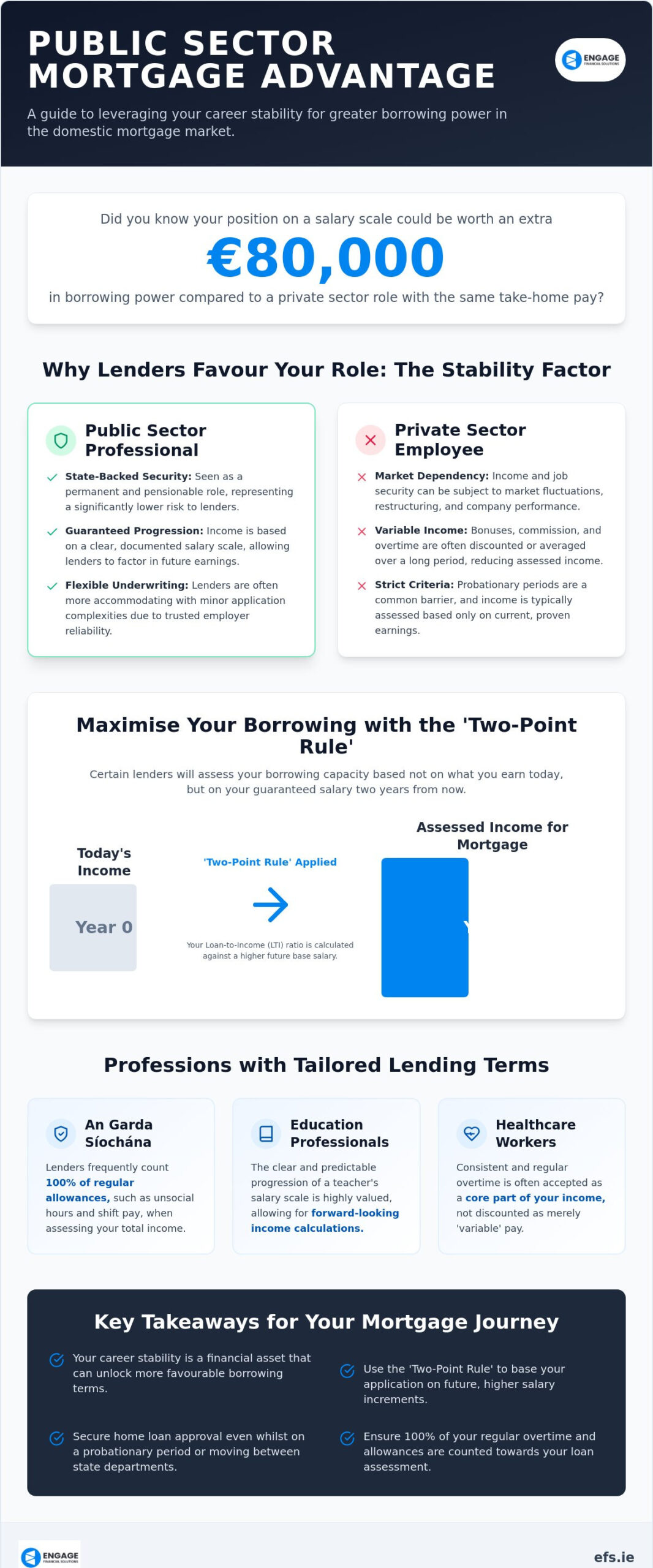
Did you know that your position on a salary scale could be worth an extra €80,000 in borrowing power compared to a private sector worker with the same current take-home pay? It’s often frustrating when lenders overlook your consistent overtime or treat a recent promotion as a hurdle because of a new probationary period. You’ve dedicated your career to public service, yet securing a mortgage for public sector employees can feel like the standard application process doesn’t quite recognise the unique stability and guaranteed progression your role offers.
This guide explains how to leverage specific lender policies that count future salary increments and 100% of your regular allowances to your advantage. We’ll explore how to bypass the common stresses of temporary contracts whilst maximising your borrowing potential to establish the long-term financial security you deserve. By understanding how the domestic market rewards your professional status, you can move from uncertainty to a successful home purchase with calm confidence and a clear path forward.
Key Takeaways
- Understand how your career stability acts as a significant financial asset, allowing you to access more favourable borrowing terms than many private sector workers.
- Learn how to use the “Two-Point Rule” to qualify for a higher mortgage for public sector employees Ireland by basing your application on future salary scale increments.
- Discover the specific criteria that allow you to secure home loan approval even whilst on a probationary period or when moving between different state departments.
- Explore how to lower your monthly repayments by switching to a lender that recognises your unique income structure and high job security.
- Gain clarity on how a specialist advisor can help you navigate complex payslips and ensure 100% of your regular overtime and allowances are counted towards your loan.
Why Public Service Roles Offer a Unique Advantage for Home Loans
Your career choice provides a level of financial predictability that most private sector employees simply cannot match. When you’re looking to secure a mortgage for public sector employees Ireland, you aren’t just presenting a current salary; you’re presenting a state-backed guarantee of future income. This “Public Sector Advantage” is a specific recognition by lenders that your role carries a significantly lower risk profile. Because your employment is tied to the Public service in the Republic, banks view your position as a foundation of long-term security.
One of the most powerful tools at your disposal is the concept of “Assumed Progression.” In the domestic mortgage market, certain lenders don’t just look at what you earn today. They recognise that your pay is structured on a guaranteed scale. By documenting your path, you can often borrow based on where your salary will be in two or three years. This forward-looking approach can increase your borrowing capacity by tens of thousands of euros, helping you bridge the gap between a starter home and your forever home without the friction usually found in standard applications.
The Stability Factor: Why Lenders Favour Your Role
The “permanent and pensionable” status of your role is the gold standard for risk assessors. Whilst a private sector worker might face the uncertainty of market fluctuations or sudden company restructuring, your position is viewed as a pillar of stability. This lower risk profile often leads to more flexible underwriting. Lenders are frequently more willing to look past minor complexities in your application because they trust the reliability of your employer. This sense of security acts as a buffer, ensuring a smoother transition from applicant to homeowner.
Common Professions That Qualify for Tailored Terms
Whether you’re safeguarding the community or educating the next generation, your specific profession opens doors to more adaptable lending criteria. Lenders have developed a deep understanding of the nuances within different state roles:
- An Garda Síochána: Lenders often count 100% of your regular allowances, such as unsocial hours or shift pay, provided you have a consistent track record.
- Education Professionals: Primary and secondary teachers on permanent contracts are highly valued. Lenders recognise the clear progression of your salary scale from the moment you’re qualified.
- Healthcare Workers: From nurses to medical specialists, the domestic market values the essential nature of your work. Regular overtime is frequently accepted as a core part of your income assessment, rather than being discounted as “variable.”
By choosing a mortgage for public sector employees Ireland, you’re opting for a process that respects the meticulous work you do. It’s about finding a partner who understands that your payslip tells a story of progression and reliability, ensuring your financial future is as secure as your career.
Maximising Your Borrowing Power with Salary Scale Adjustments
When you apply for a home loan, most people assume the bank only cares about the figure on their last three payslips. For you, the reality is far more flexible. Lenders in the domestic market recognise that your income is not static; it’s built on a guaranteed trajectory. This allows for a unique calculation known as the “Two-Point Rule,” where a lender assesses your borrowing capacity based on where you will be on your salary scale in two years’ time. It’s a forward-looking approach that treats your future earnings as a present-day reality.
Securing a mortgage for public sector employees Ireland often involves leveraging these specific policy nuances to boost your “effective income.” By projecting your earnings forward, you can often satisfy the Central Bank mortgage rules more easily, as your Loan-to-Income (LTI) ratio is calculated against a higher base. This isn’t about “gaming” the system; it’s about the financial industry acknowledging the inherent security of your career path.
Understanding the Salary Scale Uplift
This uplift is a genuine game-changer, particularly if you are currently researching first-time buyer options. Whilst one lender might only look at your current point on the scale, several prominent lenders allow for a two-point jump. Some specialist providers even consider three points ahead. To make this work, you’ll need a correctly formatted Salary Certificate. This document must clearly state your current point, your next increment date, and the confirmed salary at those future stages. It provides the empirical evidence a lender needs to justify a higher loan amount.
Making Overtime and Allowances Count
Variable income like overtime, shift allowances, or unsocial hours pay can often be the most stressful part of an application. The standard approach for many private sector workers is to have this income heavily discounted. However, for public servants, many lenders will accept 100% of these earnings if you can show they are a regular feature of your role. Typically, they will look for a two-year average to ensure the income is stable. If you’ve recently taken on an “acting up” allowance or a temporary promotion, don’t assume it won’t count. As long as your employer can confirm the duration and nature of the pay, it can often be factored into your total borrowing power.
To ensure your application moves forward without friction, you should gather the following documents early:
- A completed Salary Certificate detailing your specific pay scale and next increments.
- P60s or Employment Detail Summaries for the last two years to prove overtime consistency.
- Your last three to six months of payslips to show regular allowance codes.
- A letter from your HR department confirming your “permanent and pensionable” status.
If you’re unsure how your specific allowances will be viewed by different banks, it’s often helpful to chat with a specialist advisor who understands the nuances of state-sector payslips.
Navigating Probationary Periods and Contractual Employment
Stepping into a new role or accepting a hard-earned promotion is a milestone to celebrate, yet it often brings a specific type of financial anxiety. You might worry that starting a fresh 12-month probationary period will force you to put your home-buying dreams on hold. For many, the fear is that a lender will see “probation” and immediately stall the application. When seeking a mortgage for public sector employees Ireland, however, your previous service history carries significant weight. Most lenders in the domestic market are willing to take a more holistic view of your career path than they would for a private sector applicant.
The key to overcoming this hurdle lies in the principle of continuity. If you’re moving within the state sector, banks often focus on your total time served rather than just your time in the current grade. This perspective provides a sense of stability that simplifies the process. To understand the broader requirements, you can consult the official guide to applying for a mortgage, which outlines how financial stability is assessed across the board. By demonstrating a steady track record, you can often proceed with your application whilst still in your new role’s initial months.
Promotions and the Probation Hurdle
A promotion shouldn’t be a barrier to your progress. Because your employer remains a state entity, the risk of you failing probation is statistically very low. Lenders recognise this reality. They typically look for “continuous service” to satisfy their criteria. Continuous service is defined as the uninterrupted period of employment within the state sector, even if you have transitioned between different departments or roles. This means your years of service as a clerical officer still count even if you have just moved up to an executive role. It’s a straightforward way to maintain your borrowing momentum.
Guidance for Temporary and Fixed-Term Professionals
If you are a substitute teacher or a locum nurse, you might feel that your “fixed-term” status makes you less attractive to a credit committee. This isn’t necessarily the case. Lenders often apply the “Two-Contract Rule” for those not yet in permanent positions. This means that if you’ve completed one contract and are currently on your second, many banks will treat your income as reliable and recurring. The goal is to show a clear pattern of work and a high likelihood of renewal. You can strengthen your case by providing a letter from your department head or HR manager confirming that your skills are in demand and your contract is expected to continue. Organising your Employment Detail Summary to show consistent earnings over the last two years will provide the evidence needed to secure a positive outcome. When you are navigating a mortgage for public sector employees Ireland as a contract worker, the focus is on your professional trajectory rather than a single end-date.
Optimising Your Financial Future: Switching and Protection
Many homeowners view their monthly repayment as a fixed cost of living. For those in the state sector, this perspective misses a significant opportunity for long-term saving. As your career progresses and you move up the salary scales mentioned earlier, your financial profile becomes increasingly attractive to new lenders. This improved standing, combined with the natural growth of equity in your home, often allows you to secure a mortgage for public sector employees with much more competitive interest rates than your original deal. Equity is your best friend.
The Switcher Advantage for Established Professionals
Lenders in the domestic market view your “permanent and pensionable” status as a badge of reliability. New lenders love stability. Because your income is guaranteed and your job security is high, you are often a preferred client for the most competitive rate offers available. By switching your mortgage, you can leverage your lower Loan-to-Value (LTV) ratio to reduce your monthly outgoings significantly. As you pay down your principal and the value of your property potentially increases, you move into lower LTV bands, which unlock cheaper interest rates. This transition is far more straightforward than your initial application; a specialist advisor can manage the administrative details to ensure the move is seamless. Over the remaining term of your loan, even a marginal reduction in interest can result in savings of tens of thousands of euros. Don’t leave savings on the table.
Safeguarding Your Income and Home
Whilst securing a better rate is vital, protecting your ability to pay that mortgage is equally important. Standard mortgage protection is designed to clear the debt if you pass away, but it doesn’t help if a long-term illness prevents you from working. This is where income protection for public servants becomes essential. Your state sick pay scheme provides an excellent safety net, yet it eventually reduces to half-pay or less after specific timeframes. A tailored private policy can be structured to “kick in” exactly when your state benefits decrease, ensuring your lifestyle remains stable and your mortgage is paid. This “Future-Back” approach focuses on your long-term security, ensuring your home remains a sanctuary regardless of health challenges.
If you are ready to explore your options for a more secure financial future, you can organise a consultation to review your current mortgage and protection needs.
The Value of Personalised Advice for Public Sector Professionals
The journey to homeownership involves more than just gathering documents; it requires a partner who can translate complex financial jargon into clear, actionable steps. A specialist broker acts as a vital buffer between you and the lender, ensuring that the unique strengths of your career are highlighted rather than lost in a standard application. When you’re seeking a mortgage for public sector employees Ireland, the value lies in having a guide who understands that your payslip is different from a private sector worker’s. They see the long-term security where a generic bank computer might only see a base salary.
Why a Specialist Broker Outperforms a Direct Bank Application
Applying directly to a single bank limits your options to that one institution’s specific appetite for risk. In contrast, a specialist broker provides access to a broad range of lenders across the domestic market, some of whom have much more flexible policies for state employees. They know which lenders will favour a nurse’s overtime or a teacher’s salary scale increments, saving you time and preventing the disappointment of a rejection based on narrow criteria. By tailoring the search to your specific profession, they ensure you secure the most favourable terms available for your unique circumstances.
Starting Your Journey with Confidence
Your initial consultation is designed to be a straightforward, jargon-free conversation about your goals and your current financial health. You can expect a thorough review of your income, including those future salary points and allowances we discussed earlier, to establish a realistic borrowing target. This proactive approach allows you to anticipate potential hurdles and neutralise them before they occur, making the transition from your initial query to the final drawdown as seamless as possible.
We are committed to providing the professional guidance you need to safeguard your financial future and achieve the peace of mind that comes with owning your own home. If you’re ready to take the next step with a partner who understands the domestic public sector landscape, you can Book your personalised financial review today to begin your journey with total confidence.
Building Your Future on a Foundation of Security
You have dedicated your career to public service, and it’s only right that your home loan reflects the stability you provide to the community. By leveraging specific lender policies like the “Two-Point Rule” and the full recognition of your regular allowances, you can access borrowing limits that truly match your potential. Whether you’re stepping onto the property ladder for the first time or seeking to optimise your current repayments, your professional status is a powerful financial asset in the domestic market.
Securing a mortgage for public sector employees Ireland is a process that deserves meticulous attention and expert stewardship. As specialists in salary scale and allowance calculations regulated by the Central Bank, we offer full-service support from your first query to the final drawdown and beyond. We act as your proactive partner, neutralising potential stresses before they occur and ensuring a seamless transition to your new home. Secure your future with a tailored public sector mortgage review. Your path to long-term financial peace of mind is clear, and we’re here to guide you every step of the way.
Frequently Asked Questions
Can I get a mortgage if I am still on probation in a public sector role?
Yes, you can certainly secure approval whilst on probation if you have a history of continuous service within the state sector. Lenders in the domestic market understand that promotions often trigger a new probationary period. They prefer to look at your total career length and the stability of your employer rather than a single 12-month window. This holistic approach ensures your career progression doesn’t stall your home-buying plans.
How many points up the salary scale will lenders count towards my income?
Lenders typically allow you to jump one or two points ahead on your salary scale for income assessment purposes. Some specialist providers may even consider you at three points above your current grade. This allows you to borrow based on your guaranteed future earnings rather than just your current take-home pay. It’s a significant advantage that can add tens of thousands to your total borrowing power.
Do lenders accept 100% of my overtime and shift allowances?
Most lenders will accept 100% of your regular overtime and shift allowances if you can demonstrate a consistent two-year track record. This is especially beneficial for frontline staff such as nurses or members of the police force. By providing P60s or Employment Detail Summaries from the previous two years, you can ensure these vital extra earnings are fully counted towards your mortgage application.
Is it easier for civil servants to get a mortgage compared to private employees?
Securing a mortgage for public sector employees Ireland is often more straightforward because of the “permanent and pensionable” nature of the work. Banks value the high job security and predictable pay increments associated with state roles. This reliability often leads to more flexible underwriting and higher borrowing limits; especially when compared to private sector roles that may be subject to more frequent market volatility.
What documents do I need to provide as a public sector employee?
You will need to provide a completed Salary Certificate from your HR department along with your last three to six months of payslips. Additionally, lenders require your P60 or Employment Detail Summary for the previous two years to verify any variable income like overtime. These documents allow the bank to confirm your exact point on the pay scale and the reliability of your allowances.
Can I switch my mortgage to a better rate if I am a public servant?
Yes, you can switch your mortgage to access lower interest rates as your equity grows and your salary increases. As you move up the pay scale, your improved income profile makes you a highly attractive candidate for new lenders. Switching allows you to leverage a lower Loan-to-Value ratio to unlock the most competitive rates in the domestic market; which can save you significant money over time.
How does my state sick pay affect my need for income protection?
State sick pay provides an excellent foundation, but it eventually reduces to half-pay or less after a set period. Private income protection is designed to fill this specific gap; ensuring your mortgage repayments are covered if you are unable to work long-term. By tailoring a policy to kick in exactly when your state benefits decrease, you can maintain total financial stability for your family and your home.
What happens if I am on a temporary or fixed-term contract in the state sector?
Lenders usually apply a “Two-Contract Rule” for those on fixed-term or temporary contracts within the state sector. If you have completed one 12-month contract and are currently on your second, most banks will view your income as reliable and recurring. This policy makes a mortgage for public sector employees Ireland accessible even for those who haven’t yet secured a permanent and pensionable position in their department.
Disclaimer
Engage Financial Services LTD T/A Engage Financial Solutions is regulated by the Central Bank of Ireland CRO 764570. Director David Moore. Suite 2 First Floor, 14 -18 Main street, Blackrock, Co Dublin A94 W0Y3