


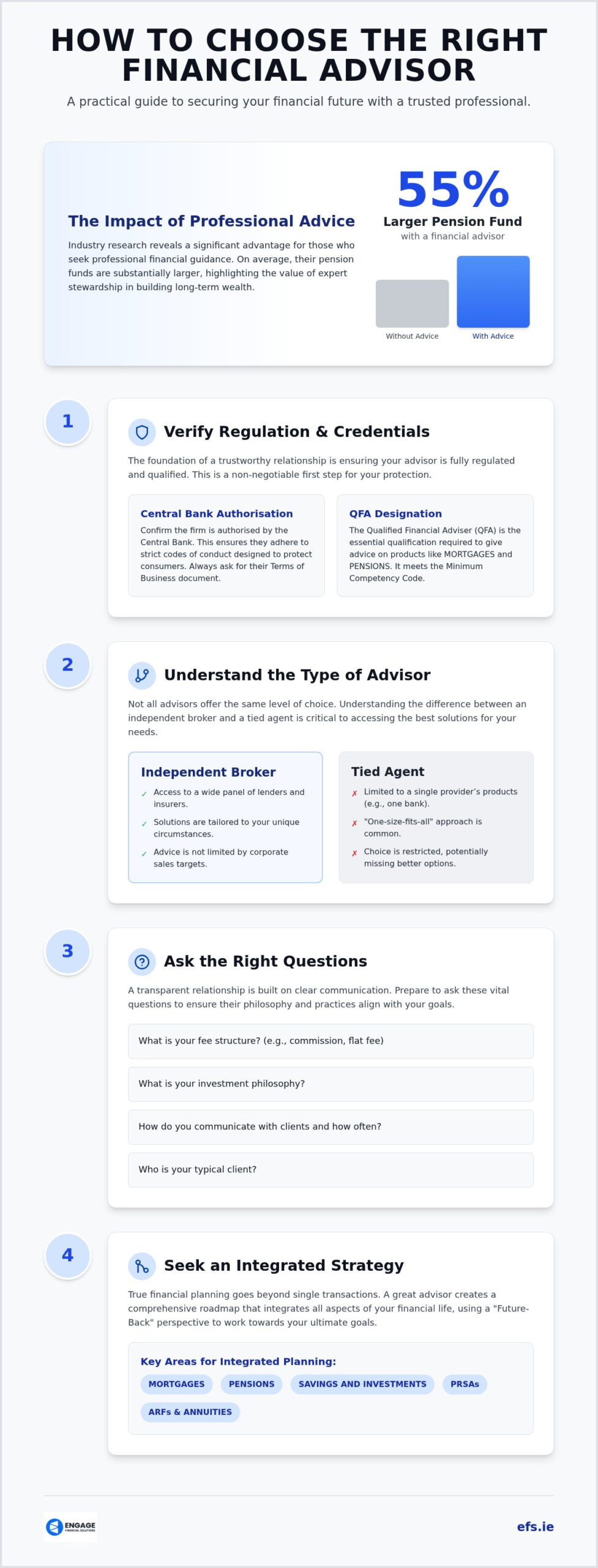
Did you know that individuals who receive professional financial advice accumulate pension funds that are, on average, 55% larger than those who do not? This striking figure from Brokers Ireland highlights that the right partnership is not just a luxury; it’s a fundamental step toward long-term stability. You likely feel the pressure of making the right choices for your family’s future, and understanding how to choose a financial advisor Ireland experts recommend is the first step toward achieving your aspirations.
It’s natural to feel some anxiety when deciding how to choose a financial advisor Ireland residents can trust, especially when faced with complex fee structures or market volatility. You deserve a relationship built on transparency and “calm competence” rather than a generic approach. This guide will provide the practical steps needed to find a regulated expert within our domestic market who offers tailored, jargon-free support. We will examine essential qualifications like the QFA designation and show you how to choose a financial advisor Ireland clients rely on to ensure all products, from MORTGAGES to PENSIONS, are seamlessly integrated.
Key Takeaways
- Discover the essential criteria for how to choose a financial advisor Ireland experts recommend to ensure your wealth is managed with professional integrity and care.
- Understand why verifying Central Bank regulation and the QFA designation is the cornerstone of finding a reliable guide who’ll prioritise your long-term security.
- Learn to distinguish between tied agents and independent brokers so you can access a broad panel of options for your MORTGAGES and PENSIONS.
- Identify the vital questions to ask a potential partner to ensure their fee structure and investment philosophy are transparent and tailored to your specific goals.
- Explore the ‘Future-Back’ perspective to see how integrated planning for SAVINGS AND INVESTMENTS and PRSAs provides a seamless path to peace of mind.
The Importance of Expert Financial Stewardship in a Changing Market
Our domestic financial landscape is currently undergoing a period of significant transformation. For many, the sheer volume of choices regarding SAVINGS AND INVESTMENTS or RETIREMENT PLANNING can feel overwhelming. A professional Financial adviser acts as more than just a broker; they are a buffer between you and the noise of the global economy. Their role is to provide a sense of stewardship, ensuring that your hard-earned capital is protected whilst you focus on your career and family. When you begin looking at how to choose a financial advisor who fits your specific lifestyle, it’s essential to look for a partner who prioritises your long-term security over short-term product sales.
There is a profound difference between simply purchasing a financial product and engaging in a comprehensive strategy. Buying a MORTGAGE or a single pension plan is a transaction; creating a roadmap that integrates your home, your income, and your future legacy is true financial planning. This holistic approach is designed to alleviate the stress of complex life transitions. Whether you are a first-time buyer or approaching the age where ARFs and ANNUITIES become relevant, having a steady guide ensures that every decision supports your overarching goals.
Navigating Market Consolidation
Recent trends in our domestic market have seen many large, bank-owned entities absorb smaller, independent firms. Whilst this creates scale, it often results in a “one-size-fits-all” mentality where volume is prioritised over bespoke service. In this environment, choosing an independent partner becomes more critical than ever. A boutique consultancy offers the benefit of a wide panel of lenders and insurers, ensuring you aren’t limited to a single provider’s offerings for MORTGAGES or protection products. This independence allows for truly tailored solutions, where your unique circumstances dictate the advice you receive, rather than a corporate sales target.
The Cost of Poor Financial Literacy
Attempting a “do-it-yourself” approach to wealth management can be risky, especially in a high-inflation environment where the value of cash can erode quickly. Without expert guidance, it’s easy to fall into the trap of unsustainable debt or miss out on tax-efficient opportunities like PRSAs. Industry research suggests that those who receive professional advice accumulate pension funds that are, on average, 55% larger than those who do not. Professional advice helps you navigate market volatility with a “Future-Back” perspective, starting with your desired end-state and working backwards to current actions. This proactive management prevents emotional decision-making during downturns, providing the peace of mind that comes from knowing your future is being meticulously managed by a steady guide.
Deciphering Credentials and Regulatory Standards
When you begin researching how to choose a financial advisor Ireland experts recommend, your first priority should be verifying their regulatory standing. In our domestic market, the Central Bank acts as the primary watchdog, ensuring that every authorised firm adheres to strict codes of conduct. This oversight is designed to protect your interests, providing a layer of security that “DIY” planning simply cannot offer. A professional firm will always be transparent about its authorisation, and this information should be easily accessible within their Terms of Business document. This document is a hallmark of a trustworthy partnership; it outlines exactly how the firm operates, the services they provide, and how they are compensated for their expertise.
The Qualified Financial Adviser (QFA) designation is the essential baseline you should look for in any consultant. This qualification ensures the advisor has met the Minimum Competency Code required to provide advice on PENSIONS, MORTGAGES, and SAVINGS AND INVESTMENTS. Whilst the QFA is a vital foundation, some advisors pursue advanced designations like the Certified Financial Planner (CFP) credential. This represents a higher level of training in complex areas of wealth management. Whether you need a straightforward plan for life insurance or a sophisticated strategy for RETIREMENT PLANNING, understanding these credentials helps you gauge the level of expertise you are engaging.
The Minimum Competency Code
The Minimum Competency Code (MCC) is a regulatory framework that ensures you receive advice from someone with the right knowledge and skills. You should always verify an advisor’s status on the official regulatory register before your first meeting. After your initial consultation, a professional advisor must provide you with a Statement of Suitability. This document explains why a particular product, such as a PRSA or a specific MORTGAGE, is right for your unique circumstances. It serves as a written record of the advice given, ensuring that your long-term goals remain the central focus of the relationship. For more details on what to expect, you can consult this consumer protection guide to financial advice.
Advanced Qualifications to Look For
Specialised knowledge becomes particularly important when you are dealing with complex transitions like moving from a pension to ARFs or RETIREMENT BONDS. These areas require a deep understanding of tax implications and market risks. A firm that prioritises ongoing professional development will be better equipped to manage these nuances as regulations evolve. Often, a team-based approach provides more robust guidance than a solo practitioner because it allows for a broader range of expertise across different life stages. If you are looking for a partner who offers this level of meticulous care, you can learn more about our approach to tailored guidance. This proactive mindset ensures that potential stresses are identified and neutralised before they can impact your financial security.
Comparing Independent Advice and Tied Agencies
One of the most significant decisions you’ll make is whether to engage a tied agent or an independent professional. A tied agent is restricted to the products of a single institution, such as a specific bank or insurance provider. Whilst they may have deep knowledge of those specific offerings, they cannot scan the wider market for a more competitive rate on your MORTGAGES or a more comprehensive policy for INCOME PROTECTION. Understanding this distinction is a vital part of knowing how to choose a financial advisor Ireland based clients can rely on for an objective, broad-market perspective. By contrast, an independent advisor or multi-agency broker works on your behalf, navigating various providers to find the most suitable fit for your unique circumstances.
A wider market view consistently leads to better outcomes, particularly when it comes to LIFE INSURANCE and protection products. Different insurers have varying appetites for risk and different pricing structures. An advisor who can access a broad panel of providers ensures you aren’t overpaying for coverage or, worse, left with a policy that doesn’t fully protect your family’s future. This level of stewardship provides a seamless experience, as your advisor acts as the buffer between you and the complex underwriting processes of multiple large institutions. It’s about finding the right balance between cost and comprehensive security.
The Broker Advantage for MORTGAGES
For those looking at FIRST-TIME BUYER MORTGAGES, the guidance of a broker is often indispensable. They understand the differing lending criteria of various domestic banks and can identify which institution is most likely to approve your application based on your specific income and savings profile. Similarly, when it comes to SWITCHING MORTGAGES, a broker can quickly calculate the long-term savings available by moving to a lower interest rate. This proactive management helps you avoid the “loyalty tax” often charged by lenders to existing customers, ensuring your home financing remains as efficient as possible throughout the life of the loan.
Understanding Fee Structures
Transparency regarding how an advisor is compensated builds immediate trust and sets the tone for a professional partnership. Generally, advisors are paid through flat fees, hourly rates, or commissions from product providers. Some firms operate on a “fee-only” basis to ensure complete impartiality, whilst others use a commission-based model that can make advice more accessible for those just starting their financial journey. What matters most is that these costs are clearly explained in the Terms of Business. When you evaluate the cost, consider the value of the tailored guidance provided rather than just the price of the products themselves. A well-structured plan for your PENSIONS and investments can far outweigh the initial advisory costs over time.
Essential Questions for Your Potential Advisor
Selecting a partner for your financial journey is a significant decision that requires more than a cursory glance at a website. Whilst credentials provide a baseline of safety, the interview stage is where you determine if a consultant’s approach aligns with your specific needs. Understanding how to choose a financial advisor who truly understands our domestic market comes down to the quality of the questions you ask during your first encounter. A professional advisor should welcome this scrutiny, as it demonstrates your commitment to a long-term, transparent partnership.
Begin by asking about their specific experience with clients in your current life stage. A first-time buyer has very different requirements regarding MORTGAGES compared to a retiree navigating the complexities of ARFs and ANNUITIES. You should also inquire about their investment philosophy. Are they focused on aggressive growth for SAVINGS AND INVESTMENTS, or do they prioritise wealth preservation through a “Future-Back” perspective? Finally, ask how many different providers they research before making a recommendation. A broad-market view is essential for ensuring you receive the best possible terms on products like INCOME PROTECTION or Company Pensions.
The Initial Consultation Process
During your first meeting, expect a thorough “fact-find” process. This is a detailed discovery phase where the advisor gathers information about your income, debts, and future aspirations. Detail matters here; the more information you provide, the more tailored your final plan will be. A steady guide will spend the majority of this hour listening rather than talking, as they need to assess your emotional risk tolerance before suggesting any INVESTMENTS. This meticulous approach ensures that the resulting strategy feels seamless and sustainable rather than forced or overwhelming.
Spotting Red Flags Early
Professional stewardship is defined by “calm competence,” so be wary of any advisor who uses high-pressure sales tactics or promises “guaranteed” high returns. In a volatile market, no legitimate expert can guarantee specific outcomes; they can only manage risk through careful planning. Another significant cause for concern is a “one-size-fits-all” recommendation. If an advisor suggests a PRSA or a specific MORTGAGE before they’ve fully understood your lifestyle, they aren’t offering bespoke advice. Transparency is non-negotiable; if they cannot clearly explain their fee structure or how they’re compensated, it’s best to look elsewhere. To begin a partnership based on clarity and trust, you can schedule a personalised consultation with our team. This proactive step ensures your financial future is built on a foundation of integrity and expertise.
The Value of a Tailored Advisory Relationship
Understanding how to choose a financial advisor Ireland based clients can trust involves looking for someone who sees the big picture of your life. Many people manage their financial affairs in fragments, with MORTGAGES held at one bank and PENSIONS with a previous employer. This fragmented approach often leads to missed opportunities for tax efficiency and unnecessary stress during market shifts. To address this, some forward-thinking firms leverage banking aggregation technology from Wealthreader to provide a unified view of all your accounts. A tailored relationship provides a vital buffer, integrating every element into a single, cohesive strategy that evolves as your life changes. It’s about more than just numbers; it’s about the peace of mind that comes from knowing every product is working in harmony toward your long-term security.
A professional partnership should feel like a stewardship of your future. When you engage a consultant who offers “full-stack” capabilities, you move away from transactional advice and toward a life-long strategy. This holistic view ensures that your SAVINGS AND INVESTMENTS are not just growing, but are also protected from unforeseen risks. By choosing a partner who understands the domestic market’s nuances, you gain a steady guide who can navigate complexities whilst you focus on your family and career.
Integrating Your Financial Life
When your financial life is integrated, your MORTGAGE PROTECTION is meticulously aligned with your overall LIFE INSURANCE strategy. This ensures there are no overlaps or gaps in your coverage, providing a seamless safety net for your loved ones. This synergy extends to RETIREMENT PLANNING, where efficient tax management ensures more of your wealth is preserved. Having a single point of contact simplifies complex transitions, whether you are SWITCHING MORTGAGES to save on interest or consolidating various PRSAs into a single, manageable fund. This straightforward approach removes the friction often associated with managing multiple providers.
Choosing Your Steady Guide
At Engage Financial Solutions, we prioritise a “Future-Back” perspective. We don’t start by suggesting a specific product; we start with your desired end-state, such as achieving a comfortable retirement or securing a family home. Our role is to act as your steady guide, providing the calm competence needed to navigate volatility and inflation. Finding an advisor whose values and personality align with yours is just as important as their credentials. It’s about building a partnership based on trust, where you feel looked after and understood at every stage. You can begin your journey with Engage Financial Solutions today to ensure your financial future is as straightforward and secure as possible. Taking this first step is the most effective way to guarantee long-term success and stability.
Securing Your Financial Future with Confidence
Choosing a partner for your wealth is one of the most significant life decisions you’ll make. You now have the practical tools to verify essential credentials like the QFA designation and understand why Central Bank regulation is your primary safeguard. By prioritising independent advice over tied agencies, you ensure access to a broader market for your MORTGAGES and INSURANCE policies. This holistic approach removes the friction of managing separate products, allowing you to focus on your long-term aspirations with total peace of mind.
Deciding how to choose a financial advisor Ireland based experts recommend doesn’t have to be a source of anxiety. We specialise in meticulous stewardship across RETIREMENT PLANNING and lending, providing the “calm competence” you deserve. If you’re ready to transition from a product-driven approach to a goal-oriented strategy, we’re here to act as your steady guide. You can book a consultation with Engage Financial Solutions for expert, tailored guidance. We look forward to helping you build a stable and optimistic future for yourself and your family.
Frequently Asked Questions
What is the difference between a tied agent and a broker in the domestic market?
A tied agent is restricted to the products of a single institution, whilst a broker can access a wide panel of lenders and insurers. This means a broker can compare rates and terms across the broader market for MORTGAGES and PENSIONS, ensuring you receive a solution tailored to your specific needs. Choosing a broker provides you with more flexibility and a higher level of objective stewardship.
How much does a financial advisor typically charge for a RETIREMENT PLANNING consultation?
Fees for a RETIREMENT PLANNING consultation vary depending on the complexity of your financial situation and the advisor’s experience. Professional firms generally charge either a flat fee for a comprehensive plan or an hourly rate for specific advice. You should always receive a transparent breakdown of these costs in the Terms of Business document before your first meeting to ensure there are no surprises.
Can a financial advisor help me with SWITCHING MORTGAGES to a better rate?
A professional advisor is essential for SWITCHING MORTGAGES to a more favourable interest rate. They will assess your current loan against the wider market to identify potential long-term savings and handle the administrative burden of the application. This ensures a seamless transition that can significantly reduce your monthly repayments and improve your overall financial stability.
Is it better to choose a small local firm or a large bank for financial advice?
Choosing between a boutique consultancy and a large bank depends on the level of personalised service you require. Large institutions often prioritise high-volume transactions, whilst smaller firms focus on “calm competence” and tailored guidance. When deciding how to choose a financial advisor Ireland residents can trust, look for a partner who offers a proactive relationship rather than just a list of generic products.
What qualifications should I look for when choosing a professional to manage my PRSAs?
You should look for the Qualified Financial Adviser (QFA) designation as the minimum baseline for anyone managing your PRSAs. This qualification ensures the advisor meets the Central Bank’s Minimum Competency Code for providing advice on retirement products. For more complex needs, an advisor with advanced credentials can provide even more robust guidance for your long-term RETIREMENT PLANNING goals.
How often should I meet with my financial advisor to review my SAVINGS AND INVESTMENTS?
Most professionals recommend a formal review of your SAVINGS AND INVESTMENTS at least once a year. However, you should also schedule a meeting whenever you experience a significant life transition, such as a career change, marriage, or an inheritance. These proactive reviews ensure your strategy remains aligned with your long-term goals and can be adjusted for any market volatility.
Can a financial advisor help with both business and personal financial planning?
Many regulated consultancies provide integrated guidance for both business owners and individuals. This includes setting up Company Pensions and Group Protection for employees, whilst also managing personal Inheritance Planning and MORTGAGES. This holistic approach ensures that your professional and personal financial worlds are working in harmony to secure your future.
What happens if I am unhappy with the advice I receive from a regulated professional?
If you are unhappy with the service from a regulated professional, you should first follow their internal complaints procedure. If the issue remains unresolved, you can escalate the matter to the Financial Services and Pensions Ombudsman (FSPO). This independent body investigates complaints against authorised firms to ensure consumer protection standards are maintained across our domestic financial market.
Disclaimer
Engage Financial Services LTD T/A Engage Financial Solutions is regulated by the Central Bank of Ireland CRO 764570. Director David Moore. Suite 2 First Floor, 14 -18 Main street, Blackrock, Co Dublin A94 W0Y3