


What would happen to your family’s security if your monthly salary suddenly vanished due to an unexpected illness or injury? Many professionals find themselves asking, “how much INCOME PROTECTION do I need?” while evaluating the local landscape of State benefits and private insurance. It’s perfectly natural to worry about paying for cover that you might not fully require, or feeling confused by how your PRSI contributions might offset your private policy. Whether you are a business owner or a senior executive, you deserve a solution that’s tailored to your specific life stage, ensuring your mortgage and bills are managed without any unnecessary friction.
We believe in providing a sense of calm competence when it comes to your financial future. This article acts as a steady guide to help you understand the complexities of tax relief and the “75% rule” that governs your maximum cover. You’ll discover how to calculate the precise level of financial cover required to safeguard your lifestyle and maintain your monthly outgoings if you’re unable to work. We’ll provide a clear formula for your calculations, explain how to maximise tax efficiency, and offer the peace of mind that comes from knowing your future is secure.
Key Takeaways
- Recognise your earning capacity as your most valuable asset and discover how INCOME PROTECTION functions as a reliable monthly safety net for your lifestyle.
- Master the industry-standard 75% gross salary rule to determine how much INCOME PROTECTION do I need whilst remaining compliant with local Revenue regulations.
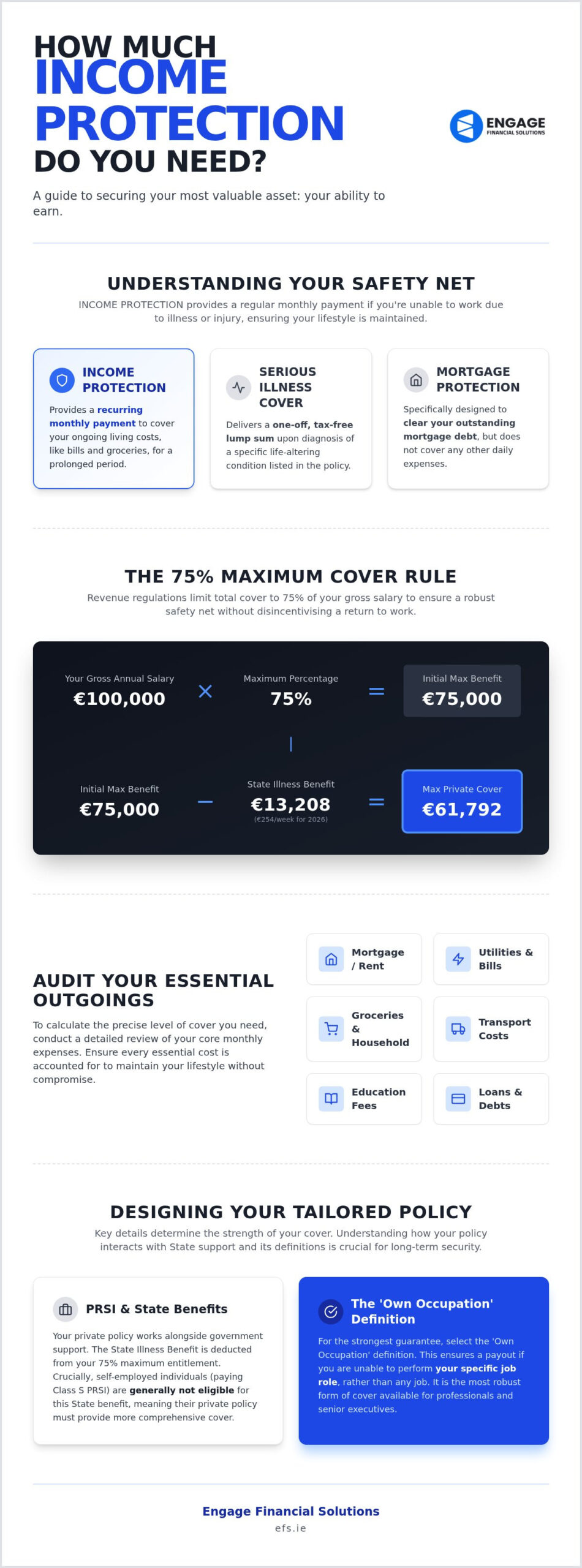
- Conduct a detailed audit of your essential monthly outgoings, such as mortgage payments and utilities, to calculate a precise level of necessary cover.
- Learn how to account for PRSI contributions and State Illness Benefit eligibility to ensure your private policy works seamlessly with government support.
- Optimise your security by selecting the ‘Own Occupation’ definition, which guarantees a payout if you are unable to perform your specific job.
Understanding the Essentials of INCOME PROTECTION
Your ability to earn an income is your most significant financial asset. It’s the foundation for your mortgage, your children’s education, and your eventual retirement. While many people insure their homes or cars without a second thought, they often overlook the very mechanism that pays for those items. When you ask yourself, “how much INCOME PROTECTION do I need?” you’re taking a vital step towards long-term security. This cover acts as a regular monthly safety net, providing a steady payment if you’re unable to work due to illness or injury. It’s a way to maintain a sense of calm competence in your financial planning, ensuring that a medical setback doesn’t spiral into a lifestyle crisis. You should distinguish this from being unemployed; this policy specifically safeguards you against the loss of earnings caused by health issues.
How INCOME PROTECTION Differs from Other Covers
Reviewing the various types of financial support available can help you build a more robust plan. While SERIOUS ILLNESS COVER provides a one-off lump sum upon the diagnosis of a specific condition, Income Protection Insurance focuses on replacing a portion of your monthly earnings over the long term. This recurring benefit is essential for managing daily living costs that don’t pause just because you’re unwell. Similarly, MORTGAGE PROTECTION is vital for clearing debt, but it doesn’t cover your groceries, utilities, or school fees. A tailored policy from Engage Financial Solutions ensures your entire standard of living is protected, rather than just a single debt.
Why Your Current Life Stage Influences Your Needs
Your requirements for cover will change as you move through different life stages. A young professional might focus on covering rent and basic bills, whereas those with established families must consider much larger financial responsibilities. We suggest a “Future-Back” perspective: start by identifying your desired end-state of total security and work backwards to determine your current needs. Whether you’re just starting out or you’re at the peak of your career, your cover should reflect your current salary and lifestyle. As your earnings increase over time, tailoring your protection ensures you’re never left with a gap between your needs and your coverage. This methodical approach provides the stability you need to move forward with confidence.
Navigating the Maximum Cover Limits and Rules
Determining the right level of cover requires an understanding of the specific rules set by the Revenue Commissioners. While you might wish to protect your entire take-home pay, the industry standard and regulatory limit is capped at 75% of your gross annual salary. This ceiling exists to ensure that your benefit provides a robust safety net without creating a situation where you’re financially better off being out of work than being in employment. This approach maintains the integrity of the system whilst providing you with the stability needed to focus on recovery. When you’re assessing how much INCOME PROTECTION do I need, it’s helpful to view this 75% figure as the absolute maximum allowable cover from all combined sources.
For those with variable earnings, such as bonuses or overtime, the calculation becomes a little more nuanced. Typically, providers will look at an average of your earnings over the last three years to establish a sustainable figure. This ensures that your policy reflects your true earning potential rather than a temporary spike in income. You can find official guidance on income protection regarding these limits to help you understand the broader regulatory framework. By working with a steady guide, you can navigate these complexities and ensure your application is accurate from the outset.
The 75% Salary Cap Explained Simply
The formula for your maximum benefit is straightforward: multiply your gross annual salary by 0.75 and then subtract the State Illness Benefit. For 2026, the maximum personal rate for the State Illness Benefit is €254 per week, which is a taxable payment. If you’re self-employed and pay Class S PRSI, you’re generally not eligible for this benefit. This means your private policy must work harder to fill the gap. The 75% rule serves as the ceiling for all combined protection benefits, ensuring your lifestyle is safeguarded without over-insuring. If you’re unsure how these figures apply to your specific situation, you can organise a consultation to clarify your entitlements.
Understanding the Impact of Tax Relief on Premiums
One of the most compelling reasons to establish this cover is the significant tax efficiency involved. Your premiums qualify for tax relief at your highest rate of income tax, whether that’s 20% or 40%. This means that for a high-rate taxpayer, the actual cost of the policy is effectively reduced by 40%. It’s a highly cost-effective way to secure your future. This relief is available on premiums up to 10% of your total annual income, allowing for a generous amount of protected earnings. By structuring your cover correctly, you ensure that every Euro spent on premiums is working as hard as possible to protect your long-term financial health.
Evaluating Your Monthly Outgoings and Financial Responsibilities
While the regulatory limits provide a ceiling for your cover, the actual amount you require depends on a meticulous audit of your personal cash flow. Identifying the “real” number involves distinguishing between your essential survival costs and your discretionary spending. When you begin to ask how much INCOME PROTECTION do I need, start by listing every non-negotiable expense that keeps your household running. This includes your mortgage or rent, utility bills, and the weekly grocery shop. By stripping away non-essential luxury spending during this calculation, you can determine the minimum monthly benefit required to maintain stability without over-insuring yourself.
It’s also vital to adopt a “Future-Back” perspective by considering responsibilities that might grow over time. You should factor in future education fees for children or potential increases in healthcare needs as you age. We also suggest including a modest buffer for unexpected household repairs. Being unable to work is stressful enough; having the funds to fix a leaking roof or a broken boiler during your recovery ensures a seamless transition through a difficult period. For a deeper look at the fundamentals of these rules, you can refer to the Competition and Consumer Protection Commission (CCPC) guide which outlines the standard considerations for local policyholders.
Calculating Your Survival Budget
A survival budget is a clear-eyed checklist of fixed costs that do not disappear when your salary stops. Beyond the obvious bills, you must consider the stewardship of your long-term goals. For instance, it’s often wise to include enough cover to continue making contributions to your PRSA or COMPANY PENSIONS. Maintaining these payments whilst on a claim prevents a temporary health setback from derailing your eventual retirement security. Additionally, prioritising debt repayments in your budget helps safeguard your credit rating, ensuring that your financial reputation remains intact for the future.
Accounting for MORTGAGE PROTECTION and Other Debts
Many homeowners believe that having MORTGAGE PROTECTION is enough to see them through a period of illness. However, whilst that policy is designed to clear the capital debt in the event of death or specific serious illnesses, it doesn’t provide the liquidity needed for daily life. INCOME PROTECTION fills this gap by covering the lifestyle costs that sit alongside your debt. Coordinating these different policies requires a methodical approach to avoid gaps in your safety net. Seeking independent financial advice is often the most straightforward way to integrate your various covers into one cohesive plan, providing the peace of mind that every aspect of your financial life is looked after.
Factoring in State Support and Employer Benefits
When calculating your requirements, it’s essential to look at the broader ecosystem of support already available to you. Private cover doesn’t operate in isolation; it functions alongside government provisions and workplace entitlements. Understanding these layers helps answer the core question: how much INCOME PROTECTION do I need? By identifying what you’re already entitled to, you can avoid paying for overlapping cover whilst ensuring no gaps remain in your safety net. This methodical approach ensures your plan is both cost-effective and robust.
The Reality of the State Illness Benefit
For many professionals, the support provided by the government is a fraction of their actual earnings. As of January 2026, the maximum personal rate for the State Illness Benefit is €254 per week. To qualify, you must be under 66 and have sufficient PRSI contributions under classes A, E, H, or P. If you’re self-employed and pay Class S PRSI, you generally won’t qualify for this payment at all. Relying solely on this benefit creates a significant income gap that could jeopardise your mortgage and lifestyle. Recognising this shortfall is a critical step in determining how much INCOME PROTECTION do I need to maintain your current standard of living.
Assessing Your Employer’s Sick Pay Scheme
Your employment contract is the first place to look when coordinating your private protection. Many companies offer a sick pay scheme that pays your full salary for a set period, such as three or six months. You can use this information to select an appropriate DEFERRED PERIOD for your policy. This waiting period is the time between falling ill and receiving your first payment. By matching this to your employer’s timeline, you can significantly reduce your premiums whilst maintaining a seamless flow of income. Some workplaces may also provide Group Protection schemes as a standard benefit, which should be factored into your overall calculation.
A methodical review of your contract ensures that your private cover is both efficient and comprehensive. It’s about stewardship of your resources, ensuring every Euro spent on premiums provides maximum value. If you’re unsure how your specific benefits interact, you can organise a professional review to tailor a solution that fits your career path perfectly. This proactive step removes the friction from financial planning and provides the long-term security you deserve.
Designing a Tailored Policy for Long-Term Security
Once you’ve audited your outgoings and accounted for State benefits, the final step is designing a policy that offers genuine, long-term security. This isn’t just about the monthly benefit amount; it’s about the quality of the cover. A critical feature to look for is the “Own Occupation” definition. This ensures that the policy pays out if you’re unable to perform your specific job, rather than any job. Without this, you might be expected to return to a different, less specialised role if you’re physically able. When people ask “how much income protection do i need ireland”, they often forget that the definition of disability is just as important as the euro amount. We aim for a frictionless experience, ensuring that from the moment you apply to the day you might need to claim, every detail is meticulously handled.
You’ll also need to choose between guaranteed and reviewable premiums. Guaranteed premiums remain the same throughout the life of the policy, providing total budget stability. Reviewable premiums might start lower but can be adjusted by the insurer later. Choosing the right structure depends on your long-term financial goals and your desire for cost certainty. It’s about finding a balance that lets you sleep soundly at night, knowing your future is protected from unexpected shocks.
Choosing the Right DEFERRED PERIOD
The DEFERRED PERIOD is the waiting time before your benefit starts. Selecting a longer period, such as 26 or 52 weeks, can significantly reduce your monthly premium. To make this work, you should align the waiting period with your existing emergency savings fund or your employer’s sick pay scheme. It’s a balance between immediate financial need and long-term cost-savings. If you have six months of expenses saved, a 26-week DEFERRED PERIOD offers a more efficient way to manage your protection budget whilst maintaining a high level of security.
Why Professional Guidance Ensures a Seamless Process
Navigating the market alone can be overwhelming, especially when dealing with complex medical underwriting. A steady guide helps you find the most flexible terms and manages the application process to remove stress. By tailoring a policy to your unique career path, you ensure that your earning capacity is truly safeguarded against the unknown. Achieving long-term financial health is a holistic process, and once your income is protected, you can move forward with confidence into other areas like RETIREMENT PLANNING. This proactive stewardship of your finances creates the stability you need for a successful and prosperous future.
Securing Your Financial Path Forward
Safeguarding your earning capacity is the most significant step you can take toward long-term stability. By auditing your essential outgoings and understanding how the 75% rule interacts with State benefits, you can create a safety net that is both robust and cost-effective. Whether you’re coordinating with an employer’s sick pay scheme or navigating the complexities of tax relief, the goal is always a seamless transition that protects your lifestyle. This methodical approach ensures your financial plan remains efficient whilst providing total peace of mind.
When you evaluate how much INCOME PROTECTION do I need, remember that professional guidance simplifies the process and ensures you have the “Own Occupation” cover you deserve. As a firm regulated by the Central Bank, we provide personalised stewardship to help you move from your current needs to your desired end-state of security. You can secure your future earnings with a tailored INCOME PROTECTION plan from Engage Financial Solutions today. Taking this proactive step now ensures you can face the future with optimism and calm competence.
Frequently Asked Questions
Is INCOME PROTECTION the same as serious illness cover?
No, these are distinct products with different payout structures. INCOME PROTECTION provides a recurring monthly payment if you’re unable to work due to any illness or injury. In contrast, SERIOUS ILLNESS COVER pays a single lump sum upon the diagnosis of a specific condition listed in your policy. Whilst both offer security, the monthly benefit of INCOME PROTECTION replaces your salary to manage daily living costs like utilities and groceries.
Can I claim tax relief on my INCOME PROTECTION premiums?
Yes, you can claim tax relief on your premiums at your highest rate of income tax. If you’re a high-rate taxpayer, this effectively reduces the cost of your cover by 40%. This relief is available on premiums up to 10% of your total annual income. It’s an efficient way to organise your financial safety net, and an advisor can help ensure you’re maximising these benefits for your future stability.
What happens to my INCOME PROTECTION if I change jobs?
If you have a personal policy, your cover usually remains in place regardless of your employer. This portability ensures your security isn’t tied to a specific contract or workplace. However, you should notify your insurer if your new role has significantly different duties or a higher salary. This ensures your benefit remains aligned with your current earnings and that you still have the correct level of protection for your lifestyle.
How long does an INCOME PROTECTION policy pay out for?
A policy continues to pay out as long as you meet the definition of disability, up until your chosen expiry age. Most professionals select an expiry age of 65 or 70 to align with their expected retirement date. If you recover and return to work, the payments stop, but the policy remains active for the future. This provides a long-term safety net that adapts to your health and offers lasting financial stability.
Do I need INCOME PROTECTION if I am self-employed?
The DEFERRED PERIOD is the waiting time between the start of your illness and when the policy begins paying out. Common options include 4, 8, 13, 26, or 52 weeks. You should choose a period that aligns with your employer’s sick pay scheme or your personal savings. A longer waiting period will reduce your monthly premium, making it a straightforward way to tailor the cost of your cover to your specific budget.
Can I have more than one INCOME PROTECTION policy?
You can hold multiple policies, but the total benefit cannot exceed the industry-standard limit of 75% of your gross annual salary. This limit includes any payments from employer-led GROUP PROTECTION schemes or other private arrangements. If you have multiple covers, insurers will coordinate to ensure the total payout remains within regulatory boundaries. It’s important to review your existing benefits to ensure you aren’t paying for overlapping cover you can’t claim.
Will my INCOME PROTECTION payout be taxed?
Yes, the monthly benefit you receive from an INCOME PROTECTION policy is treated as earned income. This means it’s subject to income tax, USC, and PRSI, just like your regular salary. Because the payout is taxable, it’s vital to calculate your requirements carefully to ensure the net amount you receive is sufficient for your mortgage and bills. A steady guide can help you determine the gross benefit needed to maintain your lifestyle.
Disclaimer
Engage Financial Services LTD T/A Engage Financial Solutions is regulated by the Central Bank of Ireland CRO 764570. Director David Moore. Suite 2 First Floor, 14 -18 Main street, Blackrock, Co Dublin A94 W0Y3