


If you were unable to work for six months, would your current employer benefits truly sustain your mortgage and your family’s lifestyle? It’s a question that causes significant anxiety, especially when you’re trying to figure out if you’re already sufficiently covered through work. You might be wondering, do i need income protection if i have sick pay? It’s a valid concern; nobody wants to pay for two policies that do the same thing whilst missing out on essential safeguards that protect your long-term stability.
We understand that choosing the right financial security can feel complex. This guide provides a clear, professional perspective on the vital differences between CRITICAL ILLNESS COVER and INCOME PROTECTION. You’ll gain a thorough understanding of how each policy functions, the tax relief available at your marginal rate, and how to choose a tailored plan that offers seamless protection. We’ll help you move from confusion to clarity, ensuring you have the confidence to secure your future and keep your household running smoothly, no matter what happens.
Key Takeaways
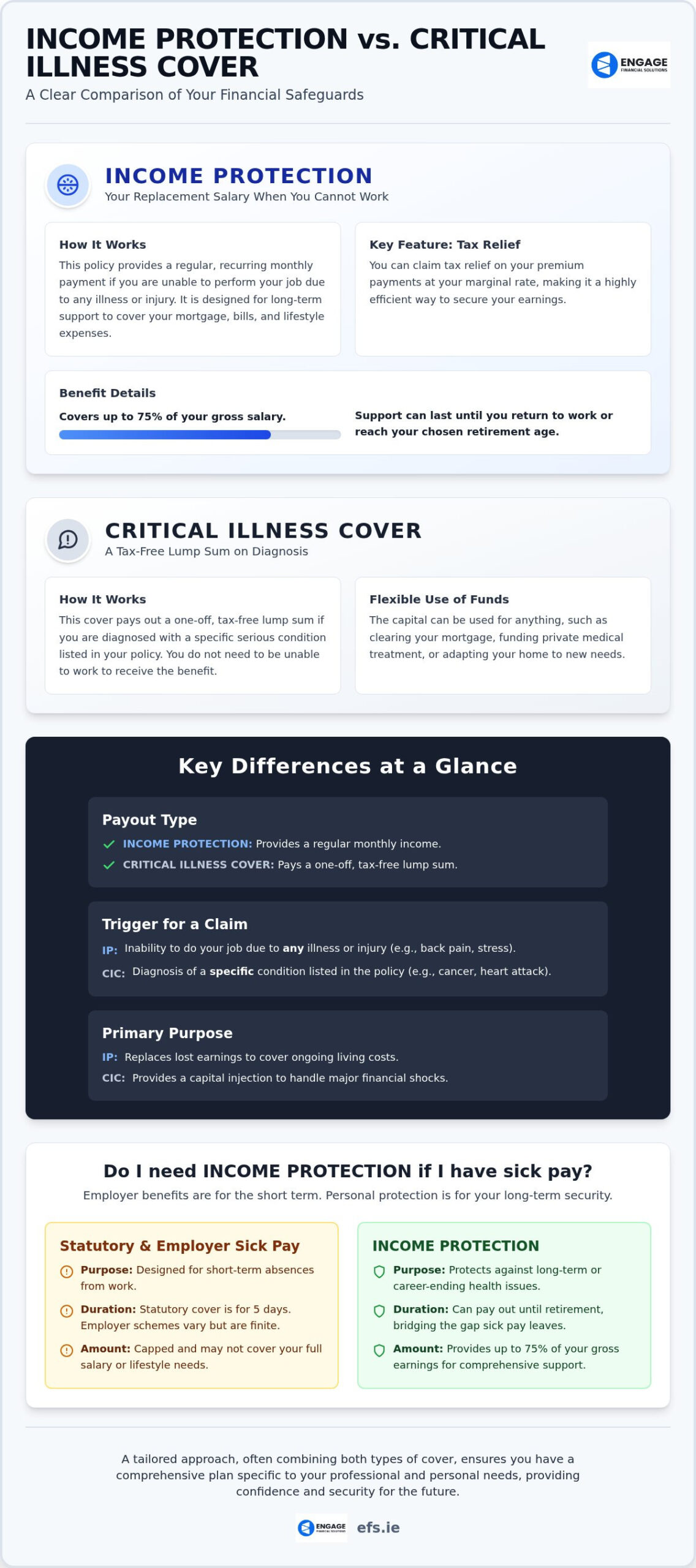
- Distinguish between the ongoing monthly support of INCOME PROTECTION and the one-off tax-free lump sum provided by CRITICAL ILLNESS COVER.
- Evaluate your current employer benefits to answer the vital question: do i need income protection if i have sick pay when facing a long-term absence from work?
- Learn how to maximise your financial efficiency by claiming tax relief at your marginal rate on qualifying protection premiums.
- Understand the different “Trigger Events” for each policy to ensure your mortgage and lifestyle remain secure regardless of the specific diagnosis.
- Discover the benefits of a tailored approach that uses a wide panel of providers to create a protection plan specific to your professional needs.
Understanding the Basics: What Are These Financial Safeguards?
Building a secure future requires a sense of calm competence. It’s about knowing that your lifestyle is shielded from the friction of unexpected health challenges. Two primary tools exist to provide this stability: INCOME PROTECTION and CRITICAL ILLNESS COVER. Whilst they both offer financial support, they serve distinct roles in a well-managed plan. The fundamental goal is straightforward; ensuring you can maintain your standard of living and meet your mortgage repayments even when your health takes an unforeseen turn.
The Role of INCOME PROTECTION in Your Budget
This policy functions as a long-term salary replacement tool. If you are unable to work due to any illness or injury, it provides a recurring monthly payment to keep your household running. Many professionals ask, do i need income protection if i have sick pay? The answer often lies in the duration of your employer’s scheme. Whilst statutory sick pay covers 5 days of absence at 70% of your wage (capped at €110 per day), Income protection insurance is designed to support you until you are fit to return to your role or reach your chosen retirement age.
- It typically covers up to 75% of your gross annual earnings, providing a reliable revenue stream.
- The benefit is calculated to include the maximum state illness benefit of €254 per week (as of 2026), ensuring a seamless transition.
- It is particularly vital for the self-employed who lack a statutory safety net and must manage their own security.
The Purpose of CRITICAL ILLNESS COVER
CRITICAL ILLNESS COVER, also known as SERIOUS ILLNESS COVER, operates on a different principle. Instead of a monthly income, it provides a one-off, tax-free lump sum following the diagnosis of a specific condition listed in your policy. This capital injection offers immense flexibility during a medical crisis. You might use the funds to clear your mortgage, pay for private medical treatments, or adapt your home to better suit your needs.
Crucially, this payout is triggered by the diagnosis itself; you don’t necessarily need to be unable to work to receive the benefit. This makes it a powerful partner to other forms of security. By working with a steady guide at Engage Financial Solutions, you can ensure these products are tailored to your specific life stage, removing the stress of financial uncertainty and providing a clear path forward.
The Core Differences: Lump Sums vs Monthly Support
Understanding the mechanics of these safeguards is the first step toward achieving long-term security. Whilst both products provide a financial buffer, they differ fundamentally in how and when they provide support. Many people ask, do i need income protection if i have sick pay? The answer depends on how you want your support delivered and the specific gaps in your current employment contract. INCOME PROTECTION provides a recurring monthly revenue to replace your salary, whereas CRITICAL ILLNESS COVER delivers a one-off capital sum to handle immediate financial shocks.
The “Trigger Event” is what initiates a claim. For INCOME PROTECTION, the trigger is your inability to perform your job due to illness or injury. In contrast, CRITICAL ILLNESS COVER triggers upon the diagnosis of a specified condition, such as a heart attack, stroke, or certain types of cancer. It’s possible to be diagnosed with a serious condition but still be physically able to work. In this scenario, CRITICAL ILLNESS COVER pays out, but INCOME PROTECTION might not. Conversely, conditions like chronic back pain or mental health issues often trigger an INCOME PROTECTION claim but are rarely covered by a serious illness lump sum.
Payout Triggers and Policy Definitions
The strength of your cover often depends on the definitions used within the policy. For INCOME PROTECTION, the “own occupation” definition is the gold standard. It ensures you receive support if you cannot perform the specific duties of your current role, regardless of whether you could technically work in a different, less demanding field. Some policies also include a Total and Permanent Disability benefit, which provides a payout if a medical professional confirms you will never be able to return to any form of employment. This adds an extra layer of stability for those in physically or mentally intensive careers.
Duration of Support and Benefit Limits
The duration of support varies significantly between the two. INCOME PROTECTION is designed to be a long-term companion, potentially paying out until you reach retirement age or are fit to return to your career. CRITICAL ILLNESS COVER is usually a fixed-term policy that ends once the lump sum is paid out. When calculating these benefits, it’s essential to consider your “deferred period.” This is the waiting time between stopping work and receiving your first payment. If your employer provides 13 weeks of full salary, you can ensure your policy is tailored to your specific circumstances, starting only when your sick pay ends to keep your premiums affordable whilst maintaining seamless cover.
Evaluating the Risk: Which Scenario Are You Protecting Against?
Choosing the right safeguard starts with a “future-back” perspective. Instead of looking at products first, look at your life five or ten years from now. If a health crisis occurred, would you need a recurring revenue stream to maintain your current lifestyle, or a significant capital injection to clear a mortgage? Understanding the financial impact of a long-term illness versus a sudden medical shock is essential for tailored security. This clarity allows you to build a plan that acts as a buffer between your family and the complexities of the financial world.
A guaranteed monthly revenue provides a unique level of stability. It allows you to focus on recovery without the friction of wondering how the electricity bill or the school fees will be paid. However, if you have significant debts or a young family, you might prioritise a lump sum payout from CRITICAL ILLNESS COVER. This capital can be used to eliminate your largest monthly expense, your mortgage, which fundamentally changes your household’s financial requirements during a difficult time. It’s about creating a foundation of peace of mind that remains steady, regardless of the diagnosis.
Considerations for the Self-Employed
For business owners and contractors, the safety net is often non-existent. Many self-employed professionals do not qualify for the maximum State Illness Benefit of €254 per week, leaving them entirely reliant on personal savings. This makes the question “do i need income protection if i have sick pay” less relevant than “how long can my business survive without me?” For these individuals, a lack of protection isn’t just a personal risk; it’s a professional one.
INCOME PROTECTION for the self-employed can be meticulously tailored to cover both personal needs and specific business overheads. By adjusting the “waiting period” to match your cash reserves, you can ensure your policy is efficient and cost-effective. Similarly, CRITICAL ILLNESS COVER offers flexibility for protecting business equity or clearing commercial loans, ensuring your professional legacy remains secure whilst you recover. This proactive approach ensures that your hard-earned success isn’t dismantled by a temporary health setback.
Assessing Your Existing Employee Benefits
If you are an employee, your starting point should be a thorough review of your contract. Many people assume they are fully covered, but employer-provided sick pay often lasts only a few weeks or months. Identifying these limits is the first step toward removing stress. Whilst statutory sick pay covers 5 days at 70% of your wage (up to €110 per day), this is rarely enough for long-term stability. You should check if your company offers a GROUP PROTECTION scheme that might already supplement your salary.
A personal policy can be designed to “wrap around” these existing benefits. This ensures a seamless transition to full support exactly when your employer’s obligation ends. By identifying the specific week your company pay drops, you can tailor your personal cover to start at that exact moment. This prevents you from paying for overlapping benefits whilst ensuring there is never a gap in your household revenue. This level of meticulous planning is what provides true long-term security.
Tax Relief and Financial Efficiency: Maximising Your Budget
Efficiency is key. When you look at the cost of safeguarding your future, it’s vital to consider the net expenditure rather than just the initial premium. INCOME PROTECTION is uniquely efficient because the Revenue Commissioners provide tax relief on your premiums at your marginal rate, which is either 20% or 40%. This forward-looking perspective allows you to see your protection not as a monthly cost, but as a strategic investment in your family’s future stability. Many professionals wonder, do i need income protection if i have sick pay, especially when they realise how affordable a tailored policy becomes after relief is applied.
There is a specific trade-off to understand regarding how these benefits are handled. Payouts from an INCOME PROTECTION policy are treated as income and taxed through the PAYE system, ensuring you contribute as you would whilst working. Conversely, CRITICAL ILLNESS COVER premiums do not qualify for tax relief, but the lump sum benefit you receive is entirely tax-free. This distinction is crucial when you are calculating how much cover you truly need to maintain your standard of living and clear any outstanding debts without friction.
How to Claim Tax Relief on Premiums
Organising your relief is a straightforward process that removes stress from your financial management. You simply notify the Revenue Commissioners of your policy details, and the relief is typically applied through your tax credits, ensuring your monthly take-home pay reflects the saving immediately. This means you benefit from the highest rate of tax you pay for maximum efficiency. The maximum percentage of your total income that qualifies for tax relief on these premiums is currently capped at 10%.
Integrating Protection with Your Mortgage
Your home is your most significant asset, and protecting it requires a meticulous, multi-layered approach. It’s important to distinguish between MORTGAGE PROTECTION, which is designed to clear your debt if you pass away, and these living benefits. Read our guide to MORTGAGE PROTECTION to understand how these policies work together to provide a complete safety net. A lump sum from CRITICAL ILLNESS COVER can clear your entire mortgage balance if you face a serious diagnosis, whilst INCOME PROTECTION ensures you can continue making monthly repayments whilst you recover from a long-term illness. To ensure your budget is as efficient as possible, you can request a tailored quote to see the net cost of your protection after relief.
Tailoring Your Security: How to Build the Right Plan
Financial security is not a commodity; it’s a bespoke suit. A one-size-fits-all approach rarely works because your career, debts, and family goals are unique to your household. When you’re assessing whether you’re already sufficiently covered by your employer, you’re really asking, do i need income protection if i have sick pay? The answer lies in identifying the specific gaps in your current safety net. We act as the steady guide and buffer between you and the technical complexities of the market, using a methodical progression to ensure you aren’t paying for overlapping benefits whilst remaining fully protected.
Our approach follows a logical “Need-Solution-Benefit” sequence. We start by identifying your desired end-state; usually a life defined by stability and the ability to stay in your home regardless of your health. By working backward to the present, we can source a policy from a wide panel of providers that fits your specific professional profile. This meticulous attention to detail ensures that technical definitions, such as “own occupation” cover, are aligned with the actual duties of your job, removing the friction and stress often associated with financial planning.
Can You Have Both Policies?
A “dual-track” approach often provides the most robust safety net for working professionals. By balancing both products, you address two distinct financial risks: the need for ongoing cash flow to manage daily life and the need for a capital sum to clear major liabilities. For instance, a balanced portfolio might include an INCOME PROTECTION policy with a 13-week waiting period to match your employer’s sick pay, alongside a CRITICAL ILLNESS COVER lump sum of €100,000 to provide a buffer for medical costs or mortgage reduction.
This strategy allows you to maximise your budget by utilizing tax relief at your marginal rate on the monthly premiums whilst securing a tax-free payout for medical emergencies. It’s about building a plan that is both flexible and efficient, ensuring every Euro spent contributes to your long-term peace of mind. Whether you are a high-earning executive or a self-employed contractor, this integrated perspective ensures your lifestyle remains secure without unnecessary expenditure.
Next Steps for a Seamless Application
Getting started is a straightforward and proactive process designed to be entirely stress-free. Your first step is to gather your basic financial information, including your gross annual salary and the specific duration of your current employer’s sick pay scheme. This allows us to pinpoint exactly when your private support needs to begin. Once we have these details, we can provide a tailored recommendation that bridges the gap between your current benefits and your future needs. Learn more about our approach to INCOME PROTECTION to see how we help clients navigate these choices. This guidance ensures a smooth transition to a more secure future, leaving you to focus on your career and family with total confidence.
Securing Your Financial Peace of Mind
Navigating the choice between INCOME PROTECTION and CRITICAL ILLNESS COVER doesn’t have to be overwhelming. By understanding that these tools serve different but complementary roles, you can build a safety net that covers every eventuality. Whether you prioritise a tax-free lump sum to clear your mortgage or a steady monthly revenue to maintain your lifestyle, the key is a plan that fits your specific circumstances. Many people find themselves asking, do i need income protection if i have sick pay; the answer involves identifying exactly where your employer’s support ends and your private security must begin.
Secure your future with a tailored consultation from Engage Financial Solutions. As specialists in seamless financial transitions with access to a wide panel of leading insurance providers, we ensure your plan is as meticulous as it is reliable. We are regulated by the Central Bank and dedicated to removing the friction from your application process. You deserve the stability that comes from expert guidance. Take the first step toward a more optimistic and secure future today.
Frequently Asked Questions
Is INCOME PROTECTION better than CRITICAL ILLNESS COVER?
Neither is inherently better as they serve different purposes within a well-structured plan. INCOME PROTECTION replaces your salary if you’re unable to work due to any illness or injury, maintaining your daily cash flow. CRITICAL ILLNESS COVER pays a tax-free lump sum for specific diagnoses listed in your policy. A tailored plan often integrates both to ensure you have monthly revenue for bills and a capital sum for major financial shocks.
Can I claim tax relief on both types of insurance premiums?
Tax relief is specifically available on INCOME PROTECTION premiums. You can claim this relief at your marginal rate, either 20% or 40%, up to a limit of 10% of your total income. This significantly reduces the net cost of your security. CRITICAL ILLNESS COVER premiums do not qualify for tax relief, but the eventual lump sum benefit you receive is completely tax-free, providing a clear financial advantage during a crisis.
Does CRITICAL ILLNESS COVER pay out more than once?
Generally, these policies pay out a one-off lump sum and then the contract terminates. Once you receive the full benefit for a specified condition, the cover ends. However, some modern policies include partial payments for less severe illnesses. These smaller payouts allow you to receive some support whilst keeping the main body of your cover intact for the future. It’s a flexible way to manage health risks over a long career.
What happens if I have INCOME PROTECTION but my employer also pays sick pay?
You can tailor your policy to start exactly when your employer’s support ends. This is achieved by selecting a deferred period that matches your company’s sick pay duration. If you are questioning do i need income protection if i have sick pay, consider that most employer schemes only last a few months. Private cover provides a seamless transition to long-term security, potentially supporting you until your chosen retirement age.
Are pre-existing conditions covered under these policies?
Most insurers exclude pre-existing conditions that you’ve sought medical advice for in the recent past. During the application, you’ll provide health details which the provider uses to assess your risk. They might offer cover with an exclusion for that specific condition or apply a higher premium. Being transparent from the start ensures your policy is reliable and that your claims process remains straightforward and stress-free when you need it most.
Is MORTGAGE PROTECTION the same as CRITICAL ILLNESS COVER?
They are distinct products with different goals. MORTGAGE PROTECTION is a form of life insurance designed to pay off your loan if you pass away. CRITICAL ILLNESS COVER is a living benefit that provides a lump sum if you’re diagnosed with a serious condition but survive. Whilst both protect your home, one handles the risk of death, and the other manages the financial strain of surviving a life-changing illness or medical emergency.
How long do I have to wait before a claim is paid out?
The timing depends on your chosen deferred period and the type of policy. For INCOME PROTECTION, you select a waiting period, typically between 4 and 52 weeks, before payments begin. CRITICAL ILLNESS COVER usually pays out as a lump sum shortly after a medical professional confirms a diagnosis. Most providers require you to survive for at least 14 days post-diagnosis before the benefit is released to your account.
Can I cancel my policy if my financial circumstances change?
You have the flexibility to cancel or adjust your policy at any time if your situation changes. There are no long-term contracts that lock you in, though you won’t receive any premiums back if you cancel. If you’re facing financial pressure, it’s often more prudent to reduce your cover levels rather than removing your safety net entirely. This proactive approach maintains a level of security whilst easing your monthly outgoings during tighter periods.
Disclaimer
Engage Financial Services LTD T/A Engage Financial Solutions is regulated by the Central Bank of Ireland CRO 764570. Director David Moore. Suite 2 First Floor, 14 -18 Main street, Blackrock, Co Dublin A94 W0Y3