


What if the most challenging part of building your dream home isn’t the actual construction, but securing the finance to make it happen? For many, the path to a bespoke property is often clouded by uncertainty regarding the specific self build mortgage requirements Ireland lenders demand in 2026. Whether you’re just starting to scout for a site or you’ve already secured planning permission, the pressure of coordinating architects, solicitors, and financial drawdowns can feel overwhelming.
We understand that you want more than just a loan; you’re looking for a seamless process that protects your future and your budget. This guide provides a clear roadmap of the application process, from understanding the latest 4.0 times income limits for first-time buyers to managing stage payments with complete confidence. You’ll discover how to structure your 10% to 20% contingency funds and utilise government supports, such as the €30,000 Help to Buy scheme, to ensure your build remains a source of pride rather than a source of stress.
Key Takeaways
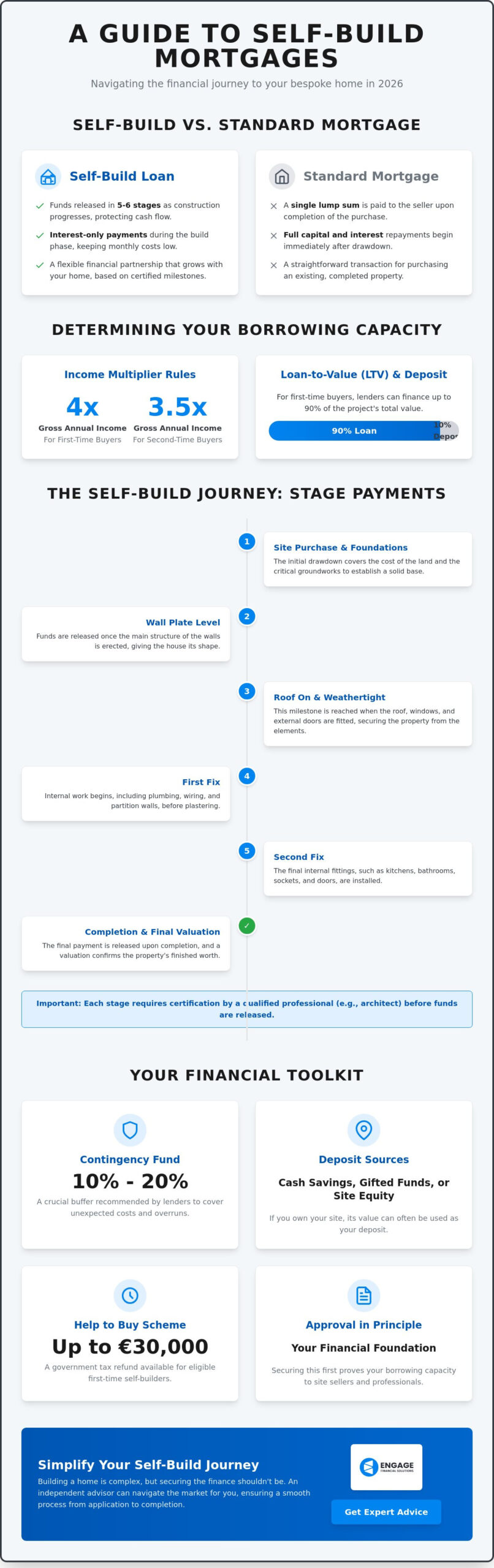
- Understand why funds are released in 5-6 distinct stages rather than a lump sum, helping you maintain a steady cash flow whilst construction progresses.
- Master the specific self build mortgage requirements Ireland lenders expect, including the essential “Golden Thread” of planning permission and certified costings.
- Learn how to calculate your borrowing capacity using Loan-to-Value (LTV) limits, which is the percentage of the project’s total value that a lender is willing to finance.
- Discover the step-by-step process for requesting drawdowns to ensure funds are released promptly after each phase of your build is certified by a professional.
- Find out how an independent advisor can simplify the application process by acting as a buffer between you and the complexities of the lending market.
Navigating the Unique Structure of a Self-Build Loan
Building your own home is a deeply rewarding journey that offers a level of customisation a standard housing development simply cannot match. However, the path to your front door requires a different financial approach than buying an existing property. A self-build mortgage is not a single lump-sum payment; it’s a flexible, multi-stage loan designed to grow alongside your project. Understanding what is a self-build? from a lender’s perspective is the first step toward securing your future home.
The most significant feature of this loan type is the stage payment structure. Instead of receiving the full amount at the start, funds are released in phases as you reach specific construction milestones. This protects both you and the lender, ensuring the money is spent exactly where it’s needed. During the construction phase, you typically benefit from an interest-only period. This means you only pay interest on the funds you have already drawn down, which helps keep your monthly costs manageable whilst you are still paying rent or another mortgage elsewhere.
Before you begin scouting for the perfect plot, obtaining an “Approval in Principle” (AIP) is vital. This document confirms your borrowing capacity and gives you the confidence to negotiate for a site. It acts as your financial foundation, proving to sellers that you are a serious and prepared buyer.
How Self-Build Loans Differ from Standard Mortgages
In a standard mortgage, the bank pays the seller in one go, and you move in. With a self-build, you enter into a multi-year partnership with your lender. Because the asset (the house) doesn’t exist yet, the bank requires rigorous documentation to manage their risk. This includes detailed costings and planning permissions. Once the build is complete, a final valuation is conducted to ensure the finished property matches the value predicted at the start of the project. This final step often allows you to transition from the build-phase rate to a more competitive long-term mortgage product.
Eligibility and Lending Criteria for Self-Builders
Meeting the self build mortgage requirements Ireland lenders set for 2026 starts with the Central Bank’s macro-prudential rules. If you are a first-time buyer, you can borrow up to 4 times your gross annual income. For those moving home, this limit is 3.5 times. You will also need a minimum deposit of 10%, though many lenders recommend a 10% to 20% contingency fund to cover unexpected cost overruns.
Lenders also insist that a qualified professional, such as a registered architect or chartered engineer, oversees the project. Their role is to certify that each stage of the build meets building regulations. Without their signature on a stage certificate, the lender won’t release the next drawdown of funds. This meticulous oversight ensures your project stays on track and remains a stable investment for your family’s future.
Determining Your Borrowing Capacity and Deposit Needs
Understanding how much you can borrow is the first step toward turning a green field into a family home. Lenders typically offer a Loan-to-Value (LTV) of up to 90% for first-time buyers. This means you need a 10% deposit based on the projected final value of the property. However, banks also scrutinise the Loan-to-Cost (LTC) ratio. This ensures the total loan doesn’t exceed the actual construction costs plus the site value. Meeting the self build mortgage requirements Ireland lenders set involves proving you have the financial stamina for the entire project, not just the foundation.
Affordability is also influenced by the broader economic climate. With average new mortgage rates sitting around 3.5% in mid-2026, your monthly repayment capacity is a primary focus for lenders. Recent ECB rate adjustments mean it’s vital to stress-test your budget. You need to be certain you can manage repayments if rates trend upwards during your build. Lenders will often add a 2% buffer to current rates when assessing your application to ensure long-term stability.
Deposit Sources: Cash, Land Equity, and Grants
You don’t always need a large cash sum to start. If you own your site outright or it was gifted to you, the value of that land often counts as your deposit equity. This is a significant advantage for many Irish self-builders. You can also leverage the Help to Buy scheme, which offers a tax refund of up to €30,000 for first-time builders. For those who find commercial lending criteria too restrictive, the Local Authority Home Loan scheme provides a government-backed alternative with competitive fixed rates. If you’re unsure how your land equity fits into the equation, it’s often helpful to explore your mortgage options with a specialist who understands these nuances.
Budgeting for the “Hidden” Costs of Building
Building costs go far beyond bricks and mortar. You’ll need to account for stamp duty, which is 1% on the value of the site itself, and comprehensive site insurance to protect the project from the start. Legal fees for land transfer and mortgage registration also add up quickly. Furthermore, you must budget for the professional fees of your architect or engineer. These experts must certify every stage of the build before the bank releases funds. A contingency fund is a vital 10% buffer for material price fluctuations; lenders usually won’t approve an application without this safety net in place to handle unexpected overruns.
Essential Paperwork: Preparing a Successful Application
Securing a mortgage for a bespoke home is as much about the quality of your paperwork as it is about the quality of your design. Lenders in 2026 look for a “Golden Thread” of documentation that links your planning permission, detailed costings, and professional certifications. Meeting the specific self build mortgage requirements Ireland lenders demand means proving that every aspect of the project is accounted for before the first sod is turned.
One critical decision you’ll face is choosing between a Fixed Price Contract and a Direct Labour approach. A Fixed Price Contract with a registered builder provides the lender with a clear, guaranteed cost for the entire project. This often makes the application process smoother. Alternatively, if you opt for Direct Labour, you must provide a comprehensive cost sheet. This document must detail every trade, from plumbing to electrical work, along with material costs. While Direct Labour offers more control, it requires a higher level of financial transparency to satisfy the bank’s risk assessment.
Before the first drawdown occurs, you must have specific protections in place. Lenders require you to have mortgage protection and life insurance active to safeguard the loan. Similarly, your supervising architect or engineer must provide proof of Professional Indemnity Insurance. This ensures that if any structural issues arise due to design or oversight, the project’s financial stability remains intact.
The Role of Planning Permission and Site Maps
Full Planning Permission is a non-negotiable prerequisite for your mortgage. Lenders won’t offer a final contract based on “outline” permission alone. In many rural counties, you may also encounter “Local Needs” clauses. These regulations require you to prove a connection to the area to build there. You’ll also need a clear, unencumbered site map that shows exactly where the property sits within the boundaries, ensuring there are no legal disputes over access or land ownership.
Working with Professionals: Architects and Quantity Surveyors
Your professional team acts as the bridge between your vision and the bank’s requirements. A Quantity Surveyor (QS) is often essential for validating your build budget, ensuring your costings are realistic for 2026 market rates. Meanwhile, your architect is responsible for signing off on stage certificates. To ensure your professional is lender-approved, check that they are:
- Registered with a recognised body like the RIAI or SCSI.
- Experienced in the specific stage-payment structure of self-builds.
- Fully insured with current Professional Indemnity cover.
- Willing to provide the detailed “Design Certs” required by Irish building regulations.
Orchestrating the Build: Managing Stage Payments and Drawdowns
Once the legal and planning paperwork is signed, the focus shifts from theory to the building site. Managing the flow of funds is just as critical as managing the trades on site. A self-build mortgage functions through a series of drawdowns, where money is released only after specific milestones are met and certified. This methodical approach ensures the project remains financially viable from the first dig to the final coat of paint.
Meeting the self build mortgage requirements Ireland lenders enforce during construction requires careful timing. When a stage is finished, your supervising architect or engineer must sign a certificate of compliance. The lender then reviews this before releasing the funds, which can take several business days. You must have enough cash on hand to pay contractors whilst waiting for these funds to clear, as delays in payment can stall the entire build and damage your relationship with tradespeople.
Lenders frequently apply “retentions,” holding back a final portion of the loan, often between 5% and 10%, until they receive the final Building Energy Rating (BER) certificate and a completion valuation. This ensures the finished home meets the energy efficiency standards promised in the initial application. Staying organised throughout this process is the best way to maintain momentum and avoid unnecessary stress.
The Typical 5-Stage Release Structure
While every lender has slight variations, most Irish self-build loans follow a standard five-stage release pattern. This helps you track progress and plan your payments to suppliers:
- Stage 1: Site purchase or initial groundworks and site preparation.
- Stage 2: Foundations and floor level completed and certified.
- Stage 3: Property is roofed and weather-tight, protecting the interior from the elements.
- Stage 4: First fix completed, including plumbing and electrical work, followed by internal plastering.
- Stage 5: Final completion, including all certifications, connections to services, and the final valuation.
Handling Cost Overruns and Contingency Funds
Even the best-laid plans can face challenges. If material prices rise or you decide to upgrade your finishes, your costs might exceed the original estimate. This is why the 10% to 20% contingency fund we discussed earlier is a non-negotiable part of the self build mortgage requirements Ireland banks demand. If the project scope changes significantly, you must communicate with your lender immediately to discuss how this affects your borrowing limits. Maintaining an open dialogue with your broker during construction acts as an early-warning system against project-stalling financial friction. If you’re ready to secure your funding and start building, talk to our experts today to ensure your finance stays as solid as your foundations.
Why Independent Advice is Key to a Successful Construction Project
Achieving a successful build is about more than just bricks and mortar; it’s about managing a complex web of financial relationships. Engage Financial Solutions acts as your steady guide, serving as the essential buffer and single point of contact between you and the technical demands of the bank. We handle the intense coordination required between your architect, solicitor, and lender, ensuring that the self build mortgage requirements Ireland lenders demand are met without causing avoidable delays on your site. This dedicated partnership allows you to focus on the creative design of your home whilst we safeguard the underlying funding structure.
The Broker Advantage: Navigating Lender Criteria
Not all lenders view self-builds with the same level of enthusiasm. Some banks have highly specialised criteria regarding stage payments or direct labour, whilst others might offer more flexibility for energy-efficient “Green” builds. As your advisor, we identify the lenders who are truly self-build friendly in the 2026 market. We also ensure your application is packaged professionally from the outset. This means presenting your costings, site maps, and planning documents in a clear, logical format that the underwriter can approve quickly.
Whether you’re navigating the complexities of site equity or coordinating multiple contractors, we provide the clarity you need to move forward. Our deep first-time buyer expertise is particularly valuable here. We understand how to seamlessly stack government grants like the Help to Buy scheme or the First Home Scheme alongside your primary loan, ensuring you maximise your borrowing power whilst navigating the self build mortgage requirements Ireland banks have established for 2026.
Holistic Financial Protection for Your New Home
A self-build project is a significant financial commitment, and protecting that investment is a vital part of your long-term strategy. We help you integrate mortgage protection early in the process, often before the first sod is turned. This isn’t just a box-ticking exercise to satisfy the bank; it’s about ensuring your family’s future security remains intact regardless of what life throws at you. We also strongly recommend considering Income Protection as a core part of your plan.
If an unexpected illness or injury prevents you from earning during the construction phase, having a replacement income ensures your build doesn’t grind to a halt. We’ll help you organise your life cover so it scales appropriately alongside your increasing mortgage debt as you draw down funds stage by stage. By taking this integrated, “future-back” perspective, you can move into your new home with the absolute confidence that your financial stability is secure for years to come.
Building Your Future with Confidence
Building a home is one of the most significant milestones you’ll ever achieve, and having a clear roadmap makes the entire journey far more rewarding. By mastering the self build mortgage requirements Ireland lenders expect in 2026, you’ve already taken the first step toward a seamless construction experience. Success lies in the details, from managing your 10% contingency fund to ensuring your architect’s certificates are ready for every stage payment. When you align your architectural vision with a robust financial plan, you create a foundation that is as stable as the walls of your new home.
At Engage Financial Solutions, we provide the meticulous, tailored guidance needed to navigate these complex mortgage structures with ease. Regulated by the Central Bank of Ireland, our experienced team acts as your steady guide through every drawdown and certification, supporting self-builders across Ireland. Book a consultation with our self-build experts today to ensure your project remains on track and your financial future stays secure. Your dream home is within reach, and we’re here to help you move in with complete peace of mind.
Frequently Asked Questions
Can I get a self-build mortgage if I already own the land?
Yes, you can. Owning the land outright or having a site gifted to you often serves as your deposit equity. Lenders will value the site and use that value toward the 10% deposit requirement, which significantly reduces the cash you need upfront. It’s a straightforward way to leverage your existing assets to secure your future home whilst simplifying the initial funding phase.
How much deposit do I need for a self-build mortgage?
You generally need a deposit of at least 10% of the total project value, which combines the site cost and construction budget. First-time buyers can often use the Help to Buy scheme to assist with this. Meeting the self build mortgage requirements Ireland lenders set often depends on proving you have this 10% plus a 10% to 20% contingency buffer for safety.
What is the difference between a fixed-price contract and direct labour?
A fixed-price contract is a legal agreement with one builder for a set price, whilst direct labour involves you hiring and managing individual tradespeople yourself. Lenders often prefer fixed-price contracts because they offer more financial certainty. If you choose direct labour, you’ll need to provide a very detailed costings sheet to prove the project is viable and professionally managed from the ground up.
Can I live in my current home while building my new one?
You can stay in your current home, provided you can prove you afford both the rent or existing mortgage and the interest-only payments on the new build. As of 2026, bridging loans for a principal home are exempt from certain income limits for up to 18 months. This flexibility allows for a much smoother transition as you wait for your new property to become weather-tight and habitable.
What happens if my build costs increase after the mortgage is approved?
Your contingency fund is designed to absorb these increases without stalling the project. Lenders typically require a 10% to 20% buffer in your initial budget to handle fluctuations in material prices or labour costs. If overruns exceed this amount, you must contact your broker immediately. They will help you navigate the self build mortgage requirements Ireland banks use to assess top-up loans or budget adjustments.
Do I have to pay stamp duty on a self-build property?
You only pay stamp duty on the value of the site, which is a significant saving compared to buying an existing house. The rate is 1% on the first €1 million of the land’s value. Because you aren’t paying duty on the construction costs of the building itself, self-building can be a very tax-efficient way to move into a high-value home whilst keeping your initial costs lower.
What insurance do I need during a self-build project?
You need comprehensive site insurance, which includes public liability and employer’s liability, before any work begins. This protects you if someone is injured on your land. Additionally, your lender will require mortgage protection and life insurance to be in place. Your supervising professional must also hold Professional Indemnity Insurance to ensure the structural integrity of the build is safeguarded throughout the process.
How long does the self-build mortgage application process take?
The process typically takes several months because of the extra documentation required. You should allow ample time to coordinate planning permission, site maps, and detailed costings from a Quantity Surveyor. Once these technical documents are submitted, the actual lender approval is relatively quick. Starting early ensures you have a clear roadmap and avoids stress when you’re finally ready to break ground.
Disclaimer
Engage Financial Services LTD T/A Engage Financial Solutions is regulated by the Central Bank of Ireland CRO 764570. Director David Moore. Suite 2 First Floor, 14 -18 Main street, Blackrock, Co Dublin A94 W0Y3