


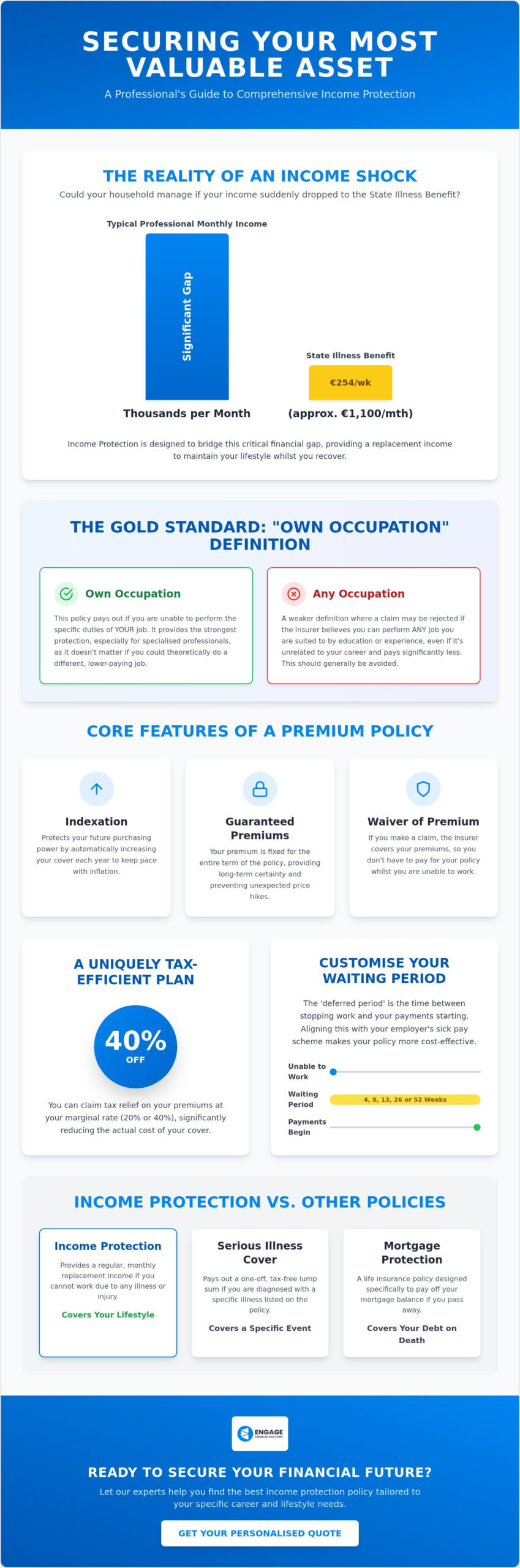
Could your household manage on just €254 per week if you were suddenly unable to work? That is the current reality of the State Illness Benefit in 2026, and it often leaves a monthly gap of thousands of euros for the average professional. Finding the best income protection policy Ireland provides isn’t just about picking the cheapest premium; it’s about ensuring your lifestyle remains stable whilst you recover. It’s completely natural to feel cautious about long-term costs or confused by how this differs from serious illness cover, but safeguarding your future shouldn’t be a source of stress.
This guide simplifies the process, showing you exactly how to tailor a policy to your specific career and lifestyle needs. You’ll discover how to claim tax relief at your marginal rate to reduce the cost of your premiums by up to 40% and understand why the “own occupation” definition is vital for your security. We’ll provide a clear comparison of providers to help you achieve a tax-efficient plan that balances comprehensive benefits with the peace of mind you deserve.
Key Takeaways
- Learn why the “own occupation” definition is the gold standard for security, ensuring your policy pays out if you are unable to perform your specific job duties.
- Compare the leading providers to identify the best income protection policy Ireland offers for your unique career path and lifestyle in 2026.
- Discover how to customise your deferred period and indexation to keep your cover affordable whilst protecting your future purchasing power.
- Explore tax-efficient strategies for directors and the self-employed, including how to claim relief at your marginal rate to significantly reduce premium costs.
- Understand how to build a flexible, “future-back” protection plan that evolves alongside your career milestones and provides a seamless safety net.
Defining the “Best” Income Protection Policy for 2026
Identifying the best income protection policy Ireland has available involves looking past the marketing brochures and focusing on the definitions of disability within the contract. Most people assume the “best” policy is simply the one with the lowest monthly cost. In reality, the most effective plan is the one that actually pays out when you need it most. Your ability to earn an income is your most valuable asset, likely worth millions over the course of your career. Income protection insurance acts as a replacement for that asset, providing a steady monthly payment if you’re unable to work due to illness or injury.
For a policy to be truly robust, it should ideally use the “Own Occupation” definition of disability. This is the gold standard for high-quality cover. It means you’ll receive benefits if you’re unable to perform the specific duties of your current job, regardless of whether you could theoretically work in a different, less demanding role. Without this protection, you might find a claim rejected because an insurer decides you’re fit for “any” job, even if it’s not the profession you’ve spent years building.
Policies in this market are also uniquely tax-efficient. You can claim relief on your premiums at your highest rate of income tax, which effectively reduces the cost by 20% or 40%. This makes securing your future much more affordable than many professionals realise, ensuring that your financial stability doesn’t come at an excessive monthly price.
Why One-Size-Fits-All Doesn’t Work
Insurer categories, known as occupation classes, range from Class 1 (typically office-based roles) to Class 4 (manual or higher-risk jobs). A policy that’s perfect for an IT consultant might be completely unsuitable for a site foreman because the risks and physical demands differ so greatly. It’s essential to organise your cover based on your actual daily tasks rather than just a generic job title. If you don’t accurately reflect your duties, you risk a rejected claim later. Tailoring your plan ensures that the best income protection policy Ireland offers for your specific situation is the one you actually have in place.
Income Protection vs Other Covers
It’s easy to confuse this with mortgage protection, but they serve very different purposes. Mortgage protection is designed to clear your debt if you pass away; it doesn’t help with the weekly shop or utility bills if you’re out of work for six months. For a deeper look at how this compares to lump-sum payouts, you can read more about Income Protection vs Critical Illness Ireland: Which One Truly Safeguards Your Future?. Think of income protection as the foundation of your financial security, ensuring your lifestyle continues even when your health falters.
Essential Features that Separate Premium Policies from Basic Cover
Selecting the best income protection policy Ireland provides requires a look at the gears that keep the plan running. High-quality policies include Indexation as a core component. This ensures that your monthly benefit keeps pace with the cost of living, which is a significant concern for 2026 and beyond. If your payout stays static whilst inflation rises, your future security will slowly diminish. By choosing a policy that automatically increases your cover, you are adopting a “future-back” approach to your financial health, ensuring your standard of living remains protected decades from now.
You should also look for “Guaranteed” premiums. Unlike “Reviewable” premiums, which an insurer can increase at their discretion, guaranteed rates stay fixed throughout the life of the policy. This provides the stability of knowing exactly what your outgoings will be for years to come. Another hallmark of premium cover is the “Waiver of Premium” feature. This ensures that whilst you are incapacitated and receiving a claim payout, you don’t have to worry about paying the policy premiums themselves. It removes a layer of friction during what is already a stressful time.
The Impact of the Deferred Period
The deferred period is the waiting time between when you stop working and when the insurer starts paying. Most providers offer choices of 4, 8, 13, 26, or 52 weeks. Before making this choice, it is vital to review your employer’s sick pay scheme. If your company pays your full salary for six months, a 26-week deferred period is far more cost-effective. If you are self-employed, you might need a shorter 4-week period, especially since your access to the State Illness Benefit may be limited depending on your PRSI contributions. Centring this decision around your existing cash reserves can significantly lower your monthly costs.
Additional Benefits to Look For
Beyond the core payout, look for “Partial Return to Work” benefits. These allow you to transition back to your role on a part-time basis whilst still receiving a proportionate benefit, supporting a seamless recovery. Many premium policies also include “Life Events” options. These allow you to increase your cover without further medical underwriting after major milestones like a marriage, a new mortgage, or the birth of a child. If you’re unsure which features align with your current savings, you can speak with an advisor to help tailor these options to your lifestyle.
Comparing Leading Providers: Which One Fits Your Profile?
Finding the best income protection policy Ireland offers involves looking beyond the basic monthly payout and examining the added-value services that vary between major providers. Whilst the core promise of replacing your income remains consistent, the leading life offices in the Irish market differentiate themselves through support services designed to help you return to health. Before you compare specific quotes, consulting a CCPC guide to insurance can provide an impartial overview of the standards you should expect from any regulated insurer.
Some providers specialise in medical support, offering policyholders access to global second opinions or dedicated rehabilitation specialists who manage your recovery path. Others prioritise emotional well-being, providing services like speech therapy, cardiac rehabilitation, or mental health counselling as part of the package. You might also find insurers that lead with digital-first application processes, which are particularly efficient for those with standard health risks who want a straightforward, friction-free setup. Choosing the right partner depends on whether you value these clinical supports or prefer a more streamlined, lower-cost approach.
Provider Strengths at a Glance
- Versatile Leaders: Some insurers excel at offering flexible solutions for a wide variety of occupation classes, from office professionals to tradespeople.
- Claims Specialists: Certain providers have built a reputation for hands-on medical support and proactive claims management.
- Pricing Specialists: Others focus on competitive rates for specific demographics, such as non-smokers or younger professionals.
Underwriting Nuances: Why the Cheapest Isn’t Always the Best
The underwriting stage is where the true value of your cover is determined. Different insurers have varying appetites for risk, particularly regarding pre-existing conditions like back pain or stress-related illnesses. One provider might apply a strict exclusion, whilst another may offer full cover with a slight premium adjustment. Chasing the lowest price can often lead to a policy with significant exclusions that render it ineffective when you actually need to claim. We recommend using a broker to pre-screen your medical history across the market, ensuring you secure a contract that offers genuine protection without the stress of hidden loopholes. This methodical approach removes the friction from the application process and leads to a much more stable financial future.
Tailoring Your Cover: Self-Employed vs Employee Requirements
Your employment status is the single biggest factor in determining the best income protection policy Ireland has to offer you. Whilst an employee might have a safety net through their firm, a business owner or a freelancer faces a very different set of risks. Understanding how your specific occupation class affects your premiums is vital. For example, a Class 1 software engineer will find different value propositions amongst insurers than a Class 4 construction manager. Tailoring your policy ensures you aren’t paying for cover you don’t need or, worse, leaving a massive gap in your security.
The Self-Employed Safety Net
For the self-employed, private cover isn’t just a luxury; it’s a necessity. Most individuals in this category pay Class S PRSI, which means they generally don’t qualify for the State Illness Benefit of €254 per week. If you can’t work, your income drops to zero immediately. When setting up your plan, you must calculate your cover based on your net profit rather than gross turnover to ensure the payout accurately reflects your take-home needs. This flexibility is essential for those with fluctuating incomes who need a plan that grows alongside their success and provides a stable foundation for their family.
Executive Income Protection for Directors
If you’re a company director, Executive Income Protection is often the most tax-efficient route. In this scenario, the company owns the policy and pays the premiums, whilst you remain the person covered. This structure offers a form of double tax relief: the premiums are treated as a deductible business expense, reducing your Corporation Tax, and you don’t pay any personal Benefit-in-Kind (BIK) tax on those payments. It’s a seamless way to secure high-level protection whilst managing your company’s cash flow effectively. By having the business pay the premium, you’re effectively using pre-tax company funds to safeguard your personal lifestyle.
Employees should start by reviewing their existing group risk or Death in Service benefits. If your employer provides some level of sick pay, you can “wrap” a private policy around it by choosing a longer deferred period that kicks in just as your work benefits expire. This keeps your premiums low whilst ensuring your long-term stability isn’t left to chance. To see how these tax-efficient strategies can work for your specific business structure, you can explore our tailored protection options today. By aligning your cover with your tax status, you ensure every euro spent contributes to a more secure future.
Navigating the Market with Engage Financial Solutions
Finding the best income protection policy Ireland can offer shouldn’t feel like a full-time job. Engage Financial Solutions acts as the essential buffer between you and the technical complexities of the insurance market. Instead of you spending hours comparing the fine print across multiple websites, we provide a comprehensive whole-of-market perspective in a single, calm conversation. We don’t just provide a product; we design a “future-back” plan that starts with your desired end-state of total financial security and works backward to the present. This ensures your cover is perfectly aligned with your career trajectory and family aspirations for 2026 and beyond.
As a regulated consultancy, our advice is always grounded in your best interests. We maintain a big-picture perspective, looking at how your income protection fits alongside your pension or mortgage protection. This holistic integration prevents your financial plan from feeling like a fragmented list of products, giving you the confidence needed to focus on your professional life. Our role is one of stewardship, guiding you through the various occupation classes and tax-efficient structures mentioned earlier to ensure your plan is as efficient as it is robust.
Our Seamless Advisory Process
We focus on removing the friction from what is traditionally a dense and stressful process. Medical underwriting can be particularly daunting, but our team manages the communication with providers to save you time and unnecessary worry. We also believe that guidance is a long-term commitment. We review your policy annually to ensure it still represents the best value, especially as providers update their rates or your lifestyle changes. This proactive management means your security is never static; it evolves as you do, providing a flexible safety net that grows with your success.
Start Your Journey to Security
The best time to secure your lifestyle is whilst you are healthy. Premiums are at their lowest when you are fit, and securing a guaranteed rate now prevents future health changes from affecting your costs or eligibility. Taking this first step is about more than just insurance; it’s about the peace of mind that comes from knowing your future is safeguarded against the unexpected. A straightforward consultation can clarify your options and provide a clear, logical path forward for you and your family.
If you’re ready to see how a tailored plan can protect your most valuable asset, you can book a consultation with Engage Financial Solutions today to find your perfect policy. We’re here to guide you through every stage, ensuring a smooth transition to long-term financial stability.
Securing Your Financial Stability for the Years Ahead
Choosing the right cover is about more than just a monthly payment; it’s about safeguarding your lifestyle and your family’s future. You now understand that the “own occupation” definition provides the highest level of security, whilst tax relief at your marginal rate makes premiums significantly more affordable. By aligning your deferred period with your employer’s sick pay or your personal savings, you can identify the best income protection policy Ireland provides for your unique circumstances.
Engage Financial Solutions acts as your steady guide through these complex choices. As a firm regulated by the Central Bank of Ireland, we provide access to all major insurance providers and offer personalised guidance from experienced financial consultants. We focus on removing the friction from the application process so you can enjoy the peace of mind that comes with long-term stability. Secure your future with a tailored income protection quote from Engage Financial Solutions and take a proactive step towards a more optimistic, worry-free career.
Frequently Asked Questions
Is income protection insurance worth it?
Yes, it’s a vital safety net for most workers because the State Illness Benefit in 2026 is capped at just €254 per week. This often leaves a significant monthly shortfall that can make it impossible to cover a mortgage or household bills. Private cover ensures you can maintain your lifestyle and provides the peace of mind that your financial stability isn’t entirely dependent on state support.
How much does the best policy cost?
The cost varies based on your age, health, and occupation class. Whilst prices change, the best income protection policy Ireland provides is the one that balances comprehensive benefits like “own occupation” cover with a premium that fits your budget. Remember that the net cost is often much lower than the quote suggests once you factor in the tax relief available at your marginal rate.
Can I claim tax relief on my premiums?
You can claim tax relief at your marginal rate of income tax, which is currently either 20% or 40%. This relief is available on annual premiums up to a cap of 10% of your total income. It’s a highly efficient way to secure your future, as the government effectively subsidises a large portion of your protection costs, making premium policies much more accessible.
What is the difference between guaranteed and reviewable premiums?
Guaranteed premiums stay fixed for the entire duration of your policy, giving you total certainty over your future outgoings. Reviewable premiums are usually cheaper at the start but allow the insurer to increase the cost at set intervals, such as every five years. Most of our clients prefer guaranteed rates because they provide long-term stability and protect you from unexpected price hikes as you age.
Does cover include stress and mental health issues?
Modern policies in this market explicitly cover mental health conditions, including stress, anxiety, and depression. These issues are amongst the most common reasons for long-term work absence, so having this protection is essential. You should always check your specific policy documents to see if any pre-existing conditions have led to specific exclusions during the medical underwriting process.
What happens if I change jobs or move abroad?
Your policy is personal, meaning it stays with you even if you switch employers. If your new role is in a different occupation class, you should notify your insurer as it might affect your premiums or cover levels. If you move abroad, many policies offer worldwide cover for a limited period, though you should always confirm the geographical limits with your consultant before you relocate.
Can I have multiple policies at once?
You can hold multiple policies, but your total payout is strictly capped. Insurers generally won’t pay out more than 75% of your gross annual income, less the €254 weekly State Illness Benefit. Because of this “over-insurance” rule, it’s usually more cost-effective to have one well-tailored plan rather than paying for multiple premiums that you might not be able to claim fully.
How long must I be off work before the policy pays out?
This is determined by your “deferred period,” which you choose when you first organise your cover. Common options include 4, 8, 13, 26, or 52 weeks. If you have a robust emergency fund or a generous employer sick pay scheme, choosing a longer waiting period like 26 weeks will significantly reduce your monthly premium whilst still protecting you against long-term illness.
Disclaimer
Engage Financial Services LTD T/A Engage Financial Solutions is regulated by the Central Bank of Ireland CRO 764570. Director David Moore. Suite 2 First Floor, 14 -18 Main street, Blackrock, Co Dublin A94 W0Y3