


The loan structure that seems safest on paper isn’t always the one that protects your household budget over time. When deciding between a tracker mortgage vs variable rate arrangement, it’s easy to assume that strict contractual transparency always trumps flexibility. Yet it’s entirely natural to feel uneasy when European Central Bank decisions directly alter your monthly outgoings, just as it’s stressful to worry about discretionary rate increases imposed by a lender on standard terms.
Whether you’re managing an existing home loan or evaluating a new purchase, you deserve total clarity over how your interest is calculated. You’ll discover the critical differences between contractually tied borrowing and lender-managed options, empowering you to make a calm, confident borrowing decision. Ahead, we outline how each Product operates, unpack the balance between contractual certainty and equity-driven savings, and provide actionable steps to help you assess your current terms with ease.
Key Takeaways
- Understand the distinct mechanics behind a tracker mortgage vs variable rate Product so you know exactly how central bank moves or commercial decisions affect your outgoings.
- Discover how accumulated home equity can help you secure lower tiered loan terms across competing retail lenders.
- Learn a simple framework to weigh contractual rate transparency against the everyday flexibility of discretionary loan structures.
- Find out how overpayment facilities allow you to build an interest buffer whilst retaining control over your household capital.
- Recognise why an independent review of your current terms is essential before relinquishing historic borrowing agreements.
Understanding the Core Differences Between Tracker and Variable Mortgages
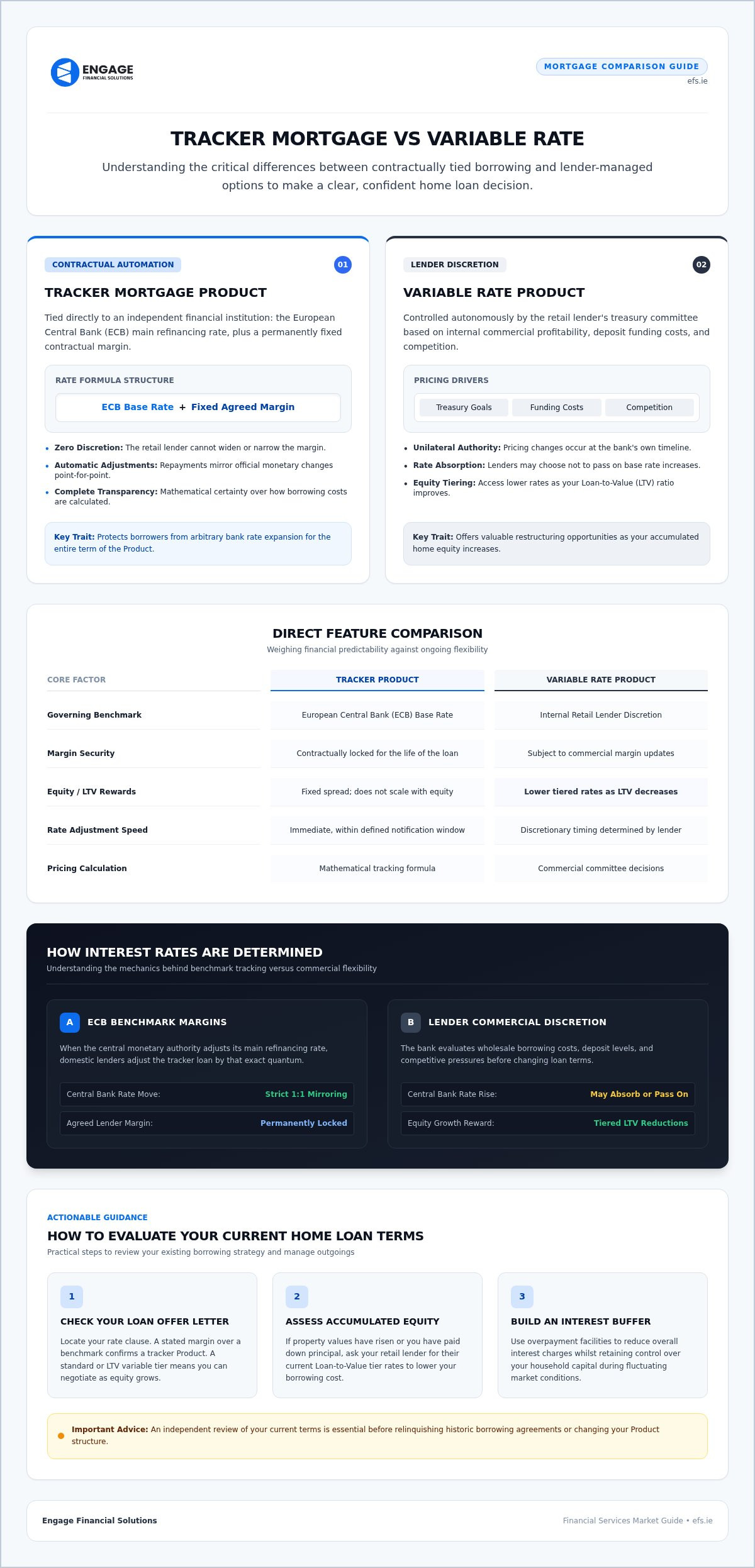
Every home loan falls into a distinct category based on how your lender calculates interest. While both models feature monthly repayments that fluctuate, evaluating a tracker mortgage vs variable rate setup comes down to one core distinction: contractually guaranteed tracking versus retail lender discretion. Understanding this difference gives you control over your household outgoings.
Broadly classified under the global umbrella of an adjustable-rate mortgage (ARM), these two structures manage market changes in entirely contrasting ways. Tracker agreements remove human intervention by binding your borrowing cost directly to an independent financial institution. Variable arrangements leave pricing decisions in the hands of your bank’s treasury committee, allowing them to adjust pricing based on internal profitability, funding costs, and competitive pressures.
What Is a Tracker Mortgage?
A tracker loan follows an external benchmark, specifically the European Central Bank (ECB) main refinancing rate. Your contract establishes a fixed percentage margin that sits permanently above that base rate. When Frankfurt increases or reduces borrowing costs, your bank adjusts your repayment schedule automatically. Your lender holds zero discretionary power to widen or narrow that agreed margin, giving you complete mathematical transparency over how your monthly repayments are formed.
What Is a Variable Rate Mortgage?
A standard variable Product gives the lender total autonomy over pricing. The bank can alter interest rates whenever it chooses, without waiting for central bank announcements or matching them point for point. Retail lenders also offer tiered Loan-to-Value (LTV) options. As you pay down your loan or property values rise, these tiers reward higher equity with reduced borrowing rates, creating valuable restructuring opportunities that trackers do not provide.
Consider how these mechanisms influence day-to-day family finances:
- Repayment predictability: Trackers provide clear foresight because any rate movement mirrors official central bank monetary announcements.
- Equity benefits: Variable options let you request rate reductions as your loan-to-value ratio improves over time.
- Market protection: Trackers shield borrowers from arbitrary lender profit margins, whilst variable rates can remain static even when central rates rise.
Actionable tip: Dig out your original loan offer letter today and locate your rate clause. If you see a stated margin over a specific benchmark, you hold a tracker. If your documentation references a standard or LTV variable tier, you have room to negotiate lower pricing as your property equity grows.
How Interest Rates Are Determined: Benchmark Margins vs Lender Discretion
How your monthly payment is calculated depends on the engine driving your interest rate. In a tracker mortgage vs variable rate comparison, one functions on strict mathematical automation tied to European Central Bank decisions. The other responds to the commercial goals and wholesale borrowing costs of your lending institution.
As outlined in the foundational Consumer Handbook on Adjustable-Rate Mortgages, fluctuating loans rely on defined indexes and margins. However, standard variable models decouple from external indices entirely, granting lenders unilateral pricing authority.
The Mechanics of Benchmark Movement
Tracker mortgages operate on contractual certainty. When the European Central Bank alters its main refinancing rate, domestic lenders must adjust tracker borrowing costs by that exact quantum. Regulated retail banks adhere to strict notification periods, updating account schedules within a set operational timeframe. Crucially, your contractually agreed lender margin remains locked for the entire life of the loan Product, insulating you from arbitrary fee expansion.
Lender Discretion on Standard Variable Options
Variable rate structures give institutions wide latitude. When monetary authorities shift base rates, your lender evaluates deposit levels, net interest margins, and competitor actions before changing loan terms. A bank might absorb a benchmark rise to stay competitive, leaving your repayments stable. Equally, they can hike variable rates to safeguard commercial margins even if official indices remain flat.
Domestic regulatory standards protect borrowers by requiring transparent notice periods ahead of discretionary rate increases. Still, standard variable holders carry commercial risk that tracker clients never face.
Several variables influence commercial pricing decisions:
- Cost of funds: The yield institutions must pay on retail customer deposits and interbank borrowing.
- Risk appetite: Adjustments in how banks price perceived exposure across broader property categories.
- Market share targets: Tactical price freezes designed to win new business from rival retail lenders.
Actionable tip: If your current repayments feel out of step with broader trends, you don’t have to stay put. Reviewing your borrowing options with an independent specialist at Engage Financial Solutions can clarify whether your variable margin remains competitive or if switching can secure meaningful savings.
Comparing the Pros and Cons: Weighing Financial Predictability Against Flexibility
Every loan structure asks you to make a choice between certainty and adaptability. Choosing between a tracker mortgage vs variable rate setup isn’t merely an assessment of where interest costs sit this afternoon. It requires balancing strict contractual safeguards against your ability to restructure borrowing as property equity accumulates.
Both models behave differently across distinct economic cycles. When central authorities ease monetary policy, trackers drop immediately without institutional hesitation. Conversely, during aggressive tightening, tracker repayments climb steeply, causing severe cash-flow friction for households. Variable structures absorb shocks unevenly, sometimes insulating borrowers temporarily whilst at other times passing along higher administrative margins.
Advantages and Pitfalls of Retaining a Tracker
The standout advantage of a tracker is absolute transparency. You always know your lender’s profit margin cannot expand beyond the original agreement. However, sharp benchmark increases hit monthly budgets without delay. Perhaps the biggest consideration is contractual rarity: tracker arrangements are legacy agreements. Once you switch away from an existing tracker Product, retail lenders will not re-offer those terms, meaning you surrender that transparent benchmark relationship permanently.
Benefits and Drawbacks of Variable Rates
Variable borrowing shines through operational adaptability. Most standard and Loan-to-Value (LTV) options permit penalty-free capital overpayments, allowing you to pay down principal faster without early redemption fees. Even better, as local property values appreciate or your loan balance drops, you can request migration into a lower LTV tier. These equity-driven reductions unlock lower interest bands that trackers cannot access, offsetting the uncertainty of discretionary bank pricing.
Balancing these contrasting models comes down to your personal priorities:
- Early repayments: Variable loans generally offer superior freedom to make lump-sum capital reductions without financial penalties.
- Contractual permanence: Tracker margins remain locked indefinitely, but you cannot reclaim them once you move to a new structure.
- Equity milestones: Variable borrowers can actively leverage home improvements or general price growth to negotiate cheaper tiered rates.
- Budget volatility: Trackers present immediate exposure to central policy swings, while variable loans carry the quiet risk of commercial margin expansion.
Actionable tip: Calculate your current Loan-to-Value ratio by dividing your outstanding mortgage balance by a realistic estimate of your home’s present valuation. If your ratio has dropped below eighty or sixty percent since you first drew down your loan, check whether your lender offers cheaper tiered variable bands that beat your current outgoings.
Decision Framework: How to Evaluate Your Current Home Loan Strategy
Making a sensible choice between a tracker mortgage vs variable rate setup requires looking honestly at your household numbers. Rather than guessing how benchmark announcements might unfold, you can test your personal balance sheet against different borrowing conditions. This approach grounds your strategy in real financial resilience.
A thorough assessment starts with three core checks: your true home equity, your household cash buffer, and your current loan agreement rules. If your monthly outgoings feel tight whenever central policy shifts, staying on an unhedged rate might expose your family to unnecessary stress.
Assessing Your Loan-to-Value Ratio and Financial Buffer
Begin by calculating your current Loan-to-Value (LTV) ratio. Divide your outstanding principal balance by an updated, realistic valuation of your property. If your ratio has dropped below key thresholds such as eighty, seventy, or sixty percent, you likely qualify for discounted variable tiers across rival lenders. Next, stress-test your monthly cash flow by modelling how your budget would cope if repayments climbed by one or two percentage points. If that simulation strains your monthly savings, the emotional peace of mind that comes from guaranteed budget stability may far outweigh the speculative perks of waiting for central rate cuts.
Comparing Alternative Mortgage Options
Evaluating your loan doesn’t stop at fluctuating structures. Many borrowers discover that locking in terms provides the certainty their family needs. Fixed-rate agreements eliminate monthly surprises entirely, protecting your cash flow over chosen terms. Borrowers with energy-efficient homes can also access preferential “green” mortgage terms, where lenders discount pricing for properties holding high Building Energy Ratings (BER). If you want to explore the practical steps of moving to an alternative lender, explore our guide to seamless mortgage switching to see how an updated structure can align with your long-term goals.
Work through this practical checklist before making any binding adjustments:
- Audit contract conditions: Locate your original loan agreement to verify your current margin and check for any terms governing capital overpayments.
- Update property valuation: Obtain a current valuation to confirm whether your reduced LTV unlocks cheaper interest tiers.
- Simulate cash-flow strain: Run scenarios with higher interest costs to ensure your emergency reserves remain intact under rate pressure.
- Weigh fixed certainty: Determine whether fixing your monthly commitment offers greater peace of mind than riding out fluctuating borrowing cycles.
Actionable tip: Take twenty minutes this week to log your current monthly loan cost alongside your household net income. If your mortgage repayment absorbs more than thirty-five percent of your take-home pay, reach out to an advisor at Engage Financial Solutions to explore whether switching mortgages can lower your ongoing overheads.
Securing the Ideal Mortgage Structure: Professional Broker Support
Deciding how to proceed in the tracker mortgage vs variable rate conversation isn’t an exercise you need to face alone. Relinquishing an irreplaceable tracker margin requires precise mathematical assessment, whilst comparing variable tiers across rival domestic lenders demands substantial research and paperwork. Partnering with an independent broker regulated by the Central Bank introduces calm competence to what can easily feel like a complex financial crossroads.
The Value of Independent Market Analysis
An experienced mortgage broker assesses your household position against a comprehensive panel of leading domestic institutions. While individual bank representatives can only sell their employer’s proprietary Product lineup, an independent intermediary searches across the market for your benefit. They provide unbiased analysis on whether retaining a legacy tracker safeguards your cash flow or whether an equity-based variable switch delivers greater household savings. This holistic approach ensures your borrowing works in harmony with your broader financial plan, from long-term investments to essential mortgage protection policies.
A Streamlined Path to Mortgage Optimisation
Restructuring your home loan shouldn’t involve unnecessary friction or administrative delays. A dedicated advisor manages lender communications on your behalf, coordinating directly with credit underwriters, property valuers, and solicitors to ensure a seamless transition. By anticipating compliance queries before they arise, your advisor safeguards your time and establishes lasting financial stability for your family across every phase of home ownership.
Professional intermediary guidance provides tangible benefits throughout the borrowing journey:
- Comprehensive panel access: Compare competitive borrowing options across multiple retail lenders rather than settling for a single bank’s terms.
- Contractual safeguards: Ensure legacy tracker terms are rigorously stress-tested before committing to an irreversible switch.
- Administrative ease: Eliminate operational stress by delegating document collation, underwriting negotiations, and legal follow-ups.
- Holistic security: Connect your mortgage structure to tailored income protection and retirement plans for lifelong peace of mind.
Actionable tip: Before signing any institutional amendment forms, request an independent loan portfolio review. An objective evaluation ensures you verify your current Loan-to-Value tier and fully understand the long-term impact on your household finances before selecting a new Product.
Positioning Your Borrowing for Long-Term Peace of Mind
Deciding between a tracker mortgage vs variable rate setup comes down to aligning your household priorities with the right financial terms. Retaining an irreplaceable tracker ensures complete benchmark transparency, whilst modern variable options reward growing property equity with lower borrowing tiers. The ideal choice isn’t about guessing market cycles; it’s about protecting your cash flow and establishing lasting security.
You don’t have to evaluate these complex decisions alone. Engage Financial Solutions is regulated by the Central Bank, offering direct access to leading domestic lending panels and seamless end-to-end management of mortgage applications. Whether you want to preserve historic contract terms or switch to an alternative Product that better matches your lifestyle, our team is here to guide every step. Take control of your borrowing journey and speak with a dedicated mortgage specialist today.
Frequently Asked Questions
Can I get a new tracker mortgage today?
No, new tracker mortgages aren’t available for new borrowers across domestic retail lenders. Banks withdrew these Products following the 2008 financial crisis, making existing trackers strictly legacy agreements. Today, borrowers deciding between a tracker mortgage vs variable rate structure are almost exclusively existing tracker holders evaluating whether to keep their contract or switch to an alternative variable or fixed Product to lower their monthly outgoings.
What happens to my tracker mortgage if central bank rates drop?
When the European Central Bank cuts its main refinancing rate, your monthly tracker repayments fall automatically. Your retail lender is contractually obliged to pass on the full reduction without delay, usually adjusting your account within thirty days. Because your set lender margin stays fixed throughout the entire loan term, every downward base rate move provides immediate, frictionless financial relief to your household budget.
Can a lender increase my standard variable rate whenever they choose?
Yes, retail banks hold unilateral discretion over their standard variable rates. They can adjust pricing upward or downward to manage operational funding costs, protect lending margins, or respond to competitor activity, even without a shift in central bank benchmarks. However, regulated lenders must provide written notice at least thirty days before implementing any rate hike, giving you vital time to review your borrowing options.
Is it possible to switch from a tracker to a fixed or variable Product?
Yes, you can switch from a tracker to a fixed or variable Product at any stage without major hurdles. However, doing so is completely irreversible. Once you relinquish a legacy tracker agreement, you permanently forfeit your contractual link to central bank rates. That’s why securing an independent mortgage review is critical before signing any paperwork, ensuring an alternative loan genuinely beats your current terms over the long term.
How much equity do I need to access lower tiered variable rates?
Most retail lenders begin discounting tiered variable rates once your Loan-to-Value ratio drops below eighty percent. Additional price reductions typically unlock at seventy, sixty, and fifty percent thresholds. When comparing a tracker mortgage vs variable rate setup, establishing your current equity position is vital. If property appreciation has pushed your loan balance into a lower tier, a variable restructure could easily deliver substantial ongoing savings.
Will I face early exit penalties if I move away from a tracker or variable loan?
No, exiting a tracker or variable mortgage does not incur early redemption charges or break fees. Unlike fixed-rate contracts that charge penalties for early settlement, fluctuating loan structures give you complete freedom to switch lenders or pay off lump sums whenever you wish. You’ll only need to cover standard administrative costs, such as legal fees and an up-to-date property valuation.
Does changing my mortgage structure require a brand new property valuation?
If you are moving to a new lender or seeking a lower Loan-to-Value tier with your existing bank, a fresh valuation is almost always required. Lenders require an inspection carried out by an approved panel valuer to establish your home’s current market worth accurately. This straightforward step ensures your borrowing ratio is properly calculated so you secure the most advantageous Product tier available.
Disclaimer
Engage Financial Services LTD T/A Engage Financial Solutions is regulated by the Central Bank of Ireland CRO 764570. Suite 2 First Floor, 14 -18 Main street, Blackrock, Co Dublin. A94 W0Y3