


What if the upcoming expiry date on your loan isn’t an administrative headache, but your greatest opportunity to lower your monthly outgoings? It’s completely natural to feel uneasy when your bank’s formal notification lands on your doormat. Opening that letter often leaves homeowners asking what happens when my fixed rate mortgage ends Ireland, particularly when the fear of an automatic jump to an expensive Standard Variable Rate looms over the household budget.
You don’t have to accept an expensive default rate or endure the stress of repayment shock. In this complete guide, you’ll discover how the lender roll-off process works, how to decipher your bank’s statutory notifications, and how to evaluate your next loan PRODUCT to secure meaningful long-term savings.
Whether you want to renegotiate with your current lender or switch institutions to cut your monthly repayments, we’ll walk you through a clear, side-by-side framework designed to safeguard your family finances and ensure a seamless transition.
Key Takeaways
- Understand the automatic roll-off reality: Discover what happens when my fixed rate mortgage ends Ireland, including how to safeguard your budget before default variable rates trigger sudden repayment shock.
- Decode statutory lender notifications: Learn how to interpret mandatory 60-day expiry letters and evaluate internal loan Product options alongside clear savings calculations.
- Compare re-fixing against switching lenders: Use a balanced framework to weigh incumbent retention rates against competitor incentives, valuation validity windows, and legal conveyancing costs.
- Follow a proactive six-month roadmap: Take methodical, stress-free steps to organise required documentation, optimise your loan-to-value tier, and secure an ideal replacement Product seamlessly.
What Happens When Your Fixed Term Expires: Understanding the Roll-Off Reality
The maturity date marks the legal completion of your fixed borrowing agreement. Up to this calendar deadline, your interest rate and monthly repayment stay completely shielded from market volatility. When homeowners examine what happens when my fixed rate mortgage ends Ireland, the fundamental reality is that your overall mortgage does not finish; only your preferential pricing window closes. Unlike the predictable amortisation provided by traditional fixed-rate mortgages, an unmanaged roll-off exposes your remaining balance to immediate price adjustments.
The Automatic Reversion to Standard Variable Rates
Once the clock runs out on your contracted term, your bank transitions your account onto its default Standard Variable Rate (SVR). Lending institutions retain full commercial discretion over their standard variable rates, meaning they can adjust your rate independently of European Central Bank benchmark movements.
Standard variable reversion is the automatic transfer of an expired loan balance to a lender’s default interest rate, routinely inflating monthly household repayments without providing any additional loan benefits.
Because domestic lenders use SVR tiers as profitable holding pens, this default loan Product rarely reflects the most competitive pricing available to you.
Why Doing Nothing Causes Immediate Payment Shock
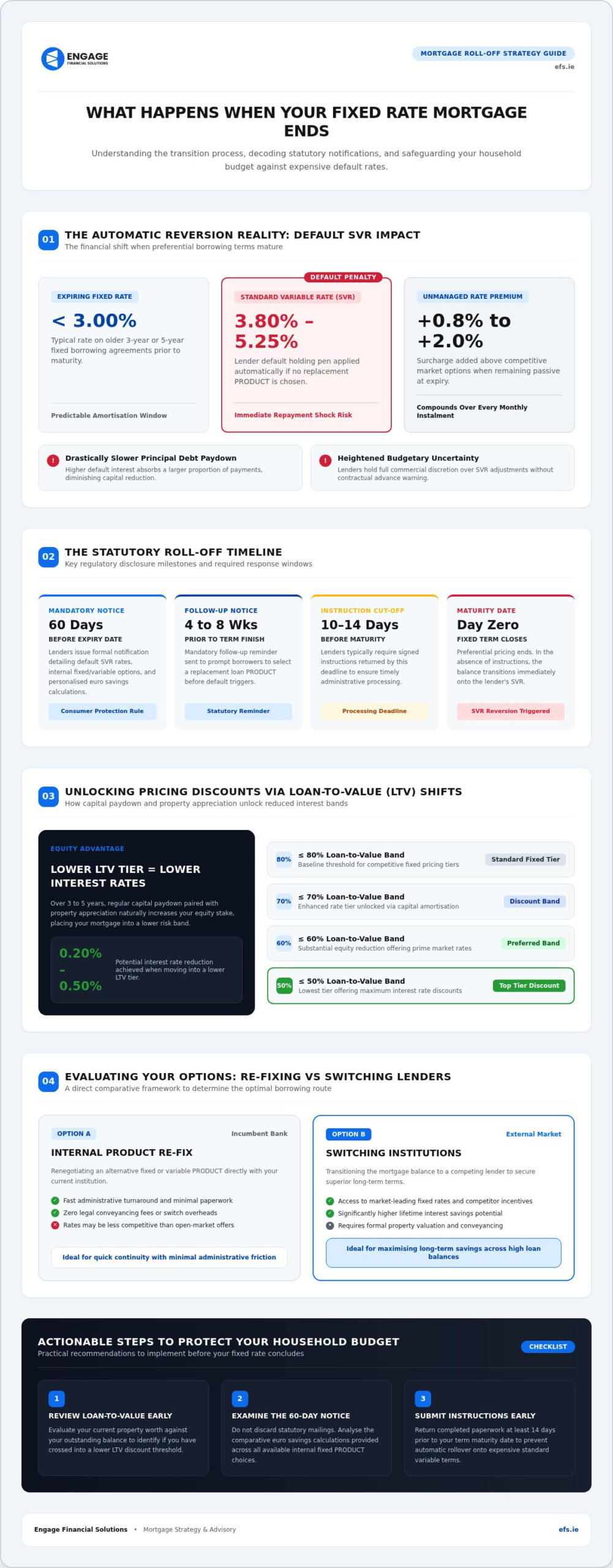
Borrowers rolling off older three-year or five-year fixed contracts often face stark adjustments. Moving from an older fixed rate below 3% to an unmanaged SVR hovering between 3.80% and 5.25% creates instant repayment shock.
Default variable terms frequently add a premium of 0.8% to 2.0% above competitive fixed options. On a substantial remaining capital balance, compound interest quickly compounds this penalty across every monthly instalment:
- Balance erosion slows down: Higher variable interest consumes a greater share of each payment, drastically reducing the pace of principal debt paydown.
- Budgetary uncertainty increases: Discretionary rate revisions leave monthly outgoings vulnerable to sudden shifts without contractual warning.
Passive inertia remains the single most expensive choice at maturity. Proactively exploring switching mortgages or securing an alternative fixed loan Product prevents costly interest drift and maintains long-term control over your household finances.
The Lender Roll-Off Timeline: Decoding Notices and Valuation Rights
Anticipating your options long before maturity keeps you in complete control. Under the Consumer Protection Code set out by the Central Bank, mortgage lenders must send you written notification at least 60 calendar days before your fixed term finishes. A mandatory reminder must follow four to eight weeks later. When borrowers ask what happens when my fixed rate mortgage ends Ireland, understanding this formal statutory timetable ensures you have sufficient runway to explore the market without facing default penalties.
Statutory Roll-Off Notification Letters and Documentation
Your 60-day expiry pack contains essential financial disclosures rather than simple marketing material. Regulated institutions must clearly set out:
- The exact Standard Variable Rate applied if you take no action.
- All alternative fixed and variable Product options currently offered internally.
- Personalised savings estimates, calculated in euro, for each replacement loan Product.
Banks typically require your signed instruction returned at least ten to fourteen days before the term ends. Leaving this paperwork until the final week restricts your options and practically guarantees a temporary rollover onto an unmanaged rate.
Leveraging Loan-to-Value Shifts for Improved Pricing
A major blind spot for many borrowers is failing to reassess their Loan-to-Value (LTV) ratio. Over a three- or five-year period, regular capital paydown combined with wider property price appreciation often significantly increases your underlying home equity. Domestic lenders structure their interest rates across distinct bands, typically:
- Equal to or under 80% LTV
- Equal to or under 70% LTV
- Equal to or under 60% LTV
- Equal to or under 50% LTV
Dropping into a lower bracket can reduce your offered rate by 0.20% to 0.50%, generating meaningful lifetime savings. To capture these discounts, commissioning an updated professional valuation is essential. A standard residential valuation usually costs between €150 and €250, with the resulting inspection report remaining valid for exactly four months across lending institutions.
If you have completed energy-efficiency retrofits, securing an updated Building Energy Rating (BER) certificate can unlock dedicated Green Product rates starting from approximately 3.00% to 3.25% for homes rated B3 or higher. Partnering with a dedicated specialist to assess your updated equity through switching mortgages allows you to present the strongest possible application and safeguard your household budget for the years ahead.
Evaluating Your Replacement Options: Re-Fixing, Variable, or Switching Lenders
Approaching maturity forces an active decision between three distinct routes. When weighing what happens when my fixed rate mortgage ends Ireland, your choice rests on balancing administrative ease against long-term interest savings. Whether you value locked-in repayment certainty or flexible lump-sum reduction terms, evaluating each path objectively ensures your next loan Product actively serves your wider financial goals.
Path One: Re-Fixing with Your Current Institutional Lender
Re-fixing internally delivers undeniable administrative simplicity. You bypass full underwriting, avoid legal conveyancing requirements, and sign a straightforward amendment form. Incumbent lenders rarely offer their absolute sharpest rates to existing borrowers, however. Settling for an uncompetitive retention deal solely to avoid paperwork can silently cost thousands over a typical three- to five-year term.
Path Two: Switching to an External Lending Institution
Transferring your balance to a new institution unlocks the most competitive pricing across the domestic market. Moving from a standard 4.50% roll-off rate to an optimized fixed Product near 3.20% on a €250,000 balance over 20 years saves approximately €170 to €200 monthly, generating over €2,000 in yearly household relief. To weigh external offers effectively, review our detailed guide on switching mortgage options.
Switching requires appointing an independent solicitor to handle the title deeds, carrying conveyancing costs between €1,200 and €2,000 plus 23% VAT, alongside a €150 to €250 valuation fee. Many lenders offset these expenses directly by providing upfront legal contributions of €2,000 to €3,000 or cashback payments worth 2% to 3% of the overall advance. Under European consumer rules, these cash incentives cannot be clawed back once your prior fixed contract has fully concluded. A specialist broker eliminates administrative friction across this process by assembling documentation, comparing whole-of-market options, and managing lender communications directly on your behalf.
Path Three: Assessing Variable and Capped Interest Alternatives
Standard variable borrowing offers maximum functional flexibility. If you anticipate selling your home, moving abroad, or making large unscheduled capital reductions from bonuses or savings, variable structures let you repay lump sums without early redemption penalties.
This freedom comes with market exposure. Discretionary variable pricing leaves your monthly payments unprotected against shifting economic cycles, whereas competitive fixed alternatives protect your household cashflow with complete certainty.
How to Prepare for Expiry: A Proactive 6-Month Action Plan
A smooth financial transition relies entirely on steady forward planning. Rather than wondering what happens when my fixed rate mortgage ends Ireland when your formal bank letter arrives, establishing a structured preparation timeline months in advance prevents last-minute panic. Breaking the process into practical milestones ensures your finances are neatly organised, fully underwritten, and ready for drawdown before your existing term lapses.
Month 6 to 4: Financial Auditing and Property Review
Begin your preparations six months out by gathering key documents and stress-testing your household expenditure:
- Audit banking conduct: Review six months of current account and savings statements. Eliminate recurring discretionary overdrafts, unvetted gambling transactions, or irregular transfers that raise underwriting questions.
- Assemble earnings records: Collect your latest Employment Detail Summary, three consecutive payslips, and a completed salary certificate.
- Request loan figures: Contact your current lender for an official redemption statement showing your exact capital balance.
- Check property documentation: Review your home’s registered energy rating on the national register. If recent retrofits pushed your rating to B3 or higher, an updated certificate qualifies you for competitive Green Product pricing.
Month 3 to 1: Application Submission and Legal Steps
With paperwork organised, submit your preferred application three months prior to maturity. Under statutory standards, regulated lenders must acknowledge a completed switcher submission within three business days and issue an underwriting assessment within ten business days of receiving all files.
Once you receive formal loan approval, instruct your chosen solicitor immediately. Conveyancers require adequate time to request title deeds, which incumbent institutions must release within ten days of notice. Concurrently, verify that your active mortgage protection insurance correctly mirrors your updated loan balance and repayment term. Reorganising borrowing without synchronising your life cover risks severe legal delays during final loan drawdown.
Mitigating Transaction Costs Through Lender Incentives
Always evaluate total borrowing costs across the full fixed term rather than focusing on headline incentives alone. An attractive €3,000 legal contribution easily covers typical conveyancing fees, but pairing it with an uncompetitive interest rate eliminates those upfront benefits within two years. To align your timeline perfectly and secure the most cost-effective loan Product, schedule a comprehensive mortgage review with an independent adviser today.
Securing Your Ideal Replacement Loan with Independent Professional Advice
Managing the conclusion of a fixed borrowing period can feel overwhelming when handled alone. If you are questioning what happens when my fixed rate mortgage ends Ireland, working with an independent consultancy replaces guesswork with objective market analysis. Rather than facing bureaucratic delays or restrictive single-lender policies, a dedicated adviser acts as your steady guide, ensuring every stage of your renegotiation unfolds smoothly from initial assessment to final drawdown.
Why an Independent Advisory Outperforms Tied Bank Branches
Walking into a local branch limits your options to that single institution’s proprietary range. Tied bank staff cannot recommend a competitor’s terms, even when an alternative lender offers lower interest rates or significantly better cashback incentives.
An independent financial advisory delivers whole-of-market access, evaluating competing institutional lenders side by side:
- Objective lender selection: You receive impartial guidance focused entirely on selecting the most appropriate loan Product for your household circumstances.
- Paperwork consolidation: Instead of completing repetitive application forms across various banks, an adviser collates your files once and submits them directly through streamlined digital portals.
- Direct underwriting advocacy: If complex income structures or historical documentation require clarification, an experienced broker negotiates directly with credit underwriters on your behalf.
Integrating Your Mortgage with Long-Term Wealth Planning
Your mortgage should never exist in isolation from your wider financial wellbeing. Restructuring your primary debt provides an ideal moment to examine your total financial picture, ensuring monthly outgoings support your future milestones rather than stretching your day-to-day comfort.
Tailored debt management works alongside essential wealth building. Aligning your revised mortgage commitments with structured pension planning, Income Protection, and family life cover protects your home against unexpected life events. This coordinated view ensures that lower interest payments translate directly into genuine, lasting security for your family.
Securing the right loan structure gives you lasting peace of mind. By partnering with our specialist advisory team, you gain access to nationwide lending options and proactive support designed to remove friction from every step of your borrowing journey.
Take Control of Your Mortgage Expiry Today
Approaching the end of your loan term doesn’t need to be daunting. When evaluating what happens when my fixed rate mortgage ends Ireland, remember that maturity offers a valuable financial reset rather than an unavoidable rate hike. By preparing early, reassessing your equity tier, and actively reviewing replacement Product options, you protect your household cashflow against expensive default variable rates.
You don’t have to manage this transition alone. Engage Financial Solutions is a regulated consultancy providing comprehensive access to leading institutional lending panels across the country. Our dedicated personal advisory focuses entirely on tailored borrowing solutions with zero high-pressure sales tactics. From managing complex lender paperwork and coordinating with solicitors to reviewing your protective insurance cover, we eliminate administrative friction at every stage.
Take charge of your borrowing today. Connect with our expert team to secure your ideal mortgage switch and step forward into long-term financial peace of mind.
Frequently Asked Questions
What happens if I do nothing when my fixed rate mortgage expires?
Your loan automatically rolls onto your lender’s Standard Variable Rate. When asking what happens when my fixed rate mortgage ends Ireland, the immediate consequence of inaction is higher borrowing costs. Because standard variable rates carry interest premiums between 0.8% and 2.0% above competitive alternatives, failing to select a new Product results in an avoidable jump in your monthly repayments.
Can my lender increase my repayments without informing me beforehand?
No, regulated lenders cannot alter your payments without advance written notice. Central Bank consumer protection rules require institutions to issue a formal notification at least 60 calendar days before your fixed term finishes, followed by a reminder four to eight weeks later. These documents outline your projected variable repayments alongside available internal fixed options, giving you time to choose a suitable replacement Product.
How far in advance should I start reviewing my alternative borrowing options?
You should begin reviewing options approximately six months before your fixed agreement reaches its maturity date. Starting early allows you to audit bank statements, address discretionary spending, and monitor your current loan balance. This runway ensures you can obtain an underwriting decision within statutory timelines and complete conveyancing smoothly, preventing any period on an unmanaged default variable rate.
Can I switch to a different mortgage lender before my fixed term officially ends?
Yes, you can break a fixed contract early, but your current bank may charge an early redemption fee. Lenders calculate break fees based on wholesale interbank market movements and remaining contract duration. You can request an exact redemption quote directly from your lender to determine whether moving early to an external Product delivers savings that outweigh the penalty.
Is switching lenders worth the effort if my balance has substantially decreased?
Switching is generally less beneficial if your remaining loan balance is relatively modest, typically under €100,000, or if you have only a few years left on your mortgage. Legal conveyancing fees ranging from €1,200 to €2,000 plus VAT and valuation costs can quickly erode the interest savings gained on smaller debts, making an internal retention Product the more practical financial choice.
What happens to my mortgage protection policy if I change lenders or terms?
Your Mortgage Protection policy remains your personal contract, but its details must align with your new borrowing terms. If your restructured loan Product involves an extended repayment duration or an increased loan balance, you must adjust your coverage accordingly. Your independent adviser can review your existing cover alongside your switch, ensuring seamless protection without leaving your family underinsured.
How do updated property values impact the interest rates lenders offer me?
A higher property value lowers your Loan-to-Value ratio, granting access to discounted interest tiers. If steady home price appreciation or capital paydown moves your equity past key thresholds like 80%, 70%, or 60%, lenders frequently reduce rates by 0.20% to 0.50%. Ordering a formal residential valuation validates this growth, helping you secure a significantly more competitive Product.
Disclaimer
Engage Financial Services LTD T/A Engage Financial Solutions is regulated by the Central Bank of Ireland CRO 764570. Suite 2 First Floor, 14 -18 Main street, Blackrock, Co Dublin. A94 W0Y3