


What if you could redirect 40% of your current tax bill directly into your own future wealth instead of handing it over to the Revenue? For many professionals earning over €44,000, the high income tax burden feels like an unavoidable drain on their monthly resources. You likely understand the importance of saving, yet the complexity of choosing between a PRSA and a PERSONAL PENSION often leads to more questions than answers. You aren’t alone in feeling that relying solely on the State Pension is a risky strategy for the lifestyle you’ve worked hard to build.
This guide empowers you to take back control by showing how a PERSONAL PENSION transforms your tax liabilities into a robust, private retirement fund. You’ll discover how to secure significant tax relief on your contributions while maintaining the flexibility to choose where your money is invested. We’ll provide a clear roadmap that clarifies age-related contribution limits, the latest Standard Fund Threshold rules, and the steps needed to ensure your financial independence is both seamless and secure.
Key Takeaways
- Discover how to transform your tax liabilities into personal wealth by securing up to 40% tax relief on your PERSONAL PENSION contributions.
- Compare a PERSONAL PENSION with a PRSA to identify which structure offers the most flexibility and value for your specific retirement goals.
- Understand the Revenue age-related contribution limits to ensure you’re maximising your savings at every stage of your professional career.
- Learn to build a diversified investment portfolio that balances risk and growth to protect your long-term financial stability.
- Gain a clear roadmap for accessing your benefits, including how to claim your Tax-Free Lump Sum from the age of 60.
Defining the PERSONAL PENSION: Reclaiming Your Financial Future
A PERSONAL PENSION is more than just a savings account; it’s a sophisticated private investment vehicle designed to give you total agency over your later years. Formally known as a Retirement Annuity Contract, this structure allows you to build a bespoke fund that reflects your specific financial goals. Taking this step demonstrates a sense of calm competence. You’re moving away from the uncertainty of state reliance and towards a future you’ve designed yourself. Every provider of these contracts is strictly regulated by the Central Bank, ensuring your capital is managed within a framework of professional stewardship and oversight.
Who Should Consider a Private Structure?
If you’re a sole trader, a partner in a firm, or an employee whose workplace doesn’t offer a group scheme, this vehicle is often the most efficient choice. It provides a level of flexibility that more rigid structures lack. You can adjust your contributions as your income fluctuates, which is vital for anyone managing their own business. Whilst some might consider a Personal Retirement Savings Account (PRSA), the PERSONAL PENSION remains a favourite for those seeking tailored investment options. Think of us as your steady guide, helping you determine if this specific path aligns with your current lifestyle and long-term aspirations. It’s about finding a solution that fits your professional journey rather than forcing you into a one-size-fits-all box.
The Legal Ownership Advantage
One of the most reassuring aspects of this contract is that it’s held directly in your name. Unlike many occupational schemes, there’s no need for a Trustee to sit between you and your money. This direct ownership provides a significant layer of security and simplicity. If your career path changes or you decide to move your professional life elsewhere, your fund remains entirely portable. You don’t have to worry about leaving bits of your future behind in various “frozen” schemes. Owning your retirement asset outright creates a seamless transition between your working life and your eventual post-work lifestyle, offering the stability you deserve. It’s a straightforward way to ensure that the wealth you build today remains under your control, no matter where your career takes you.
Maximising Your Contributions and Tax Efficiency
Viewing your retirement through a “Future-Back” perspective allows you to see how today’s decisions create tomorrow’s stability. By starting with the end goal of financial independence, you can work backwards to identify the most efficient way to fund that lifestyle. For higher-rate taxpayers earning over €44,000 in the 2026 tax year, a PERSONAL PENSION serves as an incredibly powerful tool. It doesn’t just save for the future; it actively reduces your current tax bill, allowing you to keep more of your hard-earned money within your own private wealth structure.
Understanding the Net Cost of Saving
In addition to tax-efficient retirement planning, business owners looking to scale their operations can find out more about intelligent financing solutions that help accelerate commercial growth.
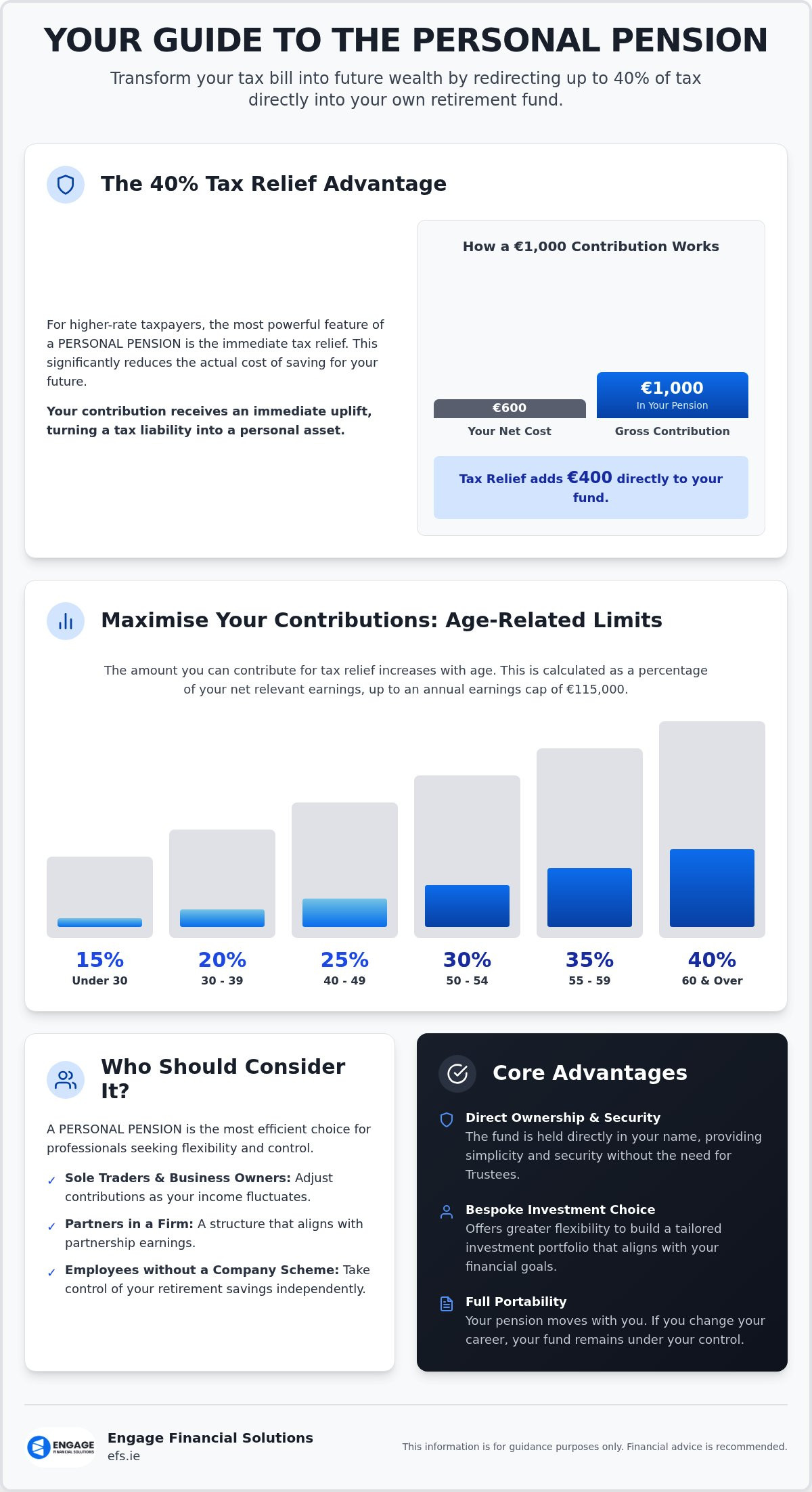
The most compelling advantage of this structure is the immediate tax relief available at your marginal rate. If you’re a higher-rate taxpayer, the actual cost of your contribution is significantly lower than the amount that ends up in your fund. For instance, a €1,000 contribution into your PERSONAL PENSION effectively costs you only €600 after 40% tax relief is applied. This immediate 40% “uplift” is a benefit you won’t find in standard savings accounts. You can claim this relief directly through your monthly payroll if you’re an employee, or via your annual tax return if you’re self-employed. For a deeper dive into the mechanics of these structures, this personal pensions guide provides an excellent overview of the statutory framework.
Age-Related Limits and the Earnings Cap
The Revenue Commissioners set specific limits on how much you can contribute while still receiving tax relief. These limits are based on your age and are calculated as a percentage of your “net relevant earnings,” subject to an annual cap of €115,000. For the 2026 tax year, the percentages are as follows:
- Under 30: 15%
- 30 to 39: 20%
- 40 to 49: 25%
- 50 to 54: 30%
- 55 to 59: 35%
- 60 and over: 40%
Meticulous planning is essential to ensure you’re maximising these bands without over-contributing beyond the €115,000 earnings limit. One of the most effective strategies is making a “backdated” contribution. If you have a tax liability for 2025, you can make a lump-sum payment before 31 October 2026 (or mid-November for online filers) and offset it against that previous year’s income. This proactive approach helps you manage your cash flow while safeguarding your future. If you’re unsure how to calculate your specific limits, our team can help you organise your contributions to ensure every Euro works as hard as possible for you.
PERSONAL PENSION vs. PRSA: Selecting Your Ideal Retirement Vehicle
Choosing between a PERSONAL PENSION and a PRSA is a pivotal moment in your financial planning. While both aim to secure your future, their internal mechanics differ. A PERSONAL PENSION is a contract between you and a life assurance company. In contrast, a PERSONAL RETIREMENT SAVINGS ACCOUNT (PRSA) is a more standardised investment account. For many professionals, the choice depends on where they are in their career and how much control they desire over their investment strategy. You can find more detail in this CCPC guide to personal pensions, which outlines the regulatory distinctions between these products. Establishing a personal pension professionals can rely on requires a clear understanding of these subtle differences.
Comparing Flexibility and Portability
A PRSA often appeals to younger professionals or those with highly fluctuating incomes because of its extreme flexibility. You can stop and start contributions without penalty. However, for established sole traders or partners, the PERSONAL PENSION often provides a more robust framework for long-term growth. We act as a steady guide to help you match the vehicle to your specific career trajectory. If you eventually move from self-employment into a corporate role, we ensure a seamless transition between your private assets and any new company scheme. This prevents the friction of managing multiple fragmented accounts. Our goal is to maintain a big-picture perspective on your wealth, ensuring that every shift in your professional life is met with a proactive adjustment to your savings structure.
Fee Transparency and Investment Range
Fee structures are a major differentiator between these two vehicles. Standard PRSAs have “capped” charges, which can be useful for smaller starting amounts. However, as your fund grows, the bespoke pricing models available within a PERSONAL PENSION often provide superior value for money. These private contracts also typically grant access to a significantly wider range of asset classes, from international equities to specialised property funds. Small differences in annual management charges might seem trivial today, but they can significantly impact your end-state security over thirty years. Unlike a PRSA, a PERSONAL PENSION doesn’t allow for employer contributions, as it’s designed specifically for your private earnings. If you need a personalised analysis of which path suits your current balance, we can help you evaluate your strategy to ensure your money is working as efficiently as possible.
Investment Strategies: Balancing Risk for Long-Term Stability
The internal composition of your PERSONAL PENSION is the engine that drives your future wealth. Asset allocation involves choosing a deliberate mix of equities, bonds, property, and cash to match your specific financial objectives. Whilst equities offer the highest potential for growth over the long term, bonds and cash provide a necessary buffer against market volatility. Most modern private plans utilise unit-linked funds. These structures allow you to pool your contributions with other investors to gain exposure to various global sectors that might otherwise be difficult to access individually.
One of the most reassuring features of a well-managed plan is lifestyling. This is a proactive strategy where your fund manager gradually shifts your assets from higher-risk growth investments into more stable, capital-protected assets as you approach your chosen retirement date. This methodical transition ensures that your fund is safeguarded against sudden market downturns just as you prepare to access your benefits. It creates a seamless path from your peak earning years into a secure post-work lifestyle.
Determining Your Risk Profile
Your investment behaviour typically falls into one of three categories: cautious, balanced, or adventurous. A cautious approach prioritises capital security but carries the risk that inflation could erode your purchasing power over twenty or thirty years. An adventurous profile seeks maximum growth but requires a higher tolerance for short-term fluctuations. We use meticulous analysis to help you find the middle ground that feels right for you. By tailoring your portfolio to your personal comfort level, we remove the friction and stress often associated with market movements.
The Role of Diversification
Stability is built on the principle of not putting all your eggs in one basket. A robust PERSONAL PENSION should provide global exposure whilst being managed within the domestic regulatory framework. This diversification protects your savings from localised economic shifts. Regular reviews are essential to rebalance your portfolio, ensuring your asset mix hasn’t drifted away from your original goals due to market performance. If you are ready to build a portfolio that reflects your unique aspirations, you can start your financial planning journey with our team today. We act as your steady guide, ensuring your strategy remains aligned with the big picture of your life-long financial health.
Accessing Your Benefits: The Bridge to a Secure Post-Work Lifestyle
Reaching the minimum retirement age, which is typically 60 for those with a private contract, marks a significant milestone in your financial journey. This is the moment your PERSONAL PENSION transitions from a growth-focused investment into a source of sustainable income. Taking a “Future-Back” perspective at this stage is essential. It allows you to ensure your accumulated wealth supports your specific lifestyle aspirations without the stress of running out of funds. You’ve spent decades building this foundation; now, it’s time to enjoy the fruits of your meticulous planning with calm competence.
Upon retirement, you’re generally entitled to take 25% of your total fund as a lump sum. The first €200,000 of this is entirely tax-free, providing an immediate financial boost for travel, home improvements, or other personal projects. Any portion of the lump sum between €200,001 and €500,000 is taxed at the standard rate of 20%. Managing these current lifetime limits effectively is a core part of the stewardship we provide, ensuring you don’t pay more tax than necessary during this transition.
The APPROVED RETIREMENT FUND (ARF) Path
For many professionals, the remaining 75% of the fund is moved into an APPROVED RETIREMENT FUND (ARF). This path is a favourite amongst those who value flexibility and control. An ARF keeps your money invested in the market, allowing for continued growth whilst you draw a regular income to suit your needs. You’re required to withdraw a minimum of 4% each year once you reach age 61, but you can take more if your circumstances change. A significant advantage of this structure is its portability; any remaining fund value can be passed to your estate, ensuring a lasting legacy for your family. For a deeper look at how these structures fit into your big picture, see our comprehensive guide to retirement planning.
The ANNUITY: Guaranteed Income for Life
If your priority is absolute stability, an ANNUITY might be the ideal choice for your post-work years. This is a contract with a life assurance company where you exchange your pension fund for a fixed monthly payment that lasts for the rest of your life. It removes the friction of market volatility, providing a “guaranteed” outcome regardless of economic shifts. You can even choose options that provide a continued income for a spouse or partner after you pass away. Whilst it lacks the flexibility of an ARF, the peace of mind that comes from knowing exactly what will hit your bank account every month is invaluable. We act as your steady guide, helping you contrast the security of an ANNUITY with the flexibility of other structures to find the perfect fit for your future.
Building Your Legacy with Confidence and Control
Securing a personal pension Ireland professionals can rely on is a strategic move towards long-term financial health. You’ve seen how to transform current tax liabilities into future wealth by leveraging age-related contribution limits and diverse investment strategies. By understanding the structural advantages of a PERSONAL PENSION over a PRSA, you can ensure your fund remains portable and flexible throughout your career. These choices aren’t just about spreadsheets; they’re about the peace of mind that comes from knowing your lifestyle is protected.
Navigating these complex financial transitions doesn’t have to be a source of friction. We act as your steady guide, providing the buffer between you and technical complexity whilst offering a partnership built on stability and optimism. You can secure your financial future with expert guidance from Engage Financial Solutions. Our approach combines regulated professional advice with tailored investment strategies and seamless pension management to keep you one step ahead. It’s time to stop worrying about the State Pension and start looking forward to the retirement you deserve with absolute certainty.
Frequently Asked Questions
Can I start a PERSONAL PENSION if my employer already has a scheme?
Generally, you cannot contribute to a PERSONAL PENSION for the same income that’s already covered by an occupational scheme. However, if you have a separate stream of non-pensionable income, such as a side business or rental income, you can set up a private plan. It’s vital to ensure your contributions align with Revenue rules to maintain tax efficiency across all your retirement assets and avoid over-contributing.
What is the maximum I can contribute to my pension this year?
Your maximum contribution depends on your age and your net relevant earnings, subject to a cap of €115,000 for the 2026 tax year. For example, if you’re aged 40 to 49, you can contribute up to 25% of your earnings. This percentage increases as you get older, reaching 40% for those aged 60 and over. Meticulous planning helps you stay within these limits whilst maximising relief.
How much tax-free cash can I take when I retire?
You’re typically entitled to take 25% of your total fund value as a lump sum upon retirement. The first €200,000 of this amount is completely tax-free. Any portion of the lump sum between €200,001 and €500,000 is taxed at the standard rate of 20%. This provides a significant financial boost as you transition into your post-work lifestyle, allowing you to fund immediate aspirations or settle any remaining debts.
Is a PERSONAL PENSION better than a PRSA for a self-employed person?
Neither is objectively better, but they serve different needs. A PERSONAL RETIREMENT SAVINGS ACCOUNT (PRSA) offers more flexibility for fluctuating incomes, whilst a PERSONAL PENSION often provides a wider range of investment funds and more bespoke fee structures for larger pots. Choosing the right personal pension Ireland professionals prefer involves matching the structure to your specific career trajectory and long-term goals. We can help you evaluate which vehicle fits best.
What happens to my private pension if I die before retiring?
If you pass away before accessing your benefits, the full value of your fund is typically paid to your estate. This ensures that the wealth you’ve worked hard to build becomes a legacy for your family or chosen beneficiaries. The fund is usually paid as a lump sum, though it may be subject to inheritance tax depending on the relationship between you and the recipient and the current tax-free thresholds.
Can I access the funds in my PERSONAL PENSION before age 60?
Generally, you cannot access your fund before the minimum retirement age of 60. There are rare exceptions, such as early retirement due to serious ill health, where you can no longer carry out your professional duties. Because these plans are designed for long-term security, the funds remain protected and invested until you reach the age where you can begin your seamless transition into a secure and comfortable retirement.
Do I have to pay tax on the investment growth within the fund?
No, the investment growth within your fund is exempt from tax. This means that any dividends, interest, or capital gains earned by your assets are reinvested without being eroded by Exit Tax or Capital Gains Tax. This tax-free compounding is one of the most powerful advantages of a personal pension Ireland offers, allowing your fund to grow much more efficiently over several decades compared to standard savings or deposit accounts.
Can I stop making contributions to my pension if my income drops?
Yes, these private contracts are designed with flexibility in mind. If your income fluctuates or you face a period of financial stress, you can reduce or pause your contributions without losing the value of your existing fund. When your situation stabilises, you can simply resume your payments. This lack of friction ensures that your retirement planning remains adaptable to the realities of your professional life without compromising your long-term security.
Disclaimer
Engage Financial Services LTD T/A Engage Financial Solutions is regulated by the Central Bank of Ireland CRO 764570. Director David Moore. Suite 2 First Floor, 14 -18 Main street, Blackrock, Co Dublin A94 W0Y3