


What if your next big career move, while a boost for your current income, inadvertently stalls the growth of your future wealth? It’s a common worry for professionals moving between roles, often leading to the pressing question of what happens to my PENSION when I leave a job. You’ve worked hard to build that fund, and the thought of it sitting in a high-fee scheme or becoming a “lost” asset amongst several previous employers is understandably stressful.
We believe that your retirement savings should be a mobile engine for your future security, not a source of confusion. Whether you’re concerned about the “two-year rule” or simply want to lower your management fees, this guide provides the expert clarity you need to protect and grow your assets whilst transitioning between roles. You’ll discover how to achieve a seamless transition by consolidating multiple pots into a tailored PERSONAL RETIREMENT SAVINGS ACCOUNT (PRSA) or a RETIREMENT BOND. We’ll walk you through your leaving service options to ensure you maintain full visibility and long-term stability for your RETIREMENT PLANNING journey.
Key Takeaways
- Identify the three primary routes for your fund, including retaining a deferred benefit or consolidating assets into a new COMPANY PENSION.
- Understand how the “two-year rule” impacts your entitlement to employer contributions and your potential options for a contribution refund.
- Learn why transferring savings into a PRSA or RETIREMENT BOND often provides better flexibility and lower management fees for your future.
- Discover exactly what happens to my pension when I leave a job and how to proactively manage your funds during a career change.
- Follow our professional checklist to organise your retirement assets, ensuring you maintain clear visibility and long-term financial security.
Understanding Your Leaving Service Options
When you hand in your notice or move to a new challenge, your focus naturally shifts to your next role. However, your accumulated retirement fund doesn’t simply disappear into the ether; it transitions into what is known as a “leaving service” phase. Leaving Service Options are the regulatory framework governing your pension choices after resignation or redundancy. The choices you make now dictate the long-term flexibility and growth potential of your nest egg. Professional stewardship from a FINANCIAL PLANNING expert helps you avoid common pitfalls like unnecessary tax leakages or “frozen” assets that no longer align with your financial goals.
Many professionals find themselves asking what happens to my pension when I leave a job Ireland, and the answer depends heavily on your specific circumstances and the length of your tenure. By taking a proactive approach, you can ensure that your hard-earned savings continue to work as hard as you do.
The Significance of the Two-Year Rule
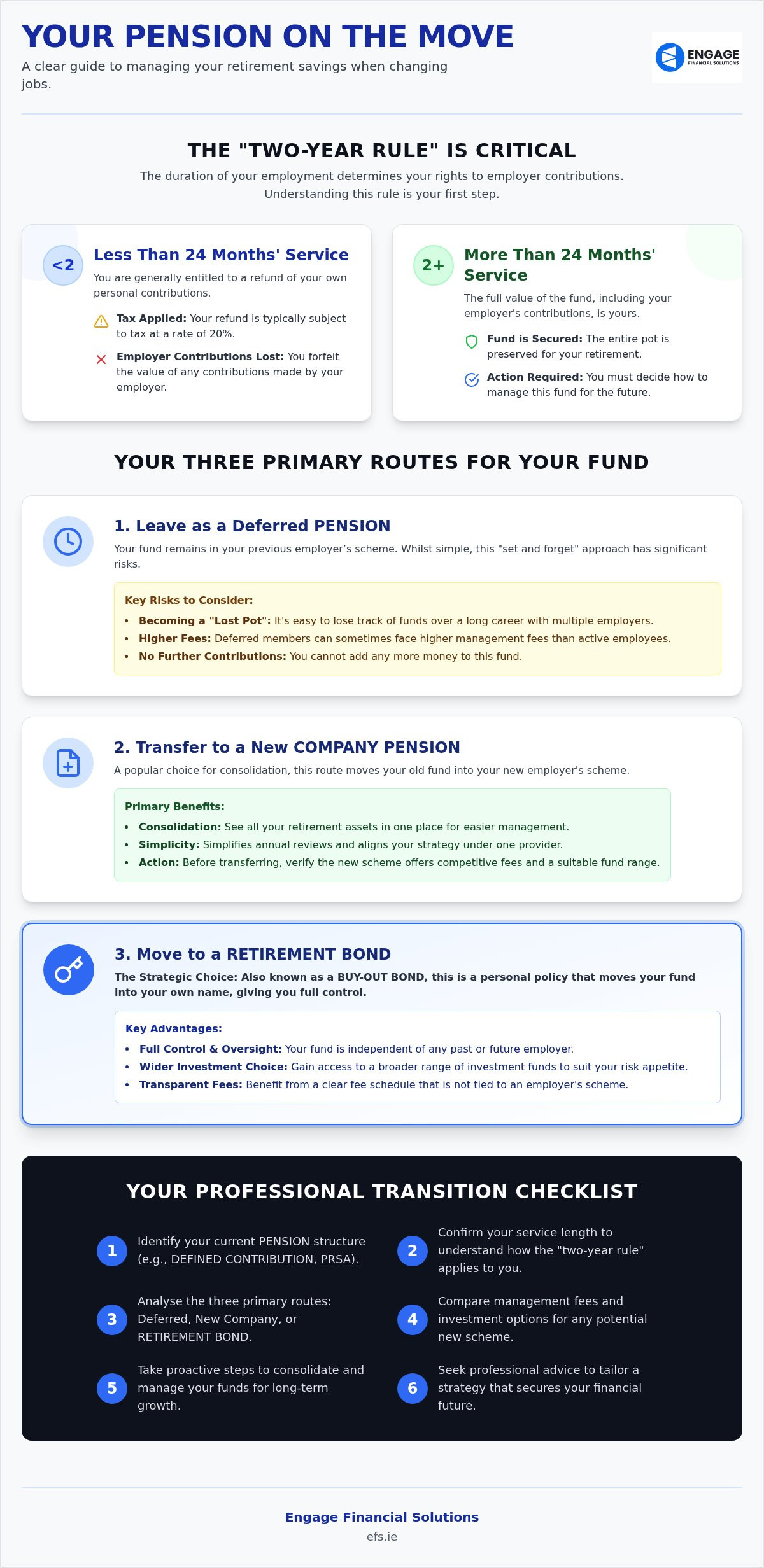
The duration of your employment is a critical factor in determining your rights to the employer’s contributions. Under current regulations, a two-year vesting period applies to most occupational schemes. If you have less than 24 months of qualifying service, you’re typically entitled to a refund of your own personal contributions. Keep in mind that these refunds are subject to tax, usually at a rate of 20%, and you’ll lose the value of any contributions your employer made. Once you surpass the 24-month mark, the full value of the fund becomes yours to keep, though it must remain within a recognised retirement structure until you reach retirement age.
Identifying Your Specific Retirement Structure
Before choosing a path, you must identify whether you’re contributing to a DEFINED CONTRIBUTION scheme or a DEFINED BENEFIT arrangement. Most modern private-sector workers have a DEFINED CONTRIBUTION plan, where the final pot depends on investment performance. You should also check if your fund is a standard COMPANY PENSION or a PRSA (PERSONAL RETIREMENT SAVINGS ACCOUNT). This distinction is vital because a PRSA often offers greater portability if you move between jobs frequently. Identifying your current structure is the first step in ensuring a seamless transition. By understanding these foundations, you can better navigate the Irish pension system and protect your hard-earned savings for the long term.
The Three Primary Routes for Your Accumulated Fund
Once you understand your vesting rights, you must decide the fate of your savings. Your fund doesn’t have to stay with your old employer. Understanding what happens to my pension when I leave a job involves evaluating three main paths:
- Retaining a deferred pension within your previous employer’s scheme.
- Consolidating your funds by transferring them to a new COMPANY PENSION.
- Moving the assets into a personalised RETIREMENT BOND.
Each route offers different levels of control, growth potential, and administrative ease. Active management is essential at this stage to ensure your fund continues to align with your personal risk appetite and long-term retirement goals.
Leaving Your Fund in a Deferred State
You might choose to leave your money exactly where it is. This is known as a deferred pension. Your fund stays in the previous scheme and continues to be managed by the existing trustees. Whilst the money remains invested and can still grow, you can’t add any more to it. This “set and forget” approach carries significant risks. Over a long career, it’s easy to lose track of multiple small pots, especially if you change address or if the previous company merges. Additionally, deferred members sometimes pay higher management fees than active staff, which can quietly eat into your final retirement pot over several decades.
Transferring your old fund into your new employer’s COMPANY PENSION is a popular alternative for those who prefer consolidation. This makes it much easier to see all your retirement assets in one place. It simplifies your annual reviews and ensures your entire retirement strategy is managed under a single investment philosophy. Before choosing this route, you should verify that the new scheme offers competitive fees and a suitable range of investment funds.
The Strategic Advantage of a RETIREMENT BOND
A RETIREMENT BOND, also known as a BUY-OUT BOND, offers a more proactive alternative. This is a personal policy that moves your fund out of the employer’s scheme and into your own name. It’s an excellent choice for professionals who want to take their fund out of their former employer’s control while maintaining full oversight. By moving a COMPANY PENSION into a bond, you gain access to a wider range of investment funds and a transparent fee schedule that isn’t tied to your old employer’s group rates. This structure ensures your retirement assets are portable and easy to manage as you move through different career stages.
According to The Pensions Authority, staying informed about your transfer options is vital for your financial health. Taking the time to review your options now prevents your savings from becoming stagnant or lost. If you’re looking for a way to streamline your finances, a professional consultation can help you decide which route aligns best with your future security.
Navigating PRSAs and Personal Retirement Options
A PERSONAL RETIREMENT SAVINGS ACCOUNT (PRSA) is specifically engineered for the realities of the modern, mobile workforce. Unlike traditional occupational schemes where the employer holds a degree of control, a PRSA belongs to you personally. It is an individual contract between you and the provider, meaning it isn’t tied to a specific employment agreement. This ownership model provides a straightforward answer when you wonder what happens to my pension when I leave a job Ireland. Your fund remains under your stewardship, allowing for a seamless transition whether you’re moving to a competitor, becoming a contractor, or taking a career break.
Maintaining momentum in your retirement planning is essential, especially during times of professional change. Engaging in professional retirement planning ensures that your PRSA is performing optimally and aligned with your broader financial aspirations. This proactive approach helps you safeguard your future whilst navigating the complexities of different employment structures. By treating your pension as a lifelong asset rather than a job-specific perk, you ensure consistent growth regardless of your employer.
Portability: The Core Strength of the PRSA
Over a multi-decade career, it’s common to accumulate several different pension schemes from previous roles. Managing these individual pots is an administrative headache, often leading to “lost” funds or overlapping management fees. Consolidating these assets into a single PRSA or RETIREMENT BOND simplifies your financial life and gives you a clear, holistic view of your retirement assets. Broken service periods can lead to fragmented savings that underperform; however, consolidation ensures every euro is working toward a unified goal. By bringing your pots together, you gain better oversight and can more easily adjust your investment strategy as you approach retirement. This straightforward process removes the stress of dealing with multiple HR departments and ensures your long-term security is never left to chance.
Your Professional Transition Checklist
Handing in your notice is a significant milestone that requires both emotional and administrative preparation. To understand what happens to my pension when I leave a job, you must move beyond general assumptions and gather concrete data. A structured approach ensures that your hard-earned savings don’t become stagnant or lost in the shuffle of a career change. By following a clear checklist, you can maintain the momentum of your retirement growth and transition with total peace of mind.
- Step 1: Contact your previous HR department or scheme trustees immediately to request your “Leaving Service Options” statement.
- Step 2: Scrutinise the current management fees and investment performance of your deferred fund to identify any hidden costs that could erode your savings.
- Step 3: Consult with a financial advisor to compare the benefits of your existing scheme against a new COMPANY PENSION or a personalised RETIREMENT BOND.
- Step 4: Organise all necessary documentation, including your P60 and scheme member number, to facilitate a seamless transfer and maintain clear visibility of your assets.
Analysing Your Options Statement
Your options statement is the most important document in this process. You need to identify two primary figures: the Transfer Value, which is the current cash value of your pot, and the Preserved Benefit, which is the value if you leave it in the current scheme until retirement. Be mindful of the decision deadline; if you don’t act within a specific timeframe, the fund often defaults to a deferred state. You should also check how your “Death in Service” benefits will change. Once you leave an employer, you typically lose the life cover associated with that role, which may necessitate a review of your personal income protection or life insurance arrangements whilst you are between roles.
Reviewing Fees and Performance
Many professionals overlook the impact of Annual Management Charges on small, forgotten pots. Over twenty or thirty years, a high fee can significantly erode your final retirement pot. You should also determine if the investment strategy of your old scheme still suits your current age and long-term goals. A strategy that worked in your twenties might be too aggressive, or perhaps too conservative, for your current stage of life. If you want to ensure your funds are working as hard as possible, it’s time to speak with a retirement specialist who can help you organise your assets into a single, high-performing structure.
Securing Your Future with Tailored Retirement Advice
At Engage Financial Solutions, we act as the buffer between you and the complexities of pension regulations. Our goal is to provide a straightforward path to financial security, ensuring no part of your hard-earned savings is left behind. Deciding what happens to my pension when I leave a job is a significant moment that requires more than just a cursory glance at a statement. We specialise in tailoring retirement structures that evolve with your career milestones, ensuring your assets remain protected and productive. Taking action today ensures that your transition is a step toward long-term success rather than a source of stress.
Why Expert Guidance Ensures a Seamless Transition
The value of an independent review of your total retirement portfolio cannot be overstated. When you move between roles, it’s easy to view each pension pot as an isolated account. We take a holistic view, examining how your previous COMPANY PENSIONS, current PRSAs, and potential RETIREMENT BONDS work together to meet your ultimate objectives. By looking at the big picture, we identify overlaps in investment strategies or inefficiencies in fee structures that might otherwise go unnoticed. This methodical approach ensures that every decision you make is backed by professional insight and a clear understanding of the current market landscape.
We also handle the administrative heavy lifting that often makes pension transfers feel like a burden. Dealing with previous HR departments, scheme trustees, and various providers can be time-consuming and frustrating. Our team manages these communications on your behalf, navigating the paperwork to ensure a seamless transfer of funds. This proactive stewardship removes the friction from the process, allowing you to focus on your new role whilst we safeguard your future. The peace of mind that comes from knowing your transition is being handled with calm competence is an invaluable asset during a career change.
Organising Your Long-Term Financial Success
True financial security comes from moving away from product-driven choices and toward a goal-driven retirement strategy. Instead of simply collecting different schemes, you should be prioritising a structure that offers flexibility and transparency. Whether you choose to consolidate into a single PRSA or move funds into a RETIREMENT BOND, your decisions should be guided by your specific lifestyle aspirations. Having a single point of contact for all your retirement assets simplifies management and ensures you always have clear visibility of your progress. This streamlined approach makes it much easier to adjust your strategy as you reach new professional heights.
Your pension is not just a collection of numbers; it’s the foundation of your future stability and optimism. By taking control of your accumulated funds now, you’re building a mobile engine for wealth that follows you wherever your career leads. We’re here to ensure that your path to retirement is straightforward, secure, and perfectly tailored to your individual needs. When your financial structures are well-managed and logically organised, you can look forward to the future with total confidence.
Take Control of Your Retirement Journey
Navigating a career change is an exciting milestone, yet it shouldn’t come at the expense of your future security. By proactively managing your leaving service options, you ensure that every contribution you’ve made continues to work toward your long-term goals. Whether you choose to consolidate multiple pots into a single PRSA or move your assets into a personalised RETIREMENT BOND, the key is maintaining clear visibility and control over your hard-earned savings.
Understanding exactly what happens to my pension when I leave a job is the first step toward a seamless financial transition. At Engage Financial Solutions, we’re regulated by the Central Bank and specialise in bespoke guidance tailored to your unique career path. We handle the administrative complexities of fund consolidation, removing the friction from your RETIREMENT PLANNING so you can focus on your next professional challenge whilst we manage the technical details.
Secure your retirement transition with Engage Financial Solutions. With the right stewardship, your career move can be a powerful step toward a stable and optimistic future.
Frequently Asked Questions
Can I take my pension as a cash lump sum when I leave my job?
Generally, you cannot access your retirement fund as a cash lump sum until you reach retirement age, which is typically 50 or older depending on your specific scheme rules. However, if you have less than two years of qualifying service, you might be eligible for a refund of your own contributions. This refund is subject to tax at 20%. It’s vital to seek professional guidance before choosing a refund, as it may impact your future security.
What exactly is a RETIREMENT BOND?
A RETIREMENT BOND, also known as a BUY-OUT BOND, is a personal policy designed to house the value of a previous COMPANY PENSION. It allows you to take your fund out of your former employer’s scheme, giving you greater control over investment choices and management fees. This is a popular choice for professionals who want to consolidate multiple pots into one manageable structure whilst maintaining growth potential and full visibility of their assets.
What happens if I have less than two years of service?
If you leave a job with less than two years of qualifying service, you may not be entitled to the employer’s contributions. You usually have the choice of receiving a refund of your own contributions, which is taxed at 20%, or transferring the value to a PRSA or a new scheme. This is often a critical factor when people ask what happens to my pension when I leave a job. The specific rules depend on the scheme structure.
Can I move my pension to another country if I emigrate?
Yes, it’s often possible to transfer your savings to an offshore arrangement, provided the receiving scheme meets specific Revenue requirements for an Overseas Transfer. This process requires meticulous documentation to ensure compliance with local regulations and to safeguard your funds. Professional advice is strongly recommended to navigate the complexities of international transfers and avoid unnecessary tax penalties or delays that can occur during the move, ensuring your assets remain secure.
How do I find a lost pension from a previous employer?
To track down a lost pension, you should first contact the HR department of your former employer or the scheme trustees. If the company no longer exists, you can search for the scheme through the Pensions Authority using your PPS number and employment dates. Once located, consolidating these funds into a single RETIREMENT BOND can prevent them from being lost again and provides a much clearer picture of your total retirement wealth.
Do I have to move my pension immediately after leaving?
No, there’s no immediate requirement to move your fund. If you do nothing, your savings will typically remain in the existing scheme as a deferred benefit. You should receive an options statement within a few weeks of leaving, which outlines what happens to my pension when I leave a job. Whilst there’s no rush, reviewing your options early ensures the fund is invested correctly and that high fees aren’t eroding your potential.
Disclaimer
Engage Financial Services LTD T/A Engage Financial Solutions is regulated by the Central Bank of Ireland CRO 764570. Director David Moore. Suite 2 First Floor, 14 -18 Main street, Blackrock, Co Dublin A94 W0Y3