


Don’t leave your life insurance cover on autopilot. Reviewing your life insurance cover makes sense after a significant life change and at least every three to five years. A review helps you check whether your protection still fits your financial responsibilities and what you can afford.
It’s understandable to want reliable cover without paying for protection that no longer suits your needs. Marriage, having children, buying a home, changing jobs or approaching retirement can all change what you need. Indexation may also affect premiums and benefits over time. This article explains when to revisit your cover, what to consider as your circumstances change and why stopping premiums requires careful thought. You’ll also learn how an adviser can help you compare your policy with your current commitments and make an informed decision.
Key Takeaways
- Revisit your policy after major changes in your family, finances or work, and compare its protection with your current responsibilities.
- If you have unit-linked whole-of-life cover, understand when reviews may affect premiums and how the policy fund relates to ongoing cover.
- Before stopping payments, find out what could happen to your policy and cover, particularly if charges are taken from a fund.
- Look at indexation alongside your budget: increasing cover can also change the premiums you pay.
- Include workplace benefits such as Death in Service or Income Protection in your review, especially after changing jobs.
When Should You Review Your Life Insurance?
For a qualifying Section 72 policy, proceeds used towards relevant inheritance tax are exempt from tax on the inheritance and excluded from its tax calculation, according to the Irish Statute Book. The sum insured is not part of the estate unless it exceeds the tax liability. This makes the policy’s purpose and amount important points to revisit as inheritance plans change.
Review your policy after a new loan, a mortgage repayment, or a change in income. For example, a policy chosen when you earned €35,000 may no longer provide the same fit if your income later rises to €70,000 or €100,000. Consider whether your household could maintain its standard of living if you died, or couldn’t work because of illness or injury. Include workplace benefits such as Income Protection in the wider assessment.
Policy structure matters too. A single-life policy covers one person, while a joint-life policy covers two; consider whether the cover still serves its purpose for both people. Check the policy term, the amount payable, and who would benefit. If children are included through extra benefits, check the terms: some policies cover children under 18 or 21. Their needs may change as they become financially independent.
Unit-linked whole-of-life policies need particular attention. Reviews typically take place after ten years, then every five years, and yearly after a certain age. Premiums may increase at these reviews. The policy’s fund value isn’t guaranteed and may not cover the insurance for the insured person’s whole life. Check the review schedule and how fund performance affects your cover.
Compare that with a Section 72 whole-of-life policy, whose premiums remain the same because it isn’t subject to review. The policy is designed to pay inheritance tax when the insured person dies. For qualifying proceeds applied to relevant inheritance tax, the Irish Statute Book explains the tax treatment. Revisit the sum insured if your inheritance tax planning changes.
Don’t cancel an existing policy until a replacement has been accepted and is in force. A new application may include health questions about changes such as illness, smoking or lifestyle. Compare the terms, premium, exclusions and benefits before deciding. A review can show whether your cover is too high, too low or still suited to your responsibilities.
Reviewing life insurance as family circumstances change
Marriage, a new child, buying a home or retiring can change who depends on your income. Review your life insurance when your family responsibilities or household finances change.
Improved health and premium changes
A healthier lifestyle may help you qualify for lower premiums when applying for cover. Quitting smoking, losing weight or making other health changes can affect how an insurer assesses a new application. This may matter if your circumstances have improved since you arranged your cover, but a change in health doesn’t automatically alter an existing policy’s terms.
Compare any new offer with your current policy’s benefits and conditions before deciding. A lower premium, for example, may come with a different term or level of cover. Consider the protection as a whole, not just the monthly payment.
Adjusting cover as needs change
Adjusting cover means matching the amount and duration of protection to your family’s current financial commitments. A new mortgage, a change in income or a child starting college can alter how much support your household might need. As children become financially independent, some expenses may no longer need to be covered.
List the people who rely on your income, regular household costs, outstanding borrowing and future commitments. Compare these needs with the benefit and remaining term of your existing policies. This can help you see whether your cover remains suitable or your responsibilities have reduced.
Family circumstances can change gradually. Revisit your list after a major event, such as a separation, job change or preparation for retirement. Include workplace benefits when assessing what your household could rely on.
Cover for mortgage and family expenses
To estimate the cover you need, add your outstanding mortgage and other debts to the family expenses you want to protect. Then account for savings, existing life insurance benefits and other resources available to your household. This gives you a practical starting point for assessing the financial gap, rather than relying on one figure for every family.
For family expenses, consider childcare, household bills and education costs, alongside how long dependants may need financial support. A family with young children may have different needs from one whose children are financially independent. Recalculate after mortgage repayments or income changes, and consider whether Mortgage Protection planning fits the home loan separately from wider family cover.
What happens if you stop paying premiums?
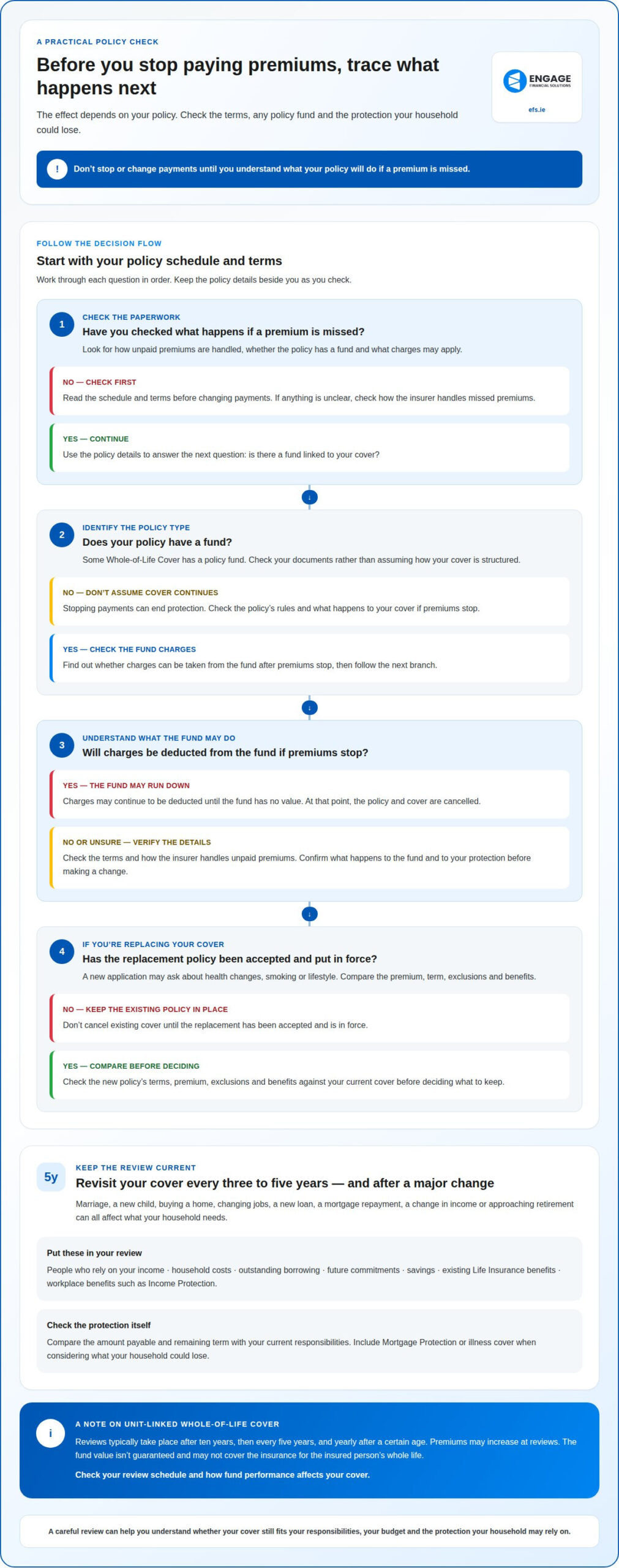
Stopping payments can end your protection, but the outcome depends on the policy type. With whole-of-life cover, an insurer may deduct charges from the policy fund after premiums stop. Those deductions can continue until the fund has no value, at which point the policy and cover are cancelled. Missing payments can therefore affect both the fund and the protection intended for your family.
Before changing payments, read your policy schedule and terms to understand what happens if you miss a premium. Check whether the policy has a fund, what charges may apply and how the insurer handles unpaid premiums. If the cover includes Mortgage Protection or illness cover, factor in the possible loss of that protection when weighing household expenses against affordability.
Review your cover periodically and whenever a major change affects your finances. A general review every three to five years can help you reassess the amount, term and cost. Unit-linked whole-of-life policies also have scheduled reviews: premiums may be reviewed after ten years, then every five years, and yearly after a certain age. These dates matter because premiums may increase, even if the original payment seemed manageable.
Whole-of-life premiums can be affected by the policy’s structure and fund value. If the fund falls short of covering ongoing insurance costs, maintaining the cover may become more difficult. Review the terms alongside your budget and consider whether the benefit still matches the financial need it was intended to meet.
Fixed-term cover works differently. Some policies set premiums for the agreed term, such as a term of 10, 20 or 30 years, or until a set age such as 70. Where the policy terms specify fixed premiums, payments remain at that amount during the agreed term. Check the schedule for the premium basis and term, rather than assuming every policy follows the same arrangement.
If a premium increases, compare it with your budget and the protection it provides. Consider whether the cover still reflects outstanding borrowing and your dependants’ needs, or whether another level would better fit your commitments. Reducing cover may lower payments, but it also reduces the benefit. Don’t stop paying until you understand the effect on the policy and any linked fund. A careful review can help you weigh affordability against the consequences of losing cover.
Indexation and its effect on premiums and benefits
Indexation is a policy feature that can increase your cover over time, often in line with inflation. If your benefit rises, your premium may rise too. Check your policy documents to see whether increases apply automatically, how they’re calculated and whether you can decline them. This helps you weigh the additional protection against your budget.
An indexed benefit, for example, may help keep a lump sum aligned with future household expenses. But a higher premium could compete with savings or other commitments. Compare the latest benefit and payment with the original figures in your policy schedule. Consider whether the increased cover still matches your mortgage, income and dependants’ needs, rather than accepting an increase without understanding its effect.
Some life and protection policies also include additional benefits, such as cover for children under 18 or 21. These extras can have specific conditions and may not replace dedicated cover for serious illness. Read the policy wording to understand what events qualify, who is covered, and whether the benefit is included without an additional premium. A marriage or new child can be a prompt to revisit those details.
Check your beneficiary details after changes in family life. Confirm who is named to receive the policy benefit and whether the details still reflect your wishes. Marriage, separation or a change in dependants can make an older designation feel out of date. Note the policy name and where its documents are stored, so the relevant people can find them when needed.
Changing jobs can affect workplace protection, including Death in Service or Income Protection benefits. Find out what cover is linked to your current employment and whether it changes when you leave. Compare it with your personal policies, household expenses and savings. Losing a workplace benefit, for example, may leave a different gap in your protection.
Keep your review practical: record the current premium, benefit amount, indexation terms, named beneficiaries and any workplace benefits. Revisit these details after a major life change, such as marriage or changing jobs. If an indexed increase is offered, compare the new premium with your budget and the extra protection it provides. This gives you a clearer basis for deciding whether the policy still supports your financial plans.
Consulting a financial advisor or insurer
A financial adviser can help you assess whether your cover still fits your wider financial plan. Your insurer can explain how a specific policy works, including its terms, benefits and premium changes. These conversations have different purposes: an adviser considers your finances as a whole, while the insurer focuses on your policy contract.
Before speaking with an adviser or insurer, gather your policy schedule, latest premium details and any letters about changes. Summarise your current income, mortgage, household expenses and workplace benefits. For example, a job change may affect Death in Service or Income Protection, so include those details in your review.
Ask your insurer to explain the policy’s review dates, indexation terms and what happens if payments stop. If you have unit-linked whole-of-life cover, ask how the fund value affects the cost of keeping the cover in place. Request an explanation of any proposed premium increase and the benefit it supports. Clear answers help you compare the policy’s current value with your needs.
A financial adviser can help you consider several policies and responsibilities together. They can assess whether your cover overlaps, leaves a shortfall or still reflects your dependants and debts. If you’re considering a replacement, compare the benefits, exclusions, premium basis and term. Don’t cancel existing cover until a replacement policy has been accepted and is in force.
Ask whether the recommendation considers your wider financial plan, not just the life insurance benefit. A family with a mortgage, children and workplace protection, for instance, has several factors to weigh. An adviser can help you consider those commitments together. For those seeking independent guidance across UK mortgage and protection products, Lee Tonks: Mortgage Guru provides specialist advice to help navigate these choices. Before making a change, make sure you understand what you gain, what you give up and how the payments fit your budget.
Use the conversation to agree on a practical review point. A review every three to five years, or after a major life change, can help keep decisions current. Bring any new policy documents to that discussion, and note down the actions you decide to take. If you’re ready to organise your next steps, review your financial arrangements with Engage Financial Solutions with a clear picture of your existing cover and priorities.
Experts recommend reviewing your life insurance cover every 5 – 10 years when **reviewing your life insurance cover**. In Ireland, consider whether children have finished college and become financially independent; review after marriage, having children, buying a home or preparing for retirement.
Engage Financial Solutions: Income Protection
Engage Financial Solutions can help you consider Income Protection as part of your wider protection needs. Life insurance provides a benefit after death, while Income Protection can support you if illness or injury prevents you from working. They cover different risks, so consider both alongside your mortgage payments, household expenses and workplace benefits.
If your review highlights a gap between your income and the support available if you can’t work, this may be a useful next step. Bring a summary of your current policies, income needs and family commitments to make the discussion focused. For support with your protection needs, you’re invited to contact Engage Financial Solutions.
Make your next financial decision with confidence
A useful next step in reviewing your life insurance cover is to consider it alongside your wider financial plans. Your protection should fit with decisions about your home, income and long-term goals, rather than being considered in isolation. If moving or buying a property is part of your plans, Engage Financial Solutions also offers Switching Mortgages, First-time Buyer Mortgages and Buy-to-let Mortgages.
Before making changes, gather your policy documents and note the questions you want answered. A focused conversation can help you understand how your protection fits with other commitments and what you want your finances to support next. Take the next step at your own pace, with a clearer view of the choices ahead.
Contact Engage Financial Solutions to discuss your financial plans and the support that may suit your circumstances. A considered decision today can help you move forward with greater clarity and confidence.
Frequently Asked Questions
How long does a life insurance policy last?
The policy lasts for the term set out in its schedule. Term Life Insurance may cover a fixed period, such as 10, 20 or 30 years, or run until a set age such as 70. Whole-of-Life Cover is designed to last for life, but a unit-linked policy’s fund value isn’t guaranteed to support cover throughout. Check the policy end date and payment terms in your documents.
Can someone help me make a decision?
Yes. A financial adviser can help you assess how protection fits your wider financial plans, while your insurer can explain the terms of a particular policy. To make the discussion more useful, bring your policy schedule, current premium details and a list of your main financial commitments. Ask for any recommended changes to be explained in terms of both the benefit and what you would give up.
What is a policy review?
A policy review assesses whether your cover, premium and policy conditions still suit your needs. It doesn’t automatically change the contract. For example, you might compare the benefit with your current financial commitments, then identify questions about exclusions or the policy term. Before deciding what to do, make a written note of any proposed changes and the reasons for them.
What types of life insurance cover can you choose?
Common options include Term Life Insurance, Whole-of-Life Cover, single-life or joint-life cover, Mortgage Protection and Section 72 Whole-of-Life policies. They serve different purposes: Term Life Insurance lasts for an agreed period, while a Section 72 Whole-of-Life policy is designed to help pay inheritance tax. Compare what triggers a payment, who is covered and how long protection lasts before choosing a structure.
When should you review your life insurance cover?
Review your cover after a major life change, such as marriage, a new child, buying a home or changing jobs, and at least every three to five years. Reviewing your life insurance cover at these points helps you account for new commitments or reduced expenses. Add a reminder to your calendar after a major event, so the review doesn’t get lost among other financial tasks.
How much life insurance cover do you need?
Estimate the financial support your household would need, then compare it with the resources already available. Include outstanding borrowing, essential family expenses and the income your dependants rely on. Consider existing policies, savings and workplace benefits to avoid counting the same support twice. For example, if your mortgage is covered separately, assess ongoing household costs and other debts.
Can you change your cover after taking out a policy?
You may be able to change your cover, depending on your policy terms. Ask your insurer how a change would affect the benefit, premium, term and conditions. A request for additional cover may involve a new application and health questions. An insurer can’t increase your premium or reduce your cover because your health changes after the policy starts.
What happens to premiums and cover if you switch policies?
A replacement policy has its own terms, premium and benefit, so compare the full details rather than just the payment. A new application may involve health questions, and its conditions may differ from your existing contract. Don’t cancel your current cover until the replacement has been accepted and is in force. This helps avoid a gap while you change policies.
Disclaimer
Engage Financial Services LTD T/A Engage Financial Solutions is regulated by the Central Bank of Ireland CRO 764570. Suite 2 First Floor, 14 -18 Main street, Blackrock, Co Dublin. A94 W0Y3