


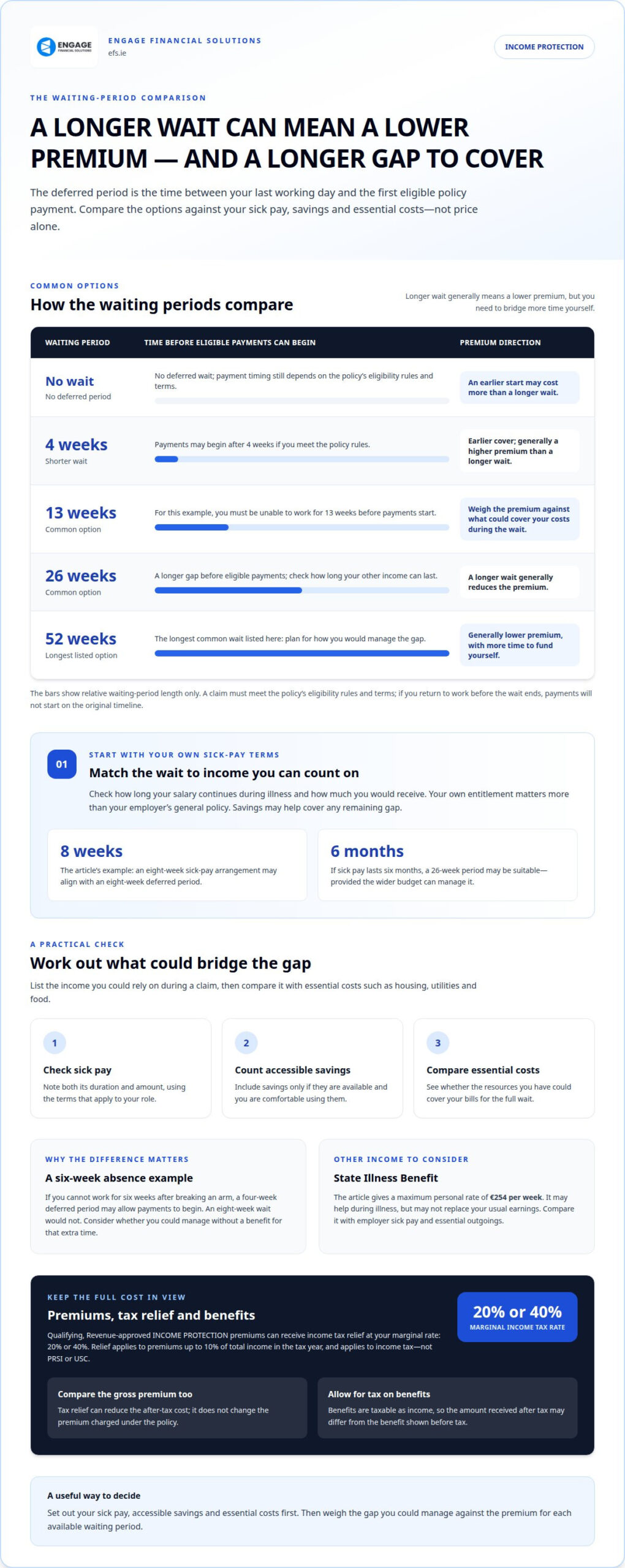
A longer income protection waiting period generally means a lower premium, but it also means waiting longer before payments begin if illness or injury stops you working. Common income protection waiting period options include 4, 13, 26 and 52 weeks, although some policies may have no waiting period. The right fit depends on how you would manage your essential costs during the gap.
It makes sense to weigh the premium carefully. Paying less each month can be appealing, but relying on savings for longer may not feel comfortable. Your employer’s sick pay can also affect how soon you need cover to begin.
This guide explains what an income protection waiting period means, how it can affect premiums and how to weigh it against sick pay and savings. You’ll find practical ways to compare the options and choose a period that supports your financial stability.
Key Takeaways
- Understand how the deferred period sets the gap between stopping work and receiving income protection payments.
- Weigh a lower premium against how long you could manage without policy payments.
- Factor in your employer’s sick-pay arrangements before choosing when cover should begin.
- Use your essential costs and accessible savings to assess how much of a waiting period you could absorb.
- Learn why changing the waiting period on an existing policy can involve reapplying and underwriting.
What Is an Income Protection Deferred Period?
The deferred period is the gap between your last working day and the first income protection payment. It is not an exclusion in itself, but a claim must meet the policy’s eligibility rules and terms.
For example, with a 13-week deferred period, you must be unable to work for 13 weeks before payments start. That timing affects how long you may need to cover costs such as your mortgage from other income, sick pay or savings.
Deferred periods and premium costs
A deferred period is the time you wait before eligible income protection payments can begin. A longer period generally reduces the premium because the policy is less likely to pay for a shorter absence. The trade-off is that you need another way to cover your outgoings during the longer gap. Weigh the premium against your monthly budget rather than automatically choosing the longest period.
Income protection policies commonly offer periods of 4, 13, 26 or 52 weeks. Some may have no deferred period. A four-week period may provide an earlier start, while a 26-week period may cost less. The appropriate balance depends on how long you could manage without policy payments and whether other income would bridge the wait.
Aligning cover with sick pay and savings
Matching the deferred period to employer sick pay means choosing a wait that broadly reflects how long your salary continues during illness. This can help avoid paying for an earlier start than you need, while savings can cover any remaining gap. For example, an eight-week sick-pay arrangement may align with an eight-week deferred period.
Public sector group schemes usually align deferred periods with employees’ sick leave entitlements. If your sick pay lasts six months, a 26-week period may be suitable. Your own entitlement matters more than the employer’s general policy, so use the terms that apply to your role and consider whether savings can cover essential bills if sick pay falls short.
The difference between waiting periods can determine whether a shorter absence leads to a payment. For example, if you’re unable to work for six weeks after breaking an arm, a four-week deferred period may allow payments to begin, while an eight-week period would not. This shows why a lower premium needs to be weighed against how long you could manage without a benefit.
State support may also form part of your income during illness, but it may not replace your usual earnings. The maximum personal rate of State Illness Benefit is €254 per week, according to the Department of Social Protection. Compare that amount with your essential outgoings and any employer sick pay when considering how long savings may need to last.
To assess the gap, list the income you could rely on during a claim and compare it with essential costs such as housing, utilities and food. Include savings only if they’re accessible and you’re comfortable using them. If these resources could cover a longer wait, you may be able to consider a longer deferred period and its generally lower premium. If not, an earlier payment start may better suit your financial position.
Factors affecting premiums
Your premium reflects the cover selected and the risk the insurer is pricing. The deferred period is one factor: a longer wait generally reduces premiums because payments begin later. When comparing income protection waiting period options, weigh the lower premium against how long you’d need to rely on other income. A shorter wait may mean a higher premium, but less time bridging the gap yourself.
If you return to work before the deferred period ends, payments won’t start on the original timeline. If you’ve partly recovered, the insurer assesses whether you still meet the policy’s definition of incapacity and its claim rules.
Other details can affect the premium, including your age, health, occupation, income and amount of cover. An occupation involving physical tasks can present different risks from desk-based work. The share of your income you want to protect, the policy’s benefit period and the age at which cover ends, such as retirement, also shape the policy. For comprehensive guidance on balancing these policy variables, firms like MyGen Insurance Brokers provide tailored risk management to ensure your coverage aligns with your personal and professional circumstances, rather than focusing on the waiting period alone.
Tax relief on premiums
Qualifying Income Protection premiums can receive income tax relief at your marginal rate, meaning the income tax rate that applies to your next portion of income, either 20% or 40%. Revenue-approved premiums qualify for relief on premiums up to 10% of total income in the tax year. This relief applies to income tax, not Pay Related Social Insurance (PRSI) or the Universal Social Charge (USC), which are separate deductions from income.
These examples show why your tax position matters when estimating the effective cost, but compare the policy’s gross premium too. Tax relief reduces the after-tax cost; it doesn’t change the premium charged under the policy.
Benefits are taxable as income. Factor this in when considering how much of your earnings a policy could replace: the amount received after tax may differ from the benefit shown before tax. Premium relief and tax on benefits work in opposite directions, so include both in your budget rather than treating relief as the full cost calculation.
To compare the Income Protection waiting period options, set out the gross premium, the tax relief that applies to you and the income gap during the waiting period. Then consider the cover amount, occupation, benefit period and end age alongside the premium. This gives you a clearer basis for weighing shorter and longer waits without judging value by price alone. Income Protection cover can be considered in that wider financial picture.
Matching the waiting period to employer sick pay
Employer sick pay can bridge some or all of the time before income protection payments begin. Compare its duration and amount with your essential costs and other financial resources.
Matching cover to employer sick pay
Matching the waiting period to employer sick pay means choosing a wait that reflects how long your salary continues during illness. This helps you balance the need for earlier cover against the income already available. For example, if your employer pays sick leave for six months, a 26-week deferred period may suit your arrangement.
Look beyond the headline duration. Sick pay may replace only part of your normal income or depend on your employment terms. Set out what you would receive during each stage of an absence, then compare it with housing costs, bills and savings. If employer payments end before the deferred period does, savings may need to bridge the gap.
Waiting periods for illness and accidents
The deferred period is the waiting time applied to a claim, whether you’re unable to work because of illness or an accident. The claim must still meet the policy’s eligibility terms. An accident does not automatically mean a payment starts sooner than it would for an illness.
Consider how your employer’s sick-pay arrangement applies to both situations. If the terms provide the same support for illness and injury, include that income when assessing the waiting period. If payments differ, base your decision on the situation that would leave you with less income.
Statutory Sick Pay and State Illness Benefit are separate sources of support. Employees are entitled to five certified sick days of Statutory Sick Pay per year, paid at 70% of normal daily pay and capped at €110 per day. Include the amount you could receive in your cash-flow estimate, rather than treating it as a replacement for your full salary.
The maximum personal rate of State Illness Benefit is €254 per week, according to the Department of Social Protection. State Illness Benefit is generally paid for a maximum of one or two years, depending on PRSI contributions. It may contribute to your income during illness, but compare it with your actual outgoings and any employer payments.
Tax relief on qualifying premiums affects the after-tax cost of cover, not the deferred-period clock. Social welfare benefits can affect the income available during a claim, so include them when estimating your shortfall.
For a practical comparison, list employer sick pay, potential State support and accessible savings alongside essential expenses. Then identify any gap before policy payments could begin. That shortfall can help you judge whether the waiting period fits your finances.
Choosing a waiting period based on personal savings
Your savings can help show how long you could manage before income protection payments begin. Compare accessible funds with essential costs rather than basing your choice on your total savings balance alone.
Start with money you can access promptly, without selling investments or disrupting plans. Separate funds set aside for a home, retirement or unexpected costs from savings you’re willing to spend during illness. This gives you a more realistic view of the financial buffer available if you’re unable to work.
Next, map that buffer against the waiting periods available. Income protection policies commonly offer 4, 13, 26 or 52 weeks. A shorter period means less time to bridge from savings, while a longer period may leave you relying on them for longer. Consider which timeframe fits your budget, not simply which option has the lowest premium.
For a practical comparison, list your essential monthly costs, such as housing, utilities, food and debt repayments. An illustrative budget might include €2,000 in essential expenditure per month. Then identify income that could continue during an absence, including employer sick pay or Illness Benefit, and estimate the remaining shortfall. Use the shortfall to assess how much of your savings a waiting period could consume.
Keep flexibility in mind. A savings balance can change as bills arise, household income shifts or a planned expense comes due. If choosing a 26-week or 52-week wait would leave little accessible money for other needs, a shorter period may better protect your day-to-day stability. Conversely, a substantial reserve set aside for income disruption may make a longer wait more manageable.
If your earnings vary, consider when income is due to arrive. If work is expected to resume after a short interruption, savings could bridge a temporary gap. But if illness keeps you from earning for longer, a depleted reserve may leave essential payments exposed before cover starts. Test your choice against both a brief absence and a prolonged one.
Try this simple review before settling on a period:
- Write down essential monthly costs and identify payments that cannot be paused.
- Separate accessible savings from money already committed to other goals.
- Account for employer payments and any Illness Benefit you may receive.
- Compare the remaining shortfall with 4, 13, 26 and 52-week waiting periods.
Income protection is intended to provide a portion of your income when illness prevents you from working, not necessarily your full salary. Choose a waiting period that balances an affordable premium with savings you can genuinely rely on, while leaving enough flexibility for other commitments. For self-employed individuals and business owners managing operational cash flow, broader risk management often goes hand in hand; resources from AllCover Insurance Brokers highlight how businesses can safeguard their revenue and key personnel against unexpected disruption.
Can I change the waiting period on an existing income protection policy?
You can seek to change a deferred period, but changing it after your policy starts requires reapplying and going through underwriting again. Underwriting is the insurer’s assessment of an application. The change is not simply an adjustment to a date on your existing policy.
Consider why you want a different waiting period before starting that process. Your employer’s sick-pay terms may have changed, your savings may have grown, or your monthly budget may now favour earlier payments. For example, someone with a 13-week deferred period might want to compare it with a 26-week period after building a larger financial buffer.
Reapplying means the proposed cover is assessed again through the insurer’s underwriting process, so a change is not automatic. Review your current policy alongside any proposed terms, including the deferred period, benefit and premium. This helps you understand what would change before deciding how to proceed.
Prepare a clear picture of your current circumstances. Note your sick pay, accessible savings and essential outgoings, then work out how long you could manage without policy payments. If you’re considering a longer wait to reduce premiums, assess whether your resources could cover the extra gap. If you need payments sooner, consider how that preference fits your budget.
Before making a decision, organise the key details together:
- Your current deferred period and policy terms.
- The revised waiting period you want to consider.
- Your employer sick pay and any expected changes.
- The savings available for essential costs during a gap in income.
- The premium and benefit shown in the proposed terms.
Keep your existing cover in view throughout the review. Don’t assume a requested change has taken effect just because you’ve started an application. Read the documentation describing the proposed terms and effective date, and understand how they relate to your current policy before acting. This helps you avoid basing a decision on an assumed change.
Consider your other financial commitments too. A shorter waiting period may matter if your salary supports a mortgage or other regular payments. A longer one may be more workable if employer sick pay and savings can bridge the gap. Revisit your calculations when your income, expenses or employment arrangements change.
If you’re reviewing your cover, discuss your Income Protection options as part of your wider financial planning.
Engage Financial Solutions: Income Protection
Engage Financial Solutions offers Income Protection to help you consider cover that fits your circumstances. If you’re weighing a shorter waiting period against a lower premium, bring together your employer sick-pay terms, accessible savings and essential outgoings. These details can clarify how long you could manage before payments begin and what level of cover may fit your wider financial plans.
Whether you’re employed or self-employed, your choice should reflect the income and resources available during illness or injury, not just the premium. Contact Engage Financial Solutions to discuss your Income Protection needs and a waiting period that may suit your financial circumstances.
Make your next decision with confidence
Your financial priorities can shift as your household, work and commitments change. Revisit your cover as part of those decisions rather than treating it as separate from your wider plans. Whether you’re switching mortgages, buying your first home or considering a buy-to-let mortgage, think about how protecting your income supports the commitments you’re taking on.
The income protection waiting period options you choose should suit your circumstances today and remain part of a plan you can review as life changes. A conversation with Engage Financial Solutions can help you bring the different pieces together and decide what to consider next.
Arrange a conversation with Engage Financial Solutions and take a considered next step towards greater financial security.
Frequently Asked Questions
How does Income Protection work?
Income Protection can provide ongoing monthly payments if illness or injury prevents you from working and your claim meets the policy terms. It can be relevant whether you’re employed or self-employed, though the income and work details used to arrange cover differ. Unlike savings, which you draw down yourself, policy benefits are paid under the agreed terms. Review how the cover fits alongside your other household finances.
How does an Income Protection claim work?
You notify the insurer that illness or injury is preventing you from working, then provide the claim information and supporting evidence it requests. The insurer assesses your circumstances against the policy’s definition of incapacity and other terms. Keep a record of when you stopped working, relevant medical information and any income continuing during your absence. This can help you give a clear account of your claim.
What is the waiting period on Income Protection insurance?
It’s the time that must pass before eligible benefits can begin. The policy sets the length, and the period is measured from the relevant date specified in its terms, commonly your last working day. For example, with a 13-week wait, payments don’t start before that period has elapsed. Read the policy wording so you understand how it defines the start date and qualifying absence.
What waiting period options are available for Income Protection?
Common choices include 4, 13, 26 and 52 weeks. An 8-week period may also suit some employer sick-pay arrangements, and some policies may have no waiting period. Availability varies across policies, so compare the periods offered alongside the benefit and other terms. A useful starting point is to note when your salary or sick pay would reduce, then see which available period aligns with that change.
How does the waiting period affect Income Protection premiums?
A longer waiting period generally lowers the premium because the policy begins paying later. The difference depends on the cover as a whole, including factors such as occupation, health, age and the benefit selected. For a fair comparison, consider the same benefit amount and policy terms across different waiting periods. Then weigh the premium against how you would manage the longer gap before payments could start.
What is the typical cost difference between 4-, 8-, 13- and 26-week waiting periods?
There isn’t one standard euro saving that applies to every policy. A longer period generally costs less than a shorter one, but the difference depends on personal and policy details, including occupation, health and the amount of cover. Compare like with like: keep the benefit and other terms consistent, then assess each premium against the extra time you’d need to fund yourself.
When does an Income Protection benefit start after a claim?
Eligible benefits can start after the full deferred period has passed and the claim meets the policy terms. Submitting a claim doesn’t itself mean payments begin immediately. For example, a claim with a 13-week wait cannot meet that waiting-period condition before 13 weeks have elapsed. The policy’s wording explains the qualifying date and how the insurer assesses whether your circumstances meet its claim requirements.
How should I choose a waiting period based on sick pay and savings?
Build a simple timeline from your first day away from work. Note when employer sick pay changes or ends, what accessible savings could cover and which essential bills continue. Include any State support you expect to receive, without assuming it replaces your full salary. Compare the resulting shortfall with the waiting periods available and choose a period your finances could reasonably bridge.
Disclaimer
Engage Financial Services LTD T/A Engage Financial Solutions is regulated by the Central Bank of Ireland CRO 764570. Suite 2 First Floor, 14 -18 Main street, Blackrock, Co Dublin. A94 W0Y3