


Yes, you can be refused mortgage protection, but a refusal doesn’t automatically close off your mortgage options. Cover is generally required for a mortgage on your principal private residence under Section 126 of the Consumer Credit Act 1995, although exemptions can apply, including when you can’t obtain insurance. Your lender’s requirements still matter.
A refusal can feel like a major setback, especially when you’re arranging a home loan or protecting a property you already own. An insurer may decline your application or postpone its decision, and each outcome calls for different next steps. Understanding the reason can help you decide whether to correct an error, explore other cover or discuss a waiver with your lender.
This article explains why age, health and other factors may affect an application, how to ask for the insurer’s reasons, and what options may remain after a decline. You’ll also learn when existing life cover could help and how a lender may consider an exemption or waiver, so you can plan your next move with greater confidence.
Key Takeaways
- Mortgage Protection is generally required for a mortgage on your principal private residence, but exemptions can apply, including when you already have enough life cover or cannot obtain insurance.
- Ask the insurer for its reasons for refusal and review whether an error in medical information may have affected the decision.
- A refusal does not rule out every route to cover: another insurer may assess your application differently, particularly if the issue may be temporary.
- A mortgage protection waiver is a decision for your lender, and it is not automatic. Understand what evidence the lender needs when considering your circumstances.
- If age or health has affected your application, find out whether the cancer-survivor code or a postponed application may be relevant before deciding what to do next.
What is Mortgage Protection insurance?
Mortgage Protection is life insurance linked to a home loan. If the insured borrower dies during the policy term, the cover is generally intended to repay the outstanding mortgage. This can help protect a surviving partner or family from having to manage the full loan alone. It does not cover repayments if you cannot work because of illness, disability or redundancy.
For a mortgage on your principal private residence, Mortgage Protection is generally required under the Consumer Credit Act 1995. Section 126 sets out the requirement and its exemptions. In practice, the lender usually needs evidence of suitable cover before the mortgage can proceed. The policy’s cover and term are normally matched to the mortgage. For example, a €250,000 mortgage over 30 years could need cover for that amount and period.
The requirement is not universal. You may be exempt if the loan is not secured on your principal private residence, or if you already have enough life insurance to repay the home loan. Existing cover must not already be assigned to another loan. The policy and mortgage details matter: insufficient cover cannot repay the full balance. A broker can help you understand how existing life insurance relates to your lender’s requirements.
Other recognised exceptions include being over 50, buying a property as an investment, or being unable to obtain insurance. A serious current illness or dangerous job may make cover unavailable. These circumstances can support a request for the lender to waive the requirement, but an exemption under the law does not force a lender to approve the mortgage without cover. Some lenders may still make Mortgage Protection a condition of lending.
- Principal private residence: Mortgage Protection is generally required for a home loan on your main residence.
- Investment property: The legal requirement does not apply in the same way when the mortgage is not on your principal private residence.
- Existing life cover: Sufficient cover may meet the need if it is available to repay this mortgage.
- Unable to obtain cover: You may seek an exemption when insurance is unavailable, but the lender’s decision remains relevant.
Mortgage Protection is different from Mortgage Repayment Protection. The latter is usually optional and may cover repayments for policy-defined events, such as accident or redundancy. It typically covers mortgage payments for 12 months. If your concern is losing income through sickness or disability, life cover alone will not replace those earnings. Understand which risk each policy addresses before relying on it. The cheapest option is not automatically suitable if its cover, term or insured borrowers do not match the loan.
Requesting and reviewing the insurer’s reasons for refusal
A refusal is a reason to clarify what affected the decision, not simply a final answer to accept without review. Start by asking the insurer for its reasons and checking the medical information behind its assessment.
Reviewing the refusal reasons
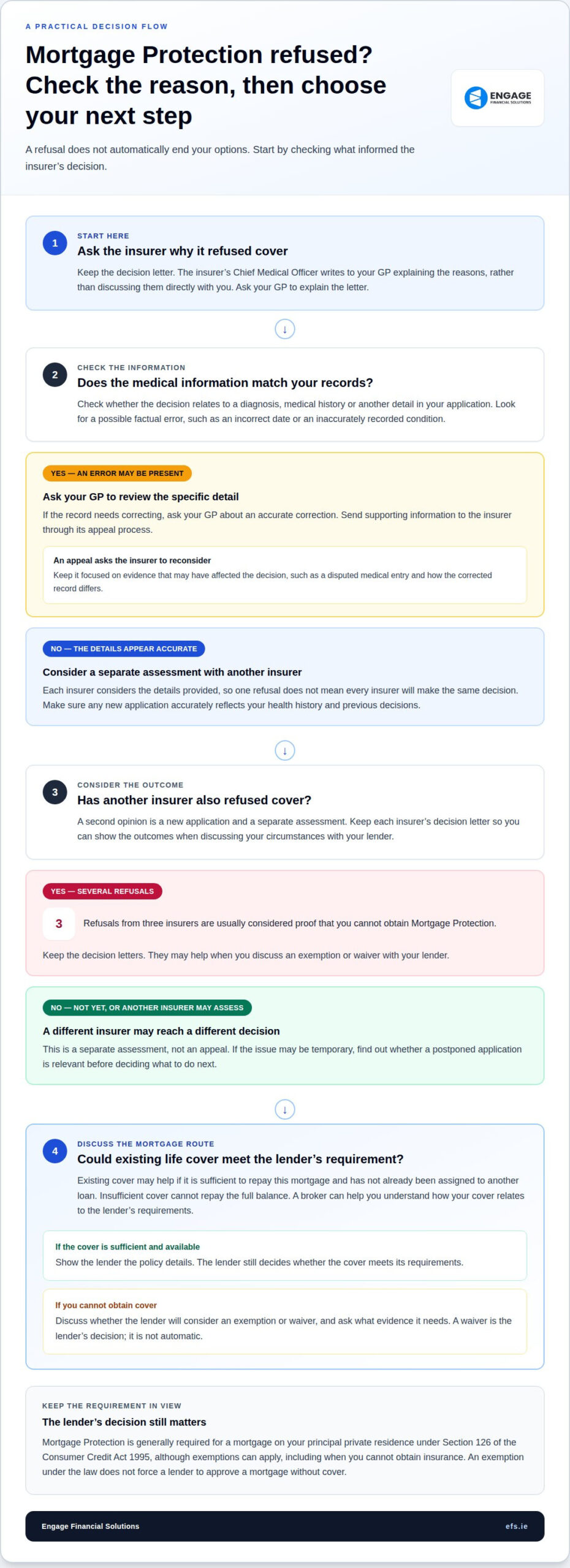
To review the refusal, find out what information led the insurer to decline your application, then check it for errors. You can ask the insurer why it refused cover. In practice, its Chief Medical Officer writes to your GP explaining the reasons, rather than discussing them directly with you. Ask your GP to explain the letter and whether the recorded diagnosis or medical history matches your records.
Keep the insurer’s decision and your GP’s explanation together. Note whether the decision relates to a particular diagnosis, your medical history or another detail in the application. If you spot a possible factual error, such as an incorrect date or an inaccurately recorded condition, ask your GP about correcting the report. Clear information can help you decide whether to appeal or apply elsewhere.
A second opinion means applying to another insurer for a separate assessment. Each insurer considers the details provided, so one refusal does not mean every insurer will make the same decision. However, refusals from three insurers are usually considered proof that you cannot obtain Mortgage Protection. Keep each decision letter: evidence of several declines may help when you discuss an exemption with your lender.
Before seeking another assessment, make sure the new application accurately reflects your health history and previous decisions. Existing life insurance may also help if it provides enough cover and has not already been assigned to another loan. Assignment means the policy is committed to repaying a different debt. The lender needs to see that the policy can cover this mortgage, rather than being relied on twice.
Appealing the insurer’s decision
An appeal asks the insurer to reconsider its refusal using corrected or additional information. It may be relevant if an error in your GP’s report contributed to the outcome. First, ask your GP to review the specific detail and provide accurate information. Then send the supporting correction to the insurer through its appeal process.
Keep your appeal focused on evidence that may have affected the decision. For example, identify the disputed medical entry and explain how the corrected record differs. An appeal is different from asking another insurer for a separate assessment, so consider both routes where appropriate.
Missed premiums and non-disclosure
A missed premium can affect an existing policy: Mortgage Protection may lapse if payments fall into arrears. That differs from a new application being refused. If you’ve missed a payment, find out whether the policy remains active before relying on it for your mortgage. A lapsed policy is not current cover.
Non-disclosure can also matter, particularly if an application leaves out a previous insurance refusal. You must disclose each previous insurance decline on future applications. Give complete, accurate answers about your history, and keep copies of applications and decision letters. If you need to review how cover fits your loan, explore Mortgage Protection options as part of your next steps.
Whether another insurer may offer cover after a refusal
A refusal from one insurer doesn’t necessarily determine what cover you can obtain elsewhere. Another insurer may assess your application differently, while a temporary health issue could make a later review more appropriate.
Start by distinguishing a final refusal from a postponement. If an insurer postpones an application because investigations are ongoing or test results are abnormal, it hasn’t yet made cover available. Where the issue may be temporary, an insurer may review the application after six to 12 months. Ask what medical information or developments would be relevant to a fresh assessment, then keep the response with your application records.
If standard cover is unavailable, the lender may consider whether a different amount or term meets its requirements. For example, it might accept €250,000 of Mortgage Protection for 20 years when you can’t obtain cover for the full mortgage term. In rare cases, a lender may accept a 10-year policy for a 20-year mortgage as a last resort. These examples are possible arrangements, not automatic alternatives. Discuss the remaining uncovered period and mortgage balance with the lender before relying on shorter cover.
Changing the mortgage term can also affect the cover you need. If the insurer can offer protection for a shorter period than your proposed loan, ask whether adjusting the borrowing term could work. A shorter policy would leave a later part of the mortgage without that protection, so compare the proposed cover dates with the loan schedule. The lender’s requirements and your ability to repay the loan remain central to this decision.
Mortgage Protection can cover one borrower or both jointly. For a couple, joint-life, first-death cover is intended to repay the mortgage when the first person dies. If one applicant has difficulty obtaining cover, a lender may sometimes consider a single policy for a joint mortgage. Ask how the available policy treats each borrower and whether its amount and term meet the lender’s conditions.
A cancer history doesn’t automatically rule out every application. The cancer-survivor mortgage protection code has applied since 6 December 2023 and covers applications for insurance cover of up to €500,000. Under the code, insurers can disregard a cancer diagnosis when treatment finished more than seven years ago. If the person was diagnosed under age 18, the period is more than five years. If these conditions match your history, raise the code when discussing an application with an insurer.
Compare the proposed cover with the loan amount, remaining term and borrowers insured. The cheapest protection insurance may not meet the lender’s requirements if its term or cover amount falls short. Ask the lender to explain which adjustment it would consider before changing your borrowing arrangements.
Mortgage Protection waivers and lender discretion
A waiver is a lender’s decision to let a mortgage proceed without the usual life cover. It may be considered when protection is unavailable or far more expensive than normal. A waiver isn’t automatic, and the lender can refuse the request. Being legally exempt from the insurance requirement also doesn’t oblige the lender to approve the mortgage without cover.
Explain the circumstances clearly when discussing a waiver, such as an insurer’s refusal or unusually expensive terms. Give the lender the relevant decision letters and information about the cover available. It can then consider whether your circumstances support proceeding without a policy. Ask what evidence it needs and how its decision affects the mortgage application, repayments and any conditions attached to the offer.
A lender cannot require you to buy Mortgage Protection from that lender. You may use another provider if the policy meets the lender’s requirements. This differs from a waiver: using another provider still means arranging cover, whereas a waiver lets the lender consider lending without it. Ask the lender to set out its required cover amount, term and policy conditions before accepting an alternative.
Some lenders offer group Mortgage Protection linked to their mortgages. The policy belongs to the lender, typically covers only the mortgage, and ends when that mortgage is paid off. You cannot transfer a lender’s group policy to a different lender when switching mortgages. If you plan to switch, arrange new cover before completing the move, as your health may affect its availability or terms.
An employer’s Group Protection may remain available even after an individual application has been declined. However, don’t assume it automatically meets a mortgage lender’s requirements. Find out what cover the employer’s scheme provides and whether the lender will accept it for the particular loan. A lender may also sometimes accept one borrower’s policy for a joint mortgage if the other borrower has difficulty obtaining cover.
Check how a lender’s group arrangement works before relying on it. Under arrangements offered by some banks, only one insurer may be available for an application. That can limit the insurance route offered through that bank, but borrowers aren’t required to buy the lender’s policy. Consider whether an individual policy from another provider meets the lender’s stated conditions.
Before choosing a route, separate three decisions: whether to request a waiver, whether a policy from another provider meets the requirements, and whether group cover applies. Ask the lender which option it will consider and what conditions remain. This helps you understand whether the mortgage can proceed, what protection applies, and how cover could change if you later switch lenders.
Mortgage Protection refusals due to age or health
Yes, an insurer can refuse Mortgage Protection because of age or health information. A postponement is different: it means cover isn’t available yet, often because investigations or test results are outstanding.
Refusals related to age
An age-related refusal means the insurer won’t offer the requested cover under its policy terms, taking the applicant’s age into account. This matters because a mortgage term can extend beyond the period for which an insurer will provide cover. If age is the issue, ask whether a shorter policy term or a different cover amount could be assessed.
Being over 50 is also one circumstance recognised for exemption from the general mortgage protection requirement. That doesn’t automatically secure mortgage approval without insurance. The lender decides whether to proceed, so explain the refusal and ask what options it will consider. If you’re applying jointly, establish whether cover for one borrower could meet the lender’s requirements.
Refusals related to health
A health-related refusal means an insurer has assessed medical information, such as a diagnosis or treatment history, and declined the application. Yes, a health condition can lead to a Mortgage Protection refusal. Ask whether the insurer has refused cover or postponed its decision because tests or investigations are continuing.
That distinction affects your next step. A postponement means the insurer has not yet made cover available, while a refusal is a decline. If results are abnormal or investigations are continuing, ask what information is needed for a future assessment. Keep the insurer’s decision and medical correspondence together so you can explain the position accurately to your lender.
A cancer history has a specific consideration. The cancer-survivor mortgage protection code has applied since 6 December 2023 and covers applications for insurance cover of up to €500,000. Insurers can disregard a cancer diagnosis when treatment finished more than seven years ago, or more than five years ago if diagnosed under age 18. If these timeframes match your history, raise the code during an application or review.
Age or health difficulties can affect a mortgage application as well as insurance. The CCPC advises borrowers refused a mortgage because they cannot get cover due to age or health to raise regulatory concerns with the Central Bank, or complain to the Financial Services and Pensions Ombudsman if they believe the lender treated them unfairly. Keep the refusal, lender correspondence and relevant medical records together.
Before switching mortgages, establish whether new cover is available. A change in health can make cover more expensive or unavailable, even if an existing policy supports your current loan. If you need to arrange or review cover, discuss Mortgage Protection options as part of your next steps.
Engage Financial Solutions: Mortgage Protection
Engage Financial Solutions arranges Mortgage Protection for borrowers seeking cover for a home loan or reviewing protection after a refusal. If an insurer has declined your application, use the information gathered so far to clarify what cover you need and consider your next steps.
The right arrangement depends on factors such as the mortgage amount, term and who needs cover. Engage Financial Solutions can help you consider Mortgage Protection alongside your wider financial needs. If illness or disability could affect your ability to earn, Income Protection may also be relevant, as it addresses a different risk from life cover.
Bring the insurer’s decision and the lender’s requirements into the conversation so your options can be considered in context. Contact Engage Financial Solutions to discuss your Mortgage Protection needs and possible next steps.
Keep your next mortgage step moving
If you’re asking whether you can be refused mortgage protection, focus your next decision on the home and borrowing plan you want to pursue. Use the insurer’s decision to identify what needs attention, then list any outstanding questions for your lender. This gives you a clearer basis for deciding whether to revisit cover, adjust your plans or explore another mortgage route.
Engage Financial Solutions offers switching mortgages, first-time buyer mortgages and buy-to-let mortgages. Whether you’re purchasing your first home, changing lender or arranging finance for an investment property, consider how your borrowing plans fit alongside your protection needs. A joined-up view can help you make decisions that reflect your circumstances and priorities.
Bring your mortgage plans and the insurer’s decision into the conversation. Contact Engage Financial Solutions to discuss your next step and keep your plans moving with greater clarity.
Frequently Asked Questions
Can another insurer cover me after I’ve been declined?
Yes, you can be refused Mortgage Protection by one insurer and still apply elsewhere. Each insurer assesses applications using the information provided, so a different decision is possible. Before applying again, gather the first insurer’s decision and make sure your medical history and previous refusals are accurately disclosed. If the decision was postponed rather than declined, ask what information would allow the insurer to reconsider it.
What if cover really isn’t possible?
If you cannot obtain cover, ask your lender whether it will consider a waiver. A waiver lets the lender consider proceeding without life insurance, but it isn’t automatic. Keep the insurer’s decision letters, as these can help explain your circumstances. You could also consider whether existing life insurance provides enough cover for the home loan and is not already assigned to another debt.
What reasons can an insurer refuse Mortgage Protection?
An insurer may refuse an application after assessing information such as your health history or occupation. A current serious illness or dangerous job can make cover unavailable. An application may instead be postponed if investigations are continuing or test results are abnormal. Ask whether the decision is a refusal or postponement, then request the reasons. That distinction helps you decide whether to appeal, wait for further information or apply again.
How do medical conditions and health history affect applications?
Your diagnosis, treatment history and current investigations can affect an insurer’s assessment. For example, an application may be postponed while test results are outstanding, rather than refused outright. If you have a cancer history, the cancer-survivor code may be relevant: it can cover applications up to €500,000, subject to its conditions. Keep medical records and insurer correspondence together so you can explain your history accurately.
Can age, smoking, occupation or dangerous hobbies lead to refusal or higher premiums?
Age or a dangerous occupation can affect whether cover is available, while smoking may increase premiums. One example reports an increase of almost 50% for smokers. Being over 50 is also a circumstance in which you may be exempt from the usual requirement, but it doesn’t automatically mean an insurer will refuse you. Answer questions about occupation, smoking and activities accurately on every application.
Is Mortgage Protection legally required to get a mortgage here?
Mortgage Protection is generally required for a mortgage on your principal private residence under Section 126 of the Consumer Credit Act 1995. Exceptions include having sufficient life insurance or being unable to obtain cover. A lender may still require insurance as a condition of lending, even where an exemption applies. Ask the lender which policy requirements apply to your loan before relying on an exemption.
What happens if you cannot get Mortgage Protection?
You can explain the refusal to your lender and ask it to consider a waiver. The lender may also consider alternative cover arrangements, such as existing life insurance that is sufficient and not assigned elsewhere. If you’re refused a mortgage because age or health prevents you obtaining cover, the CCPC advises raising regulatory concerns with the Central Bank of Ireland or complaining to the Financial Services and Pensions Ombudsman if you believe you were treated unfairly.
Can you apply to multiple insurers or use a broker after being refused?
Yes, you can apply to another insurer, and a broker can help organise the application process. Keep previous decision letters and disclose every earlier insurance decline on future applications, including refusals from other insurers. If three insurers refuse cover, those decisions are usually considered proof that you cannot obtain Mortgage Protection. This evidence may help when explaining your position to the lender.
Disclaimer
Engage Financial Services LTD T/A Engage Financial Solutions is regulated by the Central Bank of Ireland CRO 764570. Suite 2 First Floor, 14 -18 Main street, Blackrock, Co Dublin. A94 W0Y3