


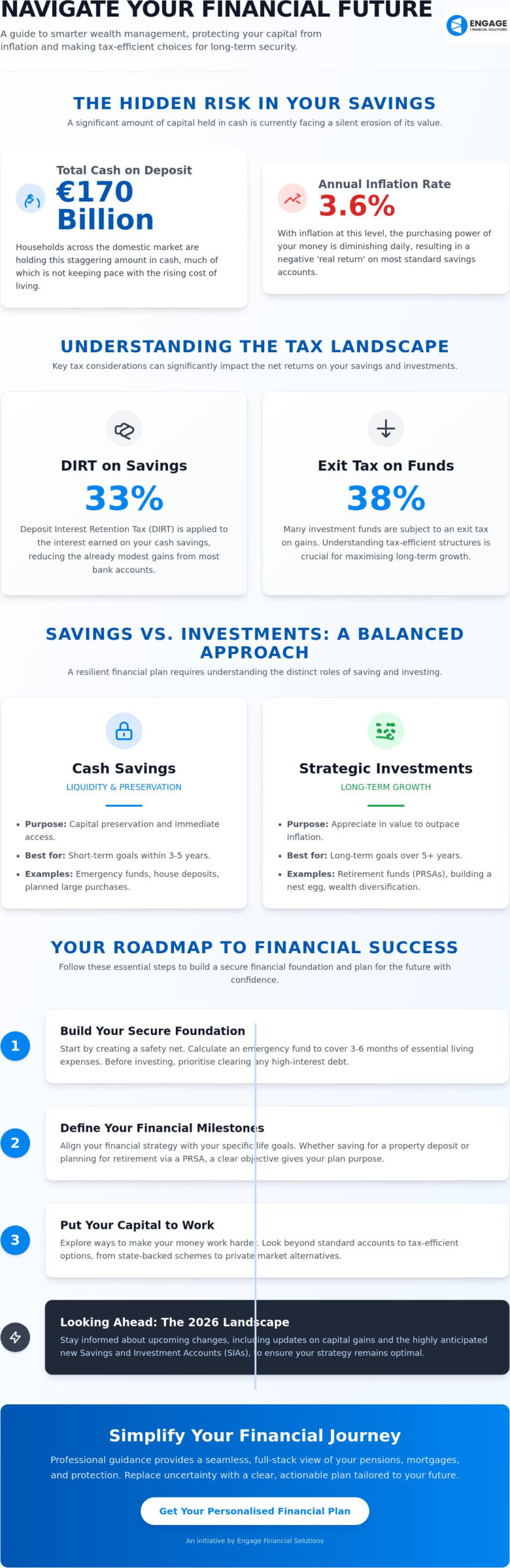
Did you know that households across our domestic market are currently holding over €170 billion in cash deposits? It’s a staggering figure, yet with annual inflation sitting at 3.6 per cent, much of that capital is quietly losing its purchasing power every single day. Whether you are looking to build a safety net for your family or you want to grow a substantial nest egg for the future, the traditional approach to savings and investments is shifting. You’ve likely felt the frustration of seeing modest interest gains diminished by the 33 per cent DIRT rate, or perhaps you feel hesitant about the 38 per cent exit tax on certain funds.
We understand that managing your wealth can feel like a balancing act between protecting what you have and taking the risks necessary for growth. It’s natural to want peace of mind that your money is working just as hard as you do. This guide will show you how to navigate the local financial landscape with confidence, ensuring you can protect your capital from inflation while making smarter, tax-efficient choices. We’ll explore the 2026 landscape, including the latest updates on capital gains and the highly anticipated Savings and Investment Accounts (SIAs), to give you a clear, professional plan for long-term security.
Key Takeaways
- Understand the silent impact of inflation on your cash and why proactive wealth management is essential for maintaining your future purchasing power.
- Learn how to balance immediate liquidity with long-term growth through a strategic approach to savings and investments Ireland, tailored to your personal goals.
- Identify the essential steps for building a secure foundation, including how to calculate an emergency fund and prioritise clearing high-interest debt.
- Explore how professional guidance can simplify complex decisions by providing a seamless, full-stack view of your pensions, mortgages, and protection.
- Discover how to evaluate different ways to put your capital to work, from state-backed options to private market alternatives, whilst keeping things tax-efficient.
Why Growing Your Wealth Matters in Today’s Economic Climate
Building a secure future is about more than just watching numbers grow on a screen. It’s about the freedom to make choices without the constant weight of financial stress. Many people feel that keeping their money in a standard bank account is the safest path, yet this approach carries a hidden risk that is often overlooked. While your balance stays the same, the world around you becomes more expensive. This is where the distinction between nominal returns and real returns becomes vital for your long-term health. If your bank pays you a small percentage in interest but inflation sits at 3.6 per cent, your real return is actually negative. You are effectively paying for the privilege of letting your capital sit still.
Validating your desire for security is the first step toward a smarter strategy. It is natural to want to protect what you have worked hard to earn. However, true resilience comes from ensuring your money grows at a rate that at least matches the rising cost of living. By shifting your perspective, you can find a balance that respects your need for safety whilst embracing the growth necessary to fund your future aspirations. This transition isn’t about taking unnecessary gambles; it’s about making informed choices that provide genuine peace of mind.
The Hidden Cost of Keeping Everything in Cash
Looking at a five-year horizon, the impact of stagnant cash can be profound. If inflation remains steady, the purchasing power of your savings today will be noticeably lower by 2031. Most standard current accounts in our domestic market offer negligible interest, which means they fail to provide a buffer against rising costs. Transitioning from a saver mindset to an investor mindset is a necessary evolution for anyone serious about wealth. It involves moving beyond simple capital preservation and looking for opportunities where your money can work harder. Finding the right balance between savings and investments Ireland offers is the key to ensuring your hard-earned capital retains its value over time.
Defining Your Financial Milestones
Wealth management is most effective when it is tied to your specific life goals. Whether you are a first-time buyer saving for a deposit or a business owner looking to diversify your assets, your strategy needs to be personal. You might be focused on short-term accessibility or long-term growth through a Personal Retirement Savings Account (PRSA). Every journey is different, and there is no one-size-fits-all solution. This is why seeking independent financial advice is so beneficial. A professional can help you ringfence what you need for today whilst positioning the rest of your capital for tomorrow. By aligning your financial choices with your milestones, you replace uncertainty with a clear, actionable roadmap for success.
Distinguishing Between Cash Savings and Strategic Investments
Understanding the difference between cash and assets is fundamental to building a resilient portfolio. Savings are essentially a form of lending your money to a financial institution in exchange for immediate liquidity and capital preservation. In contrast, strategic investments involve purchasing assets, such as equities or property, with the expectation that they will appreciate in value over time. Whilst both play a vital role, the most effective financial plans usually involve a balanced blend of both.
The Central Bank plays a critical role in this landscape by regulating financial providers and ensuring that consumer protection standards are upheld across all savings and investments Ireland residents might consider. This regulatory oversight provides a layer of security, helping you feel confident that your capital is being managed within a robust legal framework. It ensures that whether you are putting money into a deposit account or a diversified fund, your interests are safeguarded by clear rules and transparency.
When to Prioritise a Savings Account
Cash is king when you have a specific, short-term goal on the horizon. If you are planning a wedding, purchasing a new car, or building an emergency fund, a savings account is the appropriate tool. You can choose between instant-access accounts for total flexibility or fixed-term deposits if you can afford to lock your money away for a higher interest rate. Many people find comfort in State Savings schemes, which are backed by the government and offer a high degree of safety. Most deposits are also protected by a guarantee scheme, covering up to €100,000 per person per institution, which ensures your base remains secure even in turbulent times.
The Power of Long-Term Asset Growth
Whilst savings protect your current capital, investments are designed to build your future wealth. When you invest, you move from being a creditor to an owner of assets. This shift allows you to benefit from compounding, where your returns generate their own returns over decades amongst market fluctuations. History shows that time in the market is far more significant than trying to time the market perfectly. By staying invested through different cycles, you give your capital the opportunity to outpace inflation and deliver meaningful growth. If you are unsure how to strike this balance, you might find it helpful to speak with a professional advisor who can tailor a strategy to your unique circumstances.
Exploring Popular Ways to Put Your Capital to Work
Once you’ve decided to move beyond stagnant cash balances, the next step is identifying which financial vehicles suit your temperament and timeline. The local market offers a diverse range of options, from ultra-secure government schemes to dynamic market-based funds. Choosing the right path involves understanding the balance between risk and reward, as well as the tax implications of each choice. A helpful starting point for many is the Citizens Information guide to savings and investments, which provides a neutral overview of the landscape.
Before committing your capital, it is helpful to understand how your gains are treated by the state. Savings interest is typically subject to Deposit Interest Retention Tax (DIRT) at 33 per cent. On the other hand, returns from most investment funds are subject to an Exit Tax, which was reduced to 38 per cent as of 2026. This distinction is a key factor when evaluating the different savings and investments Ireland residents have at their disposal. By choosing tax-efficient options, you can ensure that a larger portion of your growth stays in your pocket.
Government-Backed Security Options
For those who prioritise absolute capital security, state-backed products remain a popular choice. Prize Bonds are a unique favourite amongst conservative savers; they don’t offer a traditional interest rate but provide the chance of winning tax-free prizes whilst keeping your original capital 100 per cent secure. Other state schemes offer fixed returns over several years, which are often exempt from DIRT. The trade-off for this high level of security is that the returns may be lower than those found in the private market, potentially making it harder to significantly outpace inflation over a long horizon.
Diversified Investment Funds and Stocks
If you are looking for higher growth potential, diversified multi-asset funds allow you to own a slice of hundreds of global companies across various sectors. These funds are professionally managed, which is ideal for busy individuals who don’t have the time to track individual stocks daily. Every fund comes with a risk rating, typically ranging from 1 (very low volatility) to 7 (very high potential risk and reward). By selecting a fund that matches your comfort level, you can benefit from market growth whilst maintaining a level of stability that suits your long-term goals. This structured approach helps remove the guesswork and emotional stress often associated with the stock market.
Crafting a Personal Roadmap for Long-Term Success
A successful financial journey isn’t the result of luck; it’s the outcome of a methodical, logical plan. When you have a clear roadmap, you replace the anxiety of the unknown with the confidence that comes from a steady guide. This process begins by securing your present before you reach for your future. By following a structured approach, you ensure that every decision you make strengthens your overall position whilst keeping your long-term aspirations in sight. Whether you’re just starting out or looking to refine an existing portfolio, these steps provide a seamless path forward.
- Step 1: Ringfence your emergency fund. Aim to have three to six months of essential living expenses tucked away in a dedicated, accessible account.
- Step 2: Clear high-interest debt. Before committing capital to growth assets, ensure you’ve eliminated expensive credit card balances or personal loans that can erode your progress.
- Step 3: Assess your risk appetite. Work with a professional to understand your emotional and financial capacity for market fluctuations, ensuring your strategy remains comfortable.
- Step 4: Match vehicles to timelines. Short-term goals belong in cash; medium to long-term goals are better suited for diversified assets that can outpace inflation.
- Step 5: Review annually. Life changes, and your portfolio should evolve to reflect your current circumstances and future needs.
The Importance of an Emergency Buffer
Liquidity is your most effective defence against market volatility. If the markets experience a temporary dip, having a cash buffer means you won’t be forced to sell your assets at an inopportune time to cover an unexpected bill. It’s best to keep this fund in a high-interest demand account where it remains accessible but still earns a modest return. This safety net provides the emotional stability required to stay invested for the long haul. When you know your daily needs are covered, you can view market movements with optimism rather than fear. This foundational step is essential for anyone exploring the savings and investments Ireland offers, as it protects your growth strategy from the friction of short-term shocks.
Tax Efficiency and Your Future
A truly tailored roadmap considers not just what you earn, but what you keep. Integrating your growth strategy with retirement planning is one of the most effective ways to build wealth. Contributing to a pension often provides significant tax advantages compared to standard investment funds, allowing more of your capital to benefit from compounding. You can also explore options like the annual small gift exemption, which allows you to pass on up to €3,000 per year to family members without triggering a tax liability. If you’re ready to build your personal roadmap, contact our team for a tailored review of your financial goals.
How Professional Guidance Simplifies Your Financial Journey
Making significant financial decisions alone often leads to second-guessing and unnecessary stress. A professional consultant acts as an essential buffer between you and the emotional noise of the market. Instead of reacting to a temporary dip or a sensationalist headline, you have a steady guide to keep you focused on your long-term horizon. This level of support is particularly valuable when navigating the various options for savings and investments Ireland residents can access, as it ensures your choices are based on logic rather than a heat-of-the-moment impulse.
A full-stack approach means looking at your financial life as a single, integrated ecosystem rather than a collection of separate products. Your mortgage, your income protection, and your growth assets should all work in harmony. Engage Financial Solutions handles the heavy lifting of regulatory requirements and complex paperwork, allowing you to enjoy the progress without the administrative friction. While digital, off-the-shelf products might seem convenient, they often lack the meticulous attention to detail that a personalised, human-led plan provides. You deserve a strategy that is as unique as your aspirations.
The Trusted Advisor Advantage
Moving from one financial milestone to the next should feel seamless. For many people in our local market, the journey begins with saving for a first home, but once that’s achieved, the focus naturally shifts to protecting that asset and building future wealth. Integrating mortgage protection and life cover into your broader strategy creates a solid foundation. If the unexpected happens, your family’s security is safeguarded, which allows your investment strategy to remain intact. A proactive advisor anticipates market changes and regulatory shifts, neutralising potential stresses before they ever impact your daily life.
Taking the First Step Toward Security
The most important action you can take for your future self is to start. You don’t need a massive lump sum to begin building resilience; starting small but starting now is what truly matters in the long run. A straightforward, jargon-free consultation can clear away the confusion surrounding tax implications and risk ratings. By choosing a partnership based on transparency and expertise, you gain the peace of mind that comes from knowing your future is in capable hands. You’ve worked hard for your money, and we’re here to ensure it provides the stability and optimism you and your family deserve for years to come.
Securing Your Financial Future Today
Building wealth is a journey that requires both a steady hand and a clear perspective. You’ve seen how inflation can quietly erode stagnant cash and why a balanced approach to savings and investments Ireland provides the most effective way to protect your hard-earned capital. By prioritising an emergency buffer and clearing high-interest debt, you create a foundation that allows your assets to grow without the friction of short-term stress.
Whether you’re looking to switch your mortgage, start a pension, or explore new growth opportunities, our expert team is here to help. We bring decades of combined experience and the reassurance of being regulated by the Central Bank to every partnership. We’ll help you organise the complexities of tax and regulation into a straightforward, personalised plan that covers everything from mortgages to retirement. Book a professional consultation with Engage Financial Solutions to tailor your strategy. Your future security starts with a single, confident step, and we’re ready to walk that path with you.
Frequently Asked Questions
How much money should I keep in a savings account before I start investing?
You should aim to keep between three and six months of essential living expenses in an accessible savings account. This emergency fund provides a vital buffer against unexpected costs like car repairs or medical bills, ensuring you don’t have to sell your growth assets at an inopportune time. Once this foundation is secure, you can confidently look at more strategic ways to put your surplus capital to work for the long term.
Is it better to pay off my mortgage or invest my extra savings?
The choice depends on your mortgage interest rate compared to the potential after-tax returns of an investment. If your mortgage rate is low, you might find that the compounding growth of a diversified portfolio offers better long-term value. However, clearing debt provides a guaranteed “return” by saving on interest payments. A professional review can help you decide which path aligns best with your desire for either debt-free security or wealth accumulation.
What is the difference between DIRT and Exit Tax on my returns?
Deposit Interest Retention Tax (DIRT) is currently 33 per cent and applies to the interest earned on standard bank deposits. Exit Tax applies to gains from most investment funds and was reduced to 38 per cent as of 2026. Understanding these rates is a vital part of navigating savings and investments Ireland residents use to grow their wealth. Choosing the right tax-efficient vehicle ensures more of your returns remain in your pocket.
Are Prize Bonds a good investment in the current market?
Prize Bonds are an excellent choice if your primary goal is absolute capital security. While they don’t offer a guaranteed interest rate, your original capital is 100 per cent protected by the state. They are a favourite amongst conservative savers who enjoy the chance of winning tax-free prizes. However, if you want to significantly outpace inflation, you may need to balance them with assets that offer higher growth potential over time.
How does inflation affect my long-term financial plan?
Inflation acts as a silent cost that reduces the purchasing power of your money over time. If the cost of living rises by 3.6 per cent annually, any capital earning less than that in interest is effectively losing value. Your long-term plan must focus on achieving “real returns,” which are the gains you make after inflation is taken into account. This ensures your future nest egg can still afford the lifestyle you’ve planned today.
Can I access my invested money quickly if there is an emergency?
Accessibility depends entirely on the specific financial vehicle you choose. Standard savings accounts usually offer instant access, whereas some investment funds may take several days or even weeks to liquidate. Certain products might also have fixed terms or exit penalties if you withdraw early. This is why we always recommend keeping a separate emergency fund in a demand account to ensure you have immediate liquidity when you need it most.
What are the risks of investing in a multi-asset fund?
The main risk of a multi-asset fund is market volatility, which means the value of your investment can go down as well as up. These funds use risk ratings from 1 to 7 to help you choose a level of fluctuation you’re comfortable with. By diversifying across different sectors and geographies, these funds aim to smooth out the journey, but they still require a long-term perspective to navigate the natural cycles of the market.
Is there a minimum amount required to start a professional investment plan?
You don’t need a large lump sum to begin; many professional plans allow you to start with modest monthly contributions. Whether you’re setting up a pension or a regular savings plan, the key is the consistency of your contributions over time. Starting early allows you to benefit from the power of compounding, which can turn even small, regular amounts into a substantial fund for your future security and peace of mind.
Disclaimer
Engage Financial Services LTD T/A Engage Financial Solutions is regulated by the Central Bank of Ireland CRO 764570. Director David Moore. Suite 2 First Floor, 14 -18 Main street, Blackrock, Co Dublin A94 W0Y3