


What if the most effective way to grow your wealth wasn’t a high-risk investment, but simply shrinking the debt you already have? For many homeowners in the domestic market, the idea of being mortgage-free years ahead of schedule is a dream that often feels out of reach due to complex rules and banking jargon. If you are looking to maximise your mortgage overpayment savings in this jurisdiction, you’ve likely encountered a wall of confusion regarding fixed-rate penalties and whether it’s wiser to keep cash accessible whilst inflation sits at 3.6%.
It’s completely normal to feel a sense of hesitation about “locking” your hard-earned money away in a long-term loan. This guide is designed to replace that anxiety with a sense of calm competence and a clear plan for your future. We’ll show you exactly how interest is calculated on your balance and explain the specific limits lenders impose; for instance, some providers allow up to 10% of your balance to be repaid annually without fees. You’ll gain the clarity needed to decide whether to overpay, boost your savings, or perhaps switch to a more flexible product to ensure your long-term financial stability.
Key Takeaways
- Understand how even modest monthly additions can trigger a powerful reverse-compounding effect, significantly reducing the total interest you owe over the life of your loan.
- Discover why opting to shorten your loan term, rather than lowering your monthly instalment, is the most effective way to secure mortgage overpayment savings locally.
- Learn how to apply the ‘Golden Rule’ of interest to determine whether your spare cash works harder in a savings account or against your home debt.
- Identify the specific allowances domestic lenders provide for fixed-rate overpayments, allowing you to pay down debt without the stress of exit penalties.
- See how switching to a more competitive mortgage rate can create the necessary cash flow to fuel your overpayment strategy and clear your debt years earlier.
Debunking the Myth: Is Mortgage Overpayment Only for the Wealthy?
Many people believe that clearing a home loan early is a luxury reserved for those who receive a large inheritance or significant annual bonuses. This couldn’t be further from the truth. In reality, a strategic approach to your debt is a flexible tool available to almost every homeowner, regardless of their income bracket. By choosing to make even modest extra payments, you are effectively taking control of your financial future and ensuring long-term stability for your family.
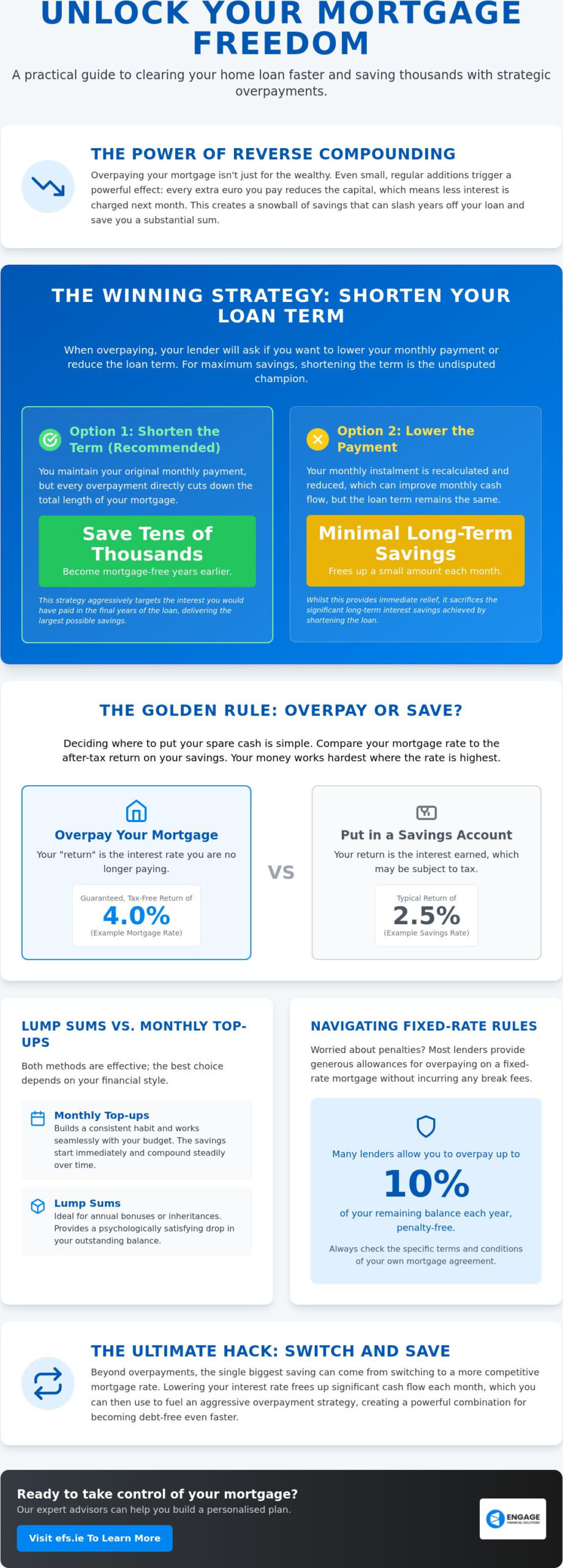
An overpayment is the act of paying more than your scheduled monthly instalment to reduce your principal balance. While it might seem like a small gesture, the impact of these contributions is magnified by the “compounding effect” in reverse. Instead of interest building up on your debt, every extra euro you pay reduces the principal; this in turn reduces the amount of interest the bank can charge you the following month. This creates a cycle of savings that can slash years off a standard 25-year term. Adding just €50 a month to a typical mortgage could save you thousands in interest over the life of the loan.
The Reality of Small, Consistent Contributions
Think of each overpayment as “buying back” your home from the bank, brick by brick. In our local market, interest is typically calculated on a daily basis. This means that the moment your extra payment hits the account, it starts working for you immediately. You aren’t just reducing a number on a screen. You are increasing your equity and the emotional peace of mind that comes with owning more of your property sooner. Most lenders in the domestic market have made this process straightforward, often allowing for small, regular top-ups through your online banking without the need for any formal paperwork or complex applications.
Lump Sums vs. Monthly Top-ups
Choosing between a one-off annual payment and a monthly contribution often comes down to your personal cash flow and psychological preference. Seeing your balance drop by a significant amount once a year can be incredibly satisfying, but monthly top-ups offer a different kind of “seamless” financial rhythm. They become a habit, much like a savings plan, but with a guaranteed “return” equal to your mortgage interest rate. It’s a proactive way to manage your wealth without feeling a sudden pinch in your pocket.
This flexibility is a hallmark of many modern loan structures. When exploring flexible mortgage features, you’ll find that the ability to stop or start these extra payments is a vital safety net. If your circumstances change, you can simply revert to your scheduled payment without friction. This makes the strategy a low-risk way to build wealth. By focusing on consistent mortgage overpayment savings in this jurisdiction, you are not just paying a bill; you are investing in your own security and a debt-free future.
Term Reduction vs. Monthly Payment Reduction: Which Strategy Wins?
When you decide to put extra money towards your mortgage, your lender will typically ask you a vital question: do you want to reduce your monthly repayment or shorten your loan term? It sounds like a simple administrative choice, but the path you pick will fundamentally change your financial trajectory. Whilst both options decrease your total debt, they serve very different goals. One offers immediate breathing room in your monthly budget, whilst the other is an aggressive move towards total financial security.
The Power of Shortening Your Mortgage Term
If your primary goal is to maximise your mortgage overpayment savings Ireland, shortening the term is almost always the superior choice. By reducing the length of the loan, you are cutting off the years where interest is most expensive. Consider a scenario where you have a €250,000 mortgage over 25 years. If you overpay enough to shave five years off the term, you could save tens of thousands of euros in interest. This is money that stays in your pocket rather than going to the bank.
Think of the interest you save as a guaranteed, tax-free return on your money. In a market where savings rates often struggle to keep pace with inflation, “earning” 3.5% or 4% by not paying it to a lender is a savvy move. This approach fits seamlessly into a long-term retirement planning strategy. Entering your later years without the burden of a monthly housing cost provides a level of security that few other investments can match.
When Monthly Payment Reduction Makes Sense
There are times when protecting your current cash flow is more important than long-term interest savings. If you are starting a family, changing careers, or simply want a larger “buffer” each month, reducing your mandatory monthly instalment provides a valuable safety net. By lowering the amount you are legally required to pay each month, you reduce the stress of a potential “what if” scenario. You can always choose to keep overpaying, but the lower baseline gives you more control over your finances.
Choosing between these paths involves weighing the opportunity cost of overpaying against your immediate lifestyle needs. Most lenders in the domestic market are quite flexible, allowing you to switch strategies as your life evolves. If you’re unsure which path aligns with your goals, it might be time to review your current mortgage and see how a tailored approach could work for you. Whether you want to clear debt fast or keep your monthly costs low, the best strategy is the one that lets you sleep soundly at night.
The Opportunity Cost: Should You Overpay or Save?
Deciding where to direct your surplus income is a delicate balancing act. You might find yourself weighing the comfort of a growing savings balance against the long-term benefit of a smaller debt. To make the right choice, you should apply the “Golden Rule” of interest: compare your mortgage rate directly with the return you’d get from a savings account after tax. Because of how the domestic market is structured, the maths often leans heavily in one direction.
In this jurisdiction, Deposit Interest Retention Tax (DIRT) is a significant hurdle for savers. If your mortgage rate is 3.5% and a savings account offers 2.25%, you aren’t just earning less on your savings; you’re also paying a third of that interest back in tax. This often makes debt reduction the more profitable choice for those seeking mortgage overpayment savings Ireland. By paying down the principal, you’re effectively “earning” the interest rate you are no longer being charged, without any tax liability on that gain.
Calculating the Real Return on Your Money
Paying off a 4% mortgage is functionally identical to finding a savings account that pays roughly 6% before tax. Amongst the domestic population, many are recognising that debt reduction offers a “guaranteed” return. Unlike investment portfolios that can fluctuate with market volatility, every euro you pay off your principal is a euro that can never again accrue interest against you. With inflation recently recorded at 3.6% in the 12 months leading to May 2026, holding cash in low-interest accounts can actually erode your purchasing power, whereas reducing debt provides a stable anchor for your future. For those looking to put surplus funds to work more broadly, exploring savings and investments Ireland strategies can help ensure every euro is positioned for maximum long-term growth.
The Importance of Financial Liquidity
Whilst the maths often favours overpayment, you must avoid the trap of becoming “house poor”. It’s vital to maintain an emergency fund that covers at least three to six months of living expenses before you commit to extra mortgage payments. Money paid into a mortgage is often difficult to get back out in a hurry, so a balanced approach is key. You should ensure your family is protected with adequate mortgage protection whilst you focus on your long-term goal of being debt-free. This ensures that your strategy remains resilient, no matter what life transitions you encounter.
Navigating the Red Tape: Break Fees and Lender Limitations
The most common hurdle preventing homeowners from taking action is the fear of being penalised. If you are on a fixed-rate contract, the prospect of a “Break Fee” or Early Repayment Charge can feel like a significant deterrent. However, these rules are rarely as restrictive as they first appear. Most lenders in the domestic market actually encourage responsible debt reduction by allowing a specific allowance each year. You can often achieve substantial mortgage overpayment savings Ireland without ever triggering a penalty.
A break fee is essentially a calculation the bank performs to see if they will lose money by letting you pay off your loan early. It usually only applies if the market interest rates have fallen since you took out your mortgage. Because the bank has already “bought” the money for your loan at a specific price, they may charge you to cover their costs if you return it early. Before you commit to a large lump sum, it’s wise to request an “overpayment quote” or a “redemption figure” from your bank. This gives you a precise, friction-free number so you can make an informed decision without any nasty surprises.
Fixed vs. Variable Rate Flexibility
If you are on a variable-rate mortgage, you generally enjoy the ultimate level of flexibility, as most local providers allow unlimited overpayments without any fees. This makes variable products an attractive option for those who expect a windfall or a significant rise in income. For those on fixed rates, timing is your best friend. You can wait until your fixed period is coming to an end to make a significant contribution, or you can use the annual allowances provided in your contract. Navigating these various lender agreements can be complex, but working with a mortgage broker can help you identify which products offer the best “seamless” overpayment terms for your lifestyle.
Similarly, for readers with property interests in the UK, it is useful to explore Mortgage Brokerage Commission and Arrangement Fees to understand how advisory costs compare in different jurisdictions.
The ‘10% Rule’ and Other Lender Secrets
Many banks in this jurisdiction operate under what is commonly known as the “10% rule.” This typically allows you to overpay up to 10% of your outstanding balance or your monthly instalment each year without penalty. A smart way to stay under the radar of penalty triggers is to adopt a “small and frequent” strategy, such as adding a modest amount to your monthly standing order. This methodical approach ensures you are constantly chipping away at the principal without needing to check the interbank rates every time you have spare cash. Break fees only occur if the lender’s cost of funds has changed significantly since you locked in your rate. If you are ready to explore your options, you can get a tailored mortgage review to see how much you could save by acting now.
Beyond Overpayments: Why Switching Might Be Your Biggest Saving
Whilst overpaying is a powerful tool, it shouldn’t be viewed in isolation. True financial freedom comes from a holistic approach where every part of your home finance works in harmony. By switching your mortgage to a more competitive rate, you can create a “double-whammy” effect. You aren’t just paying less interest to the bank; you are also creating the surplus cash needed to accelerate your journey toward being debt-free. This is where the most significant mortgage overpayment savings Ireland are often discovered, as it turns a passive bill into an active wealth-building strategy.
Organising your finances this way removes the friction that often stops people from starting. When you combine a lower interest rate with a disciplined overpayment plan, you are attacking the debt from two sides. Professional advice can help you look at the big picture, ensuring that your mortgage, your pension, and your protection policies all support your long-term aspirations. It’s about creating a seamless path from where you are now to the secure, debt-free future you deserve.
The Synergy of Switching and Overpaying
If you decide to move to a lower interest rate, your mandatory monthly repayment will naturally drop. A clever strategy is to keep your actual monthly payment at the same level as your old, higher rate. By doing this, you are effectively overpaying by default without feeling any change in your daily lifestyle. The “extra” money that would have been saved by the lower rate goes straight toward your principal balance, shortening your term automatically.
Additionally, some lenders in the local market offer cashback incentives for new customers. These lump sums provide a fantastic opportunity to kickstart your savings journey. Instead of spending the cashback on immediate costs, you can use it as an initial overpayment. This reduces your principal from day one, ensuring you pay less interest over the remaining life of the loan. Conducting regular market reviews ensures you aren’t paying a “loyalty tax” to a provider that no longer offers the best value for your specific needs.
Taking the Next Step Towards Security
The journey to a debt-free life starts with moving past the myths and taking practical, actionable steps. Whether you are just starting to add a small monthly top-up or you are ready to make a significant lump sum contribution, every euro counts toward your future stability. The goal isn’t just about the numbers on a bank statement; it’s about the peace of mind that comes from knowing you are future-proofing your finances and protecting your family’s home.
By taking a “future-back” perspective, you can see how the decisions you make today will lead to a much earlier retirement or a life free from monthly housing costs. Contact Engage Financial Solutions today for a tailored review of your mortgage and protection needs. Our team can help you build a personalised plan that safeguards your family whilst helping you clear your debt years ahead of schedule.
Securing Your Debt-Free Future
Taking control of your mortgage is one of the most empowering financial decisions you can make. We have seen how even modest top-ups can trigger a powerful reverse-compounding effect, and why choosing term reduction is often the most effective way to slash interest costs. Whether you are navigating the “10% rule” on a fixed rate or looking to create synergy by switching to a lower interest product, the path to full home ownership is now clearer and more straightforward.
Achieving substantial mortgage overpayment savings Ireland is about more than just the maths; it is about the peace of mind that comes from long-term security. As a firm regulated by the Central Bank, we provide expert guidance on switching and protection to help you build tailored financial security strategies. By looking at your finances through a “future-back” lens, you can safeguard your family whilst clearing debt years ahead of schedule. Start your journey to a debt-free future with Engage Financial Solutions and take the first step toward the stability you deserve. Your future self will certainly thank you for the proactive choices you make today.
Frequently Asked Questions
Can I overpay my mortgage if I am on a fixed-rate contract?
Yes, you can typically overpay on a fixed rate, but specific limits apply to avoid penalties. Most domestic lenders allow you to pay off up to 10% of your outstanding balance or a specific annual sum without incurring a break fee. It is always best to check your specific contract or ask your provider for an overpayment quote before you proceed.
Is it better to reduce my monthly repayments or my mortgage term?
Shortening your mortgage term is generally the most effective way to secure mortgage overpayment savings Ireland. By reducing the length of the loan, you cut out the years where interest is most expensive and clear your debt much faster. However, if your primary goal is to have more breathing room in your monthly budget, reducing your repayments might be the more suitable choice for your current life stage.
How much money can I actually save by overpaying my mortgage?
You can potentially save tens of thousands of euros in interest by making consistent extra payments over the life of your loan. Because interest is calculated daily in this market, even small monthly top-ups start reducing your total debt immediately. Shaving just a few years off a long-term mortgage can result in significant financial relief and a much earlier date for full home ownership.
What is a mortgage break fee and how can I avoid it?
A break fee is a charge applied if you overpay beyond your allowed limit whilst on a fixed-rate mortgage. You can avoid this by staying within your lender’s annual allowance or by timing larger payments to coincide with the end of your fixed-rate period. Requesting a redemption figure from your bank beforehand ensures you have a clear, stress-free path forward without unexpected costs.
Should I prioritise overpaying my mortgage or putting money into a pension?
Choosing between a pension and debt reduction depends on your personal tax bracket and your current mortgage interest rate. Pensions in the local market offer valuable tax relief on contributions, which can sometimes outweigh the interest saved on a mortgage. However, overpaying your home loan provides a guaranteed return that isn’t subject to market volatility, offering a unique sense of security.
Will overpaying my mortgage affect my mortgage protection policy?
Overpaying your mortgage won’t automatically cancel or change your mortgage protection policy. However, as your debt decreases faster than originally planned, your level of cover may eventually become higher than the remaining loan balance. This provides extra security for your family, but it’s a good idea to review your protection periodically to ensure it still aligns with your overall financial goals.
How often am I allowed to make overpayments to my lender?
The frequency of overpayments depends entirely on your lender’s specific rules and your contract type. Some banks allow you to set up a regular monthly top-up through online banking, whilst others may limit you to one or two lump sum payments per calendar year. Checking your online portal or speaking with a consultant will clarify the most flexible way for you to manage your contributions.
Can I stop making overpayments if my financial situation changes?
You have full control over your overpayments and can stop or adjust them at any time without friction. Since these are voluntary contributions above your mandatory monthly instalment, you can simply revert to your scheduled payment if your circumstances change. This flexibility ensures that your strategy for mortgage overpayment savings Ireland remains a helpful tool for building wealth rather than an added stress.
Disclaimer
Engage Financial Services LTD T/A Engage Financial Solutions is regulated by the Central Bank of Ireland CRO 764570. Director David Moore. Suite 2 First Floor, 14 -18 Main street, Blackrock, Co Dublin A94 W0Y3