


What if your lender looked past the fragmented history of hospital rotations and saw the true trajectory of your medical career? For many healthcare professionals, the journey to homeownership feels unnecessarily clinical; this is often the case when banks ignore the shift allowances and overtime that make up a significant portion of your take-home pay. You’ve worked incredibly hard to reach this stage of your profession, and it’s only fair that your mortgage for doctors reflects your actual earning power rather than just a basic salary scale.
Whether you are a junior doctor on rotation or a consultant with years of experience, managing the domestic mortgage market can feel like an additional shift you didn’t sign up for. This guide is designed to simplify the process, offering a clear path to securing a tailored loan that accounts for your unique income structure while meeting the latest Central Bank requirements, such as the four times gross income limit for first-time buyers. You’ll discover how to present your variable pay effectively, handle the transition between contracts, and move toward long-term financial security by safeguarding your future with a seamless application process that fits your busy schedule.
Key Takeaways
- Learn how your professional status as a clinician allows you to access flexible lending criteria that recognise your long-term career potential and job security.
- Discover how lenders in this market average your overtime and shift allowances over 6 to 24 months to accurately reflect your true earning power.
- Master the art of organising a digital paper trail to ensure frequent hospital rotations and contract changes don’t create friction during your application.
- Understand why tailored income protection is a vital component of a secure financial future, safeguarding your home against the physical demands of clinical work.
- Find out how a specialist broker can streamline a mortgage for doctors by effectively presenting complex pay structures and variable income to bank underwriters.
Why Medical Professionals are Viewed as Low-Risk Borrowers
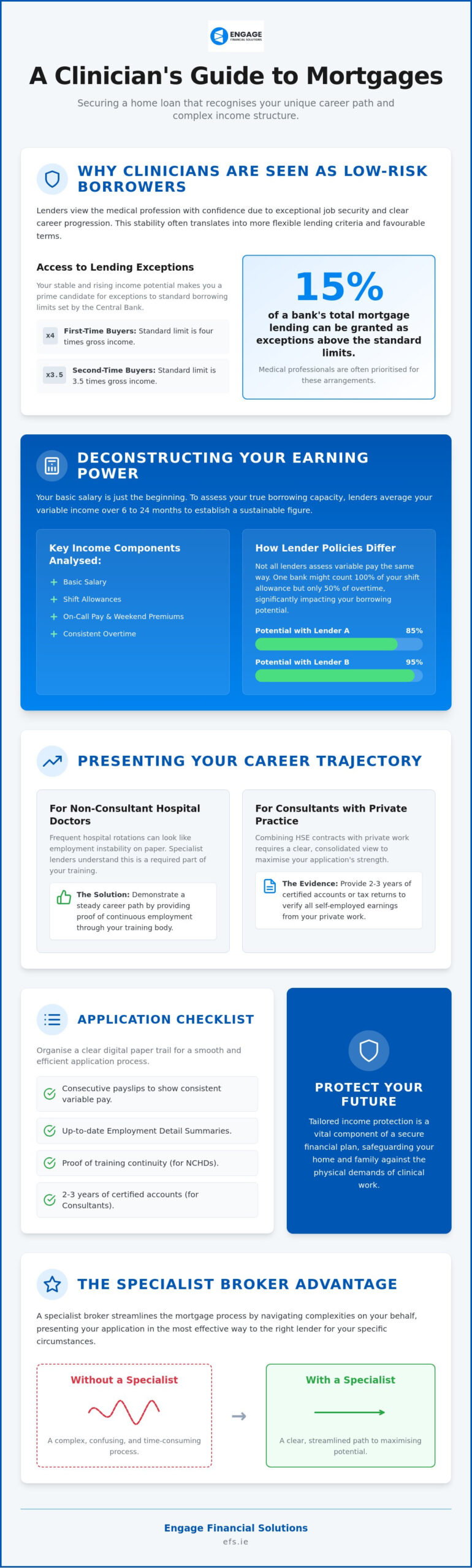
Lenders generally view the medical profession with a high degree of confidence. This stems from the exceptional job security and structured career progression inherent in the health service. Whilst other sectors might face economic volatility, the demand for clinicians remains constant; this translates into lower default rates compared to almost any other professional group. When you apply for a mortgage for doctors in this market, underwriters aren’t just looking at your current contract. They’re evaluating your lifelong earning potential and the stability of your vocation.
This positive outlook often allows for greater flexibility during the application stage. For instance, whilst standard macroprudential rules usually limit borrowing to 4 times gross income for first-time buyers and 3.5 times for second-time buyers, lenders have the discretion to grant exceptions. Because your income is expected to rise significantly as you progress, you may be a prime candidate for one of these Debt-to-Income Ratio allowances. Currently, banks can lend above the standard limits for up to 15% of their total mortgage books, and medical professionals are often at the front of the queue for these tailored arrangements.
Understanding the NCHD Career Path
If you’re a Non-Consultant Hospital Doctor, your employment history might look fragmented on paper due to frequent rotations. However, specialist lenders understand that changing hospital sites is a requirement of your training, not a sign of instability. By proving continuity of employment through your training body, you can demonstrate a steady career path. Whether you’re at Step 4 or Step 5 of your training grade, underwriters can factor in these scheduled salary increments to support your application. This proactive approach ensures your training status is seen as an asset rather than a hurdle to securing your home.
Consultants and Private Practice Income
For those who have reached the consultant level, the financial picture often becomes more complex but also more rewarding. You might hold a public contract whilst also building a private practice. Combining these dual-income streams requires a meticulous approach to ensure every Euro is counted. Lenders typically look for two or three years of certified accounts or tax returns to verify self-employed earnings from private work. By presenting a clear, consolidated view of your HSE and private income, you can maximise your borrowing capacity. Seeking expert guidance from a partner like EFS ensures your application reflects your total professional worth and long-term potential.
Navigating Complex Income Structures and Overtime
Payslips for medical professionals rarely tell the whole story. Whilst a standard office worker has a predictable monthly figure, your income might fluctuate based on the intensity of your rotation. This variability is why a standard mortgage for doctors requires a more nuanced approach than a typical application. Underwriters generally apply an “averaging” rule to variable income, looking at your last 6 to 24 months of overtime to determine what is sustainable. They want to see that your extra hours aren’t a one-off event, but a consistent part of your professional life.
Beyond your basic salary, several other components play a massive role in your borrowing capacity. Lenders will scrutinise:
- Shift Allowances: Regular payments for working unsociable hours.
- On-Call Pay: Compensation for being available outside standard hours.
- Weekend Premiums: Additional rates for Saturday and Sunday shifts.
Some lenders are more generous than others when assessing these different kinds of loans. For example, one bank might count 100% of your shift allowance but only 50% of your variable overtime. Knowing which lender views your specific pay structure most favourably can significantly increase the amount you’re eligible to borrow. If you’re unsure how your specific rota affects your application, the team at EFS can help you calculate your true borrowing power.
Maximising Your Borrowing Potential
Your basic pay is merely the starting point. To satisfy an underwriter, you need to prove that your additional earnings are reliable. Keeping a clean record of your Employment Detail Summaries and consecutive payslips is essential. When we calculate your sustainable income, we look at the “big picture” of your career path to ensure your mortgage remains healthy for the long term. This proactive documentation helps remove the friction often associated with medical applications, making the transition to your new home as seamless as possible.
Locum Work and Contract Regularity
Locum work offers fantastic flexibility and high earning potential, but it can sometimes give lenders pause. To prove income stability, most banks require a track record of 12 to 24 months of consistent locum work. They’ll look for regular lodgements in your bank statements and full tax compliance. If you’re moving between training contracts and permanent posts, it’s vital to show that there are no significant gaps in your employment history. By demonstrating a steady flow of work, even across different hospitals, you can bridge the gap and secure a mortgage that reflects your professional status.
Streamlining the Application Process for Busy Clinicians
Your working life is defined by high-stakes decisions and intense time pressure. This reality shouldn’t prevent you from securing your future home or navigating the path to homeownership. When you’re balancing hospital rotations with your personal life, the last thing you need is a fragmented mortgage process. Early preparation is your most effective tool for avoiding delays. By organising a comprehensive digital paper trail before your next heavy rotation begins, you ensure that every piece of evidence is ready for review the moment a lender requests it. This proactive approach turns a potentially stressful hurdle into a straightforward step toward long-term security.
Securing a mortgage for doctors in this market requires a clear understanding of the Approval in Principle stage. This is a preliminary statement from a lender indicating how much they’re willing to lend you based on your current financial standing. Having this in hand whilst you’re on-call or between shifts gives you the authority to bid on properties with confidence. It signals to sellers that you’re a serious buyer with the financial backing to follow through. Whether you’re a first-time buyer or moving to a larger family home, this foundation is essential for a smooth transition.
The Doctor’s Mortgage Checklist
Underwriters look for specific markers of stability in a medical application. You should gather your last three to six months of HSE payslips, your most recent Employment Detail Summaries, and any current or upcoming contracts. If you’ve taken time out for research or advanced study, these periods should be clearly documented to show they were part of your professional development. Your Medical Council registration is a vital piece of evidence; it confirms your professional status and reinforces the low-risk profile that lenders value. Keeping these documents in a shared digital folder makes the review process seamless for everyone involved.
Managing the Timeline
The journey from approval to drawing down your loan involves several moving parts. You’ll need to coordinate with solicitors for legal conveyancing and valuers to assess the property. These tasks can be difficult to manage whilst working irregular hours. A specialist broker serves as your proactive partner, acting as a buffer between you and the lender’s administrative demands. They anticipate potential stresses and neutralise them before they can disrupt your schedule. By following a methodical plan, you can navigate the legal stages without the friction that often plagues standard applications, ensuring a positive outcome for your financial future.
Protecting Your Home and Your Career
Securing a mortgage for doctors in the local market is a significant milestone, but it’s only the beginning of your financial journey. Whilst a bank requires basic mortgage protection to cover the loan in the event of death, this is often the bare minimum. For medical professionals, the risk of a career-interrupting illness or injury is a much more frequent concern. Your specialised skills are your most valuable asset. If a physical or mental health challenge prevents you from performing your specific clinical role, your ability to meet mortgage repayments could be compromised without a robust safety net.
This is where income protection becomes an essential part of your strategy. Unlike standard policies, a plan tailored for clinicians should include an “own occupation” definition. This means the policy pays out if you’re unable to perform your specific medical specialty, rather than any general work. You can also align the deferred period, the time before the policy begins to pay out, with your HSE sick pay entitlements. This ensures a seamless transition of income whilst keeping your premiums manageable. Along with this, you can often claim tax relief at your highest rate on these premiums, making it a highly efficient way to safeguard your future.
Income Protection for Medical Professionals
Choosing the right level of cover involves more than just picking a number. You need to consider the specific physical demands of your specialty. A surgeon, for example, may have a different risk profile and “own occupation” requirement compared to a GP. Serious illness cover can also provide a vital buffer, offering a tax-free lump sum that allows you to focus on recovery without the immediate stress of financial obligations. By tailoring these protections to your specific career stage, you create a foundation of stability that lasts.
Reviewing Your Cover as Your Career Evolves
Your financial needs aren’t static. As you move from being an NCHD to a Consultant, your income and liabilities will grow. This is the perfect time to review your existing arrangements to ensure they still fit your lifestyle. You might find that switching your mortgage to a more competitive rate provides the perfect opportunity to update your protection. Whether you’re increasing life insurance to protect a growing family or adjusting your income protection to match a higher salary, proactive management is key.
Safeguarding your home and your professional status with a mortgage for doctors requires a partner who understands the nuances of the medical field. If you want to ensure your protection plan is as meticulously organised as your clinical notes, talk to our specialist advisors for a tailored review of your options.
Why Partnering with a Specialist Broker Makes Sense
Choosing the right path for your property purchase shouldn’t feel like another administrative burden added to your clinical workload. Whilst a single bank can only offer their own products, a specialist broker provides access to a broad panel of lenders. This is crucial when your income includes the complex shift patterns, on-call pay, and overtime we’ve discussed in previous sections. By working with an expert who understands the nuances of the medical profession, you ensure that your application for a mortgage for doctors is presented to the bank most likely to offer flexible criteria and favourable terms.
A personalised approach respects your limited free time and demanding schedule. You don’t have to spend hours explaining why your employment history looks fragmented due to hospital rotations; we handle that narrative for you. Our role is to act as your proactive partner, managing the paperwork and negotiations so you can focus on your patients. This partnership extends far beyond a single transaction. It’s about long-term financial stewardship, from your first home to your eventual retirement planning and wealth protection.
The Value of Independent Financial Advice
Going direct to a bank limits your options to one set of criteria. An independent broker can identify which lenders are currently active in granting exceptions to standard lending limits for high-earning medical staff. We understand the local lending landscape and how to navigate its specific rules to your advantage. Whether you’re a first-time buyer or looking to move, having an advisor who can compare the entire market ensures you don’t miss out on more flexible income assessments or better rates.
Take the First Step Toward Your New Home
We know your schedule is unpredictable and often doesn’t align with standard office hours. That’s why we offer consultations designed to fit around your clinical commitments. In our first meeting, we’ll review your specific income structure, discuss your long-term goals, and map out a clear, stress-free path to approval. This methodical approach ensures that when you find the perfect property, you’re ready to move forward with total confidence in your financial backing.
Speak with our expert team at Engage Financial Solutions today to start your journey toward a secure and stable future in your new home.
Secure Your Professional Future and Your New Home
Securing a home that reflects your hard work and professional status shouldn’t be a source of stress. By recognising that your total income, including overtime and shift allowances, is a valid measure of your borrowing power, you can approach the market with confidence. We’ve explored how a tailored approach to a mortgage for doctors allows you to navigate complex pay structures whilst meeting the necessary lending requirements. Protecting that income is equally vital, ensuring that your home remains a place of security regardless of what your clinical career brings.
Our team provides the calm competence you need to manage this transition. We are regulated by the Central Bank and offer specialist expertise in medical income assessment, providing personalised guidance for busy professionals who have limited time for paperwork. We act as your proactive partner, ensuring every detail is meticulously handled from the first meeting to the final approval.
Book a personalised mortgage consultation with Engage Financial Solutions today to start your journey. You’ve looked after the health of others; now it’s time to let us look after the health of your financial future.
Frequently Asked Questions
Can I get a mortgage as an NCHD on a temporary contract?
Yes, you can secure a home loan even if you are currently on a fixed-term contract as a Non-Consultant Hospital Doctor. Lenders in this market recognise that temporary contracts are a standard part of medical training and career progression. As long as you can demonstrate a history of continuous employment or a clear path within a training scheme, underwriters are typically happy to support your application. Providing a letter from your training body or your next contract offer can help prove your long-term stability.
How much overtime pay will a lender take into account?
Most lenders will consider a significant portion of your overtime, typically between 50% and 100% of the averaged amount. Because medical pay is often variable, banks usually look at your earnings over the last six months to two years to find a sustainable average. This ensures that your mortgage for doctors accurately reflects your actual take-home pay rather than just your basic salary scale. Keeping a consistent record of your payslips is the best way to ensure this income is fully recognised during the assessment.
Do I need a larger deposit because I am a doctor?
No, you are subject to the same deposit requirements as any other buyer in the domestic market. First-time buyers generally need a 10% deposit, whilst second-time buyers also require 10% of the property’s purchase price. Your professional status doesn’t change these percentages, but it does make you a highly attractive applicant in the eyes of the bank. This often leads to a more straightforward approval process because of the inherent job security associated with your clinical role.
Can I use locum income to increase my borrowing limit?
Locum income can certainly be used to boost your borrowing capacity, provided you have a consistent track record of such work. Lenders typically look for 12 to 24 months of regular locum earnings to ensure the income is reliable and not a one-off supplement. You’ll need to provide bank statements and tax returns to verify these earnings. When presented correctly, this additional income can be the key to securing a property that matches your long-term professional aspirations.
Is it possible to get a mortgage if I have recently returned from working abroad?
Yes, it’s entirely possible to secure a mortgage shortly after returning from an overseas post. Whilst standard applicants might need to wait longer, clinicians often benefit from more flexible criteria due to the global demand for their skills. You will generally need to provide your new employment contract and evidence of your previous work history abroad. Some lenders may ask for a few months of local payslips to establish your residency and current earnings before finalising the offer.
What happens to my mortgage application if I rotate to a different hospital?
Rotating to a different hospital shouldn’t negatively impact your application if it’s a planned part of your medical training. Underwriters in this jurisdiction are well-acquainted with the rotation system and view it as a normal part of a doctor’s career path. You simply need to provide the details of your new placement and the associated contract. It’s the continuity of your employment within the health service that matters most to the bank, not the specific hospital site where you are based.
How does income protection differ for medical professionals?
Income protection for clinicians is tailored to your specific role through an “own occupation” definition. This is a crucial distinction because it means the policy pays out if you’re unable to perform your specific medical duties, rather than just any general work. You can also align the policy’s waiting period with your public sector sick pay entitlements to ensure there are no gaps in your finances. This bespoke approach provides a level of security that standard, off-the-shelf policies simply cannot match.
Disclaimer
Engage Financial Services LTD T/A Engage Financial Solutions is regulated by the Central Bank of Ireland CRO 764570. Director David Moore. Suite 2 First Floor, 14 -18 Main street, Blackrock, Co Dublin A94 W0Y3