


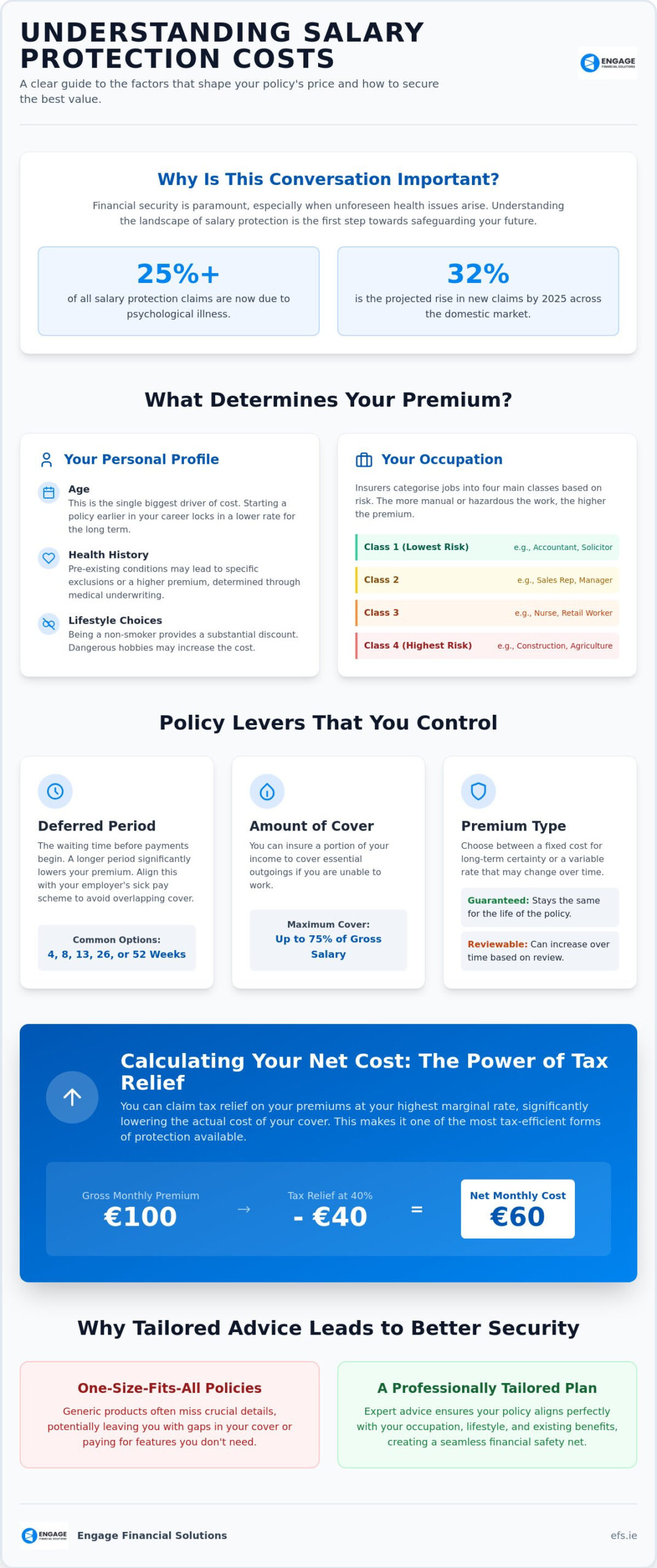
Did you know that psychological illness now accounts for over a quarter of all salary protection claims made across the domestic market? With new claims rising by 32% in 2025, it’s natural to feel a sense of unease about your financial security or the specific income protection insurance cost residents here should plan for. You’ve worked hard to build your lifestyle, and the thought of losing it all due to an unexpected illness is a heavy burden to carry. Many people want to protect their families but feel confused by complex jargon or worry they might be overpaying for their cover.
We’re here to provide some clarity and professional guidance. This guide breaks down exactly what influences the price of salary protection and how to secure the best value for your financial future. Whether you are self-employed or a PAYE employee, you’ll discover how to maximise tax relief, why your specific occupation matters, and how adjusting your deferred period can make premiums much more affordable. By the end of this article, you’ll have a clear, straightforward roadmap to safeguarding your salary and maintaining your stability.
Key Takeaways
- Understand how your age and occupational class directly impact your premiums to ensure you are not overpaying for your specific career path.
- Discover how to lower the net income protection insurance cost Ireland residents pay by claiming tax relief at your highest marginal rate of 20% or 40%.
- Learn why adjusting your deferred period, or waiting time, acts as a powerful lever to make your monthly policy costs much more manageable.
- Explore the benefits of guaranteed premiums to lock in a fixed price that provides long-term financial stability and peace of mind.
- Find out how a tailored policy from a professional advisor creates a seamless safety net that generic, one-size-fits-all products often miss.
What Determines the Price of Safeguarding Your Earnings?
Understanding the income protection insurance cost across the domestic market isn’t about finding a random price tag. It’s about how insurers calculate the specific risk of you being unable to work. Several factors come into play, but they generally fall into two categories: who you are and what you do for a living. By looking at these variables, you can see how a policy is tailored to fit your life. What is Income Protection Insurance? At its core, it’s a way to replace a portion of your earnings if you fall ill or have an accident, ensuring you can still meet your mortgage or rent payments without stress.
The total amount of cover you choose also dictates the price. Across the country, the maximum you can usually insure is 75% of your gross annual salary, minus any state benefits you might receive. If you’re self-employed, this calculation is even more vital. Since self-employed individuals paying Class S PRSI generally don’t qualify for the State Illness Benefit, the income protection insurance cost for private cover is a necessary investment in their long-term stability. This ensures that even if you can’t work, your household’s financial health remains intact.
The Role of Your Occupation and Lifestyle
Providers in this market use four main occupational classes to determine risk. Class 1 is typically for office-based roles like accountants or solicitors, whilst Class 4 covers more physically demanding jobs like construction or agriculture. The more manual or hazardous your daily work, the higher the premium will be. Lifestyle choices also weigh in heavily. Dangerous hobbies like rock climbing or frequent travel to high-risk areas can lead to price loadings. However, being a non-smoker is one of the easiest ways to secure a substantial discount, as insurers view non-smokers as having a much lower risk of long-term health issues.
How Your Age and Health Profile Influence Premiums
Age is the single biggest driver of cost. By starting a policy earlier in your career, you lock in a lower rate for the long term, providing both financial ease and peace of mind. As you get older, the statistical risk of illness increases, making policies more expensive to start later in life. Your health history also plays a part; pre-existing conditions might lead to specific exclusions or a higher starting price. Medical underwriting is simply the process where an insurer reviews your medical history to decide on your premium and any specific terms for your cover. Working with a consultant at efs.ie can help you navigate these details to find a policy that feels like a partnership rather than just a transaction.
Key Policy Features That Shape Your Monthly Premium
When you’re looking at the income protection insurance cost providers quote locally, it’s often the specific “moving parts” of the policy that determine the final figure. These features aren’t just technical details; they’re levers you can pull to align the cover with your budget and your employer’s benefits. Understanding how income protection works involves looking at the deferred period, the premium structure, and how the policy behaves over several decades. Each choice you make today affects the stability of your financial safety net tomorrow.
Selecting the Right Deferred Period
The deferred period is the waiting time between the first day you’re unable to work and the day the insurance company begins paying your benefit. Standard options across the domestic market include 4, 8, 13, 26, or 52 weeks. Generally, the longer you can wait, the lower your premium will be. This is where you can find significant savings by looking at your current employment contract.
If your employer provides a generous sick pay scheme, you don’t need your private policy to kick in immediately. For instance, as of 2026, statutory sick pay covers up to 10 days, but many professional contracts offer several months of full pay. Matching your deferred period to the end of your employer’s support ensures you aren’t paying for overlapping cover. Self-employed individuals face a different reality. Since you likely won’t have an employer’s safety net or access to State Illness Benefit, you might prefer a shorter deferred period, even if it slightly increases the income protection insurance cost you pay for private security.
Guaranteed vs Reviewable Rates Explained
You’ll also need to decide between guaranteed and reviewable premiums. A guaranteed premium stays exactly the same for the entire life of the policy, providing total certainty for your long-term financial planning. Reviewable premiums often start at a lower price point, which can be tempting if you’re just starting out. However, the insurer can increase these rates at specific intervals, often leading to much higher costs as you get older. For most people seeking peace of mind, locking in a guaranteed rate is the preferred path to avoid future stress.
Two other factors to consider are indexation and the cessation age. Indexation ensures your benefit increases annually to keep pace with inflation, whilst the cessation age is simply the date your policy ends, usually aligned with your planned retirement at 65 or 70. If you’re unsure which combination of features provides the best value for your specific salary, a quick chat with the team at efs.ie can help clarify your options. Tailoring these details ensures your policy remains a flexible, straightforward part of your wider financial health.
Calculating the Net Cost: The Power of Tax Relief
When you see the initial quote for your policy, it’s easy to focus on the sticker price. However, the income protection insurance cost Ireland residents actually pay is significantly lower thanks to generous tax incentives. This is one of the most tax-efficient financial products available in the local market. By understanding how these reliefs work, you can view your premium as a shared investment between you and the state. This relief effectively lowers the income protection insurance cost Ireland workers face, making it one of the best-value financial decisions you can make for your long-term stability.
Whether you pay tax at the standard 20% rate or the higher 40% rate, you are entitled to relief at your marginal rate. This essentially means the government subsidises up to nearly half of your premium. It transforms a standard expense into a highly affordable way of protecting your lifestyle. Because the relief is based on your tax bracket, the more tax you pay, the less your policy actually costs you in real terms.
How to Claim Your 40% Discount
For PAYE employees, the process is often seamless and straightforward. You can claim relief through the Revenue Commissioners’ “myAccount” service under the section for Permanent Health Insurance. In many cases, if your employer deducts the premium from your salary, the relief is applied automatically at source. This removes the friction of annual filings and ensures you feel the benefit in your take-home pay immediately. The maximum amount of premiums on which you can claim tax relief is capped at 10% of your total annual earnings. Self-employed individuals also benefit, though they typically claim the relief through their annual self-assessment tax return, which helps to lower their overall tax liability at the end of the year.
A Comparison of Gross vs Net Monthly Costs
Let’s look at the numbers. If your gross monthly premium is €100, the actual impact on your take-home pay is much smaller than the initial quote suggests. This makes safeguarding your earnings a far more accessible goal than many people initially realise. The table below illustrates how your tax bracket changes the actual cost you feel in your pocket every month.
| Gross Monthly Premium | Tax Bracket | Tax Relief Value | Actual Net Cost |
|---|---|---|---|
| €100 | 20% (Standard Rate) | €20 | €80 |
| €100 | 40% (Higher Rate) | €40 | €60 |
By viewing the cost through this “net” lens, the value proposition becomes clear. You aren’t just buying an insurance policy; you’re utilising a tax-efficient framework to ensure your mortgage, bills, and family’s lifestyle remain secure. This proactive approach to financial health ensures that if the unexpected happens, your transition to recovery is as smooth and stress-free as possible.
Practical Steps to Organise Affordable Coverage
You’ve seen how tax relief helps, now let’s look at how you can tailor the policy itself to keep the income protection insurance cost Ireland residents face within a comfortable monthly budget. Start by auditing your current outgoings to see what you truly need to survive. Most people assume they must insure the maximum 75% of their salary, but focusing on “must-pay” bills like your mortgage and utilities can lower your premiums. If your budget is particularly tight right now, you might consider “stepped” benefits. This structure allows you to start with a lower level of cover and increase it as your career progresses and your earnings grow.
Balancing Benefit Levels with Your Budget
It’s a common misconception that you need to replace your entire take-home pay to be secure. By prioritising your most critical expenses, you can create a lean but effective safety net. For example, you could use a mortgage protection review to see if you can save money on your life cover, then reinvest those savings into your salary protection. This big-picture approach ensures every euro you spend on insurance is working as hard as possible for your future security. By aligning your benefit amount with your actual needs, you avoid paying for unnecessary cover whilst keeping your core lifestyle protected.
Avoiding Common Mistakes When Comparing Quotes
The cheapest headline price isn’t always the best value. One of the most important details to check is the “own occupation” definition. This ensures the policy pays out if you’re unable to perform your specific job, rather than any job at all. Without this, you might find a claim is rejected because the insurer believes you could work in a different, less demanding role. Navigating these fine-print details and potential medical loadings is where professional guidance becomes invaluable. A consultant can compare multiple providers across the domestic market to ensure the income protection insurance cost Ireland workers are quoted is fair, transparent, and tailored to their specific health profile.
Regularly reviewing your policy every few years is also vital. As your salary increases or your lifestyle changes, your cover should evolve to match. This proactive behaviour prevents you from being under-insured when you need help the most. If you’re ready to see how these practical steps apply to your own situation, you can contact our advisors for a personalised assessment today. Taking this small step now creates a seamless transition to long-term financial health and gives you the peace of mind you deserve.
Why Tailored Advice Leads to Better Long-Term Security
Choosing a generic, off-the-shelf policy might seem like a quick win, but it often leaves significant gaps in your financial safety net. A one-size-fits-all approach doesn’t account for your unique career path or family aspirations. By seeking professional guidance, you gain access to a much wider panel of insurers nationwide. This competition amongst providers is essential for managing the income protection insurance cost Ireland workers encounter, as it allows a consultant to find the most competitive rates for your specific health profile and job role.
A professional advisor acts as a steady guide, helping you see the big picture. They don’t just look at one policy in isolation; they ensure your coverage is part of a seamless, integrated plan. This meticulous attention to detail prevents you from being over-insured in one area whilst being vulnerable in another, creating a sense of calm competence in your financial life.
The Benefit of a Comprehensive Financial Review
A regulated assessment looks at how your salary protection fits alongside your life insurance and long-term retirement planning goals. One of the most practical benefits of this review is identifying overlaps with your existing employer benefits. If your company already provides a level of group protection, you can tailor your private policy to start only when those benefits end, which directly lowers your monthly premiums. This holistic view ensures that every part of your financial organisation is working together to provide stability and optimism for the years ahead.
Taking the Next Step Toward Peace of Mind
Securing your future is a straightforward process when you have the right partnership. To prepare for your first consultation, it’s helpful to have a clear picture of your current gross salary and any existing sick pay arrangements your employer offers. Having these details ready allows your advisor to navigate the domestic market efficiently and provide a personalised quote that reflects your true needs.
Acting now is the best way to lock in the most favourable rates, as premiums are more affordable when you are younger and healthier. By taking this proactive step today, you are safeguarding your lifestyle and ensuring your family is looked after, regardless of what the future holds. A tailored approach doesn’t just manage the income protection insurance cost Ireland residents pay; it provides the enduring peace of mind that comes from knowing you have a reliable, professional plan in place.
Take Control of Your Financial Stability
Protecting your salary is more than just a financial obligation; it’s a commitment to your future stability and peace of mind. You’ve seen how age and occupation set the foundation for your premiums, whilst tax relief and smart policy features make the cover truly affordable. By aligning your waiting period with your existing benefits, you ensure that your safety net is both efficient and cost-effective.
The income protection insurance cost Ireland workers face is significantly reduced when you claim back up to 40% in tax relief. This makes safeguarding your earnings a practical reality for any professional in the domestic market, providing a buffer between your lifestyle and the unexpected.
Our team at Engage Financial Solutions is here to provide the expert guidance on tax-efficient salary protection you need. Regulated by the Central Bank, we offer a personalised service from our office in Blackrock to help you navigate every detail with ease. We pride ourselves on being a steady guide for our clients, ensuring their families are protected through every life stage.
Get a tailored income protection quote from the experts at Engage Financial Solutions and enjoy the confidence that comes from a secure, well-managed future.
Frequently Asked Questions
Is income protection insurance tax-deductible in the domestic market?
Yes, premiums are tax-deductible at your highest rate of income tax, which is either 20% or 40%. This relief acts as a substantial discount on your monthly payments, making the protection far more affordable. It is one of the most efficient ways to manage the income protection insurance cost Ireland residents face whilst ensuring their long-term financial stability remains intact.
Can I have more than one income protection policy at the same time?
You can hold more than one policy, but the total benefit you receive cannot exceed a specific percentage of your gross earnings. Usually, this limit is capped at 75% of your income across all your combined covers. It is important to coordinate these policies to ensure you aren’t paying for overlapping benefits that you won’t be able to claim in the future.
What is the maximum amount of income I can protect locally?
The maximum amount of income you can protect is typically 75% of your gross annual salary, less any State Illness Benefit you are entitled to. This ensures you have a sufficient incentive to return to work whilst still maintaining your essential lifestyle. By protecting this portion of your earnings, you can meet your mortgage commitments and daily expenses without financial stress during your recovery.
Does income protection cover me if I am made redundant?
No, income protection is specifically designed to replace your salary if you are unable to work due to illness or injury. It does not provide a benefit if you lose your job through redundancy. These policies focus on your health and well-being, providing a regular income stream only when a medical professional confirms you are unfit for your specific occupational duties.
How long do I have to be out of work before I can make a claim?
The time you must wait is known as the deferred period, and you select this when you first organise your cover. Options usually range from 4, 8, 13, 26, or 52 weeks. Choosing a longer waiting period can significantly lower the income protection insurance cost Ireland providers quote, especially if you can rely on your employer’s sick pay scheme in the short term.
Will my premiums increase if I make a claim on my policy?
No, your premiums will not increase simply because you have made a claim on your policy. Unlike motor or home insurance, where a claim often leads to a higher renewal price, these policies are priced based on your health and age at the time of application. This structure provides a predictable and stable cost, ensuring your financial planning remains straightforward and stress-free.
Is there a difference between salary protection and income protection?
There is no functional difference between the two terms; they are simply different names for the same type of financial cover. Both products aim to replace a portion of your earnings if you can’t work due to health reasons. You might also hear the Revenue Commissioners refer to it as “Permanent Health Insurance” when you are claiming your annual tax relief.
Do I need income protection if I already have a serious illness policy?
Yes, because these two policies serve very different purposes in a comprehensive financial plan. Serious illness insurance provides a one-off lump sum for specific diagnosed conditions, whilst income protection provides a regular monthly payment for any illness or injury that prevents you from working. Having both creates a more seamless and flexible safety net that protects your lifestyle over the long term.
Disclaimer
Engage Financial Services LTD T/A Engage Financial Solutions is regulated by the Central Bank of Ireland CRO 764570. Director David Moore. Suite 2 First Floor, 14 -18 Main street, Blackrock, Co Dublin A94 W0Y3