


What if your monthly salary suddenly vanished, yet your MORTGAGE, utility bills, and grocery costs remained exactly the same? It’s a scenario that causes genuine concern for many professionals, often leading to the pressing question: how much INCOME PROTECTION do I need to ensure my family stays afloat? Whether you’re worried about meeting monthly MORTGAGE repayments or simply maintaining your standard of living, you likely recognise that your ability to earn is your greatest asset. However, you might be hesitant to commit to a policy because you’re concerned about over-insuring or paying more than is strictly necessary.
We believe that financial security should be straightforward and stress-free. This guide is designed to replace uncertainty with a clear, tailored strategy for calculating your ideal benefit level. We’ll show you how to find a monthly figure that maintains your lifestyle whilst taking full advantage of the 40% tax relief available to higher earners. By the end of this article, you’ll understand how the maximum 75% coverage limit works, how the €254 weekly illness benefit fits into the puzzle, and how choosing the right deferred period can significantly lower your premiums without compromising your long-term stability.
Key Takeaways
- Understand the 75% gross salary rule to determine the maximum benefit level permitted under current domestic regulations.
- Learn how to accurately calculate your requirements and answer the question of how much INCOME PROTECTION do I need to safeguard your family’s future.
- Discover how selecting a longer deferred period can lower your premiums by aligning with your existing employer sick pay benefits.
- Maximise your tax efficiency by claiming relief at your marginal rate, which significantly reduces the net cost of your INCOME PROTECTION.
- Recognise the value of a tailored financial review to ensure your coverage integrates seamlessly with your MORTGAGE PROTECTION and PENSIONS plans.
Understanding the Role of INCOME PROTECTION in Your Financial Plan
Your ability to earn is your most significant financial engine. If that engine stops, the impact ripples through every part of your life, from your mortgage repayments to your children’s future plans. INCOME PROTECTION is designed to safeguard that engine by providing a steady, reliable stream of funds if you’re unable to work due to any illness, injury, or disability. Unlike other types of insurance that might cover specific one-off incidents, Income protection insurance focuses on your long-term stability. It turns the risk of a financial crisis into a manageable solution, offering the relief of a monthly payment that mirrors your regular salary. If you’re just beginning this journey, our comprehensive guide to INCOME PROTECTION provides a detailed overview of how these policies function within the domestic market.
Why a Lifestyle Audit is Your First Step
When people ask, “how much INCOME PROTECTION do I need?”, the answer often starts with a bank statement rather than a policy quote. A lifestyle audit involves a meticulous look at your outgoings to distinguish between non-negotiable costs and discretionary spending. Your non-negotiables are the essentials that keep your household running: mortgage repayments, utility bills, groceries, and transport. By identifying this baseline, you can determine the exact level of support required to maintain your standard of living. There’s a profound emotional benefit to this process. It replaces vague anxiety with a concrete figure, giving you the confidence that your family’s daily life won’t be disrupted by a sudden loss of health. Knowing exactly what you need allows you to tailor a policy that is both effective and cost-efficient.
INCOME PROTECTION vs SERIOUS ILLNESS COVER
It’s common to confuse INCOME PROTECTION with SERIOUS ILLNESS COVER, but they serve very different roles in a robust financial plan. SERIOUS ILLNESS COVER provides a one-off lump sum payment upon the diagnosis of a specific condition listed in your policy. This is often used to pay off a major debt or fund medical adaptations to your home. In contrast, INCOME PROTECTION offers a recurring monthly payment that continues until you’re fit to return to work or reach retirement age. These products aren’t mutually exclusive; they often work together to create a seamless safety net. Whilst the lump sum handles immediate shocks, the monthly benefit ensures your ongoing lifestyle remains secure. This holistic approach is why many professionals choose to integrate both into their broader strategy for long-term peace of mind and financial optimism.
The 75% Rule: Calculating Your Maximum Allowable Coverage
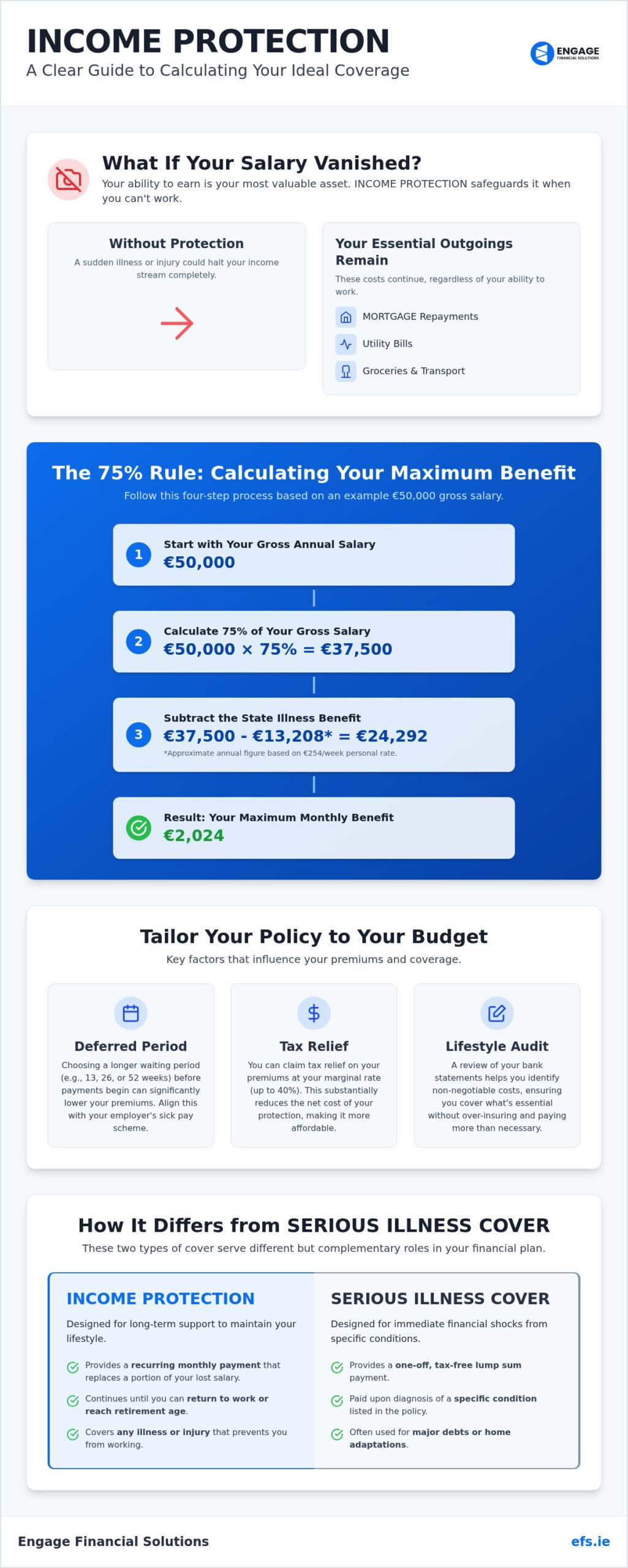
To find the answer to how much INCOME PROTECTION do I need, you must first understand the regulatory ceiling. Most providers cap your total potential benefit at 75% of your gross annual salary. This limit ensures that there’s still a financial incentive for you to return to work once your health improves. As noted by the Competition and Consumer Protection Commission, this 75% figure includes any social welfare payments you might be entitled to receive. Knowing this ceiling prevents you from paying for coverage that you wouldn’t be able to claim.
Calculating your specific maximum is a straightforward four-step process:
- Step 1: Determine your gross annual salary from all professional sources.
- Step 2: Calculate 75% of that gross figure as your starting point.
- Step 3: Subtract the state illness benefit, if you’re eligible for it based on your PRSI class.
- Step 4: Divide the remainder by 12 to find your maximum monthly benefit.
Imagine you earn €50,000 per year. First, calculate 75%, which is €37,500. Next, subtract the annual state illness benefit. For 2026, the maximum personal rate is €254 per week, totalling roughly €13,208 annually. This leaves a remainder of €24,292. When divided by 12, your maximum allowable monthly benefit from a private policy is approximately €2,024. If you’re unsure how these figures apply to your specific salary, our team can help you tailor a personalised plan.
The Impact of Social Welfare Deductions
The state provides a basic floor of support, but the level of that support depends on your employment status. For employees paying Class A PRSI, the maximum state illness benefit for 2026 is €254 per week. However, if you’re self-employed and paying Class S contributions, you generally aren’t entitled to this benefit. This means self-employed professionals often need to insure a higher portion of their income through a private policy. It’s vital to get this right so you don’t pay for coverage that the insurer will later deduct based on social welfare eligibility.
Maximising Value Through Tax Relief
One of the most compelling reasons to secure high coverage levels is the generous tax relief available on premiums. You can claim relief at your marginal tax rate, which for many professionals is 40%. Effectively, this means the government subsidises nearly half the cost of your policy. For example, a premium of €100 per month would only cost you €60 in real terms after tax relief is applied. This incentive makes it much easier to achieve the security you desire without straining your monthly budget, especially when integrated with your broader PENSIONS and MORTGAGE planning.
Factors That Influence How Much You Should Personally Aim For
While the 75% rule sets the legal maximum, your personal requirements depend on your unique financial ecosystem. To answer the question of how much income protection do i need Ireland, you should start by analysing your largest monthly outgoings. For most homeowners, the primary concern is the mortgage. Whilst MORTGAGE PROTECTION is a vital complementary security measure that clears the debt in the event of death, it doesn’t cover your monthly repayments if you’re merely out of work due to illness or injury. Your policy should ideally cover these repayments to ensure your home remains secure.
Next, consider your dependents. The cost of maintaining their education, extracurricular activities, and general wellbeing doesn’t pause just because your salary does. You should also evaluate your existing employer benefits. Does your contract provide full pay for six months, or are you limited to the statutory minimum of five days? As highlighted in the Competition and Consumer Protection Commission (CCPC) guide, understanding these gaps is essential for tailoring a policy that fits your life without being unnecessarily expensive. When calculating how much income protection do i need Ireland, don’t forget to account for the discretionary spending that contributes to your family’s quality of life.
Assessing Your Emergency Fund
Look at your liquid savings and determine how many months of your current “burn rate” you could sustain if your income stopped tomorrow. Many people plan to use their emergency fund for home repairs or career transitions. An INCOME PROTECTION policy allows you to keep those savings for their intended purpose rather than exhausting them on daily bills. Without this safeguard, you risk dipping into retirement funds early, which can have a devastating impact on your long-term financial health and optimism.
Future Goals and Inflation Protection
Your needs today won’t be the same in ten years. This is why we often recommend “indexation”, a feature that ensures your benefit keeps pace with rising costs and inflation. You should also account for future salary increases and career progression. A well-structured policy isn’t static; it remains tailored to your evolving lifestyle. By anticipating these changes now, you ensure that your level of security remains robust, regardless of how the economy or your career path shifts over time.
Adjusting Your Policy to Fit Your Budget: Waiting Periods and Duration
Once you’ve determined your ideal coverage level, the next step is ensuring the policy remains affordable over the long term. The most effective lever for controlling costs is the “Deferred Period”. This is the waiting time between when you first leave work due to illness and when the policy starts paying out. Selecting the right duration is a strategic decision that balances your immediate needs with your monthly budget. When considering how much income protection do i need Ireland, matching this period to your specific circumstances is just as important as the total benefit amount.
If your employer provides sick pay for three months, opting for a 13-week Deferred Period prevents you from paying for overlapping coverage. You can choose periods ranging from 4 to 52 weeks. Generally, the longer you can wait, the lower your premium will be. Another key factor is the “Ceasing Age”. This is the date your policy ends, which should typically align with your planned retirement age or the date your mortgage is cleared. By choosing a Ceasing Age of 65 or 67, you ensure your protection lasts exactly as long as your career requires.
The Relationship Between Waiting Periods and Premiums
The cost difference between waiting periods can be substantial. A 4-week Deferred Period is often significantly more expensive because the insurer is more likely to pay out for short-term illnesses. In contrast, a 26-week period can reduce your monthly costs by a large margin. For many professionals, a 13-week period represents the “sweet spot”. It provides enough time to bridge the gap using modest savings or employer benefits whilst keeping the policy accessible. A professional advisor can help you request a tailored premium review to find the most cost-effective balance for your specific salary and savings level.
Guaranteed vs Reviewable Premiums
You’ll also need to choose between “Guaranteed” and “Reviewable” premiums. Guaranteed premiums stay the same for the entire life of the policy, offering complete long-term stability. Reviewable premiums might start lower, but the insurer can increase them as you age or if the claims experience of the provider changes. We typically recommend prioritising the certainty of a guaranteed plan. It ensures your financial safety net remains seamless and predictable, allowing you to focus on your recovery without worrying about rising costs in the future. When you ask how much income protection do i need Ireland, remember that the quality of the premium structure is just as vital as the monthly payout.
Securing Your Future with Engage Financial Solutions
When determining how much income protection do i need Ireland, you shouldn’t have to navigate the complexities of the domestic market alone. We act as your Steady Guide, offering the professional stewardship required to turn a complicated financial decision into a straightforward plan for long-term security. Our meticulous approach ensures that every policy we recommend is tailored specifically to your lifestyle, career stage, and family requirements. By focusing on your unique needs, we remove the stress and friction often associated with insurance applications, replacing uncertainty with the peace of mind that comes from expert guidance.
True financial health requires a holistic perspective. We don’t view your INCOME PROTECTION in isolation; instead, we integrate it with your broader RETIREMENT PLANNING strategy. This “Future-Back” perspective ensures that your ability to contribute to your pension remains uninterrupted, even if you’re unable to work. Safeguarding your current earnings is the first step in protecting your future success. Whether you’re just starting your professional journey or are well-established in your career, our goal is to ensure your financial transition through any health challenge is as seamless as possible.
The Advantage of Using a Regulated Broker
Engage Financial Solutions is regulated by the Central Bank, providing you with an additional layer of security and trust. As an independent broker, we have access to a wide panel of leading insurers, allowing us to compare various structures to find the best fit for your budget and goals. We handle the heavy lifting, from navigating complex medical disclosures and underwriting processes to providing ongoing support as your life evolves. This proactive partnership means your cover stays relevant as you progress through different life stages, ensuring you never pay for more than you need whilst never being under-protected.
Next Steps to Peace of Mind
Achieving financial stability is a straightforward process when you have the right partner. To begin, we recommend gathering your most recent payslips and any existing policy documents you may have. This allows us to conduct a thorough and accurate review of your current position. Once you’re ready, you can book a consultation to discuss your specific requirements in detail. During this session, we’ll help you finalise the answer to how much income protection do i need Ireland by providing a clear, monthly figure that fits your lifestyle. Experience the calm competence of a bespoke financial solution and take the first step toward a more secure and optimistic future today.
Taking the Next Step Toward Financial Certainty
Determining your ideal level of support is the cornerstone of a resilient financial plan. You now understand that the 75% rule sets the regulatory ceiling, but your personal outgoings and existing employer benefits define your actual requirement. By aligning your deferred period with your liquid savings and taking advantage of 40% tax relief, you can secure a robust safety net that remains affordable. If you have been wondering, “how much income protection do i need Ireland”, the answer lies in a strategy that balances legal limits with your specific family goals.
At Engage Financial Solutions, we specialise in seamless financial transitions. As a firm regulated by the Central Bank, we provide the personalised financial guidance necessary to navigate the domestic market with ease. We act as your steady guide, ensuring your protection integrates perfectly with your long-term retirement aspirations. You can secure your future with a tailored INCOME PROTECTION plan from Engage Financial Solutions today. We look forward to helping you build a stable and optimistic financial future.
Frequently Asked Questions
Is INCOME PROTECTION tax-deductible within the domestic market?
Yes, your premiums are eligible for tax relief at your marginal rate of 20% or 40%. This relief is capped at 10% of your total annual income. Because the government effectively subsidises the cost, a higher level of security becomes much more accessible for most professionals. You must claim this relief through your annual tax return or the Revenue myAccount service, as it is not applied automatically by the insurer.
Can I have both INCOME PROTECTION and SERIOUS ILLNESS COVER?
Yes, these policies are designed to complement one another to create a comprehensive safety net. SERIOUS ILLNESS COVER provides a one-off lump sum upon diagnosis of a specific condition, which is ideal for clearing debts. INCOME PROTECTION provides a recurring monthly salary replacement for any illness that prevents you from working. Using both ensures that immediate financial shocks and long-term lifestyle costs are both fully managed.
What happens if I never make a claim on my policy?
If you never claim, the policy simply provides peace of mind throughout its term and then expires. These are pure protection products rather than investment vehicles, so they do not have a cash-in value at the end. The value lies in the meticulous safeguarding of your standard of living during your working years, ensuring that a sudden loss of health never leads to a financial crisis.
Does the State Illness Benefit affect how much I can claim?
Yes, the State Illness Benefit is factored into the calculation of your maximum allowable benefit. For 2026, the personal rate is €254 per week, which is deducted from the 75% gross salary ceiling. This ensures you stay within legal limits whilst receiving the support you’re entitled to. When asking how much income protection do I need, it is vital to account for this state floor so you don’t overpay for private cover.
Can I take out a policy if I am self-employed?
Yes, and it is arguably more critical for the self-employed as they often lack access to state-funded illness benefits. Since you generally don’t qualify for the €254 weekly support, a private policy serves as your primary financial floor. You can still insure up to 75% of your gross earnings. This provides a straightforward way to maintain your business and personal obligations if you are unable to work due to injury.
How long will the payments continue if I am unable to return to work?
Payments continue until you are fit to return to work or you reach the ceasing age specified in your policy. Most professionals choose a ceasing age that aligns with their planned retirement, such as 65 or 67. This ensures your earnings are protected throughout your entire career. If you suffer a long-term disability, the policy provides the stability of a guaranteed cheque until your pension benefits typically begin.
What is the difference between a deferred period and a waiting period?
There is no difference between these two terms; they both refer to the time you must be out of work before payments start. You can choose a period that matches your employer’s sick pay or your own liquid savings, such as 13, 26, or 52 weeks. Selecting a longer period is a practical way to reduce your monthly premiums whilst still ensuring you have a fallback plan for serious, long-term health issues.
Will my premiums increase as I get older?
Whether your premiums increase depends on the premium structure you select at the outset. A guaranteed premium stays fixed for the entire duration of the policy, providing long-term stability. Reviewable premiums may be cheaper initially, but they can rise as you age. Correctly structuring these details is a key part of answering how much income protection do I need to ensure your plan remains affordable until you retire.
Disclaimer
Engage Financial Services LTD T/A Engage Financial Solutions is regulated by the Central Bank of Ireland CRO 764570. Director David Moore. Suite 2 First Floor, 14 -18 Main street, Blackrock, Co Dublin A94 W0Y3