


What if the legacy you’ve spent a lifetime building was reduced by a third before it even reached your children? With CAPITAL ACQUISITIONS TAX at 33%, many families face the reality that a significant portion of their estate could be lost to the state. It’s understandable if you feel a sense of unease when discussing wealth or find the shifting tax-free thresholds confusing. You want to ensure that your home and savings provide a springboard for the next generation, not a financial burden. Whether you are aiming to protect the family home or organise a diverse portfolio, we can help you find a clear way forward.
This article will help you discover how to protect your assets and minimise tax liabilities for your loved ones through strategic financial guidance. We’ll examine practical steps for effective INHERITANCE PLANNING, from safeguarding your assets with SECTION 72 insurance to maximise your legacy to understanding how PENSIONS and INVESTMENTS can be structured for a seamless transfer of wealth. By the end, you’ll have a clear, actionable path to securing your family’s long-term stability and peace of mind.
Key Takeaways
- Understand how the 33% CAPITAL ACQUISITIONS TAX rate and the €400,000 Group A threshold affect the final value of your estate.
- Discover how a SECTION 72 POLICY can provide a tax-free lump sum to cover tax liabilities, keeping your family home secure.
- Learn how to utilise the €3,000 SMALL GIFT EXEMPTION to transfer wealth annually without affecting your lifetime tax-free limits.
- Explore how a comprehensive INHERITANCE PLANNING strategy integrates PENSIONS and INVESTMENTS for a more tax-efficient wealth transfer.
- Gain a clear, step-by-step framework to audit your assets and begin the process of securing your family legacy.
The Importance of Early INHERITANCE PLANNING for Your Family’s Future
INHERITANCE PLANNING is far more than just a tax-saving exercise; it’s a proactive strategy for stewardship that ensures your hard-earned assets reach the people you care about most. It involves looking at your life’s work from a “future-back” perspective, deciding today what kind of legacy you want to leave behind. Many people feel a natural discomfort when discussing wealth and mortality, often choosing to push these conversations to the long finger. However, this cultural hesitation can lead to significant financial friction for your beneficiaries later on.
Waiting until it’s too late often results in a reactive scramble. Without a structured plan, your loved ones might face a 33% CAPITAL ACQUISITIONS TAX bill on assets they aren’t prepared to manage. By engaging with inheritance planning Ireland early, you replace that potential stress with a sense of stability. You aren’t just passing on money; you’re providing your family with a clear roadmap and the security of knowing they are looked after. Taking these steps now ensures a smooth transition of assets, allowing your family to focus on their future rather than financial liabilities.
Why Proactive Stewardship Matters Now
The way we manage wealth transfer is changing rapidly. With property values continuing to climb, many family homes that were once well within tax-free limits are now drifting toward the threshold. Currently, the Group A threshold for children stands at €400,000. If a home is worth more than this, your children could face a substantial tax demand shortly after a bereavement. Proactive stewardship allows you to identify these liabilities before they become a crisis. You can explore Inheritance Tax systems to see how different thresholds apply based on your specific family structure. A planned estate ensures that the transition of the family home is seamless, whilst an unplanned one often forces families to sell assets just to cover the tax bill.
The Emotional Benefit of a Clear Legacy
There is a unique “calm competence” that comes from having your affairs in order. When you define your objectives clearly, you remove the guesswork for your heirs. Clear instructions are the best way to prevent family disputes during what is already an emotionally challenging time. Whether you are looking to support a child’s first home or want to ensure a fair distribution amongst siblings, a structured plan turns wealth into a tool for their success rather than a source of conflict. We view this process as a partnership, helping you navigate the complexities so your legacy remains a positive, lasting influence on the next generation.
Understanding CAPITAL ACQUISITIONS TAX and Tax-Free Thresholds
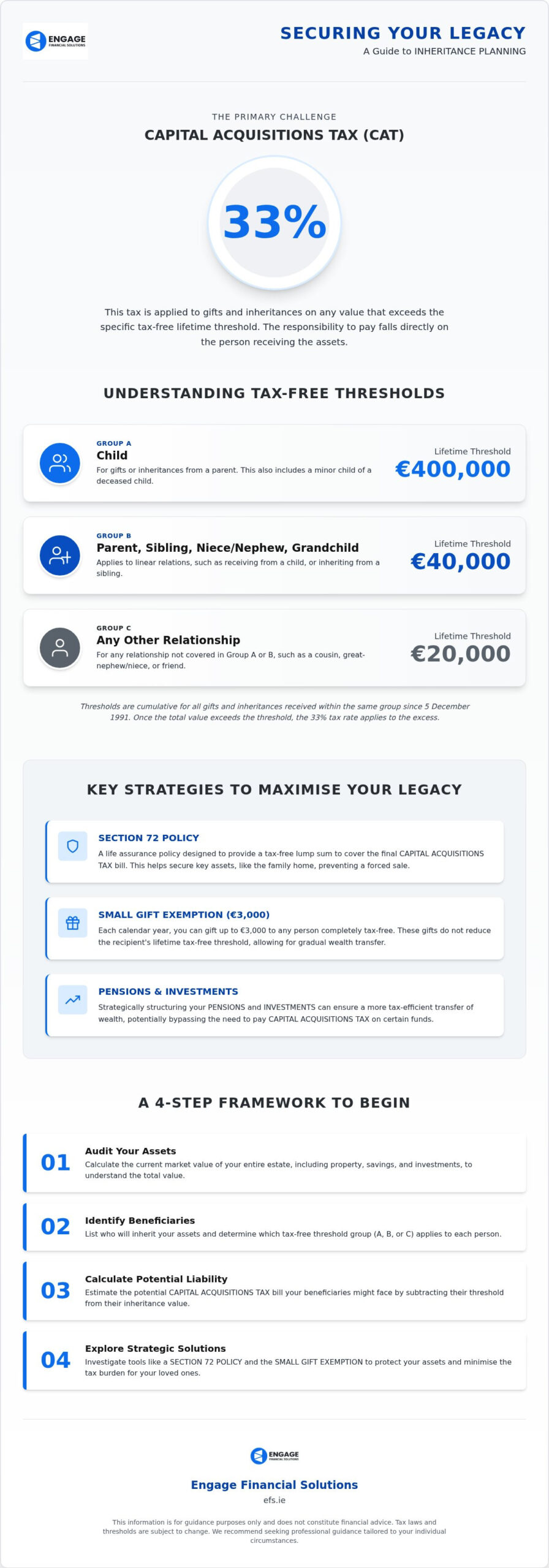
The cornerstone of any effective strategy involves a clear grasp of Capital Acquisitions Tax (CAT). This tax is currently charged at a flat rate of 33% on the value of any gift or inheritance that exceeds your specific tax-free allowance. Unlike systems where the estate pays the bill, here the responsibility falls directly on the person receiving the assets. This makes inheritance planning Ireland particularly vital for those who wish to ensure their beneficiaries aren’t forced to sell a cherished family asset just to settle a tax demand.
Thresholds are calculated on a lifetime basis. This means that any significant gifts you’ve received from people within the same group since 5 December 1991 are added together. Once the total value passes your threshold, every Euro above that limit is taxed at the full 33% rate. For many families, the family home is the primary asset, and with property prices rising, it’s increasingly common for even modest estates to drift past these limits. Understanding where you stand today is the first step toward safeguarding your legacy.
Navigating the Three Main Threshold Groups
Your relationship to the person providing the inheritance determines which tax-free group you fall into. Group A is the most generous, covering children inheriting from their parents, with a lifetime threshold of €400,000. Group B applies to linear ancestors, descendants, and siblings, but the allowance drops significantly to €40,000. Finally, Group C covers “strangers in blood,” such as cousins or friends, who are limited to a threshold of just €20,000. These stark differences mean that a lack of planning can result in very different financial outcomes for different family members.
How Asset Valuation Impacts Your Liability
The tax liability is based on the market value of the assets on the “valuation date,” which is usually the date the inheritance is officially processed. Inflation and a buoyant property market can quickly erode the effectiveness of an outdated plan. If a property was worth €350,000 when you last checked but has risen to €450,000 by the time it’s inherited, the tax-free buffer may no longer be enough. Regular reviews of your INHERITANCE PLANNING ensure that your strategy keeps pace with economic shifts. If you’re unsure how these thresholds apply to your specific family structure, a tailored financial review can provide the clarity you need to move forward with confidence.
Strategic Tools to Minimise Tax Liabilities and Maximise Legacies
Moving from the theory of tax thresholds to the practical application of financial tools is where true legacy protection begins. Effective inheritance planning Ireland isn’t just about calculating potential bills; it’s about choosing the right instruments to neutralise them. By integrating specific reliefs and approved policies, you can ensure that your family’s emotional and financial future remains intact. Proactive management allows you to transform a complex tax situation into a straightforward transfer of wealth.
The Power of the SECTION 72 POLICY
A SECTION 72 POLICY is perhaps the most efficient tool for families facing a significant CAPITAL ACQUISITIONS TAX liability. This is a specialised LIFE INSURANCE policy designed specifically to pay the tax bill arising on your death. For the proceeds to be exempt from tax, the policy must be Revenue approved and set up specifically for this purpose. It’s a proactive way to provide a tax-free lump sum that covers the state’s share, allowing your children to inherit the family home or business without financial strain. Because these policies require medical underwriting, it’s vital to establish them before certain age milestones or health changes occur.
Utilising the SMALL GIFT EXEMPTION Annually
The SMALL GIFT EXEMPTION is an often overlooked but incredibly powerful annual tool. You can gift up to €3,000 to any individual in a single calendar year without it affecting your lifetime tax-free threshold. When utilised over a long period, the impact is substantial. For example, a couple can gift €6,000 annually to each of their children. Over a 20-year horizon, this simple strategy transfers €120,000 per child entirely tax-free. This reduces the eventual size of your taxable estate whilst providing your loved ones with financial support during your lifetime.
Beyond these primary tools, other technical reliefs can further refine your strategy. Whilst a will is the foundation of any plan, Making a legally valid will is only the starting point. You can also structure your assets to utilise the CAPITAL GAINS TAX (CGT) offset. If a gift triggers both CGT and CAT on the same event, the CGT paid can often be credited against the CAT liability. This prevents double taxation on the same asset transfer. Additionally, for families with vulnerable beneficiaries, the use of TRUSTS can provide a layer of protection and professional management. If you’re ready to explore these options, a tailored financial planning review can help you identify the best fit for your family.
A Step-by-Step Approach to Organising Your Estate and Succession Plan
Creating a robust legacy requires more than just good intentions; it demands a methodical approach to your financial affairs. By breaking the process down into manageable stages, you can replace uncertainty with a structured path forward. This “future-back” perspective ensures that your end goals dictate your current actions, making the complex world of succession feel straightforward and achievable.
- Step 1: Conduct a full audit. Start by looking at the numbers. Whether you’re calculating the value of a family home or assessing the growth of various INVESTMENTS, having a clear picture of your net worth is essential. List all assets and liabilities to understand the potential tax exposure your heirs might face.
- Step 2: Define your core objectives. Decide who you wish to benefit and in what capacity. You might want to provide a lump sum for a grandchild’s education or ensure a spouse is looked after through an ANNUITY. Clear objectives prevent confusion later.
- Step 3: Model tax scenarios. Work with a professional to run the numbers based on current thresholds. Seeing how the 33% CAPITAL ACQUISITIONS TAX rate applies to your specific estate allows you to identify the exact funding gap you need to bridge.
- Step 4: Update your legal documents. A will is a foundational tool. Ensure it’s drafted in conjunction with legal professionals to reflect your latest financial decisions and family circumstances; for those seeking specialised legal opinions, Barristers Direct allows you to consult with counsel directly.
- Step 5: Implement protection tools. Once the gap is identified, put the right products in place. This might involve a SECTION 72 policy to cover tax bills or utilising PENSIONS to transfer wealth more efficiently.
The Critical Role of Timing in Your Plan
A good plan is flexible. Life events like marriage, the birth of a child, or moving house should always trigger a review of your strategy. National tax legislation can also shift, potentially altering the effectiveness of your existing setup. We recommend an annual financial health check to keep your legacy aligned with your current reality. If you haven’t reviewed your arrangements recently, seeking professional guidance is the best way to ensure your family remains protected against unforeseen friction.
Tailored Financial Guidance for a Seamless Wealth Transfer
Navigating the final stages of a wealth transfer can often feel like trying to solve a jigsaw puzzle where the pieces are constantly moving. Between shifting tax thresholds and the emotional weight of family discussions, the process can quickly become overwhelming for any household. This is where Engage Financial Solutions steps in as your steady guide, providing the authoritative expertise needed to navigate these transitions. We simplify the complexities of inheritance planning Ireland by providing a “full-stack” perspective that looks at the big picture. This means we don’t just focus on the eventual tax bill; we consider how your legacy interacts with your existing MORTGAGES, your current SAVINGS ACCOUNTS, and your long-term INVESTMENTS.
Why a Personalised Roadmap is Essential
Every family has a unique story, and off-the-shelf financial advice often fails to capture the nuances of individual relationships or specific asset structures. A generic template can’t account for the specific way you want to support your children or the particular tax efficiencies available to your business or farm assets. We act as the vital buffer between you and the friction of the financial world, ensuring your INHERITANCE PLANNING is seamlessly integrated into your wider FINANCIAL PLANNING. Whether you are looking to protect a single family home or manage a diverse portfolio of assets, a tailored approach is the only way to avoid unnecessary stress. By tailoring every step to your specific goals, we ensure that your strategy is as flexible and resilient as your life requires.
Securing Your Legacy with Confidence
The true value of professional oversight isn’t just found in the spreadsheets; it’s found in the deep sense of security it provides. When you have a structured plan in place, your perspective shifts from anxiety about potential liabilities to a sense of optimism about your family’s future. You can rest easy knowing that technical tools like a SECTION 72 policy or structured PENSIONS are working quietly in the background to safeguard your home. Our role is to provide meticulous attention to detail, anticipating potential hurdles before they even occur. We invite you to reach out for a straightforward, welcoming conversation about your goals. Booking a consultation is the first step toward creating a personalised roadmap that ensures your hard-earned wealth remains a source of success for the next generation. Visit efs.ie today to begin your journey toward long-term stability and calm competence.
Take the First Step Toward Lasting Peace of Mind
Securing your family’s future isn’t just about managing numbers; it’s about providing a stable foundation for the next generation. We’ve explored how understanding the 33% CAPITAL ACQUISITIONS TAX rate and utilising tools like the SECTION 72 policy can protect your home from significant financial friction. Whether you’re making use of the SMALL GIFT EXEMPTION or reviewing your PENSIONS, every proactive step you take today reduces the burden on your loved ones tomorrow. It’s about moving from a place of uncertainty to one of calm competence.
Navigating the complexities of inheritance planning Ireland doesn’t have to be a source of stress when you have a structured plan. As specialists in succession and SECTION 72 policies, we provide personalised, jargon-free guidance to make the process straightforward. We are regulated by the Central Bank and committed to being your steady guide through every transition. Secure your family’s future with expert INHERITANCE PLANNING from Engage Financial Solutions and start building your personalised roadmap today. Your legacy deserves the protection of a clear and reliable strategy.
Frequently Asked Questions
What is the current tax-free threshold for a child inheriting from a parent?
The current lifetime tax-free threshold for a child inheriting from a parent is €400,000. This Group A limit applies to the total value of all gifts and inheritances received from parents since December 1991. Any value exceeding this amount is subject to CAPITAL ACQUISITIONS TAX at a rate of 33%. Effective INHERITANCE PLANNING helps you manage these limits to protect your family legacy from unnecessary tax liabilities.
How can a SECTION 72 POLICY help with my tax bill?
A SECTION 72 POLICY is a specialised life insurance plan designed to pay the CAPITAL ACQUISITIONS TAX bill upon your death. The proceeds are exempt from tax if they are used to settle the revenue debt. This ensures your children receive a tax-free lump sum to cover the state’s share, meaning they won’t have to sell the family home. It is a proactive tool for achieving long-term stability.
What is the SMALL GIFT EXEMPTION and how much can I give tax-free?
The SMALL GIFT EXEMPTION allows you to give up to €3,000 to any individual in a single calendar year without paying tax. This gift does not count towards your lifetime tax-free thresholds. For a couple, this means you can gift €6,000 annually to each child. It’s a straightforward, friction-free way to transfer wealth gradually. This reduces the eventual size of your taxable estate and provides immediate support.
Do I have to pay CAPITAL ACQUISITIONS TAX on my family home?
You generally have to pay CAPITAL ACQUISITIONS TAX on a family home if its value exceeds your specific group threshold. Whilst a Dwelling House Exemption exists, it has very strict qualifying conditions, such as the beneficiary having lived in the property for three years prior to the inheritance. For most families, the home is their largest asset, making structured INHERITANCE PLANNING essential to avoid a sudden 33% tax demand.
Can I offset CAPITAL GAINS TAX against my inheritance tax liability?
You can often offset CAPITAL GAINS TAX (CGT) against your inheritance tax liability if both taxes arise from the same event. For example, if you gift a property during your lifetime, it may trigger both CGT and CAT. In this case, the CGT paid can be credited against the CAT due, preventing double taxation on the same asset transfer. This technical relief is a vital part of a tax-efficient wealth transfer.
Is INHERITANCE PLANNING only necessary for high-net-worth individuals?
No, INHERITANCE PLANNING is not just for the wealthy. Rising property values mean even modest family homes can now easily push an estate over the tax-free thresholds. Anyone with a home or modest SAVINGS ACCOUNTS and INVESTMENTS should consider a plan. Proactive stewardship ensures your assets are protected and that your loved ones aren’t left with an unexpected financial burden during an already difficult and emotional time.
What happens if I do not have a will in place?
If you don’t have a will, your estate is distributed according to the rules of intestacy. This means the law decides who gets what, which might not reflect your personal wishes or your family’s needs. It can lead to legal friction and potentially higher tax bills for your heirs. Having a clear plan ensures a seamless transition and gives you control over how your legacy is managed and protected for the future.
How often should I review my INHERITANCE PLANNING strategy?
You should review your INHERITANCE PLANNING strategy every three to five years or whenever a significant life event occurs. Marriage, the birth of a child, or a change in national tax legislation are all triggers for a review. Regular health checks ensure your strategy stays aligned with your current goals and market trends. This proactive approach helps maintain stability and keeps your family’s future secure and straightforward.
Disclaimer
Engage Financial Services LTD T/A Engage Financial Solutions is regulated by the Central Bank of Ireland CRO 764570. Director David Moore. Suite 2 First Floor, 14 -18 Main street, Blackrock, Co Dublin A94 W0Y3