


For a business owner, your health isn’t just a personal matter; it’s your most significant commercial asset. You’ve worked hard to build your reputation and your revenue, but without the safety net of employer sick pay, a sudden diagnosis can feel like a threat to everything you’ve achieved. Finding the right critical illness cover for self employed Ireland is a vital step toward securing your professional legacy. It’s natural to feel concerned about how the bills would be paid if you had to step away from the desk or the site to focus on recovery.
Whether you are a sole trader or a company director, we agree that the lack of state-funded support for those paying Class S PRSI creates a unique vulnerability. This guide provides a practical roadmap for building a bespoke financial safety net that ensures your business survives even if you face a serious health setback. We’ll explore how to secure a tax-efficient lump sum to cover your debts and clarify exactly which conditions are included, giving you the peace of mind to focus on your long-term stability.
Key Takeaways
- Understand why the lack of state-funded sick pay makes a personal safety net vital for protecting your livelihood and business during a health crisis.
- Learn how to structure critical illness cover for self employed Ireland to ensure you receive a tax-free lump sum that safeguards your professional legacy.
- Discover how to calculate a level of protection that covers both your personal bills and the essential business overheads that continue even if you cannot work.
- Explore the most tax-efficient ways to organise your premiums based on whether you operate as a sole trader or a company director.
- Gain clarity on the specific conditions covered and why expert guidance is key to navigating the complex options available in the domestic market.
The Self-Employed Reality: Why a Personal Safety Net is Essential
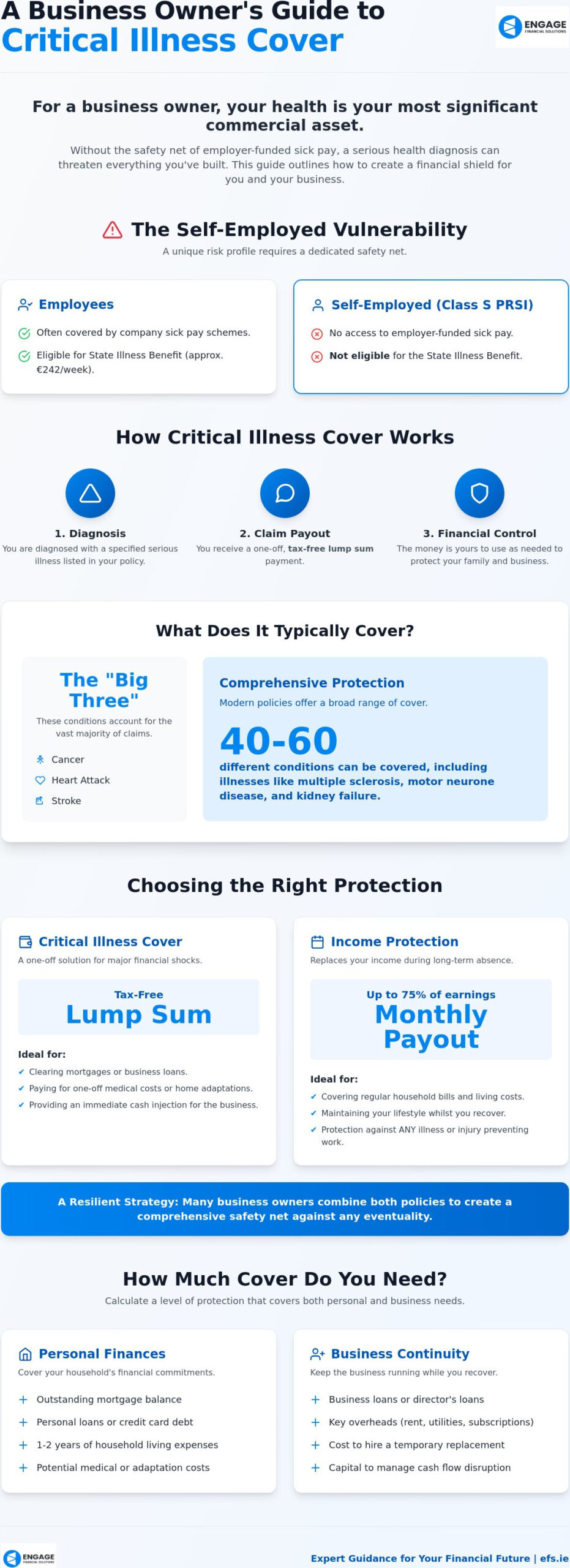
Working for yourself brings a sense of freedom that few other paths can match, but it also places the weight of responsibility squarely on your shoulders. If you are an employee, there is often a company sick pay scheme or a human resources department to manage your absence. When you are the business, a health shock doesn’t just affect your physical well-being; it ripples through your bank account and your professional commitments. This is where Understanding How Critical Illness Cover Works becomes essential. It provides a tax-free lump sum payment upon the diagnosis of a specified serious illness, giving you the liquid capital needed to protect your livelihood at a time when you need it most.
A sudden diagnosis can impact both your personal finances and your business operations simultaneously. Unlike a broken bone or a short-term flu, a serious illness often requires a prolonged period of recovery. For the 340,000 people currently working for themselves in the domestic market, the lack of a structured safety net can turn a health challenge into a financial crisis. Having a dedicated policy ensures that you aren’t forced to choose between your health and the survival of the company you’ve worked so hard to build.
The Gap in Public Support
Many individuals believe that their social insurance contributions provide a sufficient safety net, yet the reality for those paying Class S PRSI is quite different. As of 2026, self-employed workers are not eligible for the State Illness Benefit, which provides a weekly rate of €242 to eligible employees. Relying on basic state support, even if you qualify for other means-tested payments, usually leads to a sharp drop in your standard of living. Statistics from the CSO indicate that workers over the age of 35 have a one-in-six chance of being out of work for more than six months due to an accident or injury. Taking proactive control of your financial security through critical illness cover for the self-employed ensures that you aren’t left vulnerable to these odds.
Protecting Business Continuity
Your business has overheads that don’t stop just because you do. Rent, utilities, and professional subscriptions continue to accrue regardless of your capacity to work. A lump sum from a protection policy allows you to hire a temporary manager or outsource your tasks to a freelancer, ensuring your hard-earned reputation remains intact whilst you recover. There is a profound psychological benefit to this level of security; it removes the friction of worrying about debt and allows you to focus entirely on your health. By safeguarding your cash flow, you ensure that your business stays viable, providing a steady foundation for your eventual return to work.
Understanding How Critical Illness Cover Works for You
It’s easy to confuse various protection policies, especially when you’re busy running a company. At its core, this cover provides a single, tax-free lump sum if you’re diagnosed with a serious condition listed in your policy. Unlike general health insurance, which covers medical bills or hospital stays, this payment is yours to spend however you see fit. Whether you need to clear a commercial loan—such as those secured by a debenture through Funding Bay—pay for private treatment, or simply keep your household running whilst you step back from work, the choice is entirely yours.
Most policies focus on the “Big Three” conditions: cancer, heart attack, and stroke. These account for the vast majority of claims within the domestic market. However, modern policies often cover between 40 and 60 different conditions. The key trigger is a definitive diagnosis from a consultant. You don’t necessarily have to be unable to work to receive the payout; you simply need to meet the medical definition of the illness as outlined in your contract. This provides a distinct advantage over other forms of protection that require you to be totally incapacitated.
Critical Illness vs. Income Protection
A common question amongst business owners is whether they should prioritise a lump sum or a recurring salary. Income protection provides a monthly payment to replace up to 75% of your earnings if you’re unfit for work due to any illness or injury. In contrast, serious illness cover is a once-off event that terminates the policy once the claim is paid.
Many savvy professionals choose to combine both to create a truly resilient safety net. Whilst income protection manages your day-to-day lifestyle over the long term, a lump sum is far more effective for immediate debt clearance or making necessary modifications to your home or office. If you’re unsure which path fits your specific business structure, you can explore our range of Critical Illness Insurance options to see how they integrate with your wider financial plan.
What is Typically Covered?
Not all policies are created equal. You’ll often see a distinction between “standard” and “comprehensive” lists. A standard policy might cover the most common life-threatening conditions, whilst a comprehensive one includes a much broader range of illnesses, including certain neurological disorders or organ failures.
It’s vital to look closely at the “definitions” section of any quote. For example, a “partial payment” might be triggered for less severe conditions that don’t meet the full criteria but still require significant recovery time. Understanding these nuances ensures there are no surprises during a claim. By working with a steady guide, you can navigate these technical details with confidence, ensuring your policy is tailored to your actual risks rather than just the lowest premium.
Tailoring Your Cover to Your Business Structure
Your business structure acts as the blueprint for your financial decisions. Whether you operate as a sole trader or a limited company director, the way you fund your critical illness cover for self employed Ireland will differ significantly. Choosing the right ownership structure from the start ensures that your policy remains tax-efficient and compliant with local regulations. A steady guide can help you navigate these options, ensuring your protection plan aligns with your specific legal status and long-term commercial goals.
As your business grows, your needs will inevitably change. A policy that suited a startup might not provide enough security for an established firm with multiple employees and significant overheads. It is vital to organise your cover so it remains flexible. This allows you to adjust your level of protection as your revenue increases or your debt obligations shift, providing a seamless transition through different stages of your professional life.
Considerations for Sole Traders
For the unincorporated business owner, personal ownership is usually the most straightforward route. You pay your premiums from your post-tax income, which means you need to factor this cost into your personal monthly budget. Whilst premiums for serious illness cover do not qualify for tax relief in the same way that pension contributions or income protection might, the eventual payout is a tax-free lump sum. This creates a clean, uncomplicated safety net that provides immediate capital if you face a health crisis, allowing you to settle personal debts or business invoices without a complex claims process.
Options for Limited Company Directors
If you operate as a limited company director, you have more sophisticated ways to structure your protection. In many cases, the company can pay the premiums on your behalf. This is often viewed as a deductible business expense, which can be a highly efficient way to manage the cost of cover. Structuring your policy through the business entity can simplify your personal bookkeeping whilst ensuring you are personally protected.
Executive protection plans allow the business to act as the policyholder, providing a robust benefit for the director that doesn’t rely on personal net income. This approach effectively uses the company’s cash flow to safeguard your future stability. By working with a specialised consultancy, you can ensure that these arrangements are set up correctly from day one, avoiding any friction with the tax office and maximising the value of every euro spent on premiums. In a similar vein of professional risk management, you can learn more about InfoSecurix to ensure your business remains secure and compliant in an increasingly digital landscape.
Calculating the Right Level of Protection
Many individuals make the mistake of matching their protection levels solely to their mortgage balance. Whilst clearing a home loan is a significant relief, it often ignores the complex financial reality of running a business. For those working for themselves, a holistic view is required. You must consider how a health setback would affect your ability to maintain your current lifestyle whilst simultaneously keeping your professional commitments afloat. Choosing the right level of critical illness cover for self employed Ireland means looking beyond the immediate debt and planning for a future where you have the space to heal without compromise.
A “Lifestyle Maintenance” approach is often the most effective way to determine your required sum. This involves calculating the total capital needed to replace your net income for a specific period, typically two to five years. This buffer allows you to focus entirely on your recovery without the pressure of returning to work before you are physically or mentally ready. By securing a lump sum that reflects your true value to the business, you create a stable foundation that protects both your home and your professional legacy.
Assessing Your Financial Commitments
The first step is to create a clear checklist of your fixed costs. This shouldn’t just include your personal rent or mortgage, but also the commercial obligations that won’t disappear if you’re unwell. Consider the following:
- Commercial rent or office service charges.
- Leasing agreements for equipment or vehicles.
- Professional indemnity insurance and other essential subscriptions.
- Wages for staff or subcontractors who keep the wheels turning.
Once you have this total, evaluate how long your current business and personal savings would realistically last. Most find that their reserves would be depleted within months, not years. It is sensible to ensure your sum is index-linked so that the purchasing power of your payout keeps pace with the rising cost of living over the next decade. If you want to see how these figures look for your specific setup, you can contact us for a tailored quote that matches your actual outgoings.
Planning for the Recovery Phase
Recovery is rarely a linear process. A lump sum provides the liquid capital needed to “buy time,” but it also opens doors to better care. Private medical treatment, alternative therapies, or even travel for specialist consultations can be prohibitively expensive without a dedicated fund. Furthermore, a serious illness may require modifications to your home or office to ensure you can continue to function comfortably. Having a robust payout prevents a “fire sale” of business assets or the need to take on high-interest debt during a crisis. It ensures that when you do return to your desk, you’re doing so from a position of strength rather than financial desperation.
How to Organise Your Cover with Expert Guidance
Organising your protection shouldn’t feel like a transaction; it should feel like a partnership. Whilst it’s tempting to use a basic comparison site to find the lowest premium, the cheapest quote rarely offers the best value in serious illness insurance. In the domestic market, the difference between a successful payout and a rejected claim often lies in the nuanced medical definitions hidden in the small print. By using a specialised consultancy to scan the entire market, you ensure that your critical illness cover for self employed Ireland is robust enough to stand up when you need it most.
A professional advisor acts as a steady guide through the medical underwriting process. This is the stage where insurers assess your health history and determine your terms. It can be a source of stress for many, but having an expert to manage the disclosures and negotiate with providers ensures a seamless transition from application to a secured policy. We handle the technical friction so you can focus on your professional commitments, providing the calm competence required to navigate complex financial choices.
The Value of a Bespoke Review
A professional review often reveals gaps in existing protection that you might have overlooked. You may have an old policy from a previous employment or a basic plan attached to a mortgage that no longer reflects your current status as a business owner. We tailor every recommendation to your specific industry risks, recognising that a consultant’s needs differ from those of a tradesperson. Financial health is holistic. Just as you protect your physical well-being, you should also ensure your debt is structured efficiently. You might find the 2026 guide to switching mortgages helpful for optimising your monthly outgoings and freeing up capital for better protection.
Starting Your Journey to Financial Security
The path to long-term stability begins with a straightforward conversation. For your initial consultation, it’s helpful to have a basic overview of your business overheads, your current net income, and any existing policy documents you hold. This allows us to build a future-back plan that starts with your desired end-state of security and works backward to the present action. There is a profound sense of relief that comes from knowing a professional has meticulously vetted your safety net. In addition to a lump sum, we often recommend safeguarding your earnings through income protection to create a comprehensive shield for your household. Taking this proactive step today ensures that your business and your family remain protected, no matter what challenges the future may hold.
Securing Your Professional Legacy and Personal Peace of Mind
Taking the time to protect your health is the ultimate investment in your business. By moving beyond basic mortgage protection and accounting for your actual commercial overheads, you ensure that a serious diagnosis doesn’t lead to a financial crisis. We’ve explored how a tax-free lump sum can provide the liquid capital needed to hire staff, clear debts, or simply buy the time you need to recover fully. Finding the right critical illness cover for self employed Ireland is a vital step toward long-term stability.
As specialists in self-employed financial protection, we offer bespoke guidance tailored to your unique business structure. Our firm is regulated by the Central Bank and focuses on making complex transitions as straightforward as possible. You don’t have to navigate these technical definitions alone. Book a personalised consultation with our expert team to build a safety net that works as hard as you do. Your future security starts with a single proactive decision today.
Frequently Asked Questions
Is critical illness cover tax-deductible for the self-employed?
No, premiums for serious illness cover do not qualify for tax relief for sole traders. Unlike income protection, where you can often claim relief at your marginal rate, these premiums are paid from your post-tax income. The advantage of this arrangement is that any future payout you receive is completely tax-free, providing you with a clear lump sum to use as you see fit.
What is the difference between serious illness cover and income protection?
The main difference is the payout structure and the trigger for a claim. Serious illness cover pays a one-off tax-free lump sum specifically upon the diagnosis of a condition listed in your policy. Income protection provides a regular, taxable monthly income if you’re unable to work due to any illness or injury, continuing until you return to work or reach retirement age.
Do I need a medical exam to get cover when working for myself?
Not everyone needs a physical medical exam to secure a policy. In many instances, an insurer can provide a decision based on a digital application and a report from your GP. If you’re applying for a particularly high level of cover or have a complex health history, a brief medical assessment may be required to ensure your terms are tailored correctly to your health profile.
Can I get critical illness cover if I have a pre-existing condition?
Yes, it’s often possible to secure cover even if you have a pre-existing medical condition. The insurer might apply an exclusion for that specific condition or increase the premium to reflect the risk. We act as a steady guide to help you navigate different providers, as some insurers are more flexible than others depending on the specific nature of your health history.
How much does critical illness insurance typically cost for a business owner?
The cost of your policy is determined by your individual risk profile rather than your specific business type. Factors such as your age, smoking status, general health, and the total sum you wish to protect will all influence the premium. It’s best to organise a bespoke review so we can find a plan that fits your budget whilst covering your essential business overheads.
Will my policy cover me if I am diagnosed with a mental health condition?
Most standard serious illness policies focus on specific physical diagnoses like cancer, stroke, or heart attack. Whilst some comprehensive plans may include cover for very specific and severe neurological conditions, mental health is more traditionally covered under an income protection policy. It’s vital to review the specific definitions in your policy documents to understand the scope of your protection.
Is the lump sum payment from a claim taxable?
No, the lump sum payment from a successful serious illness claim is currently paid tax-free. This provides you with the full amount of your chosen cover to clear commercial loans, pay for medical treatment, or support your family’s lifestyle. Because you don’t receive tax relief on the premiums, the tax authorities do not take a portion of the final payout.
Can I cancel or change my cover if my business circumstances change?
Yes, your policy is designed to be flexible as your professional life evolves. You can typically increase or decrease your level of protection or cancel the plan if your debt obligations change or you decide to exit your business. We recommend a regular review of your critical illness cover for self employed Ireland to ensure it remains aligned with your current revenue and personal goals.
Disclaimer
Engage Financial Services LTD T/A Engage Financial Solutions is regulated by the Central Bank of Ireland CRO 764570. Director David Moore. Suite 2 First Floor, 14 -18 Main street, Blackrock, Co Dublin A94 W0Y3