
What if the most effective way to lower your recruitment costs wasn’t a larger hiring budget, but a more robust way to protect the people you already have? You’ve likely felt the pressure of a competitive Irish labour market where high staff turnover and the rising costs of long-term sick leave can disrupt even the most stable organisation. Implementing a group protection scheme Ireland is no longer just an optional extra; it’s a strategic tool designed to turn potential financial risks into long-term business resilience.
We understand that the complexity of Irish tax rules and benefit-in-kind regulations can feel overwhelming. This guide will show you how to navigate the latest 2026 updates, such as the increased USC thresholds, whilst securing tax-deductible premiums for your company. You’ll learn how to establish competitive “Death in Service” and sick pay benefits that are straightforward to manage and deeply reassuring for your team. By the end of this resource, you’ll have a clear roadmap to building a healthier, more loyal workforce through tailored solutions that safeguard your bottom line and your people simultaneously.
Key Takeaways
- Understand the essential distinction between group risk and individual policies to ensure your business provides the most efficient coverage for your team.
- Learn how to implement a group protection scheme Ireland employers use to provide vital “Death in Service” and long-term income protection benefits.
- Discover the strategic tax advantages available to Irish companies, including how premiums can be treated as a fully deductible business expense.
- Gain a clear framework for conducting a benefits audit to tailor a scheme that balances your budget with the specific needs of your workforce.
- Explore how expert guidance helps you navigate the 2026 regulatory landscape to create a seamless and competitive benefits package.
What is a Group Protection Scheme in Ireland?
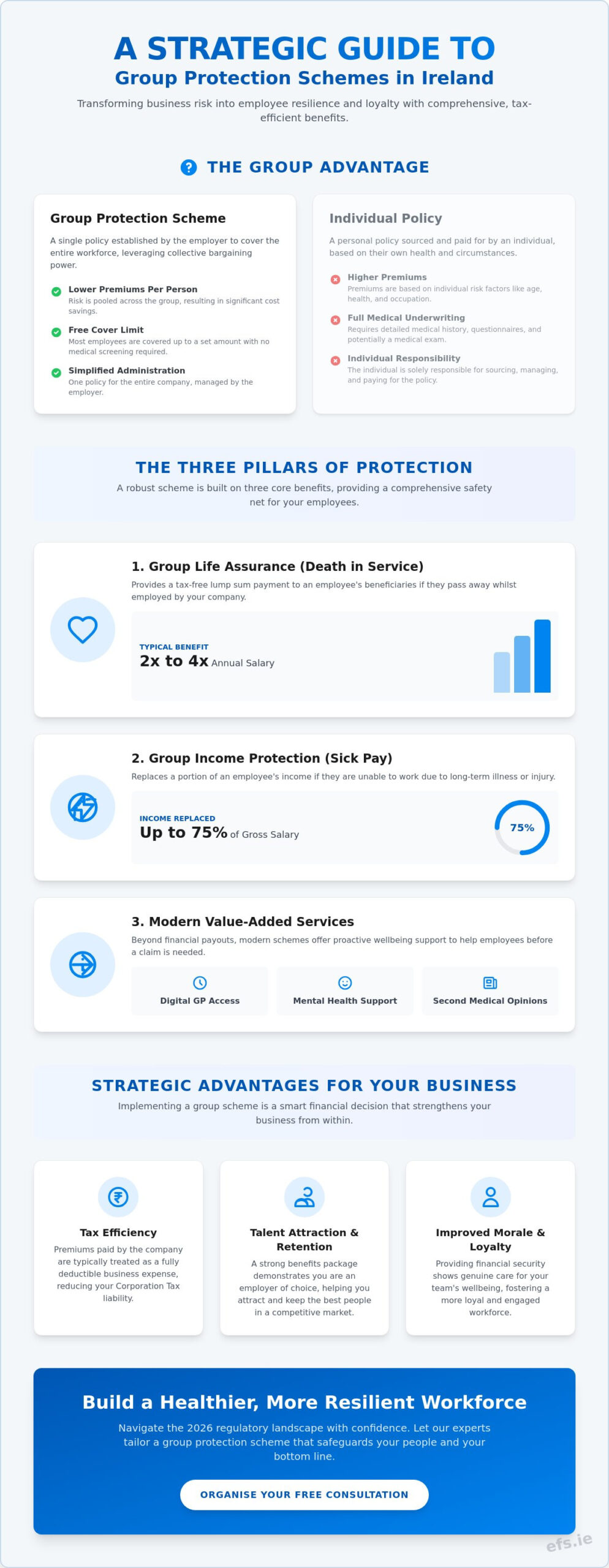
A group protection scheme Ireland serves as a vital safety net, allowing businesses to provide financial security to their employees through a unified insurance contract. Unlike individual policies that a person might source themselves, these schemes are established by you, the employer, as the policyholder. You are effectively acting as a steward for your workforce, ensuring that if life takes an unexpected turn, your team members and their families aren’t left in financial distress. This arrangement forms a core part of a broader Employee Benefits Overview, where the collective purchasing power of the company is used to secure terms that would be difficult to obtain on an individual basis.
As we move through 2026, the Irish market has shifted. Standalone life cover is often no longer enough to satisfy a discerning workforce. Employees now look for holistic support that covers not just the worst-case scenario, but also the long-term illness or injury that can derail a career. By opting for a comprehensive scheme, you align your business with modern expectations of corporate responsibility and stability. It’s a proactive way to manage “Group Risk,” a term brokers use to describe the collective insurance of a workforce under one umbrella.
The Concept of “Group Risk” Explained
The term “Group Risk” describes how insurance providers evaluate the collective health and demographics of your entire workforce rather than assessing each person individually. This pooling of risk typically leads to significantly lower premiums per head. One of the most attractive features is the “Free Cover Limit.” This allows employees to be covered up to a certain monetary value without needing to provide medical history or undergo health screenings. It’s a much more straightforward process than the rigorous medical underwriting required for individual Income Protection Ireland policies, making it easier for you to protect a diverse team quickly.
Who Can Be Covered Under an Irish Scheme?
Flexibility is a hallmark of a well-designed group protection scheme Ireland. You can generally include full-time, part-time, and even certain contract staff, provided they meet the eligibility criteria agreed with the insurer. To keep the structure fair and manageable, most employers organise their staff into “categories of membership.” For instance, you might offer different levels of cover based on years of service or job role. It’s also worth noting that directors and senior management can be included within the same framework, ensuring that the leadership team enjoys the same peace of mind and tax efficiencies as the rest of the organisation.
The Three Pillars of Employee Group Protection
A robust group protection scheme Ireland is built upon three foundational pillars that provide security throughout different life stages and health challenges. By 2026, these schemes have evolved beyond simple insurance payouts. They now integrate comprehensive value-added services as standard, such as mental health support, digital GP access, and second medical opinions. These additions reflect a shift towards proactive wellbeing, ensuring your team feels supported long before a claim is ever necessary.
Group Life Assurance (Death in Service)
Often the most recognised element of a benefits package, Group Life Assurance provides a tax-free lump sum to an employee’s beneficiaries should they pass away whilst in your employment. Most Irish businesses structure this benefit as a multiple of the employee’s annual salary, typically ranging from two to four times their earnings. For staff members, this offers immense peace of mind, particularly for those with young families or significant financial commitments. It acts as a vital safety net that complements their personal Mortgage Protection Ireland, ensuring their loved ones are safeguarded against sudden loss. The Tax Treatment of Life Assurance guidelines from the Revenue Commissioners outline how these premiums can be managed as an allowable business expense, making it a cost-effective way to show genuine care for your workforce.
Group Income Protection (Sickness Benefit)
While life cover protects against the worst-case scenario, Group Income Protection addresses the more common risk of long-term illness or injury. This pillar replaces a portion of an employee’s salary, usually up to 75% of their gross income (less the State Illness Benefit), after a set waiting time known as the deferred period. You can choose deferred periods of 13, 26, or 52 weeks to align with your company’s existing sick pay policy. A standout feature in the 2026 market is the “Early Intervention” advantage. Rather than just paying a claim, modern schemes provide rehabilitation and vocational support to help employees return to work safely and sooner. This proactive approach distinguishes the benefit from other covers, as explored in our guide on Income Protection vs Critical Illness Ireland. It is also worth noting that for contractors or business owners operating outside of a group scheme, understanding income protection self employed Ireland options is equally critical, as Class S PRSI contributors receive no State sick pay safety net.
Group Specified Illness Cover
This benefit is often a favourite amongst employees because it provides an immediate, tax-free lump sum upon the diagnosis of a serious condition, such as cancer or a major heart event. Unlike income protection, which provides a monthly stream, Specified Illness Cover offers financial liquidity when it’s needed most to cover medical costs or home modifications. Under current Revenue rules, these lump-sum payments are generally tax-free for the employee. Creating a balance between these three pillars allows you to build a truly resilient benefits package that staff value and trust.
Strategic Advantages for the Irish Employer
Investing in a group protection scheme Ireland is as much a financial strategy as it is a human resources one. For many Irish employers, the primary driver is the ability to compete for talent against multinational corporations that traditionally offer extensive benefits. However, the advantages extend far beyond recruitment. By shifting the financial burden of long-term sick leave from your company’s balance sheet to an insurer, you protect your cash flow and ensure your business remains resilient during unforeseen disruptions. This proactive management of risk allows you to focus on growth, knowing that your team is safeguarded by a professional framework.
The Financial Logic of Tax Relief
The financial logic of these schemes is compelling for any business owner. When you organise your premiums correctly, they are typically deductible as an allowable business expense against Corporation Tax. Crucially, premiums paid for Life and Income cover are generally not treated as a Benefit-in-Kind (BIK) for your employees. This allows you to provide a high-value benefit without increasing their personal tax liability. We often encourage clients to take a “Future-Back” perspective; by spending a manageable amount today, you avoid the massive disruption costs of trying to fund an employee’s long-term absence out of pocket. It’s vital to follow the specific Death in Service Benefit Rules set by Revenue to ensure your scheme remains compliant and tax-efficient while providing the maximum possible relief for the firm.
Boosting Productivity and Loyalty
A secure workforce is a productive one. When an employee knows a safety net exists, it alleviates the underlying financial stress that often leads to distracted behaviour or reduced focus. This psychological security fosters a deeper sense of loyalty, as staff see a tangible demonstration of your duty of care and corporate social responsibility. In 2026, positioning your group protection scheme Ireland as the centrepiece of your employee value proposition (EVP) tells your team that their stability is your priority. This commitment to stewardship creates a culture of optimism and long-term partnership, which is the hallmark of any successful Irish business. Rather than just a transaction, the scheme becomes a symbol of the “calm competence” your company offers its people, making your organisation a more attractive place to build a career.
Designing and Implementing Your Scheme
Implementing a group protection scheme Ireland requires a methodical approach to ensure it fits the unique culture and budget of your firm. The process begins with a “Benefits Audit” to evaluate any existing covers, such as those linked to a company pension or statutory requirements. Once you’ve identified the gaps, you can define your budget and select the pillars that are most critical for your sector. For example, a tech firm with a younger demographic might prioritise mental health support and income protection, whilst a more established manufacturing business might focus on higher life assurance multiples.
To move from planning to reality, you’ll need to gather anonymised employee data, including age, gender, and salary, for a formal market tender. This step allows you to compare various providers and find the most flexible terms for your specific workforce. Once the scheme is live, regular reviews are essential. As your business grows and your headcount increases, your requirements will shift, making it vital to ensure your protection remains competitive and cost-effective. It’s about building a sustainable framework that evolves alongside your company.
Setting the Right Benefit Levels
Choosing the correct levels of cover is a balancing act between cost and care. For income protection, you should align the “Deferred Period” with your company’s existing sick pay policy. If you provide three months of full pay, a 13-week deferral ensures a seamless transition for the employee without unnecessary premium costs. When it comes to life cover, you can choose between a flat-rate lump sum or a multiple of salary, usually between two and four times earnings. You must also consider the “Free Cover Limit,” which protects the majority of your staff without medical underwriting, though your highest-earning directors may require additional assessment to secure full coverage.
Communicating Benefits to Staff
A scheme only provides value if your employees understand it. Many staff members undervalue their benefits simply because they aren’t aware of the scope of the protection or the value-added services included. Organising “Benefit Days” or digital workshops is a straightforward way to explain how the cover works and the peace of mind it offers. It’s also a practical time to collect “Expression of Wish” forms. These documents are vital, as they ensure death benefits reach the correct beneficiaries quickly, avoiding the stress of lengthy probate processes and ensuring your stewardship reaches the family as intended.
If you’re ready to build a more resilient future for your team, you can contact our advisors at Engage Financial Solutions to begin your benefits audit today.
The Value of Expert Guidance with Engage Financial Solutions
Establishing a group protection scheme Ireland is a significant commitment to your team’s future success. Whilst the benefits of such a scheme are clear, the process of selecting a provider in the 2026 market requires meticulous attention to detail. An independent broker is essential. We don’t just find a policy; we act as your steady guide through a complex financial environment. By acting as the buffer between your business and the insurance giants, we remove the friction of administration. This allows you to focus on your core operations whilst we handle the technical intricacies of renewals and claims.
Why a “One-Size-Fits-All” Approach Fails
Choosing a provider based solely on the lowest initial quote can be a costly mistake. These budget options often contain hidden clauses that restrict claims behaviour or fail to account for the specific risks of your industry. Our role is to identify these pitfalls before they become problems. We ensure your scheme is tailored to your business size and sector, providing a seamless fit that grows with you. Whether you’re a small start-up looking to attract your first key hires or an established firm aiming to optimise a legacy benefits package, we tailor every detail to ensure it meets your specific commercial goals. Crucially, we look at the big picture, ensuring your protection integrates perfectly with other corporate benefits like Retirement Planning Ireland. This holistic approach prevents fragmented benefits and ensures every euro spent contributes to a unified strategy for staff security.
Your Partner in Long-Term Financial Success
At Engage Financial Solutions, we believe in building partnerships rather than just conducting transactions. Managing “Group Risk” shouldn’t be a source of stress for your HR or finance departments. We provide the calm competence needed to manage annual renewals and assist with complex claims, ensuring your employees receive the support they were promised. This professional stewardship provides the peace of mind that comes from knowing experts are safeguarding your workforce. If you’re ready to secure a more stable future, the next step is straightforward. Request a bespoke market comparison today to see how a tailored group protection scheme Ireland can transform your business resilience.
Securing Your Workforce for 2026 and Beyond
Choosing to implement a group protection scheme Ireland is a definitive step towards creating a more resilient and loyal workforce. You’ve seen how these schemes transform “Group Risk” into a strategic advantage by leveraging tax efficiencies and reducing the direct financial burden of long-term employee illness. By integrating the three pillars of protection, your business doesn’t just offer a job; it offers a secure future that attracts and retains the best talent in a competitive market.
As you look toward your company’s next phase of growth, professional stewardship is vital to ensure your benefits remain compliant and cost-effective. We are regulated by the Central Bank of Ireland and bring deep expertise in both the mortgage and protection markets to every bespoke consultancy project we undertake for Irish SMEs. We act as your proactive partner, simplifying the complex so you can focus on leading your team with confidence.
When you’re ready to move from planning to action, you can request a tailored Group Protection quote from Engage Financial Solutions to begin your market comparison. We look forward to helping you build a more stable and optimistic future for your business and your people.
Frequently Asked Questions
Is a group protection scheme tax-deductible for my Irish business?
Yes, premiums paid by an employer for a group protection scheme Ireland are typically treated as an allowable business expense for corporation tax purposes. This allows your company to offset the cost of providing these benefits against its taxable profits. It is a highly efficient way to safeguard your workforce whilst managing the firm’s overall tax liability in a professional and structured manner.
Does group life assurance count as a Benefit-in-Kind (BIK) for employees?
No, premiums paid by an employer for group life assurance are generally not treated as a Benefit-in-Kind for the employee under current Irish Revenue rules. This means you can provide a significant financial safety net for your team’s families without increasing the employees’ personal tax burden. It remains one of the most tax-efficient benefits an Irish employer can offer to their staff.
What is the “Free Cover Limit” in a group protection scheme?
The Free Cover Limit is the maximum amount of insurance an employee can receive under a group protection scheme Ireland without needing to provide medical evidence. This feature allows the majority of your workforce to be covered automatically and immediately, regardless of their individual health history. It removes the friction of medical screenings for most staff, ensuring a seamless implementation process for the business.
Can a small business with only 5 employees set up a group scheme?
Yes, many insurance providers in the Irish market offer tailored solutions for small businesses with as few as three to five employees. Whilst some traditional schemes require larger numbers, several insurers have developed specific “micro-group” products. These allow smaller firms to offer the same high-tier benefits as multinationals, helping you compete for talent by providing essential security to your core team.
How does Group Income Protection interact with the Irish State Illness Benefit?
Group Income Protection is usually designed to integrate with the State Illness Benefit to ensure the employee receives a consistent level of income. The insurer typically pays out the agreed percentage of the salary, such as 75% of gross income, and then deducts the amount the employee is entitled to receive from the State. This prevents any overlap in benefits whilst maintaining the employee’s financial stability during a long-term absence.
What happens to an employee’s cover if they leave the company?
An employee’s cover under the group scheme typically ceases on the day they leave your employment. However, many modern policies include a “continuation option” or “conversion option.” This allows the departing staff member to move their cover to an individual policy without providing new medical evidence. It provides a smooth transition for the individual whilst ensuring your company’s liability ends when the contract does.
Is medical underwriting required for every employee in the scheme?
No, medical underwriting is generally only required for employees whose benefit levels exceed the scheme’s Free Cover Limit. Most of your staff will be accepted into the scheme automatically without any health questions. Only high-earning individuals or those with specific requirements above the standard limit will typically need to complete a medical questionnaire or undergo a health assessment to secure full coverage.
Can we include “Specified Illness Cover” as an optional add-on for staff?
Yes, you can include Specified Illness Cover as a valuable additional pillar within your overall benefits framework. This provides a tax-free lump sum to an employee upon the diagnosis of a serious condition, such as cancer or a major heart event. You have the flexibility to offer this to all staff or specific categories of membership, depending on your company’s budget and long-term recruitment strategy.
Disclaimer
Engage Financial Services LTD T/A Engage Financial Solutions is regulated by the Central Bank of Ireland CRO 764570. Director David Moore. Suite 2 First Floor, 14 -18 Main Street, Blackrock, Co Dublin A94 W0Y3