

Did you know that by the start of 2026, the number of self-employed individuals in Ireland climbed to nearly 380,000, yet many remain just one injury or illness away from a total loss of earnings? If you’re a Class S PRSI contributor, you already know that the safety net of State sick pay simply doesn’t exist for you. It’s a stressful reality to face, especially when your monthly profits fluctuate and the rules around Revenue tax relief feel like a maze. You deserve a solution that provides stability without the friction of traditional insurance hurdles.
Whether you’re a seasoned contractor or just starting your journey, securing the right income protection self employed Ireland policy is about more than just a premium; it’s about safeguarding your future. This guide offers a clear roadmap to protecting your income and ensuring you’re taking full advantage of the tax-efficient benefits available to you. We will walk you through the nuances of policy selection and Revenue rules, helping you transition from uncertainty to a place of lasting financial peace of mind.
Key Takeaways
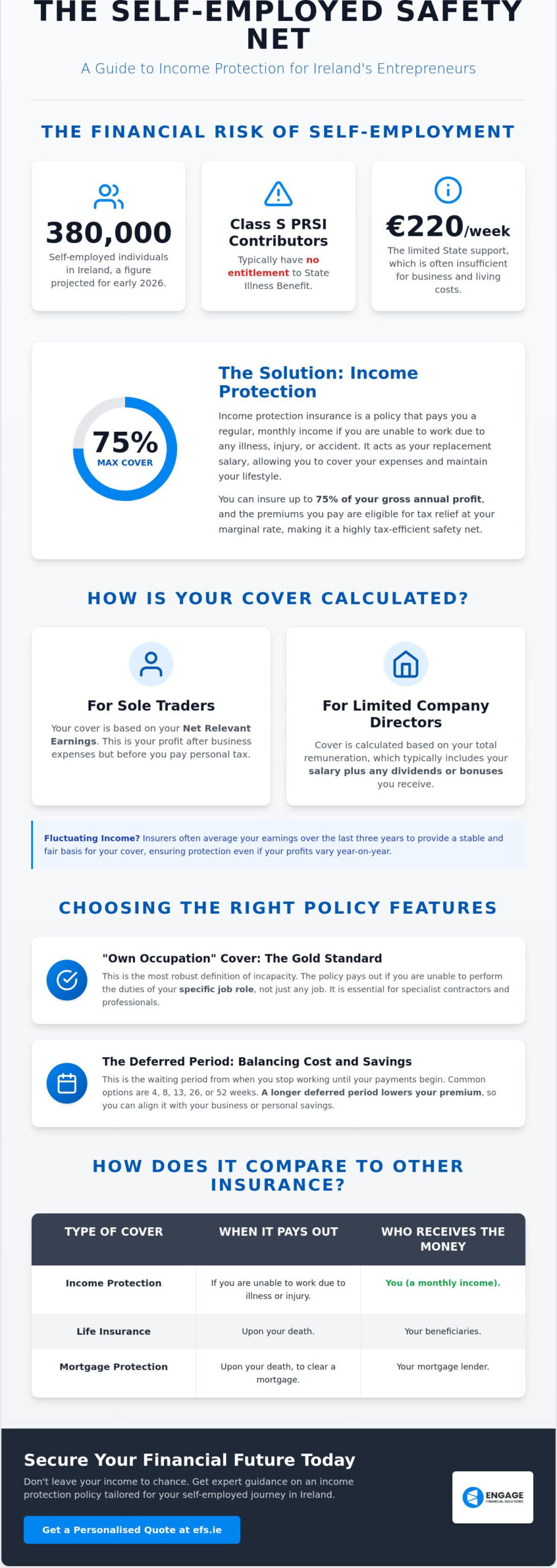
- Understand why Class S PRSI contributors face unique financial risks and how to replace up to 75% of your gross profit if you are unable to work.
- Learn the specific Revenue rules for calculating cover and how your status as a sole trader or limited company director affects your tax relief options.
- Discover why “Own Occupation” cover is the gold standard for specialist roles and how to choose a deferred period that balances cost with your existing savings.
- Master the application process for income protection self employed Ireland by understanding what medical underwriters look for to ensure a seamless approval.
- See how a “Future-Back” perspective can transform your financial planning into a straightforward path toward long-term stability and peace of mind.
Why Income Protection is Essential for the Self-Employed in Ireland
Working for yourself brings a sense of freedom and autonomy that few PAYE roles can match, but it also removes the structured safety net many take for granted. Income protection insurance is designed to bridge this gap, allowing you to insure up to 75% of your gross annual income. This isn’t just about paying the monthly bills; it’s about maintaining your lifestyle and ensuring business continuity if an illness or injury prevents you from working. It acts as a cornerstone of your long-term financial security, providing a steady stream of revenue when you need it most.
Most self-employed individuals in Ireland pay Class S PRSI. Whilst this contribution provides access to certain benefits, it leaves a significant void during periods of ill health. The State Illness Benefit, which stands at €220 per week in 2026, is often the only support available to those who qualify. For a professional with business overheads, a mortgage, and family commitments, this amount rarely covers even the basic necessities. This is why income protection self employed Ireland is no longer a luxury but a fundamental requirement for modern contractors.
It’s vital to distinguish this cover from other policies you might already hold. Whilst they all offer protection, their purposes differ significantly:
- Life Insurance: Provides a lump sum payment only upon your death.
- Mortgage Protection: Specifically designed to clear your mortgage debt with a lender, leaving nothing for daily expenses.
- Income Protection: Replaces your monthly earnings directly to you whilst you are alive but unable to work.
The Vulnerability of the Sole Trader
Freelancing often creates a “no work, no pay” cycle that leaves little room for error. If you cannot show up for a project, the revenue stops immediately, yet your business overheads and personal expenses don’t pause. Relying solely on savings is an increasingly high-risk strategy in 2026, especially as living expenses and the cost of doing business continue to fluctuate. A tailored policy acts as a buffer, ensuring that a period of ill health doesn’t lead to a permanent financial setback for your business or your home life.
Comparing Employee Benefits vs Self-Employed Reality
When you moved from employment to being your own boss, you likely left behind a package of benefits such as paid sick leave, death-in-service cover, and group protection schemes. Choosing income protection self employed Ireland restores that missing safety net, providing the same level of security you once enjoyed as a PAYE worker. It ensures that your ambition to work for yourself doesn’t come at the cost of your family’s future stability. The core purpose of income protection for a sole trader is to provide a guaranteed monthly revenue stream that replaces your earnings until you are fit to return to your craft. For expert guidance on tailoring a policy to your specific needs, the team at Engage Financial Solutions is here to help you find the right fit.
Calculating Your Cover: The Rules for Profits and Tax Relief
Determining the right level of cover is a balancing act between your current lifestyle requirements and the strict rules set by the Revenue Commissioners. In Ireland, the maximum amount of cover you can secure is 75% of your gross annual income. Unlike employees in PAYE roles, self-employed individuals do not have to subtract the €220 weekly State Illness Benefit from this calculation, as most Class S contributors are ineligible for it. This means your income protection self employed Ireland policy serves as your entire financial safety net.
How insurers define your earnings depends heavily on your business structure. If you are a sole trader, your cover is based on your Net Relevant Earnings, which is your profit after business expenses but before personal tax is deducted. For limited company directors, the calculation typically includes your salary plus any dividends or bonuses. Because your income can shift year to year, it’s vital to review your policy annually. If your business has grown significantly, you might find yourself under-insured; conversely, if profits have dipped, you could be paying for cover you cannot technically claim.
The Fluctuating Income Challenge
Insurers understand that self-employment rarely follows a perfectly straight line. To manage this, they typically use a three-year average of your profits to determine your insurable income. If your most recent year was exceptionally profitable, we can work with you to ensure your policy reflects your current trajectory rather than just your past performance. This is particularly important for contractors who move between high-value, short-term projects. If you are looking for other ways to optimise your monthly outgoings, you might also consider switching mortgage Ireland to reduce your household overheads whilst you focus on business growth.
Maximising Tax Efficiency in 2026
One of the most compelling reasons to choose income protection self employed Ireland is the generous tax relief available. You can claim relief on your premiums at your highest marginal rate of income tax, whether that is 20% or 40%. Effectively, this means the government subsidises nearly half the cost of your protection if you are a higher-rate taxpayer. It’s important to remember that tax relief is capped at premiums amounting to 10% of your total annual income. By paying these premiums from your gross income, you lower your overall tax bill while building a more stable future. Our comprehensive guide to income protection Ireland provides a detailed breakdown of how to claim tax relief and structure your policy for maximum efficiency. If you would like a personalised illustration of how these tax savings apply to your specific earnings, the team at Engage Financial Solutions can provide a clear, straightforward breakdown tailored to your business needs.
Choosing the Right Policy: Key Features and Comparison Points
Selecting the right policy for income protection self employed Ireland requires looking beyond the monthly premium. The most critical feature to look for is the “Own Occupation” definition of disability. This is the gold standard for specialists because it ensures the policy pays out if you are unable to perform the specific duties of your own job, rather than any job. For example, if a graphic designer develops a condition that prevents them from using a computer but allows them to work in a different, lower-paid field, an Own Occupation policy still honours the claim. Without this clarity, you risk a situation where an insurer might suggest you are fit for alternative work, leaving you without the financial support you expected.
Stability is another vital consideration, particularly when choosing between guaranteed and reviewable premiums. A guaranteed premium remains the same throughout the life of the policy, providing a fixed cost that helps you manage your business overheads with certainty. Reviewable premiums may start lower but are subject to increases by the insurer, often at five-year intervals. In the current economic climate of 2026, most of our clients prefer the predictability of a guaranteed structure. You should also consider adding “escalation in claim” to your policy. This ensures that if you are out of work for several years, your monthly payout increases annually to protect your purchasing power against inflation.
Deferred Periods: 4, 8, 13, or 26 Weeks?
The deferred period is the “waiting time” between the start of your illness and when the policy begins to pay out. Choosing a longer period, such as 26 weeks, will significantly reduce your monthly premium, but it requires you to have a robust emergency fund to cover your expenses in the interim. Conversely, a 4-week period offers immediate peace of mind but comes at a higher cost. Amongst the Irish self-employed, a 13-week deferred period is the most popular choice, as it often aligns with a typical three-month cash flow buffer held within a business. Matching this period to your actual savings ensures you aren’t overpaying for cover you don’t immediately need.
Support Beyond the Payout
Modern policies offer far more than just a cheque in the post. Leading insurers now provide comprehensive rehabilitation services and career retraining support to help you find a sustainable way back to work. A particularly valuable feature for the self-employed is the “proportionate benefit.” This allows you to receive a partial payout if you return to work in a reduced capacity or for fewer hours as you recover. It bridges the gap between your reduced earnings and your previous profit levels, ensuring your transition back to full-time work is seamless and stress-free. Understanding the nuances of these features is essential, and you may find it helpful to compare income protection vs critical illness Ireland to see which combination of benefits best safeguards your specific lifestyle and long-term aspirations.
The Application Process: Navigating Medical Underwriting
The transition from choosing a policy to actually securing it often feels like the most daunting part of the journey. Medical underwriting is the process insurers use to assess the risk they are taking on, and for many, this can feel slightly intrusive. However, our role is to act as your steady guide, ensuring the process is as seamless and transparent as possible. Full disclosure from the outset is essential. Being open about your medical history with your advisor prevents complications or declined claims in the future. It’s about providing a clear, honest picture so your income protection self employed Ireland policy is built on a solid foundation.
Once your application is submitted, it is reviewed by the insurer’s underwriting team, which may include a Chief Medical Officer. In 2026, many providers use tele-underwriting interviews. These are straightforward phone calls with a trained nurse who will ask detailed questions about your health and lifestyle. Depending on the information provided, there are three typical outcomes. You might receive “standard rates,” which means no changes to the quoted price. Alternatively, you may face a “loading,” which is a small increase in premium due to a specific risk, or an “exclusion,” where a particular condition is not covered. Our goal is to ensure you understand these outcomes fully before you commit.
Mental Health and Pre-existing Conditions
In 2026, the insurance industry has a much more nuanced understanding of mental health, including stress, anxiety, and depression. Whilst these conditions were once difficult to insure, modern underwriters look at how you manage your health and your history of recovery. Physical pre-existing conditions, such as chronic back pain, are also common amongst sole traders and may result in a specific exclusion for that condition. An experienced broker helps navigate medical loadings by presenting your health profile to multiple insurers to find the most favourable terms for your specific circumstances.
Proving Your Earnings to the Insurer
Because your benefit is tied to your profits, you must provide concrete evidence of your income history. Insurers typically require your Chapter 4 tax assessments or audited accounts from the last few years. If you have recently started your business, most providers follow a “12-month rule,” requiring at least one full year of trading before they can offer a policy. It is also vital that your “Occupation Class” is correctly assigned, as a mismatch here can lead to issues during a claim. To begin your journey with a tailored assessment of your eligibility, you can contact our team at Engage Financial Solutions for expert advice.
Securing Your Future with Engage Financial Solutions
Securing your future is about more than just selecting a policy; it’s about establishing a partnership that understands the rhythm of your professional life. At Engage Financial Solutions, we utilise a “Future-Back” perspective. We start by discussing your desired end-state — a life of financial stability, business success, and the freedom to recover without pressure — and work backward to identify the precise protection you need today. This ensures that your income protection self employed Ireland policy is not a generic product, but a tailored asset that evolves alongside your career.
Whilst a generic online calculator might offer a quick estimate, it is a blunt instrument that cannot account for the nuances of your business structure. Whether you are navigating the complexities of dividend splits or averaging three years of fluctuating profits, a personalised advisor provides a level of “calm competence” that an algorithm simply cannot match. We act as the buffer between you and the complexities of the financial world, removing the friction from the application process so you can stay focused on what you do best: running your business.
For entrepreneurs whose ventures span both Ireland and the United Kingdom, or those needing specific linguistic support, a Romanian speaking legal advisor UK can offer invaluable assistance with cross-border business advisory and tax services.
Tailored Protection for Irish Entrepreneurs
We take the weight of research off your shoulders by navigating the entire panel of Irish insurers on your behalf. Our goal is to find a solution that offers the perfect balance of comprehensive cover and tax efficiency, ensuring you don’t overpay for protection you don’t need. This client-centric approach provides the peace of mind that comes from knowing every detail, from your “Own Occupation” definition to your deferred period, has been meticulously managed. You can learn more about how we compare the Best Income Protection Policy Ireland has to offer in our detailed 2026 comparison guide.
Contact Engage Financial Solutions Today
Taking the first step toward long-term security should be straightforward and stress-free. We invite you to join us for a no-obligation consultation where we can discuss your specific goals and simplify the financial transitions ahead of you. Our team is dedicated to proactive stewardship, anticipating potential challenges before they occur to ensure your path to protection is seamless. When you are ready to move from uncertainty to a place of lasting optimism, we are here to guide you. We encourage you to Book a consultation with our expert team today and begin the journey toward a more stable and secure professional future.
Building Your Path to Lasting Financial Stability
Choosing the right income protection self employed Ireland policy is a vital step toward safeguarding your business and your family’s lifestyle. We’ve explored how you can protect up to 75% of your earnings whilst taking advantage of significant tax relief at your marginal rate. By selecting features like “Own Occupation” cover and matching deferred periods to your cash flow, you transform a potential vulnerability into a structured asset. It’s about moving away from the “no work, no pay” cycle and into a future defined by security and optimism.
As specialists in tailored protection for the self-employed, we provide expert guidance on Revenue tax relief and policy selection. We are regulated by the Central Bank of Ireland, ensuring that your financial well-being is managed with the highest standards of professional stewardship. Our goal is to make these complex transitions feel straightforward and stress-free. If you’re ready to create a safety net that truly understands the reality of contracting, we’re here to help you navigate every detail. Secure your income with Engage Financial Solutions today and take the first step toward a more stable professional life. Your future self will thank you for the peace of mind you build today.
Frequently Asked Questions
Can I get income protection if I have only been self-employed for a year?
Yes, you can typically secure cover once you have 12 months of trading history and a set of accounts. Insurers use this first year to establish your insurable income for the policy. If you have recently moved from a PAYE role to contracting in the same industry, some providers may offer flexibility based on your continuous professional experience and expertise.
Is income protection tax-deductible for sole traders in Ireland?
Yes, premiums are fully tax-deductible at your highest rate of income tax. This means if you pay tax at 40%, the net cost of your income protection self employed Ireland policy is significantly reduced. You can claim this relief through your annual Revenue self-assessment return, making it a highly tax-efficient way to safeguard your earnings and your future stability.
Does income protection cover me if I go out of business or become redundancy?
No, these policies are specifically designed to replace earnings lost due to illness or injury. They don’t provide cover for business failure, bankruptcy, or voluntary redundancy. You should view this as a health-related safety net rather than a general business insurance policy, as the payout only triggers when a medical professional confirms you are unfit to perform your work duties.
What is the difference between personal and executive income protection?
The primary difference lies in who pays the premium and how tax relief is applied. A personal policy is paid from your own bank account with relief claimed on your tax return. Executive cover is a company-paid benefit for limited company directors, where the business pays the premium as a deductible expense, often allowing for higher levels of tax-efficient contributions for the director.
How much does income protection for the self-employed cost in 2026?
Whilst we cannot provide a fixed price, average premiums for income protection self employed Ireland rose by 47.4% in 2025 due to a significant increase in claims. Choosing a longer deferred period or a guaranteed premium structure can help you manage these costs and ensure long-term affordability. We recommend a personal consultation to find a solution that fits your budget whilst providing robust security.
Can I claim for mental health issues under my income protection policy?
Yes, mental health conditions such as stress, anxiety, and depression are covered by most modern policies. As long as the condition prevents you from performing your “Own Occupation” and wasn’t specifically excluded during the medical underwriting process, you can make a valid claim. Insurers now place a greater focus on providing rehabilitation support to help you return to work safely and sustainably.
What happens to my policy if I return to being an employee?
You can generally maintain your policy if you return to a PAYE role. The cover remains valid, but you’ll need to update your tax relief arrangements. Instead of claiming via self-assessment, your new employer may be able to facilitate relief through the payroll system, or you can continue to claim it personally at the end of the tax year through your tax credits.
Do I need to undergo a medical exam to get cover?
A physical medical exam is not always required. Many applications are processed through tele-underwriting, where a nurse conducts a detailed health interview over the phone. A formal exam or a GP report is typically only requested if you are seeking very high levels of cover or if your medical history requires further clarification from the insurer’s Chief Medical Officer to assess the risk correctly.
Disclaimer
Engage Financial Services LTD T/A Engage Financial Solutions is regulated by the Central Bank of Ireland CRO 764570. Director David Moore. Suite 2 First Floor, 14 -18 Main street, Blackrock, Co Dublin A94 W0Y3