


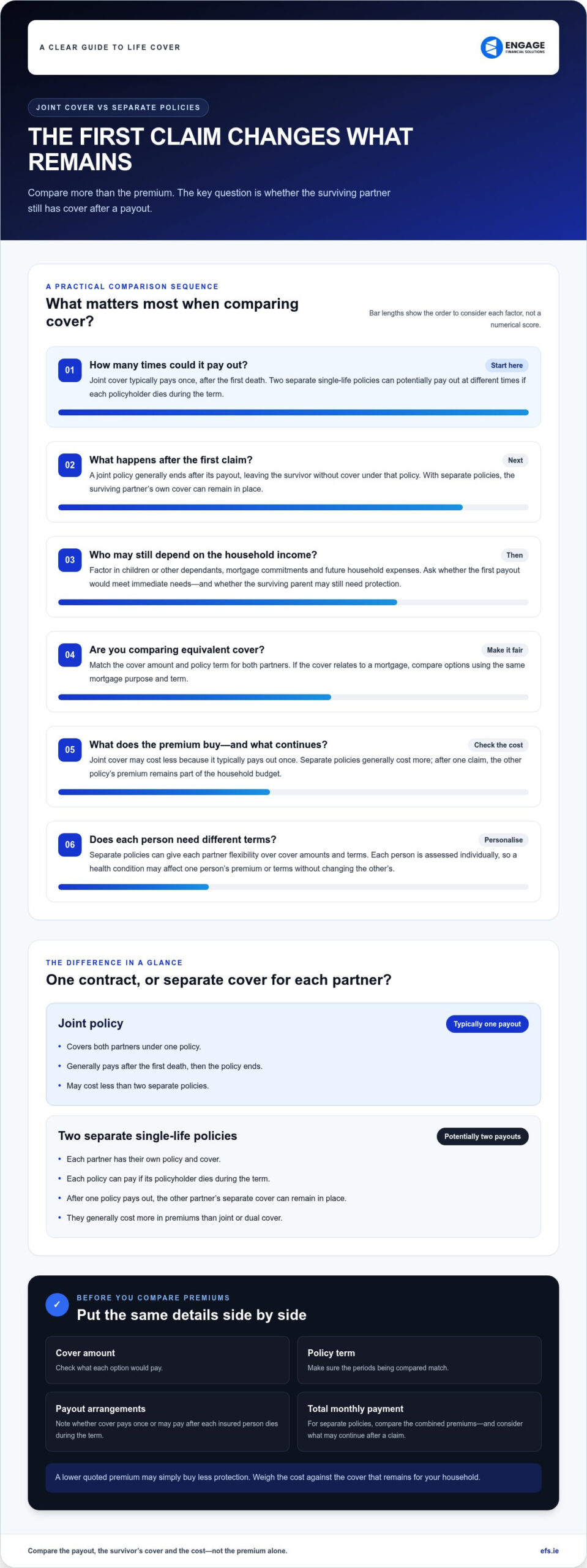
The lower-cost option can leave your partner without life cover. When comparing joint life insurance vs single policy cover, joint insurance may cost less because it typically pays out once. Two separate single-life policies can each pay out if the policyholder dies during the term. The key difference is whether cover remains for the surviving partner.
It’s natural to focus on the premium, particularly when balancing household bills with plans for dependants or future expenses. But a useful comparison also considers how many times a policy can pay out, what happens after the first death and whether each partner needs a different level of cover.
This guide explains how joint and separate policies work, what can affect their relative cost and how to weigh your family’s needs. You’ll have a clearer way to compare the options and choose cover that fits your plans.
Key Takeaways
- Compare how many times each option can pay out, not just the premium you pay.
- Consider whether your partner would still need life cover after the first claim.
- Factor in dependants, mortgage commitments and future household expenses when deciding how much protection is needed.
- Separate policies can give each partner more flexibility over cover amounts and policy terms.
- Before applying, weigh the paperwork involved alongside the cover’s cost and how each person is assessed.
What is single life insurance?
A single life insurance policy covers one person and pays the chosen amount if that person dies during the policy term. Comparing it with joint cover means weighing the premiums against how many payouts your household may need.
Separate payouts from single policies
With two separate single policies, each partner has their own cover, and each policy can pay out if its policyholder dies during the term. This can mean two payouts at different times, rather than the one payout available from joint cover. If one partner dies first, the other’s separate policy can remain in place. This may matter when a child or another dependant still relies on both incomes.
Payouts after a policyholder dies
A single policy pays its chosen benefit if the insured person dies during the term, subject to the policy conditions. A claim on one policy does not end the other partner’s cover, because it is held under a separate policy. Joint cover, by contrast, generally pays out once after the first death and then ends, leaving the survivor without cover under that policy. Consider how your circumstances could change, including if you have dependants or separate, before deciding whether one payout is enough.
For example, if one partner’s income supports a child, consider whether the first payout would meet immediate needs and whether the surviving parent would still need protection. Two single policies can provide another payout if the second person later dies during the term. This structure may suit families whose dependants need financial support over a longer period, rather than only help after the first death.
Tax treatment also deserves attention, particularly for unmarried couples. A single life insurance payout can be written in trust to bypass probate and remain outside inheritance tax calculations. An unmarried partner may otherwise have to pay 33% inheritance tax on the majority of a life insurance payout. A trust changes how the benefit is arranged, so consider this alongside who should receive the money and when they may need it. As part of wider estate planning alongside trusts, couples often also choose to register a lasting power of attorney to ensure a partner has legal authority to manage assets and financial decisions if health issues arise.
Joint cover may cost less because it typically pays out once. Two separate policies generally cost more in premiums than joint or dual cover, although the difference between joint and dual cover can be small. Compare the premium with the protection that remains after the first claim, rather than treating the lowest payment as the best value.
| Option | Who is covered? | Potential payouts | After the first claim |
|---|---|---|---|
| Single policy | One person | One per policy | The partner’s separate policy can remain in place |
| Two single policies | Each partner separately | Potentially two | The surviving partner can retain their own cover |
| Joint policy | Both partners under one policy | One | Cover ends after the claim |
Choose by matching the potential number of payouts to your dependants’ needs and the cover the survivor may still require.
Comparing the cost of joint and separate policies
Compare the monthly payment with the cover it buys and what remains after a claim. For a fair comparison, use equivalent cover amounts and terms for both partners.
Joint policy costs
A joint policy covers two people under one contract, with one premium, and may cost less because it typically pays out once. Its monthly cost depends on the cover, term and applicants’ circumstances, including health. Compare the payment with the payout structure, not just the combined premiums for individual cover. Protection for the surviving partner after a claim is part of the value comparison.
Separate policy costs
Separate policies have individual premiums, so compare the total monthly payment for both partners. Each person is assessed separately. A medical condition may affect one person’s premium or terms without changing the other’s. This arrangement can cost more than joint or dual cover, but it lets the cover reflect each partner’s needs and circumstances.
The phrase joint life insurance vs single policy describes two structures, but the useful comparison is between equivalent cover. Note the amount insured, how long each policy lasts, and whether it pays out once or can pay after each insured person dies during the term. Without matching these details, a lower quoted premium may simply buy less protection.
For example, if you’re comparing cover linked to a mortgage, use the same mortgage purpose and term for each option. Then compare the joint premium with the combined premiums for separate policies. Consider, too, how a claim affects the household’s future cover: a joint policy ends after its payout, while the surviving partner’s separate policy can remain active.
Joint cover is often priced close to dual cover, so the premium difference may be small. Few insurers actively promote new joint policies in this market. Two separate single-life policies generally cost more than joint or dual cover, and may offer little benefit in some circumstances. Weigh the extra flexibility against the additional premium rather than assuming separate cover is automatically better value.
For a joint life insurance vs single policy decision, write down each option’s total monthly payment, cover amount, term and payout arrangements. This makes it easier to see whether a price difference reflects a useful difference in protection. If one person’s health affects the terms, record that separately from the other partner’s quote.
Finally, consider the payment after the first claim. Joint cover ends, so no further premiums are due under that policy, but neither person remains covered by it. With separate policies, the other partner’s cover can continue, and its premium remains part of the household budget. Weigh that continuing cost against the protection it provides. If mortgage borrowing is central to your plans, Mortgage Protection planning can help you consider cover alongside that commitment.
Assessing dependants and future expenses
Choose cover based on the people and costs that would remain if either partner died. A couple without other dependants may find joint cover sufficient, but children or relatives relying on household income can make continued cover for the survivor more important.
Start with a practical example: if one parent dies, the surviving partner may need to manage childcare, housing and everyday bills on one income. List the expenses your household would still face, then consider whether a payout after the first death could meet them. Include regular commitments and future needs, such as education or care for a dependant.
Next, ask whether your household needs one payout or protection for both deaths during the policy term. Joint cover pays out once, after the first insured person dies, and then ends. That may suit a couple whose main goal is meeting a shared, short-term commitment. Separate cover can provide another payout if the second person later dies during the term, which may matter when children or other loved ones depend on both partners.
Marriage doesn’t by itself determine how much cover your household needs. While couples planning their wedding often focus on celebration and entertainment with services like Stevie Dee Wedding DJ, establishing long-term financial security is just as essential. Focus on who depends on each person’s income, care or contribution. For example, if a partner provides unpaid childcare, their death could leave the household facing replacement care costs, even without a salary to replace. Consider both partners’ roles when estimating the financial impact of a death.
- Write down each dependant and the support they receive from you.
- List household costs that would continue, including mortgage payments and childcare.
- Identify future expenses, such as education or ongoing care.
- Decide whether the surviving partner needs life cover after the first payout.
How joint life insurance works
A joint life insurance policy covers two people under one contract and has one monthly premium. The policy sets the amount payable and the length of cover. In the type of joint policy described here, it pays out once if the first insured person dies during the term. The payout goes to the surviving life insured and is the same whichever person dies first.
After that claim, the joint policy ends. The survivor has no further life cover under it and pays no further premiums. For example, if a couple chooses joint mortgage protection, the payout clears the mortgage and the cover ends. This can meet a shared borrowing need, but it doesn’t leave life cover in place for the survivor.
Dual life cover works differently, although people sometimes confuse the terms. It covers both people separately, with each assessed individually. If one partner dies during the term, their policy can pay out while the other partner’s cover continues. The second policy can also pay out if that person later dies during the term, so the arrangement can provide two payouts.
Mortgage protection offers a clear comparison. Joint mortgage protection pays out once, clears the mortgage and then ends. Dual mortgage protection also clears the mortgage after the first death, but keeps cover for the surviving partner for the rest of the term. That remaining cover reduces as the mortgage would have done, rather than ending with the first claim.
Joint cover is often cheaper than two separate policies because it typically pays out once. But the premium alone doesn’t show how much protection remains after a claim. Compare the policy amount, term and payout rules. A lower monthly payment may suit a couple seeking one payout for a shared commitment; a need for continued cover for the survivor points towards a different structure.
Relationship changes matter, too. Divorce doesn’t automatically change a life insurance policy, and insurers generally don’t allow an active joint policy to be changed directly into two single policies. Some joint policies do allow a split into two individual policies after separation. Read the policy terms for this provision before relying on it.
If a joint policy ends after a claim, the survivor would need a new single-life policy to obtain further cover. Changes in age or health by then can affect the premium or terms. A single-life policy covers one person, while a joint policy covers two lives under one contract. Unmarried couples should also distinguish joint cover from a “life of another” policy, which is structured around one person insuring another.
Before choosing, compare who receives the payout, what event triggers it and whether cover continues for the survivor. Then match those details to the policy’s purpose, such as clearing a mortgage or providing longer-term protection.
How do you compare and apply for joint or single life insurance?
Compare the purpose of the cover first, then check how each policy handles applications and claims. A clear process helps you weigh one joint application against separate policies without overlooking the cover each partner needs.
Start by setting out the amount of cover and policy term that fit your household plans. If you share a mortgage, for example, compare options against the borrowing and consider whether cover should clear it after the first death. Separate policies let partners choose different amounts and terms, which can suit different incomes or responsibilities.
Next, compare the payout arrangements. A dual-life policy covers each person separately and can pay out twice, once after each policyholder dies during cover. Joint cover pays out once after the first death. Put the number of potential payouts alongside the premium and the cover remaining for the survivor, so your comparison reflects what your household would receive.
Then consider how health information affects each application. With dual cover, each person is assessed individually. A medical condition may affect that person’s premium or terms, while the other partner’s premium remains unaffected. If medical history is relevant, the order of applications matters: underwriting decisions relate to the applicant, and applying to the wrong insurer first can limit options.
For a joint application, both people need to be present to provide their personal details. The application can involve one set of paperwork, while separate policies involve extra administration. Before applying, organise both applicants’ details and make sure each person understands the cover amount, term and payout structure under consideration.
Use this comparison checklist before you decide:
- Match the cover amount and term to your mortgage or household need.
- Compare the total premium for both partners, not one policy against two.
- Record whether a claim pays once or can pay out for each person.
- Check whether separate policies allow different amounts and terms.
- Consider how each person’s health assessment may affect their own terms.
For example, one partner may need more cover because they contribute more household income, while the other has different financial responsibilities. Separate policies can reflect that difference. A joint policy may be simpler to apply for, but it gives both people the same insured amount.
Once you have compared these points, choose the structure that matches your priorities: one application and one payout, or separate cover tailored to each person with the potential for two payouts. Discuss your life cover needs as part of a considered financial plan.
Engage Financial Solutions: Income Protection
Engage Financial Solutions can help you consider how Income Protection fits alongside life cover in your wider financial plan. Life insurance is designed to pay a benefit after a death covered by the policy. Income Protection addresses a different concern: it protects income if illness or injury affects your ability to work, subject to the policy terms.
Consider both risks when planning for a mortgage, household bills or dependants. For example, life cover may support loved ones after a death, while Income Protection can form part of a plan for managing financial commitments during a period away from work. The right balance depends on your responsibilities and existing arrangements.
For guidance on fitting Income Protection into your financial plans, contact Engage Financial Solutions.
Make your next financial decision with confidence
Choosing between joint life insurance and a single policy is one part of protecting the plans you’re building together. As your household changes, review how your cover fits alongside your mortgage, income and longer-term commitments. A new home, a move to a rental property or a change in borrowing can all prompt a fresh look at your financial priorities.
Engage Financial Solutions also offers Switching mortgages, First-time buyer mortgages and Buy-to-let mortgages. If a property decision is shaping your protection needs, considering your mortgage and life cover together can help you form a more joined-up plan.
Take the next step at a pace that suits you. Contact Engage Financial Solutions to discuss how your financial plans can support the future you’re working towards.
Frequently Asked Questions
How does a joint policy pay out?
A joint first-death policy pays its benefit if the first insured person dies during the term. The survivor receives the payout, and the policy then ends. For example, if the policy is intended to clear shared borrowing, the payout can address that commitment, but won’t provide continuing life cover for the survivor. Read the policy’s claim and beneficiary wording so you understand who receives the money.
So, which should you pick?
Choose based on your household’s need for ongoing protection, not just the monthly premium. If you want cover to remain for the surviving partner, separate policies can support that aim. If one payout would meet a specific shared need, joint cover may suit. Compare the term, cover amount and what happens after a claim, then consider how the options fit your financial plans and dependants.
What if one of us has medical history?
With separate cover, each person is assessed individually, so a medical condition may affect their terms without changing the other partner’s premium. For example, one partner could receive different terms while the other’s policy is assessed on their own circumstances. Previous underwriting decisions can affect later applications, so organise relevant medical details before applying and consider the order of applications carefully.
When might joint life make sense?
Joint cover may suit a couple whose main purpose is one payout for a shared, short-term commitment. For example, partners without other dependants might prioritise addressing a shared debt if either dies during the term. Consider whether the survivor would still need cover afterwards. If children, relatives or future expenses rely on continuing financial support, compare that need with a policy that keeps cover in place.
What is joint life insurance and how does it work?
Joint life insurance covers two people under one policy, with one premium. The first-death arrangement described here pays out once if either insured person dies during the policy term. The payout is the same whichever person dies first and goes to the surviving life insured. For an unmarried couple, ownership and the intended recipient are important planning details, alongside the payout trigger and the policy term.
What is single life insurance and how does it work?
Single life insurance covers one person and pays the selected benefit if that person dies during the policy term. Each partner can hold their own policy, with cover amounts and terms suited to their individual responsibilities. For example, if one person contributes more towards household costs, their cover might be designed around that need. Compare the intended recipient and how the benefit fits your household arrangements.
What is the difference between joint first-death and joint second-death life insurance?
First-death cover pays out after the first insured person dies, whereas second-death cover is designed to pay out after the second insured person dies. The timing affects who may benefit and when the money becomes available. First-death cover can provide funds to the survivor sooner. Second-death cover may be considered where the financial need arises after both people have died, such as providing for beneficiaries at that point.
How do joint and single life insurance premiums compare?
Joint cover may have a lower premium because it typically provides one payout, while premiums for two separate policies are generally higher than for joint or dual cover. The difference between joint and dual cover can be small. Compare equivalent cover amounts and terms, then consider how health assessments affect each person. A lower payment may not represent better value if it leaves a protection gap after a claim.
Disclaimer
Engage Financial Services LTD T/A Engage Financial Solutions is regulated by the Central Bank of Ireland CRO 764570. Suite 2 First Floor, 14 -18 Main street, Blackrock, Co Dublin. A94 W0Y3