


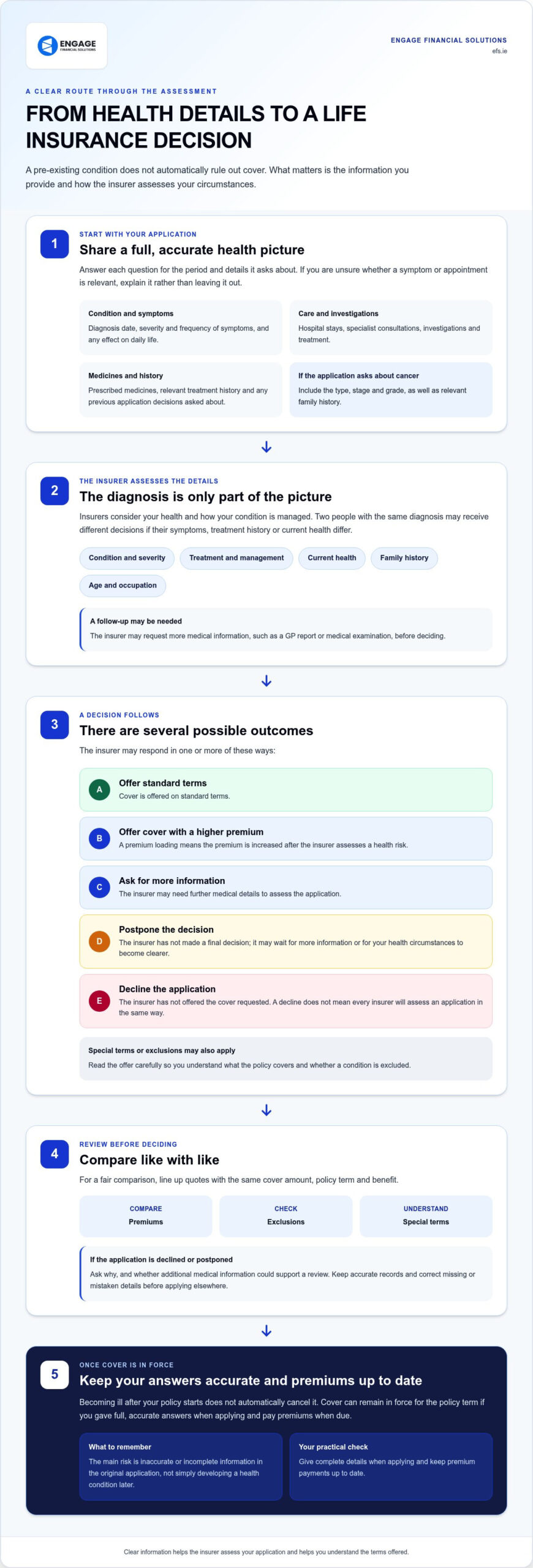
A pre-existing condition doesn’t automatically prevent you from getting life insurance. An insurer may accept your application on standard terms, charge a higher premium, request more medical information, postpone its decision or decline cover. Life insurance with a pre-existing medical condition can remain in force if you gave full, accurate information when applying and keep up with your premiums.
It’s understandable to worry that a diagnosis could mean higher costs or that a policy might later be cancelled. Insurers assess the details of your health and how your condition is managed, so clear, complete answers matter from the outset.
This guide explains what an insurer may ask about your medical history, when it might request a GP report or medical examination, and how your condition could affect eligibility, premiums or exclusions. You’ll also learn when a life insurance application may be postponed and why a policy could be invalidated if important information was inaccurate or missing.
Key Takeaways
- Answer health questions fully and accurately, including details of symptoms, investigations, treatment and medicines.
- A pre-existing condition doesn’t automatically rule out cover; its type, severity and management can affect the insurer’s decision.
- An insurer may accept your application on standard terms, charge a higher premium, request more information, postpone its decision or decline cover.
- Prepare for possible follow-up questions or a GP report, and understand what any exclusions or special terms mean for your cover.
- Keep premiums up to date and remember that inaccurate or incomplete application information could put your policy at risk.
Can a life insurance company cancel your policy if you get sick?
Becoming ill after your policy starts doesn’t automatically cancel it. Cover can remain in force for the policy term if you gave full, accurate answers when applying and pay premiums when due. The main risk is inaccurate or incomplete information in your original application, not simply developing a health condition later.
A pre-existing condition can include a diagnosis made before applying, but also undiagnosed symptoms or a history of investigations, treatment or counselling. Answer each question for the period and details it asks about. If you’re unsure whether an appointment or symptom is relevant, explain it rather than leaving it out.
Insurers consider your health, family history, age and occupation before deciding whether to accept, postpone or decline an application. Applying for life insurance with a pre-existing medical condition may result in standard terms, a higher premium, requests for information, special terms or an exclusion. A recent diagnosis can lead to a delay while the insurer gathers information or waits for your health circumstances to become clearer.
Give specific details about the condition, rather than just a broad label. Include:
- The diagnosis date, symptoms, their severity and frequency, and any effect on daily life.
- Hospital stays, specialist consultations, investigations and treatment.
- Prescribed medicines, including what you take and relevant treatment history.
- For cancer, the type, stage and grade, as well as relevant family history.
If you’re receiving cancer treatment, you may be unable to obtain cover until treatment is complete. A postponement or decline isn’t the same as cancelling a policy: it means the insurer hasn’t accepted the application on the terms requested. Disclose any previous decline, postponement or acceptance on special terms for life, serious illness or income protection on a later application.
For a fair comparison, line up quotes with the same cover amount, policy term and benefit, then compare premiums alongside exclusions and special terms. Consulting independent insurance resources such as allinsurancenofees.com can offer helpful perspective on how different providers approach policy terms and pricing. If an application is declined, ask the insurer for its reasons and whether additional medical information could support a review. Provide accurate records and correct any missing or mistaken details before applying elsewhere. This helps you understand what affected the decision and compare like-for-like terms.
Eligibility for life insurance with a pre-existing condition
A diagnosis doesn’t automatically make you ineligible for life insurance. An insurer’s medical underwriting process considers your health history and the details of your condition before deciding whether to offer cover, and on what terms. Your answers help the underwriter understand the condition, rather than relying on its name alone.
For example, two applicants with the same diagnosis may receive different decisions if their symptoms, treatment history or current health differ. A well-managed condition may be assessed differently from one involving ongoing investigations or recent changes. Age, occupation and family history can also form part of the assessment. These factors help the insurer decide whether the risk fits its terms.
There are several possible outcomes when applying for cover. An insurer may offer life insurance on standard terms, apply a premium loading, request more information, postpone its decision or decline the application. A loading means a higher premium because of the health risk assessed. Special terms or an exclusion may also affect what the policy covers, so read the offer carefully before accepting.
A postponement means the insurer hasn’t made a final decision yet. It may seek updated details or wait for more information about an illness. A decline means it hasn’t offered the cover requested. Neither outcome proves that every insurer will assess your application in the same way. If your circumstances change, such as treatment ending or new health information becoming available, keep relevant records to support a later application. Similarly, for those exploring cover in the United States, specialist services such as US Insurance Made Easy help navigate underwriting requirements to find affordable solutions.
Life insurance and illness cover are not interchangeable. Life insurance pays a benefit under the policy’s terms if the insured person dies during the cover period. Critical illness cover is designed to pay a cash sum for specified illnesses, subject to the policy conditions. A pre-existing condition may make this cover unavailable, or lead to an extra premium or an exclusion for that condition. Consider whether Critical Illness Insurance fits your wider protection needs, and compare its terms separately from life cover.
To prepare for an eligibility assessment, gather a clear account of your diagnosis, symptoms, treatment and prescribed medicines. Include relevant investigations and specialist appointments, and describe how the condition affects daily life. If an application asks about previous decisions on life, serious illness or income protection, disclose any decline, postponement or special terms. Accurate details give the underwriter a clearer basis for assessing your application and help you understand the offer before deciding.
How medical conditions affect eligibility and premiums
An insurer assesses your health condition alongside its severity and how it’s managed. Those details can affect whether cover is offered and the premium you pay.
Effects of existing conditions on premiums
A premium loading is an increase to the usual premium after an insurer assesses a health risk. The condition itself matters, as do its severity and how well it’s managed. For example, an insurer may assess a stable condition differently from one involving ongoing symptoms or treatment. The medical details in your application help shape the decision and the terms offered.
Possible outcomes include standard terms, a higher premium, requests for more medical information, special terms or exclusions, postponement, or a declined application. An exclusion can mean the policy does not cover a particular condition in specified circumstances. Read the offer carefully so you understand how its terms affect the protection you’re taking out.
Life insurance costs in the Irish market
There isn’t one extra amount that applies to everyone with a pre-existing condition. The premium depends on the insurer’s assessment of your condition, its severity and how it’s managed. A loading can increase the premium, while another application may be offered on standard terms or with different conditions.
When applying, compare quotes on the same basis: cover amount, policy term and benefit. Then weigh the premium against any exclusions or special terms, rather than judging by price alone. This gives you a clearer view of what each offer provides for its cost.
A mortgage can influence the cover amount and term you’re considering, because protection is often arranged around a financial commitment. Keep your comparison consistent: changing the cover amount or policy term can also change the premium. Consider those choices separately from the effect of your health condition when reviewing offers.
For a practical comparison, note the details each quote assumes, including:
- The cover amount and policy term.
- Whether the insurer applies a loading or exclusion.
- Any further medical information needed before a decision.
Critical illness cover is assessed separately from life insurance. A pre-existing condition may make it unavailable, lead to an extra premium or result in an exclusion for that condition. If you’re considering cover for a specified illness, compare its terms and premium separately rather than assuming the life insurance decision applies to both.
Information and medical reports insurers may request
An insurer may ask for more detail about a disclosed health condition before deciding your application. Follow-up requests could include a condition-specific questionnaire, a GP report, medical screening or additional tests.
Answer the application questions carefully, then keep a copy of your responses. For each condition, note when it was diagnosed, the symptoms you experienced, and whether you had investigations, treatment or hospital care. Include specialist appointments, prescribed medicines and any impact on daily activities. A clear timeline can help you give consistent details if the insurer asks follow-up questions.
Questions may also cover your age, occupation, smoking status, height, weight, alcohol use, travel and hobbies. These details help the insurer assess your application as a whole. Include previous investigations even if they didn’t lead to a diagnosis. For example, mention a scan or consultation prompted by symptoms and explain what happened afterwards.
An insurer needs your consent before requesting a medical report from your doctor. If a report is requested, you have 21 days to arrange a consultation with your doctor to review it, if you wish. Keep track of any requests and deadlines, and respond with accurate information so the assessment can progress.
Whether you need a medical examination can depend on factors such as the amount of cover applied for and your answers. Screening may involve measurements, blood tests and possibly a urine test. An examination can include height and weight measurements to calculate body mass index (BMI), waist measurement, blood pressure and pulse checks, and urine testing for blood, glucose and protein.
Further tests may include a smoking-status test, an HIV test, blood tests or an electrocardiogram, which records the heart’s electrical activity. An insurer may also ask you to complete a Nurse Medical, with tests selected according to your condition. These checks provide additional information for the medical assessment; they don’t mean every applicant will undergo every test.
Before an appointment, prepare a current list of medicines and the names of treating specialists. If you’ve attended hospital, note the reason and outcome of the visit, along with any follow-up plan. For a condition such as asthma, for example, record your treatment and any recent changes. These details can make it easier to answer accurately if the insurer asks for clarification.
Respond promptly to requests and avoid guessing dates or treatment details. If you can’t recall an exact date, explain that and provide the closest accurate information you can. Accurate, consistent answers help the insurer assess your medical history and decide what further information is needed.
Frequently asked questions about life insurance and pre-existing conditions
What questions might an insurer ask?
An insurer may ask about your health, lifestyle and personal circumstances when assessing your application. Questions can cover your occupation, smoking, alcohol use, travel and hobbies, as well as your medical history. If you work in a particular role or take part in a higher-risk hobby, for example, describe it clearly rather than relying on a broad label. Accurate, specific answers help avoid misunderstandings during assessment.
Can family medical history affect my application?
Yes, an insurer may consider family history as part of its assessment, but a relative’s diagnosis isn’t the same as your own. If asked, give the condition and relevant details you know, especially if the question concerns a specific illness such as cancer. Don’t assume that family history automatically prevents cover. It’s one factor considered alongside your own health and circumstances.
How does health affect eligibility and premiums?
Your health can affect whether an insurer offers cover and the premium or terms attached. For example, an insurer may view a well-managed condition differently from one with ongoing symptoms or treatment. If you receive an offer, compare the premium with the cover amount, term and any exclusions. This makes it easier to judge the protection provided, not just the cost.
What might happen after I declare a condition?
After you disclose a condition, the insurer may assess your application using the details provided and seek further evidence. It could then offer cover, propose different terms, postpone its decision or decline the application. If you receive an offer, read the policy wording and ask what each exclusion or special term means for your circumstances before accepting. Keep the decision and documents with your application records.
What if I leave out a health issue?
Leaving out relevant information or giving inaccurate answers can put your insurance policy at risk. For example, a forgotten investigation or symptom may matter if the application asked about it. If you notice an omission, contact the insurer promptly and explain the correction clearly. Keep a record of what you amended and when, so you have an accurate account of the information supplied.
Can I get life cover with a pre-existing condition?
Yes, you may still be able to get life cover, although the insurer’s decision depends on your condition and circumstances. One person may be offered cover on standard terms, while another may face a loading, exclusions, a postponement or a decline. If your health details change after applying, make a clear note of the change and when it happened for any further discussion.
Which conditions can affect eligibility or premiums?
There isn’t a single list that determines every application. The insurer considers the particular condition, its severity and how it’s managed. Cancer, MS and Type 1 diabetes are examples that can affect assessment, but the outcome can differ by cover type. For cancer, treatment status can matter; someone undergoing treatment may be unable to obtain life insurance until treatment is complete.
Can an application be declined or offered with special terms?
Yes. An insurer may decline an application or offer cover with a premium loading, exclusions or other special terms. Disclose any previous decline, postponement or acceptance on special terms for life, serious illness or income protection on a later application. Keep a copy of each decision and its terms, then use those records to give consistent answers if you apply again.
Engage Financial Solutions: Income Protection
Engage Financial Solutions can help you consider Income Protection alongside your wider financial commitments. If a health condition affects your life insurance options, it may be useful to review how your household would manage if illness kept you from working. Income Protection is separate from life insurance, so consider its terms and how it fits your circumstances rather than treating it as a replacement.
Whether you’re protecting your income, reviewing Mortgage Protection for a home loan or planning for longer-term financial stability, a joined-up view can help you understand how each decision fits your goals. Discuss your needs and the role Income Protection may play in your plans with Engage Financial Solutions.
Contact Engage Financial Solutions to discuss your financial protection needs.
Plan your next step with confidence
Use your next conversation to connect protection decisions with the commitments you want to safeguard. If you’re arranging life insurance with a pre-existing medical condition, note the financial priorities you want cover to support, such as family security or a mortgage. This keeps the discussion focused on what matters to you and how each option fits your wider plans.
If a home purchase or investment property is also on your mind, Engage Financial Solutions offers First-Time Buyer Mortgages, Switching Mortgages and Buy-to-Let Mortgages. Considering these alongside your protection needs can help you take a more joined-up view of your financial plans.
Contact Engage Financial Solutions to discuss a way forward that reflects your priorities. A considered next step can help you build greater clarity and confidence for the future.
Frequently Asked Questions
What questions might an insurer ask?
An insurer may ask about your health, lifestyle and personal circumstances when assessing your application. Questions can cover your occupation, smoking, alcohol use, travel and hobbies, as well as your medical history. If you work in a particular role or take part in a higher-risk hobby, for example, describe it clearly rather than relying on a broad label. Accurate, specific answers help avoid misunderstandings during assessment.
Can family medical history affect my application?
Yes, an insurer may consider family history as part of its assessment, but a relative’s diagnosis isn’t the same as your own. If asked, give the condition and relevant details you know, especially if the question concerns a specific illness such as cancer. Don’t assume that family history automatically prevents cover. It’s one factor considered alongside your own health and circumstances.
How does health affect eligibility and premiums?
Your health can affect whether an insurer offers cover and the premium or terms attached. For example, an insurer may view a well-managed condition differently from one with ongoing symptoms or treatment. If you receive an offer, compare the premium with the cover amount, term and any exclusions. This makes it easier to judge the protection provided, not just the cost.
What might happen after I declare a condition?
After you disclose a condition, the insurer may assess your application using the details provided and seek further evidence. It could then offer cover, propose different terms, postpone its decision or decline the application. If you receive an offer, read the policy wording and ask what each exclusion or special term means for your circumstances before accepting. Keep the decision and documents with your application records.
What if I leave out a health issue?
Leaving out relevant information or giving inaccurate answers can put your insurance policy at risk. For example, a forgotten investigation or symptom may matter if the application asked about it. If you notice an omission, contact the insurer promptly and explain the correction clearly. Keep a record of what you amended and when, so you have an accurate account of the information supplied.
Can I get life cover with a pre-existing condition?
Yes, you may still be able to get life cover, although the insurer’s decision depends on your condition and circumstances. One person may be offered cover on standard terms, while another may face a loading, exclusions, a postponement or a decline. If your health details change after applying, make a clear note of the change and when it happened for any further discussion.
Which conditions can affect eligibility or premiums?
There isn’t a single list that determines every application. The insurer considers the particular condition, its severity and how it’s managed. Cancer, MS and Type 1 diabetes are examples that can affect assessment, but the outcome can differ by cover type. For cancer, treatment status can matter; someone undergoing treatment may be unable to obtain life insurance until treatment is complete.
Can an application be declined or offered with special terms?
Yes. An insurer may decline an application or offer cover with a premium loading, exclusions or other special terms. Disclose any previous decline, postponement or acceptance on special terms for life, serious illness or income protection on a later application. Keep a copy of each decision and its terms, then use those records to give consistent answers if you apply again.
Disclaimer
Engage Financial Services LTD T/A Engage Financial Solutions is regulated by the Central Bank of Ireland CRO 764570. Suite 2 First Floor, 14 -18 Main street, Blackrock, Co Dublin. A94 W0Y3