

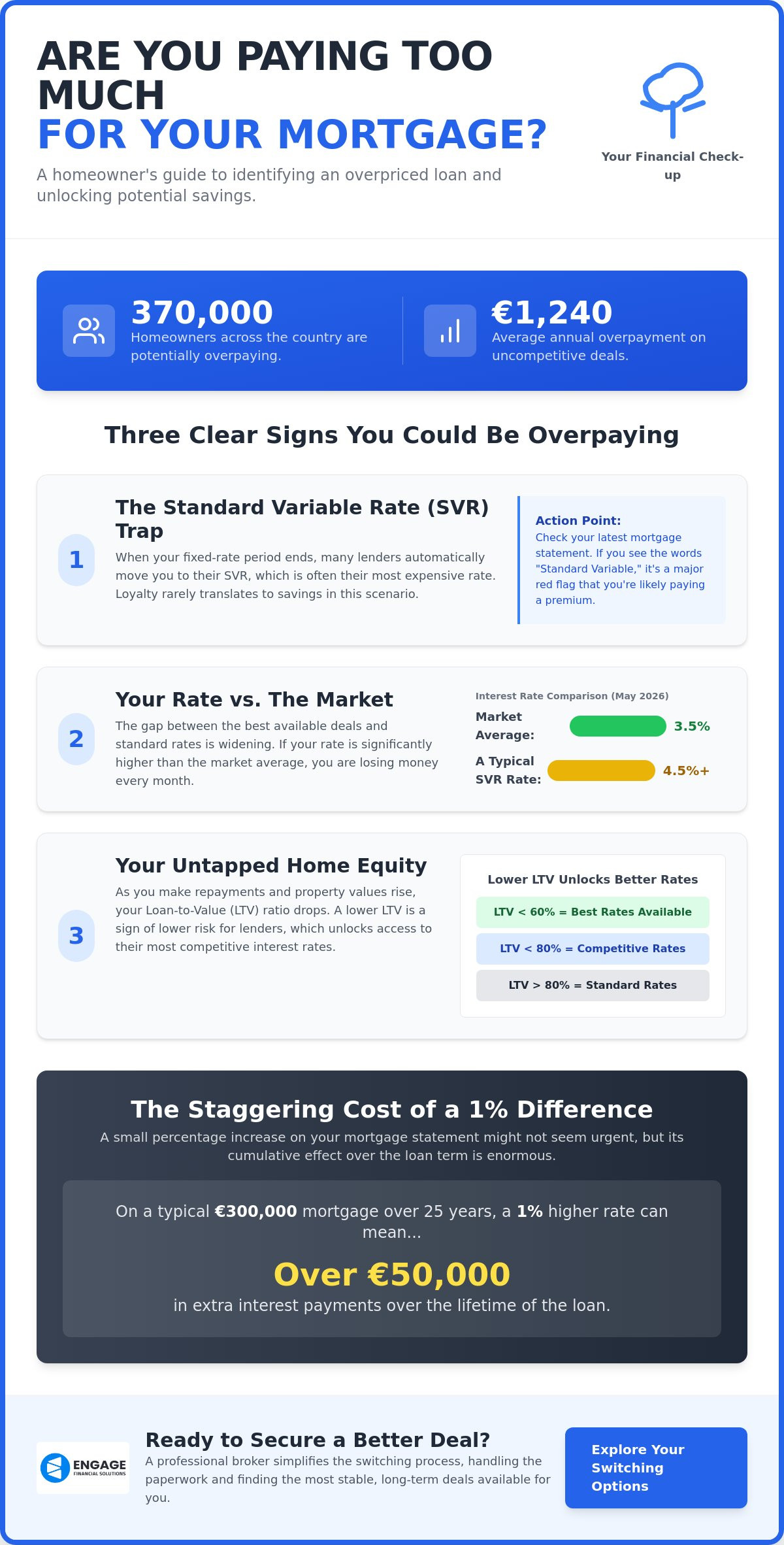
Did you know that roughly 370,000 homeowners across the country are currently sitting on mortgage deals that cost them an average of €1,240 more than necessary every single year? If you find yourself looking at your monthly bank balance and asking, “am I paying too much for my mortgage?” you certainly aren’t alone. With the European Central Bank raising lending rates to 2.40% this June, the pressure on household budgets has become a very real concern for many families.
We understand that the thought of switching lenders can feel overwhelming, especially when you’re trying to weigh up the benefits of fixed versus variable rates. It’s natural to want certainty and security for your family’s future without getting caught in a complex or friction-filled process. This article is designed to provide you with a clear, straightforward checklist to determine whether your current repayments are working for you or against you.
By the end of this guide, you’ll have a simple “yes or no” answer on whether it’s time to switch. We’ll explore the clear warning signs of an uncompetitive rate and show you how a seamless transition could lead to lower monthly outgoings and greater long-term financial stability.
Key Takeaways
- Learn to recognise the red flags of an overpriced loan and determine if it is time to ask, “am I paying too much for my mortgage?”
- Understand how rising property values can improve your loan-to-value ratio, potentially unlocking much lower interest rates and reduced monthly outgoings.
- Evaluate your current interest rate against the 2026 market benchmark of 3.5% to see if you are among the thousands of homeowners overpaying on their debt.
- Discover how a professional broker simplifies the switching process by managing the paperwork and identifying the most stable, long-term deals available.
Recognising the Red Flags of an Overpriced Mortgage
Many homeowners set up their monthly direct debits and then simply stop looking at the fine print. It’s a common habit, but it can be a very expensive one. If you haven’t reviewed your paperwork in the last two years, you might be wondering, “am I paying too much for my mortgage?” whilst your lender quietly collects extra interest. Identifying the warning signs is the first step toward securing your financial future. Comparing your current monthly repayment to the original offer you signed often reveals a creeping increase in costs that many families overlook amongst their other bills.
The SVR Trap: Why Loyalty Rarely Pays
When your initial fixed-rate period ends, most lenders will automatically move you onto their Standard Variable Rate (SVR). This is often their most expensive tier. Lenders rarely highlight this transition because the “loyalty penalty” is highly profitable for them. To see where you stand, check your most recent statement for the specific rate name. If you see the words “Standard Variable,” you’re likely paying a premium for staying put. It’s a common misconception that being a long-term customer earns you better rates; in reality, the best deals are usually reserved for those proactive enough to consider switching mortgages to a more competitive provider.
Comparing Your Rate to the National Average
As of May 2026, the average rate for new loans in the local market sits around 3.5%. If your current rate is significantly higher, perhaps closer to 4.5% or 5%, you are losing money every month. Understanding what is a mortgage at its core helps you realise that it’s a flexible financial tool, not a life sentence. With the European Central Bank raising lending rates to 2.40% this June, the gap between the best available deals and the standard rates is widening. If your lender hasn’t contacted you with a better offer whilst rates dropped elsewhere, they are essentially counting on your inaction.
A small percentage difference might not feel urgent when looking at a single month’s bank statement. However, the cumulative effect is staggering. For a typical family, staying on a rate just 1% higher than the market average could mean the difference between a comfortable retirement and years of avoidable financial strain. Proactive management is the only way to safeguard your home against these hidden costs. If your bank hasn’t reached out to offer you a better deal recently, it’s a clear signal that they are prioritising their margins over your savings. Taking the time to audit your current deal now ensures you are not paying for your lender’s profits at the expense of your own stability.
Decoding Your Loan-to-Value Ratio and Interest Rates
Your mortgage is essentially a balance between two numbers: what you owe the bank and what your home is worth today. This relationship is known as your Loan-to-Value (LTV) ratio. Put simply, LTV is the percentage of the property value that is borrowed. Whilst you’ve been busy making repayments, the market has likely been working in your favour. Rising property prices across the local market often mean your LTV has dropped naturally over time. If you haven’t checked your home’s estimated value lately, you might be asking “am I paying too much for my mortgage” without realising you’ve already qualified for a much cheaper rate bracket.
Why Your LTV is the Key to Cheaper Rates
Lenders view a lower LTV as a sign of reduced risk. When you owe less than 60% or 70% of your home’s value, banks are much more eager to offer you their most competitive products. Recent research on mortgage switching suggests that many homeowners remain on high rates simply because they haven’t updated their property valuation. Obtaining a fresh valuation is often the most powerful tool you have for negotiation. It allows you to prove you’ve moved into a lower risk bracket, such as dropping from 80% to 60% LTV, where interest rates typically take a significant dip. If you want to see if your equity has grown enough to save you money, it’s worth exploring your switching mortgages options today.
Fixed vs Variable: Which Costs More in 2026?
Choosing between a fixed or variable rate is a decision about both cost and comfort. In the current 2026 climate, following the ECB’s rate hike to 2.40% in June, many households are opting for the security of fixed repayments. This choice protects you from sudden market fluctuations and ensures your monthly outgoings remain predictable for years to come. On the other hand, variable rates offer flexibility if you plan to make large overpayments or move house soon. However, that flexibility often comes with the risk of rising costs if central bank rates continue to climb. For a deeper dive into which path suits your lifestyle, you can read our comparison guide on fixed or variable options to find the right fit for your long-term stability.
To calculate your current position, take your remaining loan balance and divide it by a realistic estimate of your home’s current market value, then multiply by 100. If that number is lower than when you first signed your contract, you are likely overpaying. Don’t let your hard-earned equity sit idle whilst you continue to pay rates designed for higher-risk borrowers. Proactively managing these ratios is the simplest way to ensure your debt remains a manageable tool rather than a growing burden.
The Homeowner’s Checklist: Evaluating Your Current Deal
Taking a proactive approach to your finances starts with a simple audit. It is easy to lose track of market shifts, but a few minutes spent reviewing your current agreement can reveal significant savings. Research suggests that around 370,000 households could save an average of €1,240 per year by switching, yet many homeowners never take the first step. If you are asking yourself, “am I paying too much for my mortgage?” use this checklist to gauge your position against the current 2026 market landscape. With average new rates hovering around 3.5% in May 2026, anything higher suggests you could be on a more competitive deal.
- Is your interest rate above 3.5%? Compare your current rate to the market average; even a small difference can save you thousands over the life of the loan.
- Have you been with the same lender for over three years? Lenders often reserve their best rates for new business, leaving loyal customers on more expensive standard variable products.
- Has your property value increased? A higher valuation improves your LTV ratio, which is a primary factor in Understanding local mortgage rules and unlocking lower interest brackets.
- Are you currently on a variable rate? Whilst variable options offer flexibility, fixed rates currently provide more stability against the ECB’s 2.40% lending rate.
- Does your current loan lack flexible features? Modern loans often allow for overpayment allowances, helping you clear debt faster without incurring penalties.
Tick These Boxes Before You Call a Broker
Preparation makes the switching process much smoother. Before reaching out for professional advice, gather your most recent annual statement and your original letter of offer. These documents contain the essential data points: your remaining term, your current interest rate, and your outstanding balance. It is also vital to check if your current contract includes breakage costs. If you are in the middle of a fixed term, your bank might charge a fee to leave early, though these costs have decreased in the current interest rate environment. Having this information ready allows for a much more tailored and efficient review of your options.
Understanding the “Break-Even” Point
Switching is only beneficial if the long-term savings outweigh the initial costs. You will typically need to budget for legal fees and a fresh property valuation. A good rule of thumb is that if a new deal saves you at least €100 per month, the switch usually pays for itself within the first year. Many lenders in the current market also provide cashback incentives to help cover these entry costs, making the transition even more straightforward. By focusing on the total cost of credit over the next five years, you can ensure your decision provides genuine financial relief. Securing a switching mortgages deal that fits your life can provide the long-term stability you deserve.
Practical Ways to Reduce Your Monthly Repayments
Finding out that you are on an uncompetitive rate is just the first step. Now, you need to look at the practical ways to lower those monthly outgoings and protect your household budget. One of the most effective methods to safeguard your financial stability is to review your loan term. Whether you choose to extend the term to improve your current cash flow or shorten it to save on long-term interest, the decision should always align with your overall lifestyle goals. This proactive approach ensures your debt remains a manageable tool rather than a source of stress.
If your home has a high Building Energy Rating (BER), you might qualify for a ‘Green’ mortgage. These products are designed to reward energy efficiency with lower interest rates, providing a straightforward way to reduce your costs whilst contributing to a more sustainable future. If you haven’t checked your BER certificate recently, doing so could be the key to unlocking a more favourable deal. If you are still wondering, “am I paying too much for my mortgage Ireland”, exploring these specialised options is a great place to start your review.
To further improve your chances of securing these rates, you can discover Madison May Consulting Ltd for specialist advice on retrofitting and enhancing your property’s energy performance.
The Power of Mortgage Overpayment
Small, consistent additions to your monthly payment can have a significant impact on your long-term security. By targeting the capital balance directly, you reduce the amount of interest the bank can charge you in the following months. This simple habit can shave years off your total loan term, potentially saving you tens of thousands of Euro. You can learn more about the specific benefits in our article on mortgage overpayment savings. Just be sure to check your contract for any fee-free limits; most lenders allow a certain percentage of overpayment each year without penalty.
Switching to a More Competitive Lender
Whilst overpaying is a useful strategy, it might not be enough if your underlying interest rate is fundamentally too high. Moving to a new lender is often the most impactful move you can make to lower your outgoings. The local market is currently very competitive, with lenders eager to attract reliable homeowners through attractive introductory rates and cashback offers. The process is a seamless transition that our team can manage on your behalf, removing the friction often associated with financial changes. For a step-by-step breakdown of the process, see our comprehensive guide to switching. If you are ready to see how much you could save, our team is here to help you switching mortgages with total confidence.
How a Professional Broker Simplifies the Switching Process
While the digital tools provided by banks can give you a rough estimate, they often fail to capture the full complexity of the local lending market. Each lender has its own unique criteria and appetite for risk. Navigating these nuances alone can feel like a full-time job. If you find yourself repeatedly asking “am I paying too much for my mortgage Ireland”, a professional broker provides the independent perspective you need. Brokers often have access to specific rates and products that aren’t always available to the public, ensuring you see the complete picture before making a commitment.
The true value of a broker lies in their ability to provide tailored advice. Your financial needs when you first bought your home are likely very different from your needs today. Whether you are growing a family or planning for a comfortable retirement, a broker matches your specific life stage to the right product. This regulated advice provides a layer of security that “doing it yourself” simply cannot match. It ensures that your decision to switch is based on long-term financial health rather than a short-term introductory offer.
In some cases, your profession might require even more niche expertise; for instance, medical professionals in the UK can benefit from the specialised guidance found at doctorsmortgages.co.uk when managing complex contract-based incomes.
Removing the Friction from Financial Changes
One of the biggest hurdles for homeowners is the perceived “mountain of paperwork” involved in a switch. Engage Financial Solutions acts as a steady guide and a buffer between you and the banks. We take on the heavy lifting of market comparison, turning what could be weeks of research into a few hours of expert analysis. This methodical approach is designed to remove stress and friction from the process. By handling the administrative details on your behalf, we maintain a sense of calm competence that allows you to focus on your daily life whilst we secure your future savings.
Your Next Steps to a Better Deal
Securing a more competitive deal is a straightforward journey when you have the right partner. The process typically begins with a simple, no-obligation review of your current mortgage statement. From that initial chat, we can quickly determine if a switch makes financial sense for you. Most homeowners are surprised to find that the entire transition can be completed in a matter of weeks, leading directly to a cheaper monthly bill and greater peace of mind. Our role is to safeguard your interests at every step, ensuring a seamless move to a lender that values your business. You can book a consultation with our experienced team today to see exactly how much you could save over the coming years.
Secure Your Long-Term Financial Stability
Reviewing your mortgage shouldn’t be a source of stress or confusion. By understanding how your Loan-to-Value ratio has improved and recognising the high cost of staying on a Standard Variable Rate, you’ve already taken the most important step toward lower monthly outgoings. Your home is likely your most significant asset. Ensuring your debt is structured correctly is essential for your future security and peace of mind. Taking control of your repayments today prevents the “loyalty penalty” from eroding your hard-earned savings over the coming years.
If you are still asking, “am I paying too much for my mortgage Ireland” it is time to seek professional, regulated guidance. Our expert team is based in Blackrock and regulated by the Central Bank, providing you with the stability and protection you deserve. We maintain access to a wide panel of domestic lenders to find the specific, tailored product that matches your current life stage and long-term aspirations. Whether you are looking to reduce your term or lower your monthly bills, we offer the expertise to make it happen.
Start your seamless mortgage review with Engage Financial Solutions today. We are here to navigate the complexities of the financial market on your behalf, providing the calm competence you need to move forward with optimism and confidence.
Frequently Asked Questions
How much does it cost to switch my mortgage in this market?
Switching costs typically involve legal fees ranging from €1,000 to €1,500 plus VAT, alongside a valuation fee of approximately €150. If you are wondering “am I paying too much for my mortgage Ireland”, it’s encouraging to know that many lenders provide cashback offers that completely offset these initial expenses. These incentives are designed to make the transition as seamless as possible for proactive homeowners.
Can I switch my mortgage if I am currently in a fixed-rate term?
You can certainly switch during a fixed term, though you may face an early repayment charge, often called a breakage fee. In the current interest rate environment of 2026, these fees are often lower than people expect. It’s always a good idea to ask your current provider for a breakage calculation to see if the long-term savings of a new deal outweigh the cost of leaving.
What is the minimum equity I need to qualify for a better rate?
Most lenders require a minimum of 10% equity in your home, which equates to a 90% Loan-to-Value (LTV) ratio. However, the most significant interest rate drops occur once you reach the 80%, 70%, or 60% LTV brackets. If you are asking “am I paying too much for my mortgage Ireland”, checking your current LTV against recent property price growth is the best place to start.
How long does the switching process typically take from start to finish?
The entire journey usually takes between six and eight weeks from your initial consultation to the completion of the switch. This timeline depends on how quickly you can gather your documents and the responsiveness of the solicitors involved. Our team works to remove any friction, ensuring the process moves forward at a steady and predictable pace.
Is it worth switching if I only have 10 years left on my mortgage?
Switching is often very beneficial even with a shorter remaining term. If a new lender offers a rate that is 0.5% lower than your current one, the interest saved over a decade will likely be thousands of Euro. As long as the total savings exceed the legal and valuation outgoings, the move will improve your long-term financial health.
Will switching my mortgage affect my credit rating?
A standard credit check is performed as part of your application, which may cause a very minor and temporary dip in your score. This is a normal part of the process and shouldn’t cause concern. Maintaining a more affordable loan with consistent, timely repayments is actually a positive factor for your credit profile over time.
Do I need to hire a solicitor when moving to a new lender?
Yes, you must engage a solicitor to handle the legal transfer of the property deeds to your new lender. They are responsible for discharging your old mortgage and ensuring the new charge is correctly registered. Many homeowners find that the cashback provided by new lenders comfortably covers these professional fees.
What documents should I prepare for a mortgage review?
To get a clear picture of your options, you should gather your last three payslips, six months of bank statements, and your most recent annual mortgage statement. Having these documents ready allows for a much more efficient review. It helps us identify the most tailored solutions for your specific needs without unnecessary delays.
Disclaimer
Engage Financial Services LTD T/A Engage Financial Solutions is regulated by the Central Bank of Ireland CRO 764570. Director David Moore. Suite 2 First Floor, 14 -18 Main street, Blackrock, Co Dublin A94 W0Y3