


Could an exception help you borrow above a standard mortgage limit? Possibly, but it isn’t an entitlement. For first-time buyers, the applicable loan-to-income limit is based on gross annual income, while the rules for second and subsequent buyers may differ. Lenders can make exceptions within limits on their overall lending, but each lender decides which applications to consider.
It’s understandable to focus on how much you might borrow, especially when a property feels within reach. But a higher borrowing limit doesn’t automatically make the repayments comfortable or sustainable. To understand mortgage exceptions, look beyond headline figures at lender discretion, the difference between income-based and property-value limits, and the affordability assessment behind every application.
This guide explains what lenders may consider, including income stability, savings habits, existing commitments and your ability to manage repayments. You’ll also find practical ways to prepare an application and weigh your next steps without assuming an exception will be approved. Tailored mortgage guidance can help you understand your options and approach the process with greater clarity.
Key Takeaways
- Separate loan-to-income exceptions from loan-to-value exceptions. Flexibility on one limit doesn’t automatically change the other.
- Review your income, regular commitments and household budget to work out what repayments could comfortably fit.
- Gather clear evidence of your finances and be ready to explain why you need to borrow above a standard limit.
- A mortgage adviser can help you understand lender criteria and prepare an application, but only the lender decides whether to approve an exception.
Mortgage exception rules: what an exception can and cannot change
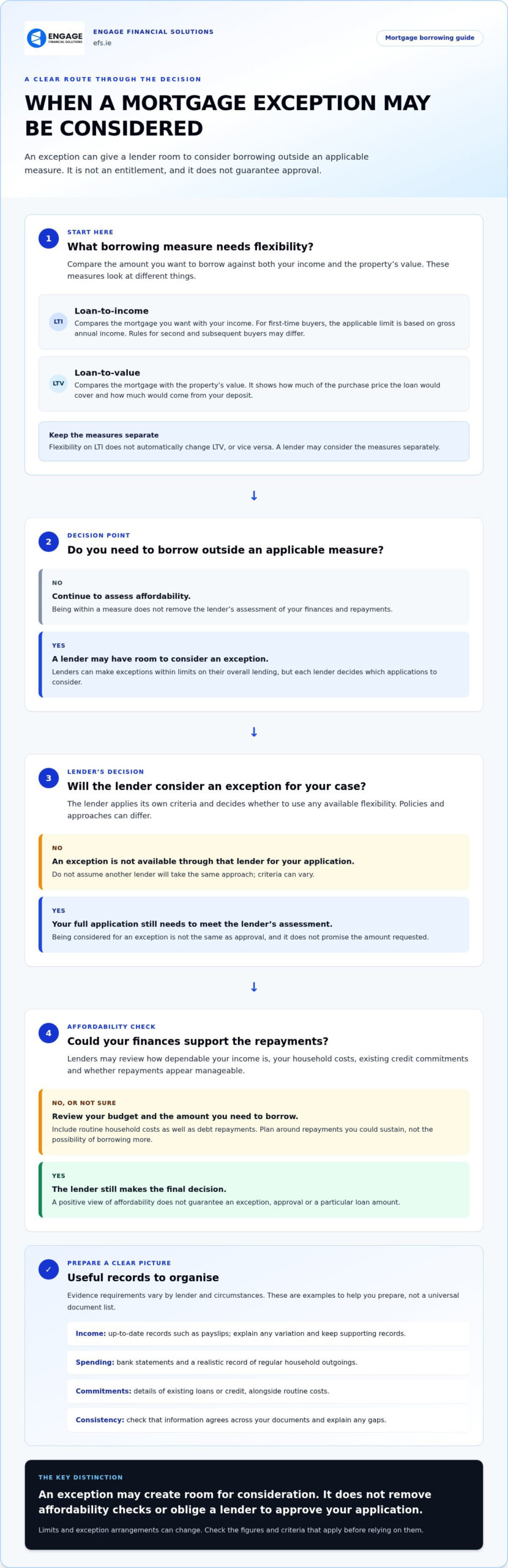
A mortgage exception is a lender’s decision to consider borrowing outside an applicable mortgage measure. It isn’t an automatic right, and it doesn’t mean a lender must offer a larger loan. The rules set boundaries and may allow lenders some flexibility, but each lender decides whether to use that flexibility for an application. Limits and exception arrangements can change, so verify the figures that apply before relying on them.
This distinction matters if the amount you need appears to exceed a standard limit. An exception may give a lender room to consider your case, but it doesn’t remove the need to assess your finances or make sure repayments are manageable. The Mortgage loan overview explains the broader structure of a mortgage. The terms below show how income and property value can shape your borrowing decision.
What do LTI and LTV mean in a mortgage application?
Loan-to-income (LTI) compares the amount you want to borrow with your income. It is an income-based measure: the lender considers the proposed loan in relation to your gross income. Loan-to-value (LTV) compares the mortgage with the property’s value. It shows how much of the purchase price the loan would cover and how much would need to come from your deposit.
Illustrative example: imagine a buyer with gross annual income of €60,000 seeking a €250,000 mortgage on a property valued at €300,000. The LTI comparison is the loan against the buyer’s income; the LTV comparison is the loan against the property’s value. These figures illustrate the calculations only, not current lending limits or approval criteria.
The measures answer different questions. LTI relates to your income and the scale of the debt; LTV relates to the property value and your deposit. Before discussing your borrowing needs, calculate both using your own figures. A change to one measure doesn’t automatically change the other, and a lender may consider them separately.
Does an exception guarantee a larger mortgage?
No. An exception may allow a lender to consider an application outside a relevant measure, but it doesn’t promise that the lender will approve the loan or offer the amount requested. The lender still assesses the full application, including whether your income and commitments support the repayments. Lender criteria and the use of exceptions can differ, so don’t assume one lender’s approach applies across the market.
Being considered for an exception is not the same as meeting a lender’s full approval and affordability requirements. Keep that distinction in mind when planning a purchase. Base your budget on repayments you could sustain, not on the possibility of borrowing more. Understanding both measures can help you have a clearer conversation about your options.
How lenders assess mortgage exception applications
An exception is only one part of a mortgage decision. A lender assesses your full application, including whether your income is dependable, what you already owe and whether the proposed repayments appear affordable. Being within an exception arrangement doesn’t remove those checks. No single job type, income level or buyer category guarantees a favourable decision.
Think of the assessment as a whole-picture review. A lender may look at how your income is earned and how consistent it has been, alongside regular household costs and existing credit commitments. It may also consider whether your finances could support repayments if circumstances or borrowing costs changed. The exact approach and evidence requested can vary by lender and application, so check current criteria rather than relying on assumptions.
What affordability evidence may a lender consider?
Prepare a clear picture of your finances before applying. This could include up-to-date records of your income, regular outgoings and credit commitments, such as payslips, bank statements and details of existing loans or credit. These are examples, not a universal document list. The lender will set evidence requirements for your circumstances.
Check that the information is accurate and consistent across your documents. If your income varies, note what causes the variation and gather supporting records that explain it. Include routine costs as well as debt repayments, so your budget reflects what you actually spend. Organising this material early can make it easier to discuss affordability and address gaps before an application progresses.
Why lender policy matters as well as the rules
Mortgage measures set a framework, but individual lenders also apply their own criteria and decide how to assess applications. Their current policy, appetite for a particular case and assessment of your finances can differ. A lender may have room to consider an exception without choosing to use it for your application.
Regulatory flexibility creates room for consideration; the lender’s own decision determines whether that room is used. General rules or examples of other borrowers shouldn’t be treated as a prediction of your outcome. Before making plans around a higher loan, establish what you need to borrow, review your ongoing budget and understand which evidence supports your application. A tailored review can help clarify how your circumstances may be presented against lender criteria. Tailored mortgage guidance from Engage Financial Solutions can help you understand your application options without assuming an exception will be approved.
Mortgage exception versus standard borrowing: compare the decision, not just the limit
A standard assessment and an exception discussion are different stages of a lending decision. The standard assessment considers your application against the applicable lending measures and the lender’s affordability assessment. If borrowing would exceed a measure, an exception may give the lender room to consider the case. It doesn’t remove the lender’s other checks or require approval.
The table separates the general framework from the lender’s individual decision. It gives no limit figures because rules and exception arrangements can change. Check current information from authoritative sources before relying on any numbers.
| Stage | What it means for you | What it does not mean |
|---|---|---|
| Standard assessment | Your proposed borrowing is considered against the applicable measures, your finances and the property details. | Being within a measure doesn’t guarantee approval or establish that repayments suit your budget. |
| Possible exception consideration | A lender may consider whether its discretion can apply to the relevant measure and your circumstances. | There’s no automatic entitlement, and the lender doesn’t have to use an available exception. |
| Lender approval | The lender decides whether the full application meets its current criteria and whether it will make an offer. | Potential exception eligibility alone isn’t approval or a promise of a particular loan amount. |
How does an LTI exception differ from an LTV exception?
An LTI exception relates to borrowing in comparison with income. An LTV exception relates to the mortgage in comparison with the property’s value, and therefore the deposit needed. They address separate constraints. An application that may be considered for flexibility on income grounds doesn’t automatically qualify for flexibility on property value, or vice versa. Identify which measure is affecting your plans before discussing options.
For example, if the amount you hope to borrow is high relative to your income, the question may centre on LTI. If the mortgage is high relative to the property value, the issue may instead be LTV and the deposit. A lender assesses the relevant circumstances and its own current policy. Passing one measure doesn’t settle the other.
What should you weigh before relying on an exception?
Look beyond the maximum loan figure. Compare the proposed repayments with your take-home income, regular household costs and existing commitments. Then consider future plans that could affect your budget, such as changes in income or other expected expenses. This helps you decide what borrowing feels sustainable, whether or not an exception is considered.
Treat claims about borrowing at a particular income multiple, including references to five times income, as lender-specific unless current authoritative rules establish otherwise. A lender’s approach may depend on its policy and your application, so don’t treat an example as a general standard.
Greater borrowing capacity does not, by itself, establish affordability. Use a realistic household budget to guide your target, and check current measures and lender criteria before making decisions based on a possible exception.
Prepare for a mortgage exception discussion with a practical checklist
A focused conversation starts with clear figures, not just the maximum loan you hope to secure. Work through these steps to identify what is affecting your borrowing plans and discuss options from a realistic starting point.
- Review your finances. Set out your income, regular household expenses, savings and existing credit commitments. Check what remains after normal bills and debt repayments, and consider whether that would leave room for unexpected costs.
- Gather supporting evidence. Organise recent records that show your income, spending, savings and borrowing commitments. The precise documents required depend on your application and the lender, so use this as a starting file rather than a complete document list.
- Clarify the borrowing need. Note your property budget, the amount you hope to borrow and the monthly repayment you consider sustainable. Be specific about the gap you’re trying to address, rather than relying on a maximum loan figure alone.
- Discuss the options. Explain your circumstances and ask how current measures and lender criteria relate to your application. Keep an open mind about alternatives if an exception isn’t considered or the repayments would stretch your budget.
What to organise before discussing your borrowing options
Keep your records together and make sure the figures are current and accurate. Include regular costs that are easy to overlook, such as transport, childcare or subscriptions, if they apply to your household. Use your actual spending to estimate what a repayment could fit around, rather than assuming every remaining euro is available for the mortgage. A first-time buyer can also use a first-time buyer mortgage guide to prepare for the wider purchase process.
Questions to resolve before choosing a route
Before the discussion, identify the main constraint: borrowing compared with income, the deposit available, or overall affordability. These point to different parts of the assessment. Check current measures and lender criteria rather than relying on an older article or an example that may relate to another lender or time.
If you receive an indicative view, clarify what it means. It can help you understand a possible route, but it isn’t the same as a formal lending decision. Approval depends on the lender’s assessment of your full application, so avoid committing to a property on the assumption that an exception will be granted. If you’re considering changing your existing mortgage, focus the conversation on your switching circumstances. A new purchase calls for a different discussion.
Bring your budget, records and questions together for a clearer review of your mortgage options. Discuss your mortgage options with Engage Financial Solutions for personalised guidance through the application process.
Get tailored Mortgage guidance for your next step
Understanding how exceptions work is useful, but deciding what to do with that information depends on your circumstances. A mortgage adviser can help you review your borrowing needs, finances and lender options, then explain how different criteria may affect your application. This guidance can make the next steps clearer without suggesting that an exception or approval is assured.
Engage Financial Solutions arranges Mortgages and sources residential and commercial property loans from a panel of lenders. This can support a review of available options against your objectives and affordability. Whether you’re buying your first home, moving or considering a change to your existing mortgage, the aim is to build a borrowing plan that fits your situation, not simply pursue the largest possible loan.
How tailored mortgage support can simplify the next step
A clear application begins with a clear picture of what you need. An adviser can help you understand which lender criteria may be relevant, organise the information supporting your application and identify questions that need resolving. For example, you might need to clarify whether your borrowing concern relates to income, your deposit or the repayments your household can manage.
Bring together your current income and spending details, existing credit commitments, savings and a realistic property budget. This gives the discussion a practical foundation. Your adviser can then help you consider lender options and how your circumstances may fit their criteria, while keeping repayment comfort and future plans in view. The lender makes the lending decision.
If your situation concerns replacing or changing an existing mortgage, Switching Mortgages may be relevant to the discussion. If you’re purchasing a home, the focus will instead be on your purchase plans, deposit and sustainable borrowing needs. In either case, personalised guidance can help you compare the route ahead with greater clarity.
Move forward with a clearer borrowing plan
Keep the key distinction in mind: an exception is flexibility within the applicable measures, lender discretion determines whether that flexibility is considered, and mortgage approval is a separate decision based on the full application. A useful next step is to write down the repayment you believe your household can sustain, alongside the amount you hope to borrow. This makes it easier to discuss options realistically.
Tailored Mortgage guidance can help you understand lender criteria and organise your next steps, whether you’re applying for a new Mortgage or exploring a switch. Engage Financial Solutions can support you through the mortgage process and help you consider options without assuming an exception will be approved. Discuss your Mortgage options and take a considered step towards a borrowing plan that reflects your goals and budget.
Take your next step with confidence
Your next move doesn’t need to depend on the possibility of borrowing more. Start with the home or mortgage outcome you want, then shape a plan around repayments that leave room for your wider priorities. A clear, individual review can turn questions about mortgage exception rules into a practical conversation about your options.
Engage Financial Solutions’ advisers are described as certified experts, and the firm’s website displays exactly 64 Google reviews. This can support a considered discussion focused on your circumstances, without treating an exception as a promised result.
If you’re ready to explore a borrowing plan that reflects your goals and budget, discuss your Mortgage options. A steady, informed next step can help you move towards your plans with greater clarity.
Frequently Asked Questions
How much above the lending limit can a lender approve through an exception?
There isn’t a fixed amount that every borrower can receive above a limit. Lenders can allocate up to 20% of the value of their mortgage lending to loan-to-income exceptions. Separate loan-to-value exception allowances are 5% for first-time buyers and 20% for second and subsequent buyers. These are limits on a lender’s overall lending, not a personal allowance or promise of extra borrowing.
Can a first-time buyer apply for a mortgage exception?
A first-time buyer may be considered for an exception, but can’t claim one as a right or require a lender to use its allowance. The lender assesses the complete application against its current criteria. Before discussing an exception, work out the borrowing you need, the deposit available and repayments that fit your budget. This keeps the conversation grounded in your circumstances rather than an assumption of approval.
Does a larger deposit guarantee a mortgage exception?
No. A larger deposit can reduce the mortgage in relation to the property’s value, which is relevant to loan-to-value. It doesn’t guarantee an exception, change an income-based assessment or establish that repayments are affordable. If your deposit has grown, update your budget and calculate the loan you would need. The lender still decides whether any exception is appropriate and whether the full application meets its criteria.
Can a lender refuse an exception even if I appear to meet the criteria?
Yes. A lender can decline to use an exception even if your circumstances seem to fit the broad conditions. Its decision may reflect its own current policy and assessment of your complete application, including income, commitments and repayment capacity. If you receive a refusal, ask what aspect of the application affected the decision and whether any information was missing. That can help you understand a practical next step.
What happens if my mortgage exception application is declined?
A decline means you shouldn’t plan on borrowing the requested amount on that basis. Review the lender’s reasons, check that the application details were accurate and consider whether a lower loan, a larger deposit or a different property budget is realistic. Don’t assume another application will be accepted, as lender criteria differ. Rework the figures against your household spending first, then discuss whether another route is suitable.
Can a mortgage exception apply when switching a mortgage?
It may be relevant if a Switching Mortgages application involves borrowing that falls outside an applicable measure, but an exception isn’t automatic just because you already have a mortgage. The new lender assesses the application against its current policy. Clarify whether you’re seeking to transfer existing borrowing or increase it, as that helps define the question to discuss. Review the proposed repayments alongside your regular commitments before exploring Switching Mortgages.
Is a mortgage exception the same as mortgage approval?
No. A useful way to understand mortgage exception rules is to distinguish a lender’s flexibility around a lending measure from its decision on your full application. An exception being considered doesn’t guarantee an offer, the amount requested or terms that suit your finances. Treat any early or indicative view as provisional, and wait for the lender’s formal decision before making commitments based on the borrowing.
Disclaimer
Engage Financial Services LTD T/A Engage Financial Solutions is regulated by the Central Bank of Ireland CRO 764570. Suite 2 First Floor, 14 -18 Main street, Blackrock, Co Dublin. A94 W0Y3