


A lower loan-to-value ratio can shape your mortgage options, but it won’t guarantee a better rate or approval. If you’re reviewing your mortgage or considering a switch, understanding loan to value (LTV) starts with knowing which figures matter and what the result can, and can’t, tell you.
It’s understandable to feel unsure: should you use the property’s purchase price or its current value, and how does the outstanding mortgage balance fit in? As a starting point, LTV compares the amount you owe or plan to borrow with the property’s value. For a purchase, a lender’s valuation may differ from the agreed price, which can affect the calculation.
This guide explains how to calculate LTV and how lenders may consider it alongside your income, repayments and other application details. You’ll also learn how a change in property value could affect your position when reviewing a mortgage switch, and what figures to gather before discussing your next steps. Think of LTV as a useful snapshot, not a verdict on your application.
Key Takeaways
- Calculate an indicative LTV by dividing your outstanding mortgage balance by your property’s value, then multiplying by 100.
- Use the current amount owed, not the original mortgage. A higher LTV means the loan represents a larger share of the property’s value.
- Lenders may consider LTV when assessing mortgage options or rate bands, but a lower ratio doesn’t guarantee a lower rate.
- Before reviewing a mortgage switch, gather your current balance and an estimate of your property’s value. Note how and when you obtained that estimate, as the lender may use a different valuation.
- Personalised guidance can help you consider LTV alongside your wider mortgage priorities when exploring Switching Mortgages.
What does loan to value mean for your mortgage?
Loan to value, usually shortened to LTV, compares a mortgage loan with the value of the property it is secured against. In plain English, it shows what share of the property’s value is represented by the borrowing.
LTV can be a useful starting point when you’re buying a home or reviewing an existing mortgage. A higher percentage means the mortgage makes up a larger share of the property’s value; a lower percentage means it makes up a smaller share. For a broader overview of the term and its uses, see Loan-to-value ratio (LTV).
What does a high or low LTV indicate?
Hypothetical example: Imagine a property valued at €300,000 and a mortgage loan of €240,000. The loan represents 80% of the property’s value, so the LTV is 80%. If the loan were smaller while the property value stayed the same, the LTV would be lower. If the loan were larger, it would be higher.
This example illustrates how the two figures relate. It doesn’t predict a lender’s decision or the mortgage terms that might be available. A lower LTV means the borrowing is a smaller proportion of the property value, but it doesn’t show whether repayments fit your budget or whether your application meets a lender’s criteria.
LTV is different from loan-to-income (LTI). LTV compares the loan with the property value; LTI compares borrowing with income. They measure separate parts of your financial position, and neither tells the whole story on its own.
Why does LTV matter when reviewing a mortgage?
Lenders may consider LTV when assessing a mortgage application and deciding which options or interest-rate bands may be available. The ratio helps show how the loan compares with the property’s value, but each lender sets its own criteria. The same indicative LTV may therefore lead to different options with different lenders.
Treat LTV as one piece of information, not a verdict. A particular percentage doesn’t guarantee approval, a specific rate or a certain borrowing amount. Lenders may also assess your income, regular spending, existing commitments and ability to meet repayments. Your circumstances and the purpose of the mortgage matter too.
For a useful first step, keep the measures distinct in your notes: record the property value and loan balance for LTV, and your income for an LTI discussion. This helps clarify what each figure can tell you and what still needs to be considered in a wider mortgage review.
How to calculate your LTV correctly
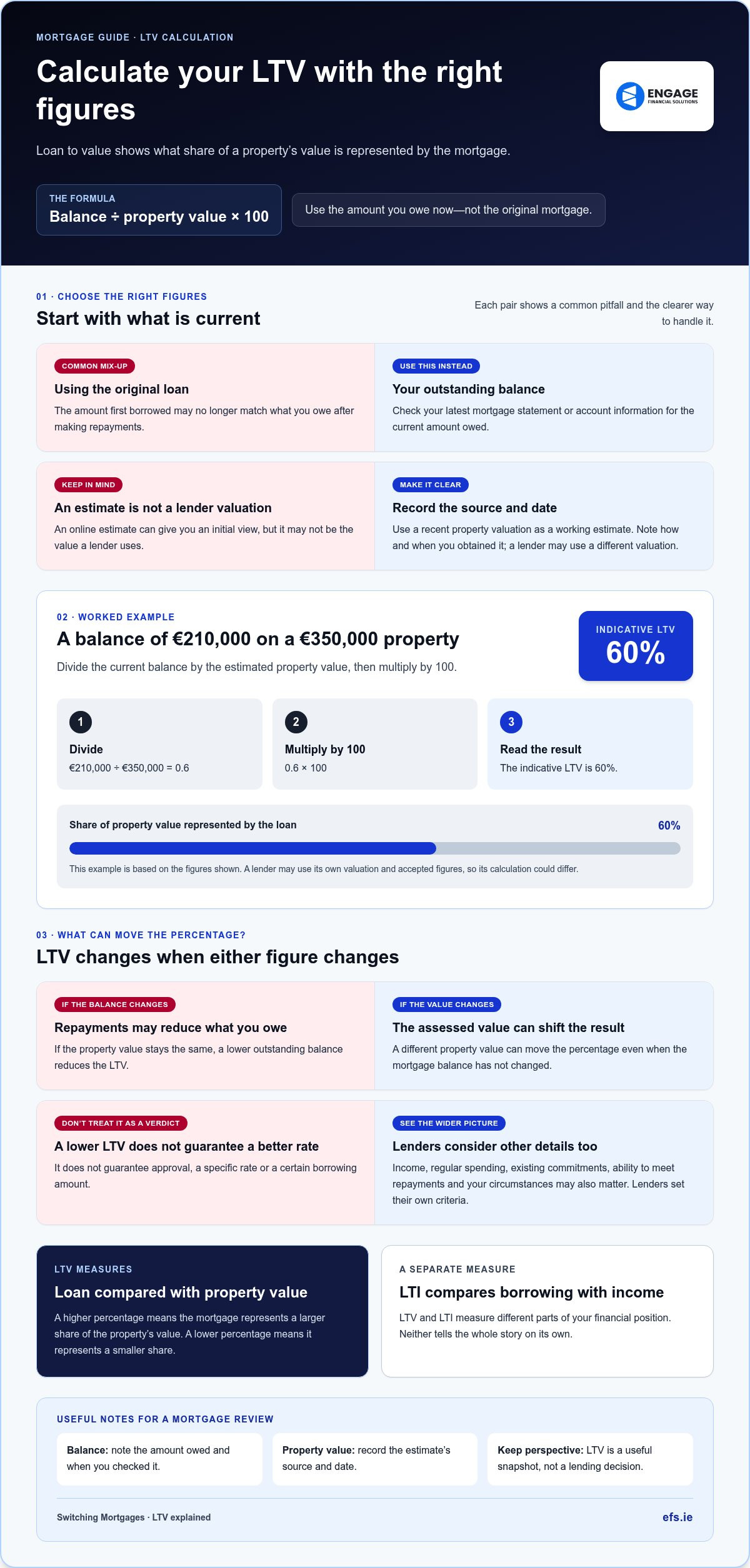
For an existing mortgage, use the amount you still owe, not the sum you originally borrowed. The calculation is:
LTV = (outstanding mortgage balance ÷ property value) × 100
Divide the current balance by the property value, then multiply the result by 100 to express it as a percentage. The order matters: reversing the figures won’t show the share of the property represented by the loan.
Which figures should you use?
Start with your latest mortgage statement or account information to find the outstanding balance. This is the amount still owed at that point in time, which may differ from the original loan because you’ve made repayments. For the property value, use a recent valuation as a working estimate. An online estimate can help you form an initial view, but it doesn’t automatically replace the figure a lender may use.
Worked example: Suppose your current mortgage balance is €210,000 and your estimated property value is €350,000.
- Divide €210,000 by €350,000 to get 0.6.
- Multiply 0.6 by 100.
- The indicative LTV is 60%.
This result is indicative and based on the figures in the example. It doesn’t predict a lender’s decision or the terms that may be available. A lender may apply its own valuation process and use figures it accepts, so the LTV in its review could differ from your estimate. If you’re preparing for a review, note the date of your balance and the source and date of your property-value estimate.
What can change your LTV over time?
Your LTV can change when either figure changes. As you repay your mortgage, the outstanding balance may fall, reducing the ratio if the property value stays the same. A change in the value used for assessment can also move the percentage, even if your balance hasn’t changed. The result depends on both the balance and the valuation used.
Keep a record of the figures you used and when you checked them. Update your calculation when you receive a new mortgage statement or have a more relevant property valuation. This makes it easier to explain how you reached the percentage and distinguish your own estimate from the figure used in a lender’s assessment.
LTV calculations sit within a wider lending framework. The Central Bank mortgage measures provide regulatory context, while a lender’s own assessment determines the valuation and criteria it applies. If you’re considering a switch, tailored mortgage guidance can help you weigh your figures against your priorities.
How LTV can affect mortgage rates and switching options
Your LTV may help a lender assess how a mortgage compares with the property securing it. It can be one factor in deciding which mortgage options or interest-rate bands to consider, but it doesn’t promise a particular offer. Lenders set their own criteria, so an indicative ratio may be treated differently across applications.
A lower LTV doesn’t automatically secure a better rate. A lender may also consider your income, regular commitments, credit history and ability to meet repayments. These factors address different parts of the assessment: LTV relates to the property and loan, while affordability and credit assessment relate to your finances and application. Consider them together rather than relying on a single percentage.
Does a lower LTV automatically mean a better rate?
No. A lower ratio may be relevant to the options available, but the lender’s current criteria and its assessment of your full application still matter. Some lenders may use LTV bands when setting rates, while others may assess the overall circumstances differently. Even if your indicative figure changes, that alone doesn’t establish eligibility for a specific rate or confirm that switching is suitable.
| LTV can help inform | LTV cannot decide alone |
|---|---|
| How the loan compares with the property value used in a review | Whether your application will be approved |
| Which options or rate bands a lender may assess | Whether repayments fit your budget |
| What property and mortgage figures may be relevant | Your full financial and credit assessment |
Use this distinction when comparing possibilities. Alongside your estimated LTV, note your current mortgage terms, income and regular commitments, then consider what you want from a review. This gives you a more balanced basis for weighing options without assuming the ratio will determine the outcome.
What does LTV mean when switching mortgages?
During a switch review, the current mortgage balance and the property value used in the assessment may influence the LTV considered. Your own estimate is useful preparation, but a lender may use its own valuation process. If the assessed value differs from your estimate, the ratio used in the review may change even if the balance stays the same.
A different LTV may make different options relevant, but it doesn’t promise approval, a lower rate or savings. Consider the full terms and how they fit your circumstances. The mortgage switching guide offers more context for weighing the wider decision.
Before a review, bring together your latest mortgage information, property-value estimate and priorities. This makes it easier to discuss what the figures may indicate and which questions to explore next.
Practical ways to review and improve your LTV position
An indicative LTV can help you prepare for a mortgage review, but its usefulness depends on having current, sensible figures. Treat it as a starting point, not a target in itself. Before considering a switch or other change, gather the information behind your calculation and think about what you want your mortgage to do for you.
What information should you gather before a review?
Bring together the figures and details that explain your current position. A short preparation list can make the discussion more focused:
- Your latest outstanding mortgage balance and the date it applies to.
- Your property-value estimate, including its source and date.
- Your current mortgage terms and relevant details about the loan.
- Your priorities, such as repayment flexibility, certainty over repayments or reviewing the overall cost.
Use the balance and property value to work out an indicative ratio, then keep the underlying figures beside it. This makes it easier to update your estimate if either figure changes, and avoids treating a percentage without context as the complete picture. If you’re preparing for Switching Mortgages, clear priorities also help you assess whether an option fits your wider plans rather than focusing on LTV alone.
Valuation methods matter. An online estimate can help you form an initial view, but it doesn’t automatically replace a valuation used in a lender’s review. A lender may request its own valuation or supporting information, and may assess the property value differently from your estimate. Keep the source and date to hand so you can distinguish your indicative calculation from any figure used in an assessment.
Can you reduce your LTV?
If the property value stays unchanged, reducing the outstanding loan can lower the LTV. Repayments may gradually reduce the balance, though the pace depends on your mortgage arrangements. Before making extra repayments, consider how they fit your budget and other financial priorities. A lower ratio by itself won’t secure approval, a particular rate or a saving.
Property values can also move, changing the ratio even if your mortgage balance doesn’t. Those movements aren’t guaranteed, and the value used in a lender’s assessment may differ from your own estimate. Avoid basing a mortgage decision on an assumed future increase in property value. Use current information, and update your figures if your circumstances or valuation changes.
When reviewing options, compare the wider mortgage terms and your priorities alongside LTV. Consider how repayments fit your budget and whether the overall arrangement suits your plans. Engage Financial Solutions provides tailored mortgage guidance to help you consider Switching Mortgages in the context of your wider needs. Explore tailored mortgage guidance as you prepare your next steps.
How tailored Switching Mortgages guidance can help with your next step
An indicative LTV gives you a helpful starting point, but the next decision is about how your mortgage fits your circumstances and plans. A review can bring the ratio together with your current mortgage terms, repayment preferences and future priorities. That broader view helps you consider options without treating one percentage as the answer.
Engage Financial Solutions provides personalised guidance for Switching Mortgages. The team supports a seamless switching process and can consider flexible repayment options as part of the wider discussion. What may suit you depends on your circumstances and the options available. No LTV figure alone can determine suitability, approval, a particular rate or savings.
How LTV fits into a wider mortgage review
Take your indicative calculation alongside details of your existing mortgage, such as its current terms and the type of repayments you prefer. Then think about what matters most in the months and years ahead. You might value more certainty in your repayments or want to understand how different options could fit your budget. These priorities help frame a useful review.
A tailored review can help clarify which next steps may be relevant and what information may be needed to explore them. It also gives you a chance to consider the full mortgage arrangement, rather than focusing only on whether your LTV has changed. Keep your notes simple: record your balance, the property value used for your estimate, your current terms and the questions you want answered.
When might you review your mortgage?
You may want to revisit your mortgage when your circumstances or priorities change. That could be a shift in household income, a change to your plans for the property, or simply a point when you want to understand whether your current arrangement still suits you. There’s no need to rush into a decision. A review can help you gain clarity, even if you decide not to make a change.
If you’re a first-time buyer rather than an existing borrower considering a switch, the questions you need to explore will be different. The first-time buyer mortgage guidance can help you consider that journey in context.
For a mortgage-switch review, bring your current terms, an up-to-date balance and your property-value estimate, along with the priorities you’ve identified. Engage Financial Solutions can help you consider how LTV fits into the wider picture and explore possible next steps at a pace that feels right for you. If you’re ready to discuss your position, explore mortgage switching support.
Make your next mortgage decision with confidence
Your next step doesn’t need to be a commitment to switch. It can simply be a considered review of what matters to you now and how your mortgage fits your plans. A clear conversation can help turn an indicative LTV figure into a more informed view of the options worth exploring, without assuming a particular outcome.
Engage Financial Solutions’ certified experts have decades of experience, and the website displays exactly 64 Google reviews. The team provides personalised guidance to help you consider Switching Mortgages in the context of your wider priorities, with a seamless process and flexible repayment options as part of the approach.
If you’re ready to explore what a mortgage review could mean for you, take a calm first step and explore tailored mortgage switching support. You can move forward at a pace that feels right, with a clearer sense of the questions to ask and the choices ahead.
Frequently Asked Questions
What is loan to value on a mortgage?
Loan to value is a percentage showing how a mortgage loan compares with the value of the property used as security. For example, an LTV of 70% means the loan represents 70% of the property value used in that calculation. It’s a snapshot of the loan in relation to the home, not a measure of your income or whether the monthly repayments fit your budget.
How do I calculate my loan to value ratio?
Divide your current outstanding mortgage balance by the property value you’re using, then multiply by 100. For instance, a balance of €165,000 against a property value of €275,000 gives an indicative LTV of 60%. Use a current balance rather than the original loan amount, and note the date and source of the property estimate so you can explain your calculation during a review.
Does a lower LTV guarantee a better mortgage rate?
No. A lower LTV may be relevant to the mortgage options or rate bands a lender considers, but it doesn’t guarantee a better rate. Lenders use their own criteria and may also assess your income, commitments and wider application. If you’re comparing options, look at the full mortgage terms and how repayments fit your plans, rather than assuming a change in LTV will produce a particular result.
Can my LTV change if my mortgage balance stays the same?
Yes. If the value used for your property changes, your LTV can change even while the mortgage balance remains constant. For example, if an assessment uses a higher property value, the same loan represents a smaller share of that value. The value applied in a lender’s review may differ from your own estimate, so treat your calculation as indicative.
Can a property valuation change my LTV?
Yes. The property value is one of the two figures used to calculate LTV, so a different valuation can produce a different percentage. An online estimate may be useful for your initial calculation, but it doesn’t automatically replace the valuation used in a lender’s assessment. Note the valuation’s date and source, and be prepared for the assessed figure to differ.
What LTV do I need to switch my mortgage?
There isn’t one LTV figure that applies to every mortgage switch. The options available depend on the lender’s criteria and your circumstances. A switch with no additional borrowing may be assessed differently from one that includes extra funds. Before exploring a switch, gather your current mortgage details and property-value estimate, then review the lender’s requirements as part of the wider application.
Is LTV the same as loan to income?
No. LTV compares the mortgage loan with the property value, while loan to income compares borrowing with your income. They answer different questions, so one can’t stand in for the other. For a clearer view of your borrowing position, keep the relevant figures separate: property value and loan balance for LTV, and income information for a loan-to-income assessment.
Disclaimer
Engage Financial Services LTD T/A Engage Financial Solutions is regulated by the Central Bank of Ireland CRO 764570. Suite 2 First Floor, 14 -18 Main street, Blackrock, Co Dublin. A94 W0Y3