


If you’re considering consolidating multiple pensions after changing jobs, bringing old pension pots together may seem like the simplest way to manage them. But a transfer can affect charges, investment choices, guarantees and the options available when you retire. Fewer accounts don’t automatically mean a better outcome.
Start by finding out what you have and how each arrangement works. This guide explains how to identify your pension pots, compare transfer implications and decide whether consolidation fits your retirement plans. Pension type matters because arrangements can provide different benefits and ways of building retirement savings.
Gathering current scheme information and identifying benefits that could be affected will help you make a more informed decision. Whether you’re considering a PRSA or keeping pensions separate, focus on what supports your goals, not simply on reducing the number of accounts.
Key Takeaways
- Find statements from past and current pension schemes, then record each arrangement’s type and key features.
- Identify whether a pension is Defined Contribution or Defined Benefit before considering a transfer, as the benefits and risks can differ.
- Compare charges, investment choices, guarantees and administration side by side to see what you might gain or give up.
- Keep your retirement goals in view: consolidating multiple pension pots may simplify oversight, but fewer accounts don’t automatically mean a better outcome.
- Gather up-to-date scheme information and note your questions before weighing your options with tailored retirement planning advice.
Combining multiple pensions: what it means and where to begin
Changing jobs can leave you with pension savings in several arrangements. Consolidation means transferring eligible savings from one or more arrangements into another, where the scheme terms allow it. This differs from simply keeping a clear record of separate pensions: each pot stays where it is when you organise the records, but a transfer moves the savings to a new arrangement.
Fewer accounts may make paperwork easier to manage and give you a more joined-up view of your retirement savings. However, a simpler setup isn’t automatically better value. Charges, investment options and benefits can vary, so first build an accurate picture of what you have. A general overview of a pension scheme can explain how arrangements differ, but your own scheme documents set out the relevant terms.
Which pension pots might you have from previous jobs?
Start with your work history, rather than guessing which pensions can be transferred. List each former employer, the dates you worked there and any pension provider or scheme name you remember. Include your current employment too: an active workplace arrangement may have different terms from a pension linked to a past job.
Look through old statements, benefit summaries, emails and letters. Record the provider’s contact details and any policy or membership reference shown on the paperwork. If information is missing, note exactly what you need to find out. This gives you a focused list of details to request and helps avoid treating pensions from different jobs as if they work alike.
What does consolidation change, and what stays separate?
A transfer changes where pension savings are held. It doesn’t change the jobs you worked, the dates you were employed or the history behind each pension. Depending on the receiving arrangement, it may change how you view or administer the savings. That administrative change is separate from investment performance, which depends on how the savings are invested, and from the benefits attached to the pension.
For example, imagine you have a pension from a previous employer and another from an earlier role. If the scheme terms allow a transfer and you decide to proceed, savings from one arrangement might be moved into the other. You would still have worked for both employers, but the savings would no longer be held in two separate pots. This is an illustration only: transfer options and consequences depend on the arrangements involved.
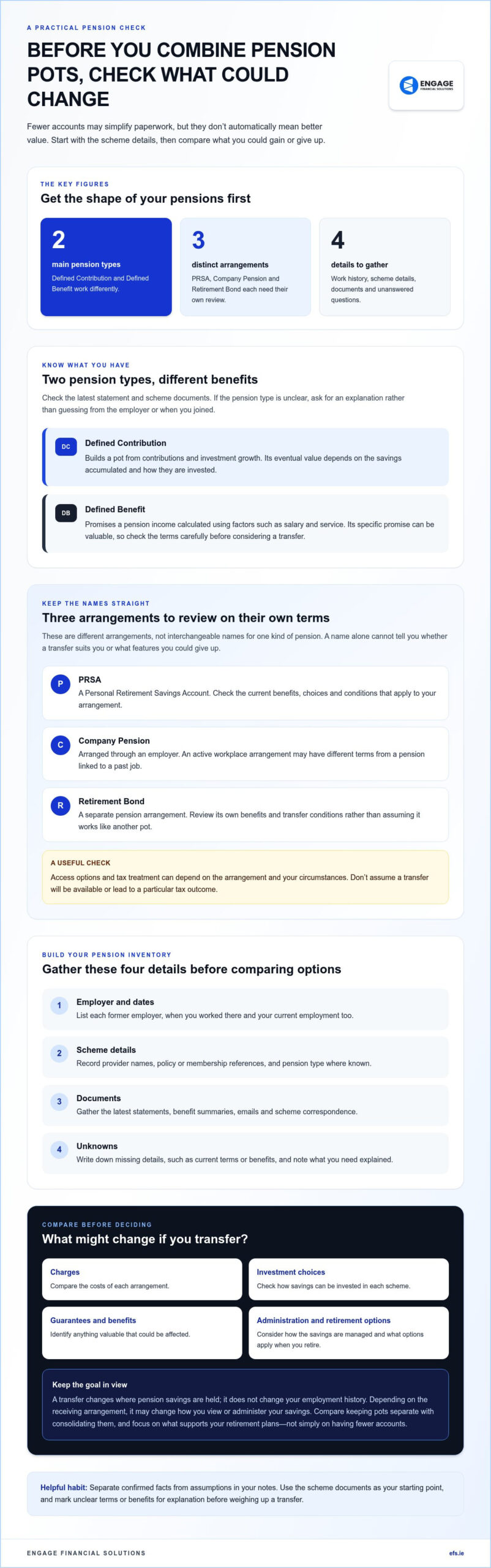
Before taking action, create a basic inventory:
- Employer and dates: Note where and when you worked.
- Scheme details: Record provider names, policy references and pension type, where known.
- Documents: Gather the latest statements and scheme correspondence.
- Unknowns: Mark details you still need, such as current terms or benefits.
This groundwork helps you compare keeping pensions separate with consolidating them, without treating fewer accounts as the goal in itself.
How to identify pension types before considering a transfer
Before deciding whether to move pension savings, identify the arrangement they’re in. Different types can work in different ways, and their benefits, transfer conditions and implications may not be alike. A transfer that seems straightforward could affect what you receive later, so use the scheme’s own documents as your starting point.
Check the latest statement, joining information and correspondence for each pension. Look for the arrangement’s full name and any description of how benefits are calculated. If the documents use unfamiliar terms, write them down and get an explanation rather than assuming two pensions with similar names work the same way. Guidance on pension transfers can provide background, but your scheme’s terms are central to your decision.
How can you tell what kind of pension you have?
A Defined Contribution scheme builds a pot from contributions and investment growth. Its eventual value depends on the savings accumulated and how they are invested. A Defined Benefit scheme, by contrast, promises a pension income calculated using factors such as salary and service. That promise can be valuable, so consider its specific terms carefully before weighing a transfer.
Look for these labels on your statement, then note the provider, scheme name and any description of benefits. If the type isn’t clear, get an explanation of the arrangement and its current benefits before deciding. Don’t infer the pension type from the employer’s name or from how long ago you joined.
Why do PRSAs, Company Pensions and Retirement Bonds need separate consideration?
These are distinct arrangements, not interchangeable names for one kind of pension. A PRSA is a Personal Retirement Savings Account. A Company Pension is arranged through an employer, while a Retirement Bond is a separate pension arrangement. The name alone doesn’t tell you whether a transfer is suitable or what features you could give up.
For each arrangement, gather current scheme information and find out how its benefits are described, what choices apply to you and what conditions govern a possible transfer. Access options and tax treatment can depend on the arrangement and your circumstances, so don’t assume that a transfer will be available or lead to a particular tax outcome. Keep unanswered questions alongside the relevant document so they’re ready for review.
As you organise your notes, separate confirmed facts from assumptions. For example, record “statement describes a promised income” rather than labelling a scheme Defined Benefit unless the documents support that conclusion. This helps you compare the actual features, not just familiar-sounding product names. If you’re considering consolidating multiple pensions, tailored pension and retirement planning can help bring scheme details and your wider goals into the same discussion before you act.
How to compare pension consolidation against keeping pots separate
A useful comparison looks beyond the number of accounts. Put each pension’s current terms beside those of the proposed arrangement and consider what could change if you transfer. This helps you weigh simpler administration against possible effects on benefits, charges and investment choices.
Use the same headings for every pot, and mark each detail as confirmed, unclear or not applicable. Don’t fill gaps with assumptions: request up-to-date scheme information before treating two options as a like-for-like comparison.
Benefits and guarantees: Record the benefits available now, including any guaranteed income or special terms. Note whether a transfer could affect them.
Charges: List each charge shown in the scheme information, its basis and how it is applied. Keep confirmed figures separate from charges you still need explained, including any transfer-related charge if one applies.
Investment choices: Compare the available choices and how each fits your time horizon and comfort with investment risk. A wider or narrower choice is not automatically better.
Administration: Consider how you receive information and keep track of each pot now, then compare this with the proposed arrangement. Fewer accounts may be easier to oversee, but convenience alone doesn’t establish value.
Which fees and benefits should you compare?
Use current documents rather than relying on an old statement or a remembered figure. Note what each charge relates to and whether it is expressed as a fixed amount or in another way. Don’t assume schemes use the same fee structure, or compare figures until you understand what each includes.
Look for guarantees, valuable benefits and terms that could be affected by moving savings. If a detail is unclear, label it as a question rather than treating it as a confirmed cost or benefit. Past investment performance can provide context, but it can’t show on its own which arrangement is suitable or what future returns will be.
When might keeping pensions separate be worth considering?
Keeping a pot separate may deserve closer consideration if it includes a guarantee, a benefit linked to salary or service, or a scheme feature that matters to your plans. It can also be practical if you can manage the records and each arrangement still fits your needs. Having several accounts isn’t automatically a problem.
Bring your wider plans into the comparison. Your intended retirement timing, how long the savings may remain invested and your tolerance for changes in value can all shape the decision. Broader retirement planning can help connect pension choices with your future goals.
Before deciding, write down what each option gives you, what it may cost, what remains uncertain and how it supports your retirement plans. Choose based on the likely outcomes, not simply the number of accounts.
How to prepare for a pension consolidation decision
A well-prepared decision starts with reliable information, not a transfer form. Gather current details for each pension, note what’s missing and keep questions beside the relevant documents. This makes it easier to understand your options and reduces the risk of overlooking a feature that matters to your retirement plans.
Work through these steps in order:
- Locate the paperwork. Collect recent statements and correspondence for each arrangement, including pensions from previous employers.
- Identify each scheme. Record the provider, scheme name and policy or membership reference so you can match documents to the right pot.
- Request up-to-date information. If a statement is old or incomplete, request current details from the scheme before comparing options.
- Record the facts and gaps. Note the current value, charges, investment information, benefits and relevant terms. Mark anything missing as a question rather than estimating it.
- Compare the options, then pause. Consider the information alongside your retirement plans and clarify uncertainties before making a decision.
What information should you gather from each provider?
Keep a separate record for every arrangement, even if two pensions appear similar. Include the provider and scheme identity, policy reference, latest stated value, charges, investment information and any terms describing benefits or guarantees. Save the documents that support each detail, and note when the information was issued so you can judge how current it is.
- Provider name and scheme or arrangement name
- Policy or membership reference and latest available value
- Charges and how they are described in the scheme information
- Investment choices or current investment details
- Benefit terms, guarantees and transfer information
- Missing statements, unclear wording and questions to resolve
Don’t fill gaps with remembered figures or assumptions. A clear record helps you compare arrangements consistently and makes a discussion about your options more focused.
What should you clarify before authorising a transfer?
Before signing or authorising anything, make sure you understand how the proposed transfer could affect benefits, guarantees, charges and investment arrangements. Get an explanation of any terms you don’t understand, and check the scheme’s current information for relevant deadlines or process requirements. The transfer process isn’t automatic, and the options depend on the scheme and your circumstances.
Consider what would change as well as what might become simpler. If you can’t explain in your own words what happens to the existing benefits and where the savings would go, pause and get clarification before proceeding. A transfer is a consequential decision, so authorise it only once you understand its potential effects and how it fits your wider retirement plans.
For support assessing the information in the context of your goals, explore tailored retirement planning advice before deciding on your next step.
How tailored pension advice can help you choose your next step
Once you’ve gathered scheme information, the next challenge is understanding what it means for your future. A personalised review can bring the terms of each pension together with your plans, so the decision isn’t based on account numbers alone. Advice should help you weigh the options, including keeping arrangements separate, rather than assume consolidation is always the right answer.
Engage Financial Solutions provides pension and retirement planning guidance to help you assess your circumstances before making a transfer. The discussion can focus on what each arrangement offers, what might change and how the options fit with your wider financial priorities. You remain in control of the decision, with a clearer view of the factors to consider.
How can a pension review fit the bigger retirement picture?
Your pension choices connect with the life you want in retirement. Consider when you may want to stop or reduce work, what income you might need and how your pension savings sit alongside other financial commitments. A review can consider relevant PRSAs, ARFs and Company Pensions as part of that wider picture, while taking account of the specific terms for each arrangement.
This broader view can help you consider whether bringing savings together would support your plans, or whether a particular benefit or arrangement is better left undisturbed. It can’t guarantee a particular investment result, tax outcome or retirement income. Instead, it can clarify the trade-offs and show where more information is needed before you decide.
What should you expect from a considered next step?
Bring your latest pension statements, scheme documents and the questions you’ve noted. It can also help to write down your priorities, such as simplifying administration, preserving a particular benefit or understanding how your savings may support your intended retirement timing. Complete information makes for a more grounded discussion.
A considered recommendation should reflect your personal circumstances and the scheme information available, not a general assumption that every pension should be transferred. You should understand the reasoning, possible implications and any remaining uncertainties before taking action. If something is unclear, ask for it to be explained in plain language and take the time you need to decide.
Whether you’re leaning towards a transfer or simply want to understand your options, a measured review can give you a clearer route forward. You can discuss your pension options with Engage Financial Solutions and consider a next step that suits your retirement plans.
Make your next pension decision with confidence
Your pension arrangements should support the retirement you want, not simply be easier to count. Before deciding whether consolidating multiple pensions is right for you, consider what you want your savings to make possible and which features you value most. That perspective can help you judge whether a change supports your plans or whether keeping an arrangement as it is makes more sense.
You don’t have to settle every question at once. Keep your scheme information together, note anything you still need explained and consider how the options relate to your circumstances. Engage Financial Solutions provides pension and retirement planning guidance to help you weigh those choices as part of your wider financial picture.
There’s no need to rush into a transfer for the sake of simplicity. A clear, considered decision can bring greater confidence, whether you choose to combine arrangements or keep them separate. Discuss your pension options with Engage Financial Solutions and take your next step with a clearer view of the future you’re planning for.
Frequently Asked Questions
Is it always a good idea to combine multiple pensions?
No, combining pensions isn’t automatically the right choice. Convenience can help, but it doesn’t establish whether a transfer suits you. Compare each arrangement’s benefits, charges, guarantees and investment choices, then consider whether the result supports your retirement plans. If you value a particular benefit, make that part of the comparison rather than focusing only on having fewer accounts. Tailored guidance can help you assess the options before authorising a transfer.
Can I combine a Defined Benefit pension with other pensions?
A Defined Benefit pension may have transfer options, but its scheme terms need careful individual assessment. It provides benefits under terms set by the scheme, while a Defined Contribution arrangement reflects accumulated savings and investments. These aren’t interchangeable outcomes. Get current transfer information for the scheme and clarify what benefits could change. Consider the possible consequences in light of your circumstances before deciding whether to proceed.
How do I find old pensions from previous jobs?
Begin with a list of former employers and the dates you worked for them. Search old statements, provider letters, emails and employment records for scheme names, policy references or contact details. These details can help you identify the scheme and request current information. Keep a separate note for each possible pension, including gaps you haven’t resolved. Don’t assume a missing document means no pension exists, or make decisions using incomplete records.
What should I compare before transferring a pension?
Compare each scheme’s benefits and guarantees, charges, investment options and terms for accessing benefits. Then consider how each option supports your retirement timing and income needs. Use current statements and scheme information, not remembered figures or past investment performance alone. Note when the information was issued and flag anything unclear. Transfer implications can differ by pension type and personal circumstances, so understand the relevant details before authorising a move.
Could consolidating pensions mean losing valuable benefits?
A transfer could affect valuable benefits, depending on the scheme and the proposed arrangement. Look through benefit statements and scheme terms for guarantees, special retirement conditions or other features that matter to you. Get a clear explanation of how each would be treated if you transferred. Don’t assume a benefit will disappear, but don’t treat it as protected without evidence. A scheme-specific assessment can clarify the implications before you proceed.
Does combining pensions reduce charges?
Not necessarily. Whether a transfer reduces charges depends on the terms of your existing arrangements and the proposed destination. Gather current charge information for each pot and compare like with like, including how each charge is applied. Also note whether investment choices or benefits would change. A lower charge alone may not settle the decision if other features matter to your plans. Don’t assume there will be a saving until the details are clear.
Do I need financial advice before transferring a pension?
Advice can help you understand a transfer, although its role depends on the arrangement and decision. A financial adviser can help interpret scheme information, identify trade-offs and compare options against your retirement goals. Before making a consequential decision, make sure you understand how it could affect your particular benefits and choices. Bring current statements and write down your questions so the discussion can focus on your circumstances.
Disclaimer
Engage Financial Services LTD T/A Engage Financial Solutions is regulated by the Central Bank of Ireland CRO 764570. Suite 2 First Floor, 14 -18 Main street, Blackrock, Co Dublin. A94 W0Y3